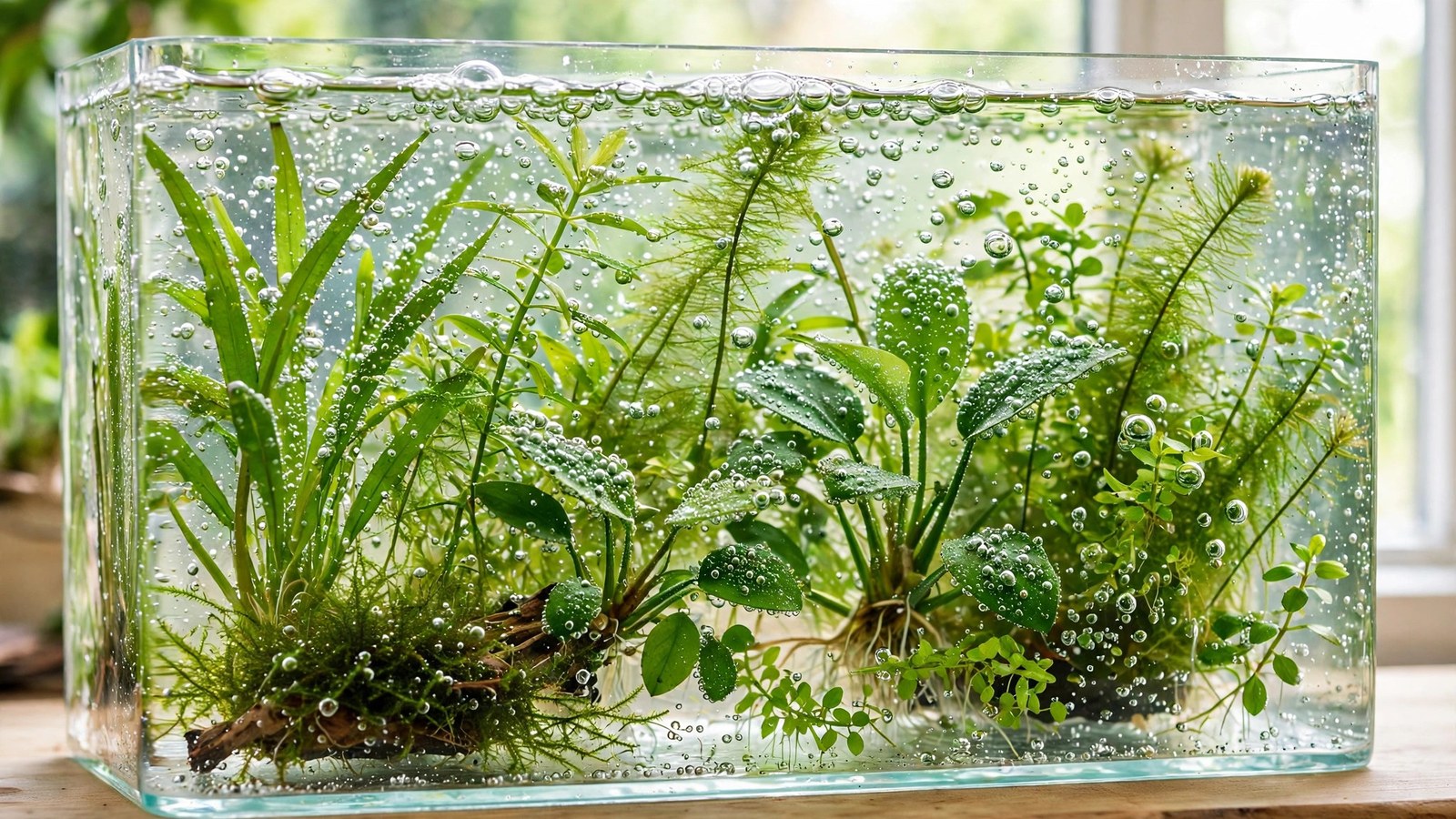
Every new plant that enters your tank is a Trojan horse: pest-snail eggs, hair-algae spores, and hitchhikers you won't notice until they've spread across your aquascape. Chemical dips handle that risk, but they also risk melted leaves and lingering residue. The chemical-free alternative with a devoted following among planted-tank keepers is reverse respiration — a five-hour soak in plain seltzer water that suffocates pests instead of poisoning them. Our freshwater aquarium plants complete guide treats a pre-planting dip as non-negotiable, and this is the gentlest dip in the lineup. Here's the full protocol, the honest limits, and which plants survive it.
Why Reverse Respiration Exists
Planted-tank keepers already have four dip methods, and each one is a toxin: the bleach dip is fast and brutal, the alum dip is the snail-egg specialist, hydrogen peroxide targets algae, and the potassium permanganate dip is broad-spectrum chemistry. Every poison has a dose window where it damages the plant too.
Reverse respiration is the fifth dip and the only non-chemical one. Instead of adding a toxin, it changes the water itself: carbonated water holds far more dissolved CO2 and far less oxygen than tank water. Soak a plant in it, in total darkness, and pests and algae face water they can't breathe in — while the plant, built to survive dark nights and low-oxygen mud, rides it out.
How Reverse Respiration Actually Works
The working theory is asphyxiation. Dissolved CO2 displaces oxygen, creating water rich in carbon dioxide and starved of it. Snail eggs, tiny invertebrates, and filamentous algae suffocate in it over hours. Darkness is the second half: without light, algae can't photosynthesize away the CO2 or make oxygen to save themselves — which is why the soak must be genuinely light-free.
Plants survive because they're built for this kind of hardship: their tissues tolerate short spells of darkness and low oxygen, and the spongy internal air channels (aerenchyma) in leaves and stems carry enough reserve oxygen to last for hours.
One honest note: this mechanism is community-tested rather than lab-proven. The method was refined over years in a long Aquarium Co-Op forum thread, and an independent chemist reviewed its plausibility — but there is no peer-reviewed trial behind it. Treat it as a well-evidenced hobby technique, not a scientific certainty.
The reverse respiration aquarium plants protocol
Follow these steps exactly. The 5-hour timing is the originator's 2026-updated guidance — the older 12-hour soak still circulates in old posts, but five hours kills the pests with less plant stress.
- Rinse and inspect. Shake each plant in tank water to dislodge debris, then trim damaged leaves — rotting tissue fouls the soak.
- Buy the right seltzer. The label should list one ingredient: carbonated water. No flavors, sweeteners, sodium, citric acid, or added minerals. Let it reach room temperature — cold seltzer shocks tropical plants.
- Submerge completely. Weigh plants down so every leaf stays submerged. Any leaf breaking the surface becomes an air pocket where pests survive.
- Go dark for 5 hours. Lid on, towel over, lights out. No peeking — every glimpse of light lets algae photosynthesize.
- Rinse, then recover. Rinse under dechlorinated water, then float the plants 1–2 hours in tank water with an air stone running to re-oxygenate them before planting.
- Inspect and plant. Pick off dead algae (it turns pale and slimy), then plant normally and watch for melt over the next week. For severe pest pressure, follow up with quarantine before they join the display tank.
What the Seltzer Dip Kills — and What It Doesn't
| Target | Result |
|---|---|
| Pest snails (bladder, ramshorn, pond) | Reliably killed |
| Snail eggs | Reliably killed — a standout result |
| Hair / thread algae | Reliably killed |
| Diatoms | Reliably killed |
| Green spot algae | Reliably killed |
| Black beard algae | Widely reported; results vary |
| Small invertebrate pests (planaria, hydra) | Frequently reported |
| Bacteria and viruses | No evidence — not a sterilizer |
| Every last egg of hardy species | Not guaranteed |
Its boundary: it disinfects the plant in the bucket, not your aquarium. It won't cure an in-tank algae outbreak, and sterile tissue-culture plants don't need it.
Which Plants Tolerate It — and Which Melt
| Category | Examples |
|---|---|
| Tolerate well | Anubias, Java fern, Amazon swords, Vallisneria, most robust stem plants |
| Tolerate once established; watch new arrivals | Cryptocorynes (prone to melt from any change — see how to acclimate new aquarium plants to avoid melt) |
| Handle with care — consider a shorter soak | Fine-leaf stems like Cabomba and Limnophila, mosses, liverworts, delicate floaters |
| Skip or test a trimming first | Plants already melting, rare or expensive specimens, anything you can't afford to lose |
Unsure about a species? Soak a side shoot alongside the main plant. If the trimming melts, pull the plant early or switch to the alum dip (linked above).
When Not to Use It
Gentlest is not the same as strongest. Skip it when the plant is already stressed or melting, when you're handling rare specimens you'd rather not experiment on, or when you need near-certain eradication: a strict quarantine for new aquarium plants plus an alum dip is the belt-and-braces answer for high-risk stock. And if all you can find is flavored seltzer, walk away; the wrong bottle is worse than no dip.
Frequently Asked Questions
Does reverse respiration kill snail eggs?
Yes — snail eggs are among the dip's most reliably reported kills. The gelatinous egg masses can't withstand hours of CO2-supersaturated, oxygen-poor water. Eggs are often more chemical-resistant than adult snails, so this is where the method outshines chemical dips.
Can I reuse the seltzer for a second batch?
No. Once poured, dissolved CO2 escapes quickly — flat seltzer is just expensive water with no disinfecting power. Use a fresh, unopened bottle per batch, and don't start the 5-hour clock until every plant is fully submerged. Re-capping a half-used bottle won't save it — the CO2 is gone within hours.
Will it harm the beneficial bacteria in my tank?
No — the seltzer never touches your tank. The soak happens in a separate bucket and you rinse before planting, so filter bacteria, the substrate colony, and livestock are completely unaffected. That's a real advantage over in-tank treatments, which expose the whole ecosystem to the active agent.
Can I just do reverse respiration inside the aquarium?
Absolutely not. Supersaturating a display tank with CO2 would suffocate fish, shrimp, and snails along with the algae, and the pH crash can be severe. Strictly a bucket treatment for new arrivals — never add carbonated water to a stocked tank.
Why does the soak have to be completely dark?
Light lets algae photosynthesize — consuming the dissolved CO2 and releasing oxygen, directly defeating the mechanism that kills them. In total darkness, algae can only respire, so CO2 stays high and oxygen stays low. Even brief light exposure gives algae a lifeline.
A Gentle Tool, Used Honestly
Reverse respiration asks so little: no bleach ratios, no chemical residue, no risk to your tank's inhabitants — just seltzer, a dark bucket, and five hours of patience. Its limits are real — not a sterilizer, not for every plant, never in a stocked tank — but as a chemical-free first line of defense for new arrivals, it's one of the smartest habits a planted-tank keeper can adopt. The reverse-respiration how-to at Fins for Grins is the best next read.