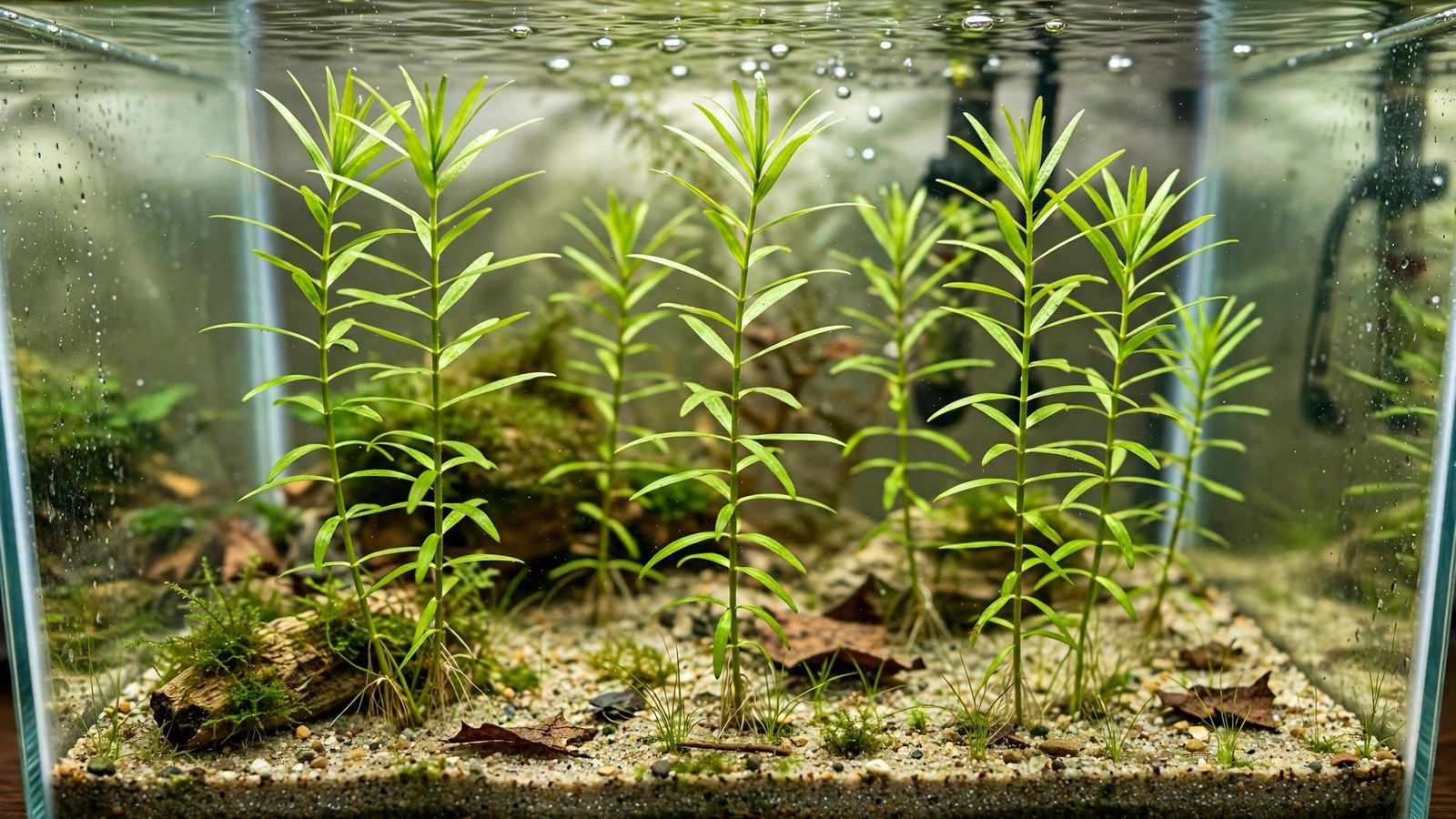
Look past the magenta 'Sao Paulo' cultivar and the ruby-leaved praetermissa, and you will find the quiet member of the smartweed family. Swamp smartweed — persicaria hydropiperoides — is the upright green species that colonises pond margins and stream banks across the Americas, half in the water and half in the air. Under strong light it grows one of the most distinctive textures in the hobby: rigid vertical stems clothed in deeply rippled leaves.
Can you grow swamp smartweed fully submerged? Yes. Persicaria hydropiperoides is an almost emergent-aquatic species that adapts to submerged life without the melting that ruins true marginals. Hard fact: its strictly upright habit and short internodes never vary with conditions — unlike the magenta 'Sao Paulo' cultivar, which can trail across the substrate.
Why persicaria hydropiperoides stands apart from other smartweeds
The Persicaria genus is famous for colour, but swamp smartweed is the understated green original. Where the cultivars sprawl and demand constant trimming, this species grows rigidly upright, with short internodes and a straight inflorescence tipped with tiny white flowers — that straight flower spike is its most reliable identification feature. Its species name references its likeness to water pepper (Persicaria hydropiper), its hotter-tasting cousin; swamp smartweed is the mild one, hence the name mild waterpepper.
It is most commonly found at or near water bodies, growing partially submersed with roots in the mud and stems rising into the air, which is why it shrugs off the transition to aquarium life. If you are building a broader planted layout, this species pairs well with the principles in our complete guide to freshwater aquarium plants, where native species get the same systematic treatment as the popular imports.
Light, temperature, and water chemistry
Swamp smartweed is unusually forgiving about light. It survives under low light — roughly 15–25 PAR at the substrate — staying smaller and flatter-leaved without drama. Under strong light (60+ PAR, 8–10 hour photoperiod) with ample nutrients, each leaf takes on a deep, wavy ripple that makes the whole stand look alive. If your leaves are coming out flat, raise the light first, not the fertiliser.
Temperature is flexible at 15–28 °C (59–82 °F), and it tolerates pH 6.0–7.5 with soft-to-moderately-hard water. CO₂ injection is not required, though the plant will use extra carbon if you offer it. It does insist on nutrients in the water column and a stable tank.
| Parameter | Survival range | Best display |
|---|---|---|
| Light | 15–25 PAR (low) | 60+ PAR, 8–10 h photoperiod |
| Temperature | 15–28 °C / 59–82 °F | 22–26 °C / 72–79 °F |
| pH | 6.0–7.5 | 6.5–7.0 |
| GH | 3–12 dGH | 4–8 dGH |
| CO₂ | Not required | Optional; boosts density |
Substrate and fertiliser: start low, observe livestock
Plain gravel or sand works fine, though a nutrient-rich aquasoil speeds up the initial rooting phase noticeably. The real engine is the water column: under strong light it is a hungry plant, and the undulate leaf form only fully develops when nutrition keeps pace.
Feed a quality liquid fertiliser weekly, with root tabs beneath established stands once or twice a year as backup. The standing rule: start low, observe livestock, and only then ramp up toward full label doses — this plant tolerates lean weeks far better than your shrimp tolerate a sudden nitrate spike. Our review of the best liquid fertilisers for aquarium plants suits hungry stem plants like this one, and our piece on whether aquarium plants really need fertiliser explains why this species sits in the "yes" camp. Still weighing formats? Compare liquid fertiliser vs root tabs.
Watch for pale new growth with green veins — iron hunger, which this plant shows earlier than most — or pinholes in older leaves, pointing to potassium. Keep nitrates in the 10–20 ppm band and phosphates around 1–2 ppm, and the plant stays compact and wavy rather than leggy.
Trimming and propagation: cut, replant, repeat
Snip a stem above a node, replant the top, and the stump pushes one or two side shoots from the node below the cut — that is the whole method. Our walkthrough of how to propagate aquarium plants covers the technique if you have never done it.
Division is the second option for dense nursery pots: tease the root mass into two or three portions and plant each a few centimetres apart. Monthly pinching also helps — snipping out the growing tip (not a full cut-back) wakes the lateral buds, keeping the stand bushy instead of spindly. See our stem plant trimming guide for technique and tools.
Replant tops in a staggered zigzag rather than a straight row — rigidly upright stems in a line read like a fence, while offset planting mimics the natural riverside clumps it forms in the wild.
Tank size, placement, and native-tank companions
The one real constraint: this is not a nano-tank plant. Submerged stands top out around 20–30 cm, but it needs horizontal room to form the clumps that make it beautiful — hence the honest 150-litre minimum. In smaller tanks it survives but never shows you what it can do. Place it midground to background, where vertical stems contrast with rosettes and carpets.
The obvious home is a North-American native biotope — an eastern pond or slow stream margin — alongside natives like vallisneria, water sprite, or American waterweed. Check the Illinois Wildflowers entry for mild waterpepper for its wild habitats, or the Flowgrow aquatic plant database for its submerged form, so you know the aquarium look you are shopping for. Honest note on availability: in North America it is obtainable through careful wild collection (check local regulations) or from hobbyists, but it remains rare in the European trade — so expect to hunt, and buy the fullest pot you can.
Frequently Asked Questions
Is swamp smartweed the same as water pepper?
No. Water pepper is Persicaria hydropiper; swamp smartweed is Persicaria hydropiperoides — the species name simply notes its resemblance. True water pepper is sharply pungent, while swamp smartweed is mild, hence the name mild waterpepper. Check the label before buying.
Can persicaria hydropiperoides grow emersed or in a paludarium?
Yes — it is one of its strengths. Growing naturally at water margins, it transitions between submerged and emersed life with very little adjustment. In a paludarium it will grow up out of the water and may even flower, producing the straight spike of tiny white blooms that is its best identification feature.
Where can I buy swamp smartweed?
It depends where you live. In North America it is obtainable through careful wild collection (check local regulations first) or hobbyist forums and swaps, since it is not a mainstream nursery crop. In Europe it remains rare — try specialist native-plant vendors and hobbyist networks rather than general shops.
Does it need CO₂ injection to look good?
No. Many growers get perfectly good stands without CO₂. What drives the wavy-leaf display is strong light plus ample nutrients — extra CO₂ speeds things up and improves density, but it cannot substitute for light. If you had to choose one upgrade, choose the light first.
Why are my leaves flat instead of wavy?
Flat leaves almost always mean low light. The rippled form is this plant's response to strong light plus rich nutrition — under dim conditions it defaults to plain flat blades. Raise light toward 60+ PAR at the substrate, keep nitrates at 10–20 ppm, and new growth should show the signature waves within two to three weeks.
Swamp smartweed will never be the flashiest plant in your tank — it is the reliable, upright, wavy-leaved backbone that makes the flashy plants look intentional. Give it room, feed it steadily, trim it often, and you get one of the most distinctive textures in the hobby.