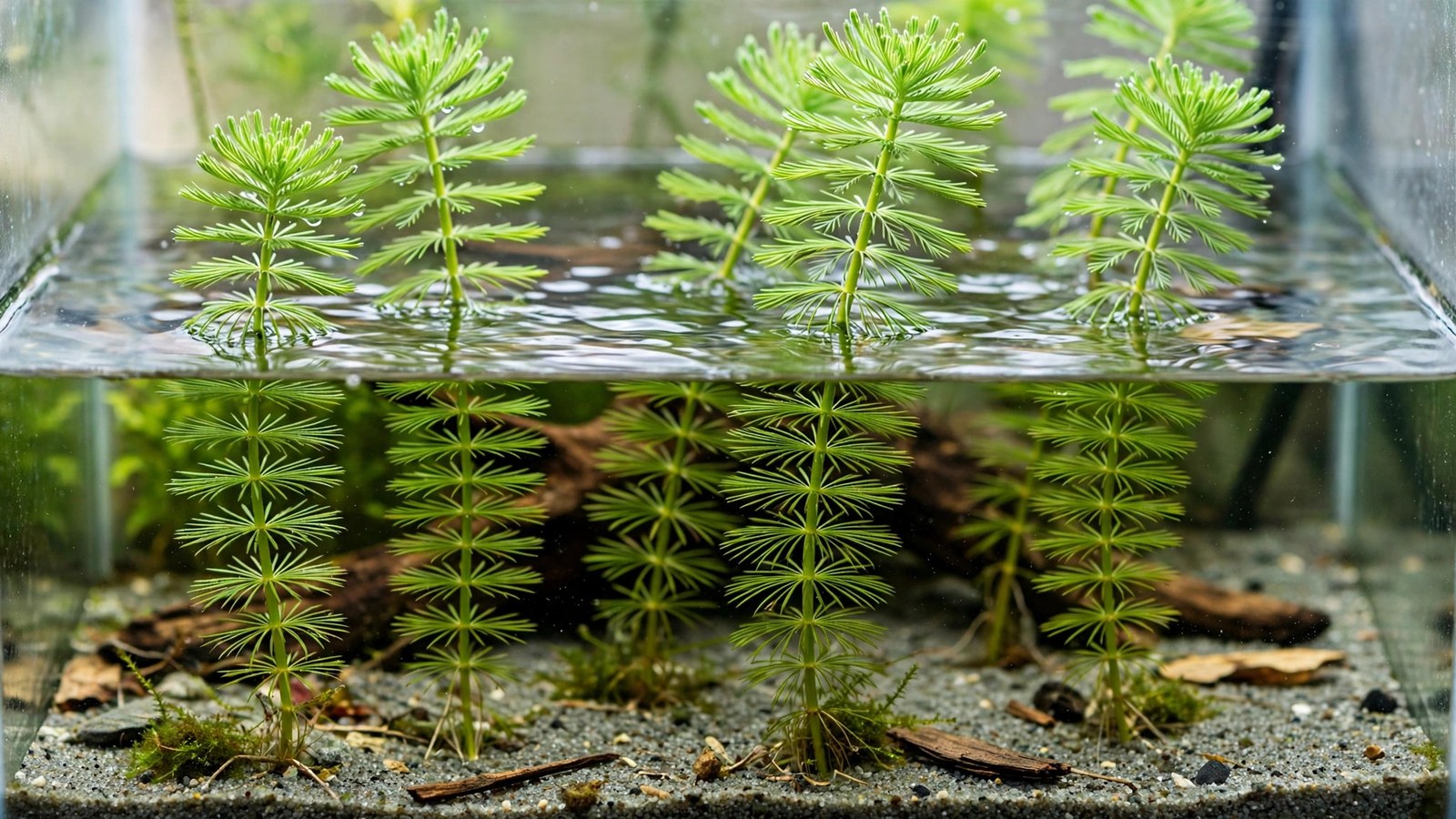
Parrot's feather has an unfair advantage and an unfair reputation in the same package. The feathery bottle-brush shoots that draw you in at the shop are usually grown emersed — in humid air, not underwater — and most melts when the plant goes fully submerged. Handle the conversion right, though, and myriophyllum aquaticum care becomes one of the easiest ways to get a lush, fast-growing background in a tropical tank.
Below: the light it needs, the temperature window, how to convert emersed stock, and the one legal fact every buyer must know.
Myriophyllum aquaticum care: provide moderate to bright light (30–60 PAR), pH 6–7.5, and temperatures of 20–28°C. Plant cuttings an inch apart in nutrient-rich substrate, trim every 7–10 days, and expect 1–2 inches of growth per week. Critically, check local laws before buying: it is a regulated invasive species in several US states and must never be released into waterways.
Myriophyllum Aquaticum Care: What to Know First
Parrot's feather (Myriophyllum aquaticum, family Haloragaceae) is a South American stem plant from the Amazon basin and a true amphibious grower: it lives fully submerged, but in an open-top tank it pushes feathery emergent shoots 12 inches above the waterline. Do not confuse it with the green milfoil (M. mattogrossense) or Eurasian watermilfoil (M. spicatum) — this guide covers the Amazonian one.
Most store stock is emersed-grown, so the plant needs 3–5 weeks to replace its air-adapted leaves with submerged foliage. Do not uproot it "to check if it's alive" during that window — pale, softening outer whorls are normal shedding, not rot.
Lighting: The Difference Between Dense and Leggy
Light is the single biggest lever here. At 30–60 PAR — a good full-spectrum LED running about 8 hours a day — the whorled leaves pack tightly and the plant earns its nickname. Under dim light, internodes stretch and lower leaves drop. Keep the photoperiod at 7–8 hours in a fresh setup to hold off algae while it establishes.
Before cranking intensity, check how much light aquarium plants need — parrot's feather punishes excess light with algae on its fine leaves, not with better growth.
Tank Setup: Water, Substrate, and Placement
Parrot's feather is forgiving about water chemistry — pH 6 to 7.5 is ideal, and it tolerates up to 8. Temperature is the narrower window: 20–28°C (68–82°F). It sulks below 18°C and softens above 30°C, so it belongs in tropical or warm-temperate tanks, not unheated coldwater setups.
Give it a nutrient base: nutrient-rich substrate or root tabs, plus a modest liquid fertilizer routine — the fine leaves pale quickly when nitrogen runs low. Place it at the back; mature stands reach 4–16 inches, so a 20-gallon or taller tank is the practical minimum. Plant stems 1 inch apart, not in tight fistfuls; see how to plant stem bunches so clumps settle instead of floating up on day two.
CO₂ and Fertilizer: Keep It Conservative
Injected CO₂ is not required — it grows fast in a low-tech tank with decent light and fertilizer. CO₂ pushes growth to around 2 inches a week but triples your trimming load. Start liquid fertilizer at half the label rate for two weeks, observe livestock, then step up only if new growth pales. Follow a simple aquarium plant fertilizer schedule rather than improvising.
Propagation: Cut, Replant, Repeat
Snip healthy tops 4–6 inches long, strip the lowest inch of leaves, and push the bare end into the substrate — they root within a week at tropical temperatures. The cut base usually sprouts side shoots at the node below the cut, so one stem becomes several within a month.
Trimming: The Weekly Non-Negotiable
Under good conditions you will trim every 7–10 days — untrimmed stands go thin at the base. Cut just above a leaf node, replant the best tops, and discard or trade the rest — learn how to trim stem plants properly and the routine takes five minutes. Stagger your cuts rather than topping the whole stand at once.
Emersed Growth and the Invasive-Species Warning
Left at the waterline in an open-top tank, stems breach the surface and revert to the waxy blue-green nursery foliage — emergent shoots can rise about 12 inches and grow visibly faster on atmospheric CO₂. But any fragment carried out on wet hands is a potential introduction in a warm climate. Seal trimmings in the bin and never rinse plants near storm drains.
Common Problems and Fixes
| Symptom | Likely cause | Fix |
|---|---|---|
| Lower leaves melting, bare stems at the base | Emersed stock converting; tops shading the base | Wait 3–4 weeks; stagger trims for light penetration |
| Long gaps between whorls, sparse look | Light too dim | Raise intensity to 30–60 PAR or extend photoperiod to 8 hours |
| Pale or yellow new growth | Nitrogen or iron deficiency | Increase fertilizer gradually; observe livestock |
| Algae coating the fine leaves | Too much light for the nutrient level | Shorten photoperiod, add gentle flow, trim worst stems |
| Stems turning to mush overnight | Sudden cold or parameter swing | Stabilize at 20–28°C; remove mushy stems immediately |
If you are building your first planted setup around fast stem plants, the freshwater aquarium plants guide covers hardscape, substrate, and planting order. Species data is documented by retailers such as aqua-fish.net's parrot's feather profile.
Frequently Asked Questions
Is parrot's feather easy to grow in an aquarium?
Yes, once past the initial conversion. Shop stock is usually emersed-grown and melts back over 2–4 weeks before producing submerged foliage. After that it is one of the easier stem plants: no CO₂ required, pH-tolerant, and fast at 20–28°C. The main cost is weekly trimming.
Why is my parrot's feather melting after planting?
Emersed-grown stock sheds its air-adapted leaves when submerged — this is normal conversion, not death. Leave the stems planted and resist uprooting them to check the roots; new submerged foliage emerges at the tips within 3–5 weeks. As long as the stems stay green and firm, the plant is on track.
Does Myriophyllum aquaticum need CO₂?
No. It grows well in low-tech tanks with moderate light and basic fertilizer. CO₂ accelerates growth to about 2 inches per week under strong light, but it is optional — only add it if you can commit to the heavier trimming schedule.
Can parrot's feather grow out of the water?
Yes. In open-top tanks it sends emergent shoots up to 12 inches above the waterline, reverting to waxy blue-green nursery foliage. Emergent growth is faster and hardier, but every fragment that leaves the tank is an invasion risk — trim over the water and seal trimmings in the trash, never the drain.
Is parrot's feather illegal to buy or keep?
It depends on where you live. It is a regulated invasive species in several US states — some retailers cannot ship it to IL, WA, IN, MI, MN, NY, OH, PA, or WI. Check your state and local laws before ordering, and never release it into waterways.
How do you propagate parrot's feather?
Take stem cuttings: snip a healthy top 4–6 inches long, strip the bottom inch of leaves, and push the bare end into the substrate — it roots within a week at tropical temperatures. The cut base usually sprouts side shoots at the node below the cut.
A Fast Background With One Legal Condition
Myriophyllum aquaticum earns its place as a classic background plant: cheap, fast, forgiving of water chemistry, and unmatched in texture when trimmed under good light. Give it 30–60 PAR, temperatures of 20–28°C, conservative fertilizer, and weekly trimming, and it will fill a background wall in a month.
One condition: verify it is legal where you live before buying, and treat every trimming like the potential invader it is — sealed trash, never the waterway. Do that, and parrot's feather is one of the most rewarding stem plants a tank can host.