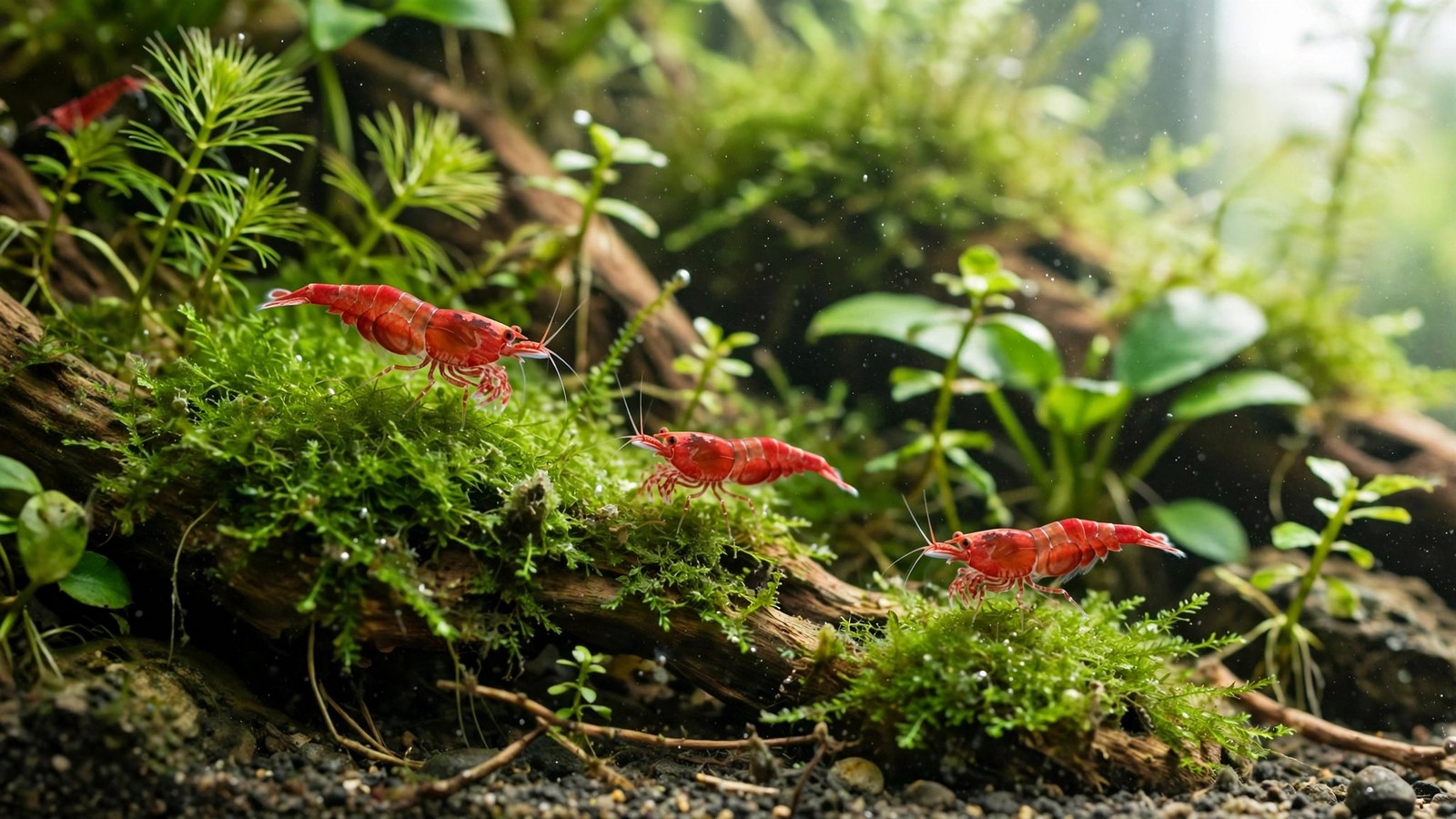
Your new shrimp are grazing happily for a week, then the molting deaths begin. The water is crystal clear, the plants are thriving — yet the shrimp can't shed their old shells. A GH booster is the missing piece, and this guide shows you exactly which one your shrimp need and how to dose it. This guide is the shrimp-specific companion to the plant-side RO remineralization guide: here we cover GH targets by shrimp genus, GH-only vs GH/KH remineralizers, and dosing with a TDS meter.
Direct answer: For a shrimp tank starting from RO water, pick your GH booster by genus. Caridina (crystal reds, Taiwan bees) take a GH-only remineralizer — Salty Shrimp Bee-Shrimp Mineral GH+ at about 3 g per 20 L yields roughly 6 °dH and ~200 ± 50 µS conductivity, with a KH/°dH ratio of 0.06/1.0 so carbonate hardness stays near zero. Neocaridina (cherry shrimp) take a GH/KH+ formula — about 2 g per 10 L gives ~6 °dGH and ~300 ± 50 µS with a 1.0/0.5 GH/KH ratio. Mix outside the aquarium, close the tin immediately, and verify with a TDS meter.
What a GH booster actually is
A GH booster is a mineral salt that restores the calcium and magnesium stripped out by a reverse-osmosis unit. RO water is a blank page: perfect as a starting point, lethal as-is, because shrimp pull calcium and magnesium from the water to harden new shells after every molt. Without them, molts stall and the colony slowly collapses.
Keep three measurements straight. GH is the calcium and magnesium shrimp molt with. KH is the buffering that holds pH steady. TDS is the total dissolved load, read in ppm on a meter. Three separate dials — and a GH booster turns up GH; whether it also touches KH depends on which product you buy.
Choosing your GH booster shrimp tank formula
This is the #1 buyer confusion in the hobby, and the manufacturer's own framing settles it: soft-water Caridina get GH-only, neutral-pH Neocaridina get GH/KH+.
Bee-Shrimp Mineral GH+ is built for softwater bee-shrimp habitats. About 3 g (one level measuring spoon) per 20 L of RO water brings you to roughly 6 °dH and ~200 ± 50 µS conductivity, while the KH/°dH ratio of 0.06/1.0 keeps carbonate hardness near zero. It does not directly move pH, so near-zero KH lets your buffering soil and botanicals hold the acidic pH Caridina need — the manufacturer's Bee-Shrimp Mineral GH+ dosing details confirm the full parameters.
Shrimp Mineral GH/KH+ is the neutral-pH formula for Neocaridina. About 2 g per 10 L reaches roughly 6 °dGH and ~300 ± 50 µS conductivity, with a GH/KH ratio of 1.0/0.5 — the added KH is exactly what cherry shrimp want for stable neutral water. The 200 g tin is listed at $27.95.
The rule is short: keeping Caridina? Buy GH-only. Keeping Neocaridina? Buy GH/KH+. Dosing GH/KH+ into a Caridina tank drags KH up and fights the low pH your bees need; dosing GH-only into a Neocaridina tank starves the water of the buffering cherries are used to.
The reference GH+ product the comparison section discusses: Bee Shrimp Mineral GH+ ★4.8.
Caridina vs Neocaridina: target parameters
| Parameter | Caridina (crystal red, Taiwan bee) | Neocaridina (cherry shrimp) | Booster to buy |
|---|---|---|---|
| GH | 4–6 °dH | ~6 °dGH | GH-only vs GH/KH+ respectively |
| KH | 0–1 °dKH | ~3 °dKH | GH+ keeps KH near zero; GH/KH+ adds it |
| TDS | 120–150 ppm | ~170 ppm | Dose by meter, not by guess |
| Conductivity at label dose | ~200 ± 50 µS | ~300 ± 50 µS | Your meter's target number |
| pH behavior | Soil + botanicals drive pH under 7 | KH holds neutral, stable pH | GH+ doesn't directly move pH |
Dosing with a TDS meter: the method
Forget counting drops per litre. The professional method is dosing by meter. Fill a clean bucket with RO water, add a partial dose of salt, stir — it dissolves in seconds — then read the TDS meter. Add a little more or top up with RO water until the meter lands on your target: 120–150 ppm for a Caridina tank, ~170 ppm for Neocaridina.
Once you know your recipe, write it down: "20 L bucket + 3 g GH+ = 140 ppm" becomes your personal water-change formula. Small batches stay consistent week after week, and consistency is what shrimp colonies reward.
Fertilizers are not a substitute
Here's the honest distinction that saves colonies: fertilizers don't replace GH minerals. Plant fertilizers deliver nitrogen, potassium, and traces for your plants; a GH booster delivers the calcium and magnesium your shrimp molt with. They are two separate jobs, and a well-planted shrimp tank usually runs both — a shrimp-safe fertilizer for the plants plus a GH booster for the water chemistry. Skipping either one leaves half the tank hungry.
If your tank is heavily planted, run the two routines together: your fertilizer dosing calendar handles the plants weekly, your GH-booster bucket handles the shrimp at every water change — even when you dose a shrimp-safe all-in-one like NilocG Thrive.
Frequently Asked Questions
Can I use a GH booster with tap water?
No — GH boosters are made for RO, rainwater, or fully desalinated water. Dosing into unknown tap water adds minerals on top of a mystery, so your GH, KH, and TDS become unknowable and swing between water changes. Strip the water to a blank page with RO first, then remineralize deliberately with the booster.
Will a GH booster raise my pH?
A GH-only booster does not directly move pH — with KH near zero, your buffering soil and botanicals can hold the acidic pH Caridina need. A GH/KH+ formula adds carbonate buffering, which stabilizes pH in the neutral range Neocaridina prefer. So the answer depends entirely on which of the two products you bought.
Can I just use fertilizer instead of a GH booster?
No. Fertilizers feed plants with nitrogen, potassium, and trace elements; a GH booster supplies the calcium and magnesium shrimp need to build and harden new shells after molting. A planted shrimp tank needs both jobs done: shrimp-safe fertilizer for the plants, GH booster in the water-change water for the colony.
What happens if I use GH/KH+ for Caridina?
The added KH buffers the water against the low, acidic pH that crystal reds and Taiwan bees need to thrive and breed. Your buffering substrate will exhaust itself fighting that KH instead of holding pH under 7. For Caridina, switch to the GH-only formula and keep KH at 0–1, exactly as the manufacturer's softwater framing intends.
Why must I mix the salts outside the aquarium?
Pouring powder straight into the tank creates localized spikes of mineral concentration and cloudy water before it dissolves, stressing shrimp for no reason. Mixing in a bucket also gives you the TDS meter check — 120–150 ppm for Caridina, ~170 ppm for Neocaridina — before a single drop reaches your colony.
Start with the right salt
Shrimp water chemistry rewards deliberate choices, not expensive equipment. An RO unit, a TDS meter, and the correct GH booster for your genus will carry a colony further than any gadget: GH-only dosed to 120–150 ppm for Caridina, GH/KH+ dosed to ~170 ppm for Neocaridina. Pair that with food that supports healthy molting and consistent water changes, and the white-ring molting failures that haunt so many new shrimp tanks simply stop happening.