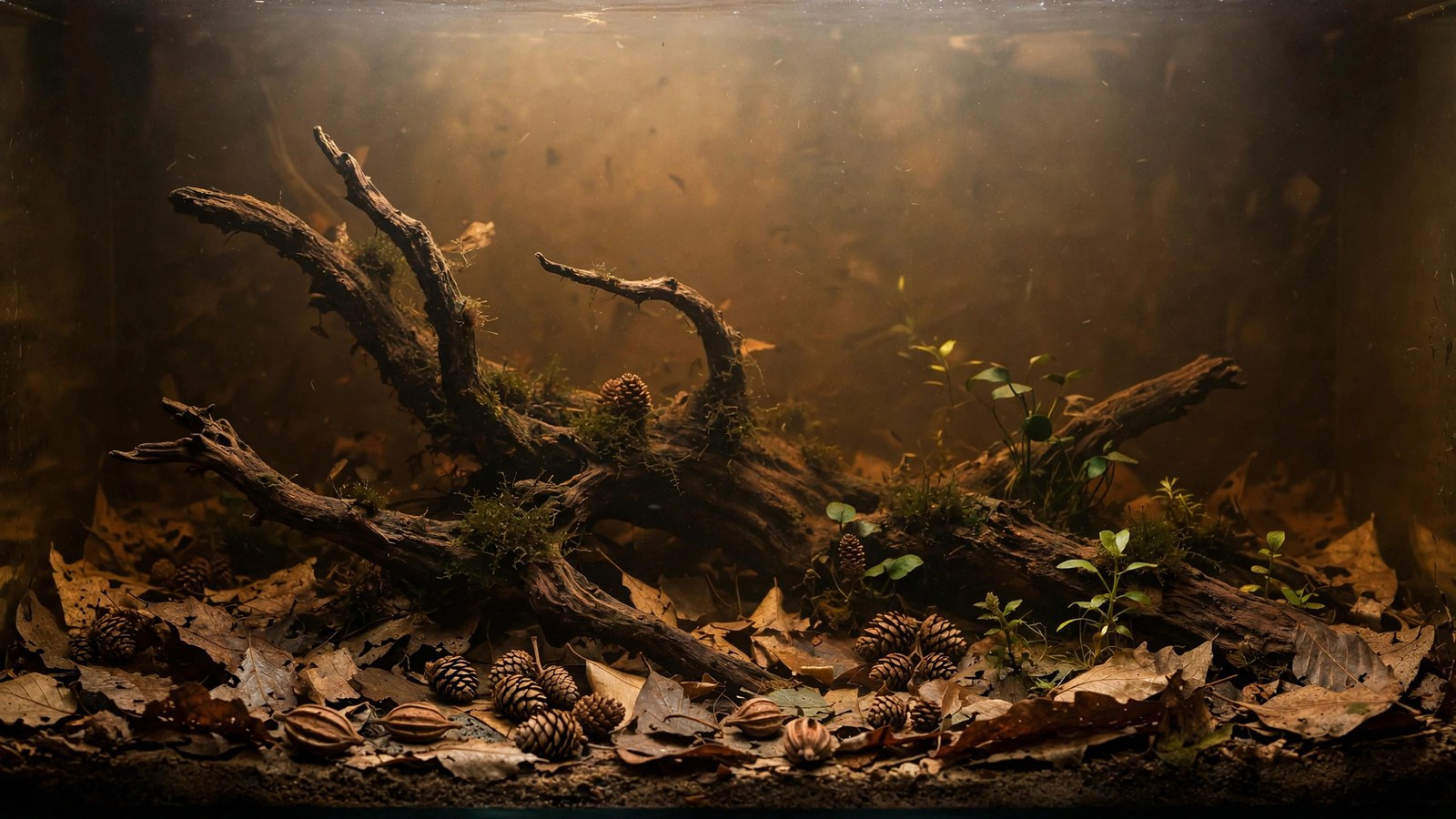
Drop a handful of catappa leaves into clear tank water and within 48 hours you'll have tea. Do it on purpose and you get blackwater — soft, acidic, tannin-stained water that makes tetras school tighter and fry graze biofilm off every surface. The catch is that not all blackwater botanicals pull equal weight; half the pods sold as "botanicals" are decoration with a marketing story. This guide ranks 7 botanicals by real tannin power, pH effect, dosage, and lifespan — so you buy what works and skip what doesn't.
Botanicals suit simple, low-light setups. If you're building the scape around amber water, a low-tech planted tank setup is the right foundation. Leaves, cones, and pods are the engine — here's how to drive them.
Blackwater Botanicals Ranked by Tannin Power
Strength is leaching power per unit — how fast each stains water and shifts pH in soft, low-KH water. Time your first 90 days in a planted tank around the durations so tannins never gap.
| Botanical | Strength | pH effect* | Lasts | Per 10 gal | Re-dose |
|---|---|---|---|---|---|
| Catappa leaves Terminalia catappa | Very strong | −0.5 to −1.0 | 3–4 weeks | 2–4 large leaves | Monthly |
| Alder cones Alnus glutinosa | Very strong | −0.5 to −0.8 | 2–3 weeks | 6–10 cones | Every 3 weeks |
| Oak leaves (red/white oak) | Strong | −0.3 to −0.6 | 4–6 weeks | 8–12 leaves | Every 5 weeks |
| Guava leaves Psidium guajava | Medium–strong | −0.2 to −0.5 | 2–3 weeks | 4–6 leaves | Monthly |
| Banana stems (dried stalks) | Medium | −0.1 to −0.3 | 2–3 weeks | 2–3 pieces (2") | Every 3 weeks |
| Coconut husk pieces | Medium | −0.1 to −0.2 | 4–6 weeks | 1–2 pieces | Every 5 weeks |
| Seed pods (sterculia, carapa, magnolia) | Weak | Negligible | 6–8 weeks | 4–8 pods | Every 6–8 weeks |
* Assumes soft water at 1–3 dKH. In hard, buffered water the same doses move pH half as much or less — add gradually and test.
Catappa Leaves: The Gold Standard
Nothing beats catappa for tannin output per gram. One large leaf (15–20 cm) stains 5 gallons in 24 hours; 3–4 per 10 gallons builds true darkwater color within a week. They also grow the richest biofilm here — shrimp, snails, and fry graze the surface for weeks, which is why breeders add them when acclimating new plants. Dosing guidance (about 1 leaf per 5–20 gallons for tinting, more for blackwater) is in the catappa leaf notes from Aquarium Co-Op.
Rinse and boil 10–15 minutes to kill hitchhikers and speed sinking, or drop in dry and wait 24–48 hours for waterlogging. A skeletonized leaf has stopped leaching — pull it, and keep one spare leaf behind the last so tannins never gap. In shrimp tanks, spent skeletons are food.
Alder Cones and Oak Leaves: The Precision Tools
Alder cones are the espresso shots of the botanical world — tiny, dense, potent. Six to ten in 10 gallons darken water as fast as a catappa leaf, and you tune intensity one cone at a time — ideal for nano blackwater tanks under 10 gallons. They fade in 2–3 weeks, so plan a three-week re-dose rhythm. The KeepingFish blackwater aquarium guide covers how cones fit the full method.
Oak leaves are marathon runners: 3–4 days to stain, then steady leaching for a month or more, with a thick structure that makes a lasting substrate layer. Use only brown, naturally fallen leaves — green ones carry sap that spikes ammonia. Collect 50+ feet from roads and away from sprayed lawns, or buy pre-packaged. For full leaf-litter floors, see our botanicals for planted aquariums guide on layer depth and substrate pairing.
Guava Leaves, Banana Stems, and Coconut Husk
Guava leaves are the safest first botanical — nearly impossible to overshoot. Use 4–6 per 10 gallons for warm amber in two days; they pair well with floating plants that filter tinted light. Banana stems and coconut husk are mid-tier leachers best used as hardscape accents: banana stems grow a biofilm coat otocinclus and shrimp swarm, while coconut husk leaches gently for 4–6 weeks. Both give the blackwater look without aggressive pH swings.
Seed Pods: Decoration With a Rumor Attached
Sterculia, carapa, and magnolia pods look spectacular on dark substrate but release a fraction of what leaves and cones do. Their woody shells resist breakdown, so 6–8 weeks of leaching gives mostly cosmetic surface color, not the humic load that defines blackwater. Use them for looks and shrimp micro-territories — paired with one catappa leaf or five alder cones per 4–6 pods.
What to Buy (and What to Skip)
Spend on the two strong performers. A 50-pack of catappa leaves and a bag of alder cones covers months of chemistry at a low per-dose cost — buy pre-cleaned, pesticide-free, "aquarium grade," and skip bags that smell musty (moisture damage means mold). Seed pods and banana stems are decorative; the tannin engine is still just the catappa and the cones. Rinse new shipments in dechlorinated water, hold 24 hours, and quarantine the way you quarantine new aquarium plants — imports can carry mites and fungal spores.
 ★4.8
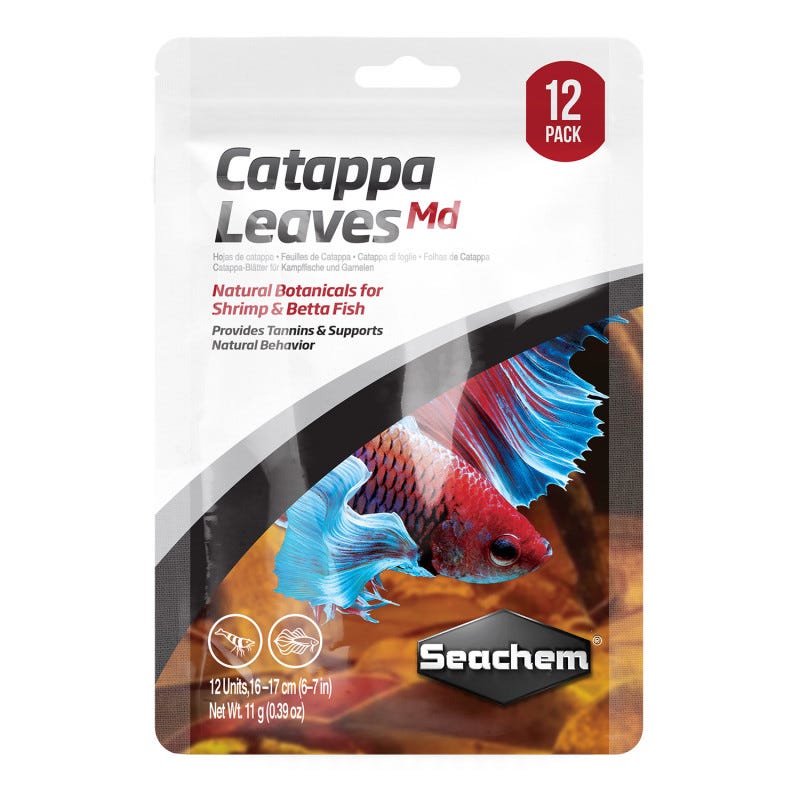
Seachem Catappa Leaves 12-pack
Check Price on Amazon ★4.8Re-Dose Schedules That Hold Blackwater
Tannins are consumable: they oxidize, get stripped by filtration, and fade with every water change — a 30% weekly change removes roughly a third of your color. Replace catappa monthly on a fixed date, alder cones every three weeks, and spot-check color after each change. Keep one "hero dose" (a fresh leaf or five fresh cones) as your floor, layered over older spent material for biofilm. To pause the tint, pull fresh botanicals and run activated carbon for 48 hours. For dim, acidic-water species — Anubias, Java fern, Cryptocoryne — use the complete freshwater aquarium plants guide, and read our how water changes affect your plants first.
Frequently Asked Questions
How many catappa leaves for a 20-gallon blackwater tank?
For light amber tinting, 2–3 large leaves. For true blackwater color and pH movement, 6–8 leaves per 20 gallons. Start low, wait 5 days for the full stain, then add more. In soft water a full dose drops pH roughly 0.5–1.0 points, so test before doubling down — especially with shrimp or wild-caught fish.
Do botanicals expire, and how do I store them?
Dry botanicals in a cool, sealed bag keep for years — tannin content doesn't degrade on the shelf. Moisture is the enemy: damp leaves grow mold and lose potency. Once in the tank the clock starts — leaves stop leaching in 3–4 weeks, cones in 2–3. Spent skeletons aren't waste; shrimp graze their biofilm for weeks longer.
Can I use leaves I collect outside?
Yes, with strict rules: only naturally fallen brown leaves, never green ones, from unsprayed trees. Collect 50+ feet from roads and away from treated lawns; oak, magnolia, and guava are safe picks. Rinse, boil 10–15 minutes, soak overnight. In doubt, buy aquarium-grade — pesticide residue kills shrimp at trace levels and boiling won't remove it.
Will botanicals crash my pH overnight?
Not if you dose sensibly. In soft, low-KH water a full catappa dose shifts pH down 0.5–1.0 points over several days — gradual, not a crash. The risk is stacking strong botanicals in tiny tanks under 5 gallons with near-zero buffering. Add half your dose, wait 48 hours, test, then top up.
Do seed pods actually create blackwater?
Not really — they're the weakest tannin producers on this list. Sterculia and magnolia pods leach only surface color for 6–8 weeks and won't meaningfully lower pH. They're excellent decoration and shrimp habitat, but pair them with catappa leaves or alder cones for real blackwater chemistry.
Start With Two Bags and a Schedule
Blackwater needs the right ingredients on a calendar. One bag of catappa leaves, one bag of alder cones, a monthly re-dose date, two rounds of water tests. Add seed pods and banana stems for the scape once chemistry is stable. Done this way, your tank stays amber, soft, and alive — never a brown, acidic guess.