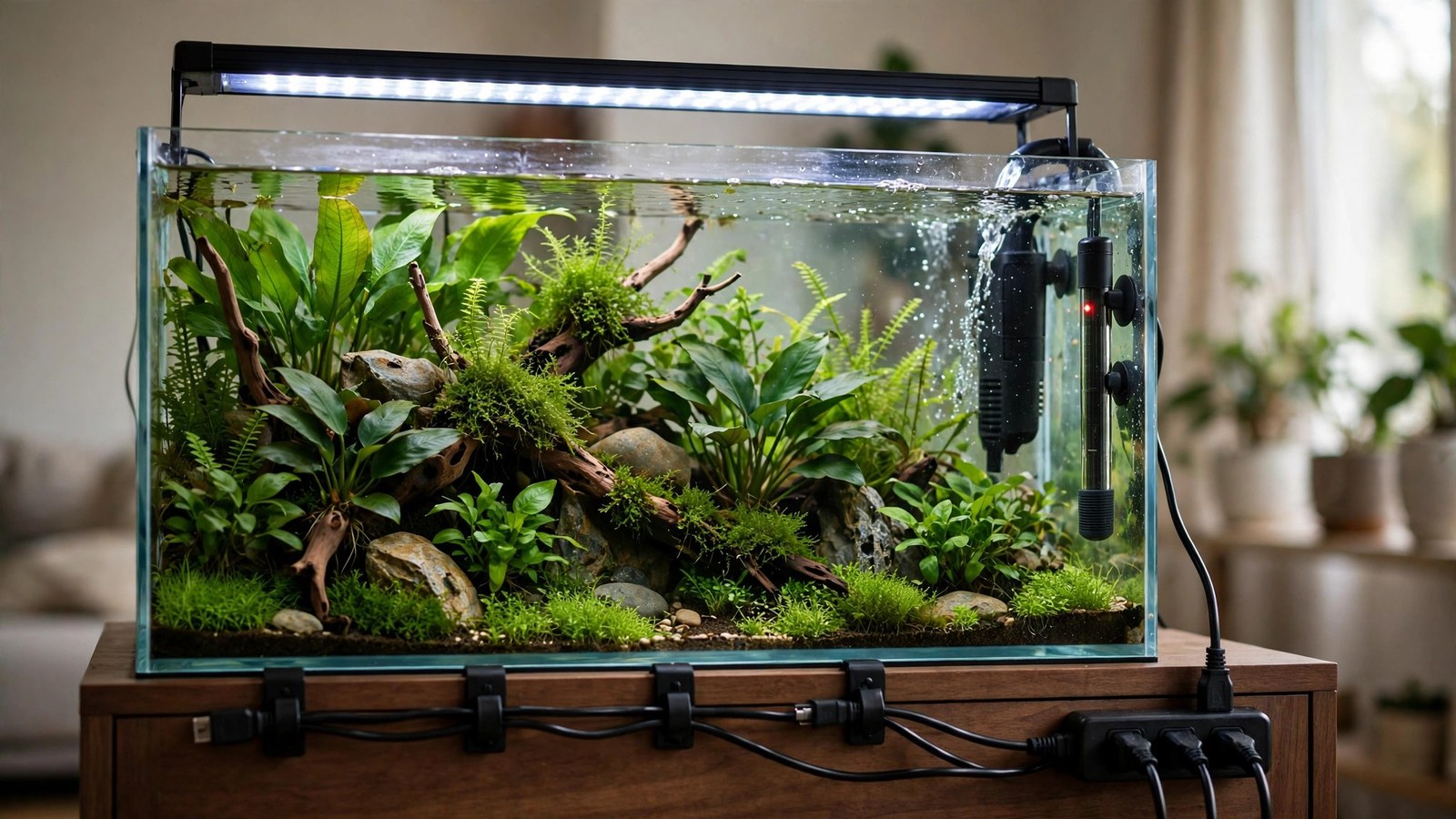
You buy a $35 LED and a $60 filter, and your hobby now costs $10 a month — forever. Nobody mentions aquarium electricity cost when you're comparing fixtures, but it's the expense that never stops. The good news: a planted tank is one of the cheapest appliances in your house, and an hour of tinkering halves the bill.
This guide gives you the watts-to-dollars math, names the real cost drivers, and shows six ways to pay less. For the bigger picture, see the complete planted aquarium cost breakdown this guide sits inside.
Where the Watts Actually Go
Everything plugged in falls into four buckets — light, water movement, heat, small accessories:
| Equipment | Typical wattage | What drives it |
|---|---|---|
| LED light | 20–90W | Tank size and plant demand |
| Fluorescent (T5/T8) | 40–110W | Older fixtures; 2–3× the LED draw |
| Canister filter | 15–40W | Runs 24/7; bigger pumps draw more |
| Hang-on-back filter | 5–12W | Cheap to run |
| Heater | 50–300W | Rated watts are a ceiling |
| Air pump | 2–8W | Near-negligible |
| Wavemaker | 4–15W | Only high-flow setups notice it |
| CO2 solenoid | ~2W | Only on during the photoperiod |
The light has the highest honest hourly draw, the heater has the highest potential draw, and the filter never sleeps — which is why the heater dominates the monthly total. Dialing in exactly how much light your aquarium plants need matters as much for your wallet as for your plants.
Aquarium Electricity Cost: The Four-Step Calculation
Five minutes, no meter required. Run this per device:
- Find the wattage — device label, box, or product page.
- Multiply by hours per day — lights: photoperiod (6–10h); filters: 24; heater: duty-cycle trick below.
- Divide by 1,000 — kWh per day.
- Multiply by 30, then by your $/kWh rate from the power bill (~$0.17/kWh works for sketching).
Formula: Watts × hours/day ÷ 1000 × 30 × $/kWh = monthly cost.
The heater duty-cycle trick
A 150-watt heater doesn't draw 150 watts around the clock — it clicks on and off, and the duty cycle is the fraction of time it's on. In a heated home, a tropical tank at 76–80°F keeps the heater firing 20–35% of the time, so 150W × 25% × 24h = 900 Wh/day — the same as a 37.5-watt device running constantly. Cold rooms raise it; warm rooms lower it.
Worked Example: A 40-Gallon Planted Tank
A medium-tech 40-gallon at $0.17/kWh — swap in your own wattage and rate:
| Equipment | Watts | Hrs/day | kWh/day | $/mo |
|---|---|---|---|---|
| LED light | 45 | 8 | 0.36 | $1.84 |
| Canister filter | 23 | 24 | 0.55 | $2.82 |
| Heater (150W, 25% duty) | 37.5 avg | 24 | 0.90 | $4.59 |
| Air pump | 4 | 24 | 0.10 | $0.49 |
| CO2 solenoid | 2 | 10 | 0.02 | $0.10 |
| Total | 1.93 | $9.83 |
About $10 a month — less than a streaming subscription. A 20-gallon low-tech tank with a small light and no heater can land under $3; a 75-gallon high-tech setup with twin lights and a big heater can pass $20.
Summer vs Winter: The Seasonal Swing
The heater is the only load that changes with the calendar. In a 68°F living room, a tank at 78°F fights a 10-degree gap; in a 60°F winter room that gap doubles, and the duty cycle roughly doubles with it. A $10/month July tank can cost $13–$15 in a cold January. Warm the room, not just the tank — a tight lid also cuts evaporative cooling.
Six Moves That Shrink the Bill
1. Switch fluorescent to LED
An 80-watt fluorescent becomes a 40-watt LED with equal or better growth. At $0.17/kWh on an 8-hour photoperiod, that's ~$1.60/month saved — the fixture often pays for itself within a year.
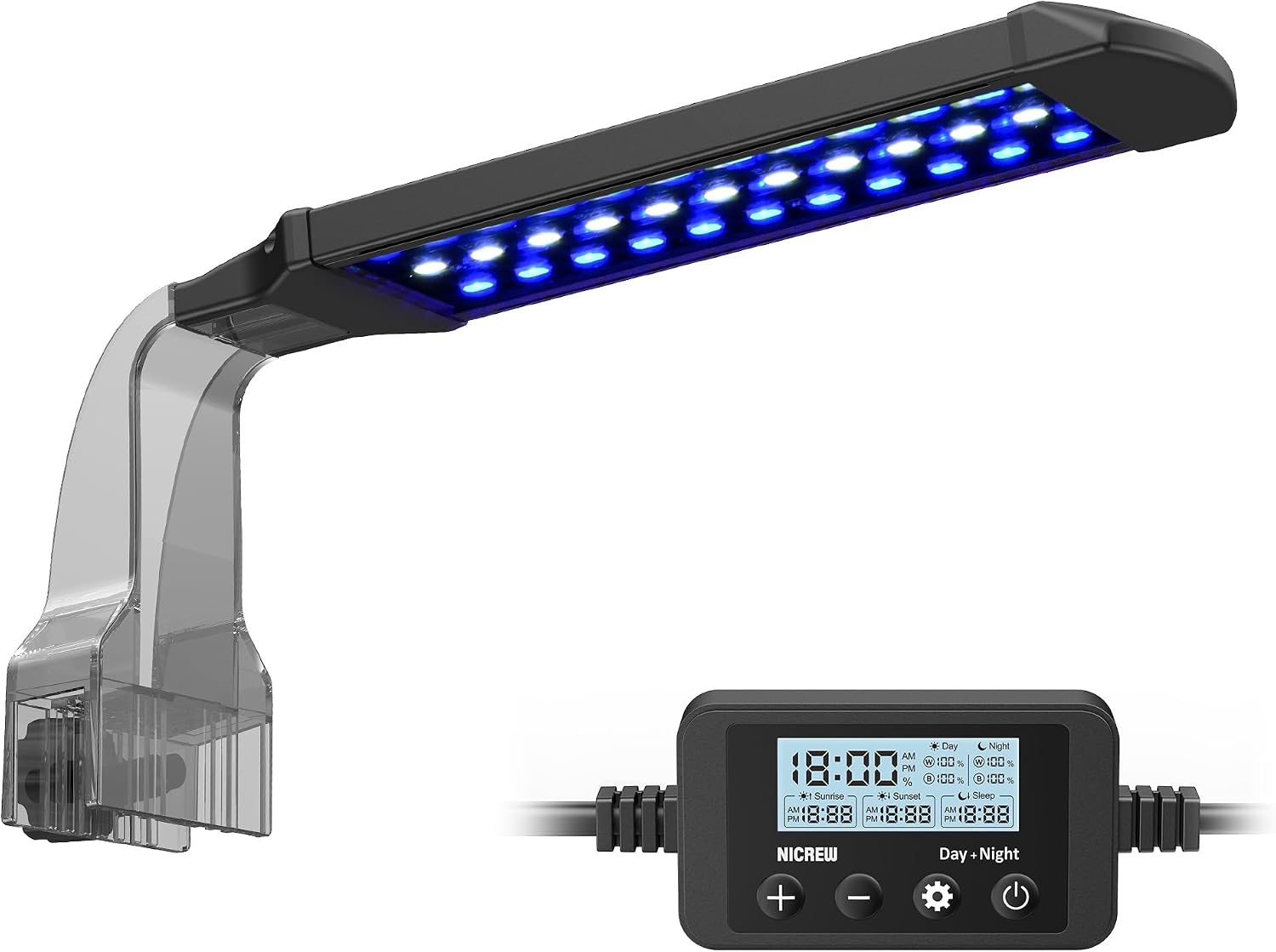 ★4.6
NICREW ClassicLED Plus planted aquarium light
Check Price on Amazon ★4.62. Put the light on an outlet timer
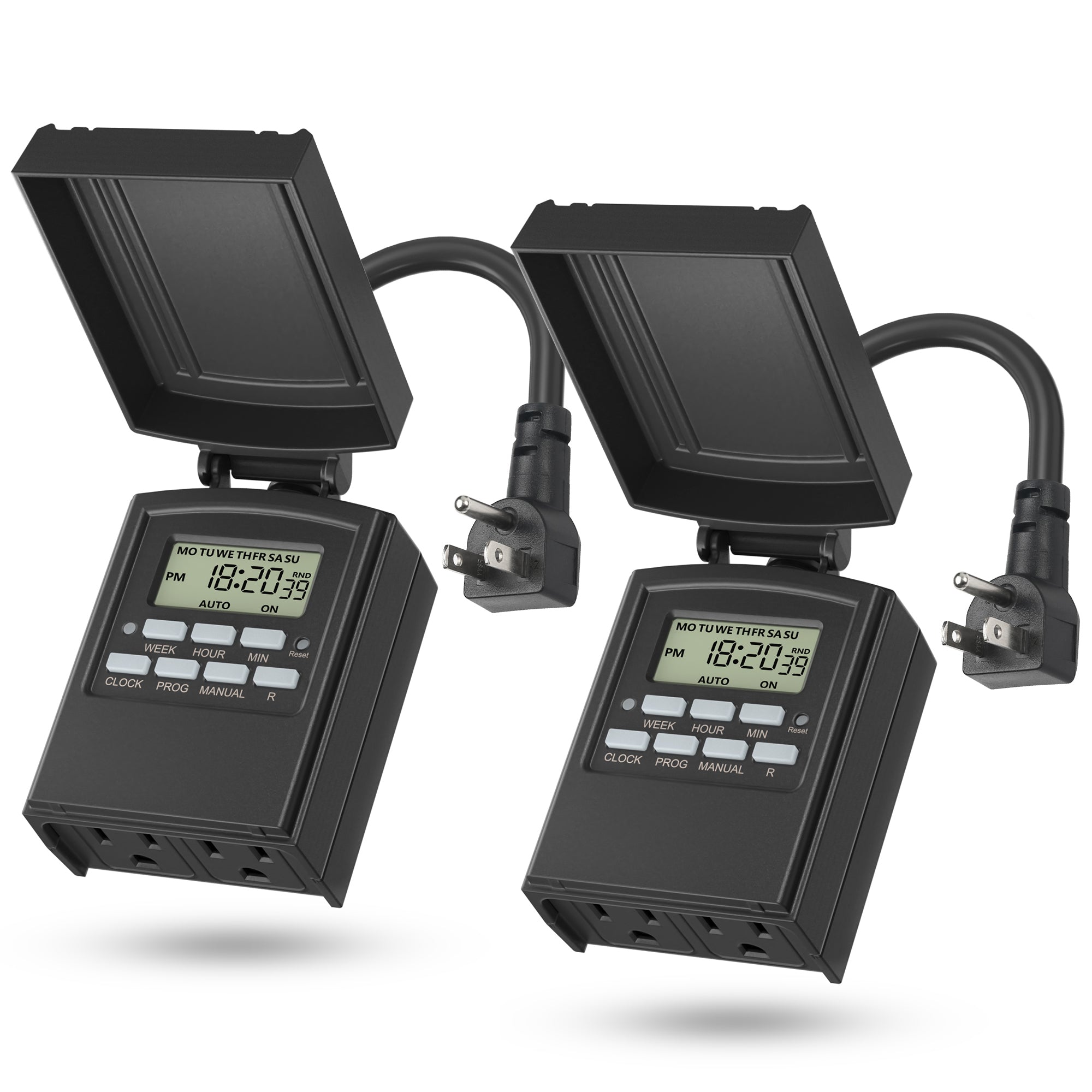 ★4.4
BN-LINK Digital Outlet Timer
Check Price on Amazon ★4.4A $10–$15 timer locks in an 8-hour photoperiod daily — cheap, algae-safe, steadier plant growth. It pays for itself twice.
3. Size the heater right — and add a controller
3–5 watts per gallon covers a 10-degree lift above room temperature. An oversized heater costs nothing extra while idle but swings temperature harder and fails "on" more dramatically. An Inkbird-style controller adds a safety cutoff and tighter cycling — slight savings plus livestock insurance.
4. Choose efficient pumps
Filters run 24/7, so small wattage gaps compound. Modern DC-pump canisters draw 30–50% less than older AC models at the same flow — a genuine bonus when yours is due for replacement.
5. Keep the room warmer
In a dedicated tank room, 72°F instead of 65°F can nearly halve every heater's duty cycle — one heat source beats five fighting cold air. It's also why a low-tech planted tank setup — no CO2, modest light, hardy plants is the true low-energy counterpoint: fewer devices, lower wattages.
6. Kill phantom loads
Timed UV (8–12h instead of 24) and unplugging retired gear add up. Stable water levels keep heaters submerged and efficient; see the best auto top-off options for aquariums if evaporation is constant.
To check your local rate, the U.S. Energy Information Administration's electricity data page publishes current residential rates by state.
Frequently Asked Questions
How much does it cost per month to run a fish tank?
A typical 40-gallon planted tank costs roughly $8–$12 per month at average U.S. rates; 10–20 gallon tanks land at $2–$5, large high-tech setups can reach $20+. The heater is almost always the biggest share, then the light, then the filter.
Does a fish tank heater use a lot of electricity?
Less than the label suggests. Heaters draw rated wattage only while actively heating — typically 20–35% of the time in a heated home — so a 150-watt heater averages around 38 watts. Cold rooms push the duty cycle up, which is why bills peak in winter.
Are LED aquarium lights cheaper to run than fluorescent?
Yes, substantially. LEDs deliver the same usable light at roughly half the wattage of fluorescent tubes, and the diodes last for years instead of needing annual tube replacements. On an 8-hour photoperiod, swapping an 80-watt fluorescent for a 40-watt LED saves around $1.50–$2 per month — about $20 a year.
How can I measure my aquarium's real electricity use?
A plug-in watt meter (under $20) is easiest: run your power strip through it for a week and read actual kilowatt-hours, heater cycling included. For a free estimate, apply watts × hours/day ÷ 1000 × 30 × $/kWh per device.
Does shortening the photoperiod save much money?
Yes — one of the cheapest wins available. Cutting a forgotten 14-hour photoperiod to a timed 8 hours saves ~40% of lighting cost with zero new equipment and cuts algae pressure. A $10 outlet timer pays for itself in months.
The Bottom Line on Tank Power Bills
A planted aquarium is one of the cheapest luxuries in your home: a few dollars a month for most setups, under twenty for ambitious ones. Run the four-step math once, fix the obvious leaks — LED, timer, right-sized heater — and the bill's no mystery.