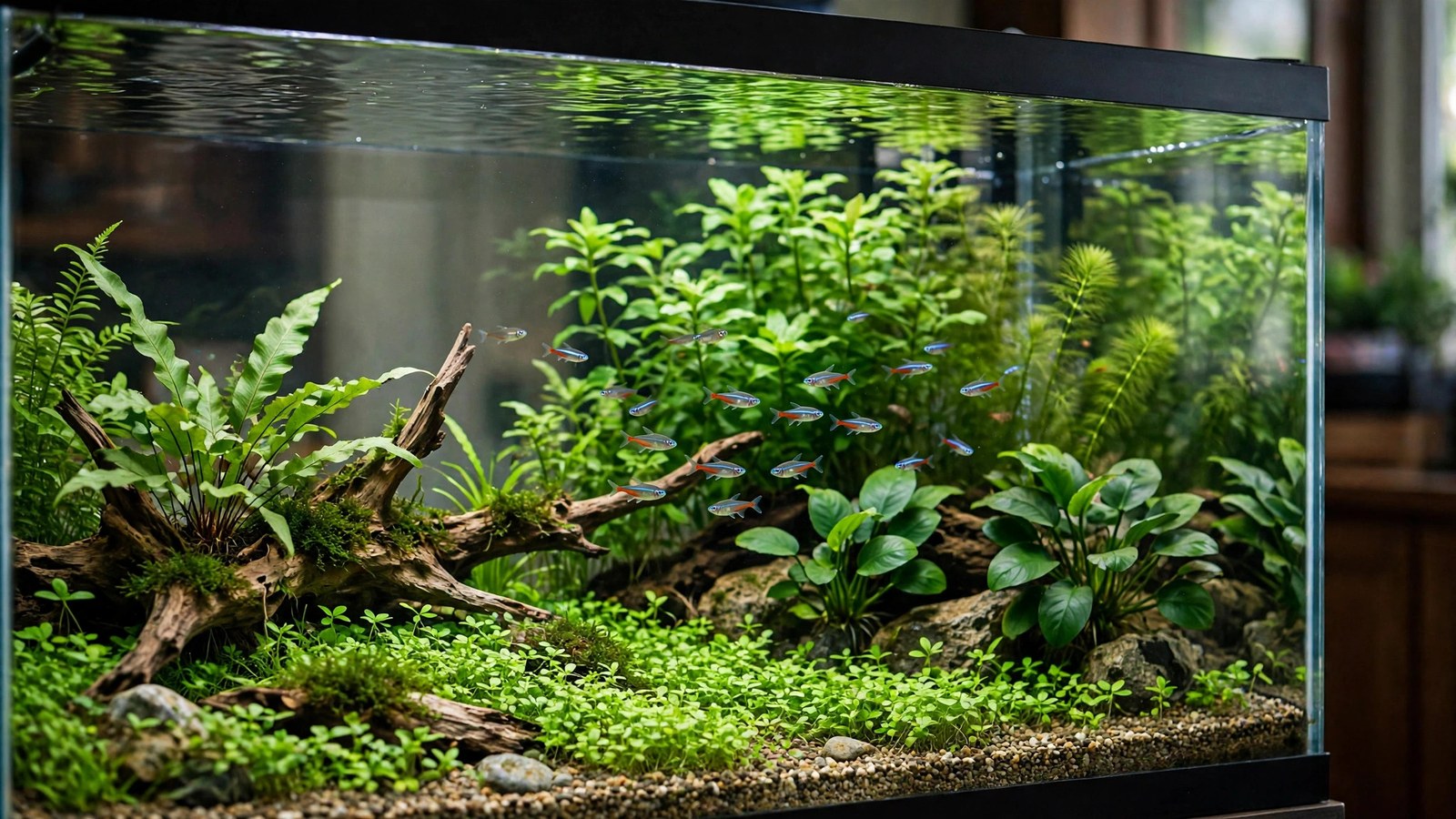
You've probably seen it in a forum or a dog-eared fishkeeping book: "two watts per gallon for a planted tank." It is one of the most repeated pieces of advice in the hobby — and in the LED era, following it is one of the easiest ways to buy the wrong light. The watts-per-gallon rule for planted tanks was written for fluorescent tubes in the 1990s, when every tube made roughly the same amount of light per watt. Today's LEDs shatter that assumption: two fixtures drawing the exact same wattage can deliver three times, or one-third, the usable light. In this guide, you'll learn where the rule came from, exactly why it fails with LED lighting, and the simple system to use instead — matching PAR to your plants and your tank's depth, and knowing how to judge a light even when the manufacturer publishes no data at all.
Where the watts-per-gallon rule came from
In the 1990s and 2000s, nearly every planted tank was lit by fluorescent tubes — T12s, then T8s, then T5HOs. Fluorescent tubes had a convenient property: their luminous efficacy (how much light they produced per watt) barely varied between brands. A 36W tube from any major manufacturer produced roughly the same amount of light, and that light scattered in a predictable, unfocused pattern. Under those conditions, dividing total wattage by tank volume gave a serviceable shorthand. The classic guidance said 1–2 watts per gallon for low-light plants like anubias and java fern, 2–3 for most stems and swords, and 3–5+ for demanding carpeting plants and red species. If you want the modern version of that "how much light" question, our guide on how much light aquarium plants need translates it into today's terms.
The rule worked because wattage was a reliable proxy for light output. Three things have changed since: LEDs replaced tubes, efficacy now varies wildly between fixtures, and spectrum (which watts say nothing about) turned out to be half the story. Let's take each in turn.
Why LEDs broke the rule completely
Wattage measures electrical power going into a fixture, not light coming out. With fluorescents, the ratio was nearly fixed, so the proxy held. With LEDs, efficacy ranges from roughly 60 lumens per watt in cheap white floodlights to 120–150+ lumens per watt in quality planted-tank fixtures with modern diodes and drivers. That means two fixtures both labelled "30 watts" can deliver anywhere from ~1,800 to ~4,500 lumens — a 2.5× difference — before you even consider spectrum.
And spectrum is the second blow. Plants photosynthesize using specific wavelengths — mainly red and blue — and a light's watts are spread across whatever spectrum its diodes emit. A 30W fixture heavy in blue light will grow algae beautifully while leaving your carpeting plants stunted, because the watts were "spent" on wavelengths plants can't use well. For the full story, see our explainer on light spectrum for aquarium plants. The table below shows why "same watts" means almost nothing today:
| 24W fixture | Typical efficacy | Approx. lumens | Light quality |
|---|---|---|---|
| T8 fluorescent tube | ~60 lm/W | ~1,450 | Broad, unfocused, drifts in spectrum with age |
| T5HO tube with reflector | ~90 lm/W | ~2,150 | Intense, focused; spectrum stays stable longer |
| Budget generic LED | ~80–100 lm/W | ~2,000–2,400 | Narrow blue-heavy spectrum, poor color rendering |
| Quality planted-tank LED | ~120–140 lm/W | ~2,900–3,400 | Tuned red/blue spectrum, high CRI, consistent |
All four are "24 watts." The best produces more than twice the light of the worst — and far more of it in wavelengths plants actually use. Anyone who shops by watts per gallon for planted tanks in the LED era is comparing numbers that no longer correlate with results.
Watts per gallon ignores the two things that matter most
1. Efficacy varies wildly between LEDs
This is the core failure. The old rule assumed a fixed relationship between watts and photons. In the fluorescent era that relationship was roughly true. Today it is not, as the table above shows. A 20-gallon tank with 40 watts of premium LED (roughly 5,000+ lumens of plant-optimized light) can be a high-light tank needing pressurized CO2 — while the same 40 watts from a budget floodlight is barely medium light. Same "2 watts per gallon," completely different tanks, completely different algae risk. If that mismatch has you reaching for CO2 to keep up, check that your system is actually dialled in with a CO2 drop checker guide rather than guessing.
2. Depth matters far more than gallons
The rule divides by volume, but light doesn't care about volume — it fades with distance through water and suspended particles. A 20-gallon "long" tank (12 inches deep) and a 20-gallon "high" tank (24 inches deep) need very different amounts of light at the substrate, yet watts per gallon gives them the identical prescription. As a rough rule of thumb, light intensity halves every 6–10 inches of water depth depending on water clarity, and tall tanks can lose 60–75% of surface light before it reaches the substrate. A "2 watts per gallon" light that grows a carpet beautifully in a 12-inch-deep tank can barely keep crypts alive in a 24-inch-deep one. Depth — measured in inches from the light to the substrate — is the dimension the old rule never saw.
| Old T5HO rule (WPG) | Plant category | Modern target: PAR at substrate | Rough LED equivalent (quality fixture, 12–16" depth) |
|---|---|---|---|
| 1–2 WPG | Low light (anubias, java fern, mosses, crypts) | 15–30 µmol/m²/s | ~6–12 W per 10 gallons |
| 2–3 WPG | Medium light (swords, most stems, vallisneria) | 30–60 µmol/m²/s | ~12–24 W per 10 gallons |
| 3–5+ WPG | High light (carpets, red plants, Tonina, Eriocaulon) | 60–80+ µmol/m²/s | ~24–40 W per 10 gallons |
Treat the LED column as a starting estimate, not a rule — it assumes a modern fixture (110+ lm/W) at moderate depth. Deeper tanks need more; quality fixtures with good optics need less. And high-light levels only work with matching CO2 and fertilization, or you'll grow algae instead of plants.
What to use instead: PAR, not watts
PAR — photosynthetically active radiation — measures the photons plants can actually use, at the point that matters: the substrate. It's expressed in micromoles per square metre per second (µmol/m²/s). Unlike watts, it accounts for efficacy, optics, spectrum and depth in a single number. The ranges in the table above are the whole system: find your plants' light needs (low, medium, or high — Tropica's plant database lists light requirements for every species), measure or estimate the PAR your fixture delivers at your substrate depth, and you're done. No division by gallons anywhere.
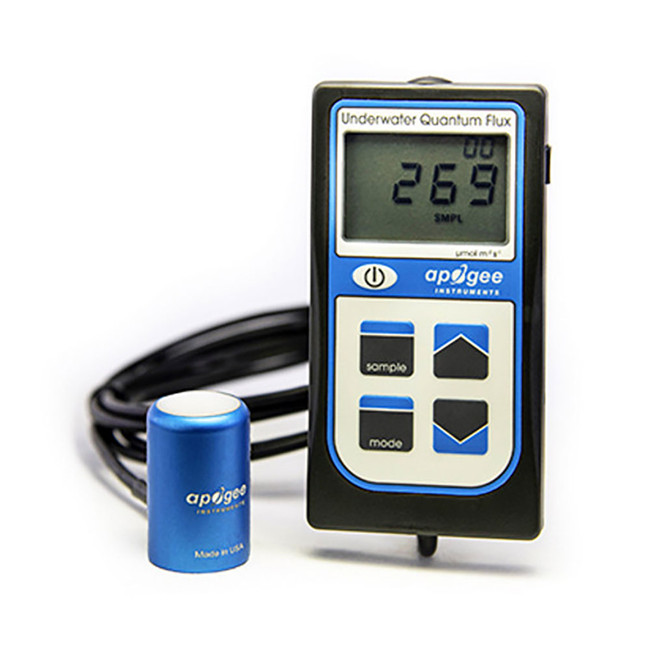
How do you get a PAR number? The honest answer is a PAR meter — either borrowed from a local fish club or a reef shop that rents them. A practical alternative is manufacturer-published PAR charts (measured at specific depths), which reputable planted-tank brands increasingly provide. Our PAR meter guide walks through both approaches. When nothing is published and no meter is available, a lux meter or even a phone lux app gives a rough proxy — multiply lux by ~0.015 for LED daylight spectrums to get an approximate PAR — but treat that as a ballpark, not a lab result.
How to shop for a light when no PAR is published
Many lights, especially budget ones, publish neither PAR nor efficacy. You're not flying blind, though. Check these signals, in order:
- PAR charts in the listing or manual. Any brand that publishes depth-specific PAR is confident in its product — this is the strongest trust signal.
- Independent meter readings. Search hobbyist reviews and forums for the fixture name plus "PAR" — reef and planted-tank communities love measuring things. A budget light with third-party PAR data beats a mid-range light with none.
- Efficacy and diode specs. 110+ lm/W, named diode brands, and a stated spectrum range suggest a serious fixture. Vague "super bright!" copy with no numbers suggests the opposite.
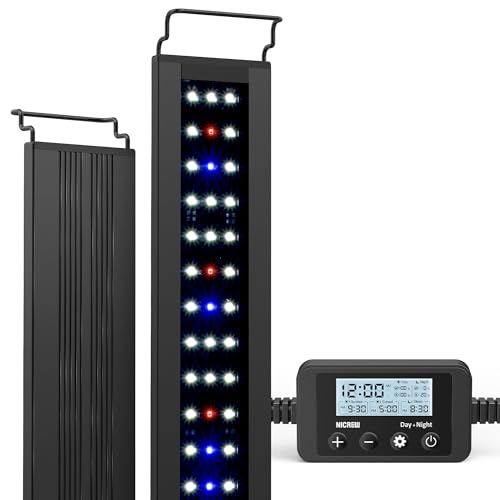
- Brand track record in planted tanks. Fluval, Chihiros, Twinstar and Nicrew publish real data and have years of planted-tank results behind them. Our roundup of the best aquarium lights for planted tanks filters for exactly these signals.
- Adjustability. A dimmable light you can turn down to 60% is far more forgiving than a fixed-output light — dimming is how you fine-tune intensity to your tank without buying twice.
 ★4.6
NICREW ClassicLED Plus LED Aquarium Light
Check Price on Amazon ★4.6If you're weighing flashy RGB fixtures against plain white plant lights, our guide to RGB aquarium lighting for planted tanks breaks down what the color modes actually do for growth. And when you do end up in the high-light tier, expect pressurized CO2 to become non-negotiable — light that strong outpaces what liquid carbon and good flow can support on their own.
Frequently Asked Questions
Is 1 watt per gallon enough for LED lights in a planted tank?
Sometimes — which is the problem. One watt per gallon from a modern, efficient planted-tank LED over a shallow tank is genuinely low-medium light, fine for anubias and java fern. One watt per gallon from a cheap floodlight over a 24-inch-deep tank is near darkness at the substrate. The phrase "1 WPG for LED" has no fixed meaning because LED efficacy and spectrum vary so much. Measure PAR or shop by the trust signals above instead.
How many watts does a 10-gallon planted tank need?
For a standard 10-gallon (about 12 inches deep): roughly 6–12 watts of a quality planted-tank LED for low-light plants, 12–24 watts for medium-light stems and swords, and 24–40 watts for high-light carpets and red plants — the last only with pressurized CO2. These assume a modern fixture at 110+ lm/W. A deeper or rimless tank, or a budget fixture, shifts the numbers. Watts are a budget check, not a target.
Can I convert watts to PAR?
Only with big error bars. You can estimate: multiply the fixture's lumens by ~0.013–0.018 to get approximate PAR near the surface for daylight-spectrum LEDs, then halve it per 6–10 inches of depth. But spectrum, optics and reflector quality swing the result by 2× or more, so this gets you a ballpark, not a prescription. A borrowed PAR meter for one afternoon beats any conversion math.
 ★4.4
Apogee MQ-510 Underwater PAR Meter
Check Price on Amazon ★4.4Does watts per gallon still work for fluorescent T5HO fixtures?
Mostly, yes — and that's where the rule came from. Tubes from reputable brands still have similar efficacy and predictable light spread, so the classic 2–5 WPG ladder remains a decent starting point if you're running T5HO or T8. Just remember that modern LEDs will deliver the same growth at roughly half to two-thirds the wattage, which is why so many upgraders end up with algae after a "like-for-like" wattage swap.
What about lumens per gallon — is that any better?
It's a small step up, since lumens measure light output rather than power input — a lumen-per-gallon number automatically accounts for the fixture's efficacy. But lumens still ignore spectrum (they're weighted for human eyes, not plants), optics, and depth. Lumens per gallon is a slightly better bad ruler; PAR at the substrate is the actual measurement. Use lumens to compare two fixtures of similar spectrum; use PAR to decide what your plants get.
The bottom line
Watts per gallon was a brilliant rule for 1995 — a time when every light source was nearly identical and wattage was a trustworthy stand-in for brightness. It is a bad rule for today because wattage no longer correlates with the light your plants receive. Forget the division: identify your plants' needs (low, medium, or high), make sure your fixture delivers that as PAR at your substrate depth, and give high-light tanks the CO2 and nutrients they demand. Do that, and you'll never need to calculate watts per gallon again.