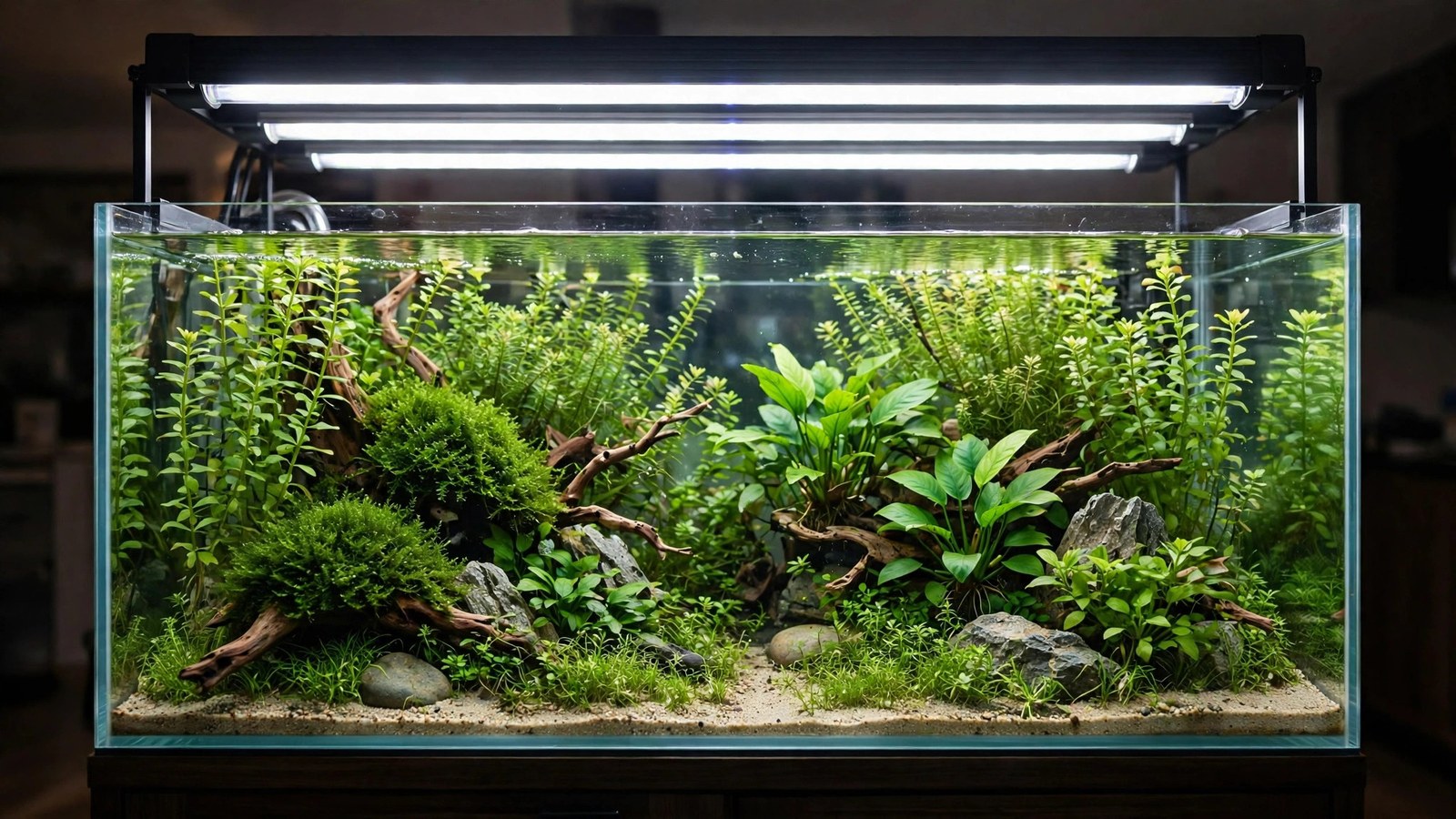
For a decade, T5 fluorescent tubes were the undisputed kings of planted-tank lighting — then LEDs arrived, and the hobby moved almost overnight. In 2026, T5 is a legacy technology kept alive by loyalists, while LED dominates completely. But "LED won" doesn't answer which is right for your tank. This is the honest T5 vs LED comparison for planted tanks: where each still makes sense, what each costs to run, and whether that old T5 fixture in your closet deserves a second life.
How They Work (Briefly)
- T5 HO (high-output) fluorescent: 5/8-inch diameter tubes, usually 24–54W each, in multi-tube fixtures (2–4 tubes typical). Light is diffuse, even, and broad-spectrum; intensity is controlled by tube count and fixture height. Tubes degrade and need replacement every 9–12 months.
- LED: arrays of light-emitting diodes, often with adjustable spectrum channels and dimming. Light is directional (needs lenses/diffusers for spread); intensity is electronically controlled. Diodes last years with gradual output decline.
Head-to-Head Comparison
| Factor | T5 HO fluorescent | LED |
|---|---|---|
| Light quality for plants | Excellent — broad, even, proven spectrum | Excellent — tunable, high PAR efficiency |
| Spread/evenness | Superb — diffuse tubes cover evenly | Good to excellent — depends on optics; cheap bars hotspot |
| Intensity control | Coarse (tube count, height) — no dimming on most fixtures | Fine — dimming standard, often app-controlled |
| Spectrum control | Tube swaps (fixed options) | Continuous RGB/W tuning on many fixtures |
| Upfront cost (2026) | Low (used market) to moderate | Moderate to high |
| Running cost | Higher — less efficient + yearly tube replacement | Lower — efficient + multi-year diode life |
| Heat output | Significant — can warm small tanks | Low to moderate |
| Lifespan/maintenance | Tubes every 9–12 months; ballasts eventually | Diodes 5+ years; occasional driver issues |
| Features | On/off (timers) | Ramping, sunrise/sunset, moonlights, app control |
| Availability (2026) | Declining — tubes harder to find each year | Dominant — vast selection |
Where T5 Still Wins
Let's give the old king its due — T5 has genuine, not merely nostalgic, advantages:
- Evenness of coverage. A 4-tube T5 fixture bathes the tank in beautifully diffuse light with almost no hotspots — something LED bars achieve only with good diffuser design. For wide, shallow tanks (like 48-inch breeders), T5 spread is still arguably the best in the business.
- Simplicity. No apps, no firmware, no channel programming — tubes on, tubes off, timer in between. For aquarists who find smart fixtures exhausting, T5's dumb reliability is a feature.
- Proven plant growth. Decades of world-class aquascapes were grown under T5. The spectrum works; the results are beyond debate.
- Used-market value. Quality T5 fixtures sell cheap secondhand as hobbyists upgrade — a 4x54W fixture for the price of a budget LED bar is real value if you can still source tubes.
Where LED Wins (Decisively, in 2026)
- Dimming and control. This is the war-winner. Light acclimation, intensity stepping, sunrise ramping — all trivial with LED, all awkward or impossible with T5. Control isn't a luxury feature; it's the primary tool for avoiding algae.
- Running costs. LEDs convert more electricity to PAR and need no yearly tube replacement. Over 3–5 years, a mid-range LED is cheaper to own than a "cheap" T5 fixture — tube costs alone ($15–25 per tube × 2–4 tubes yearly) add up fast.
- Heat. T5 fixtures run hot enough to raise small-tank temperatures measurably — a real problem in warm climates or shrimp tanks. LEDs run far cooler.
- Form factor. Slim LED bars suit rimless, open-top aesthetics; T5 fixtures are bulky by comparison.
- Future-proofing. T5 tube availability shrinks yearly as manufacturers exit fluorescent. Buying into T5 in 2026 means betting you can source tubes in 2029 — a bet I'd decline.
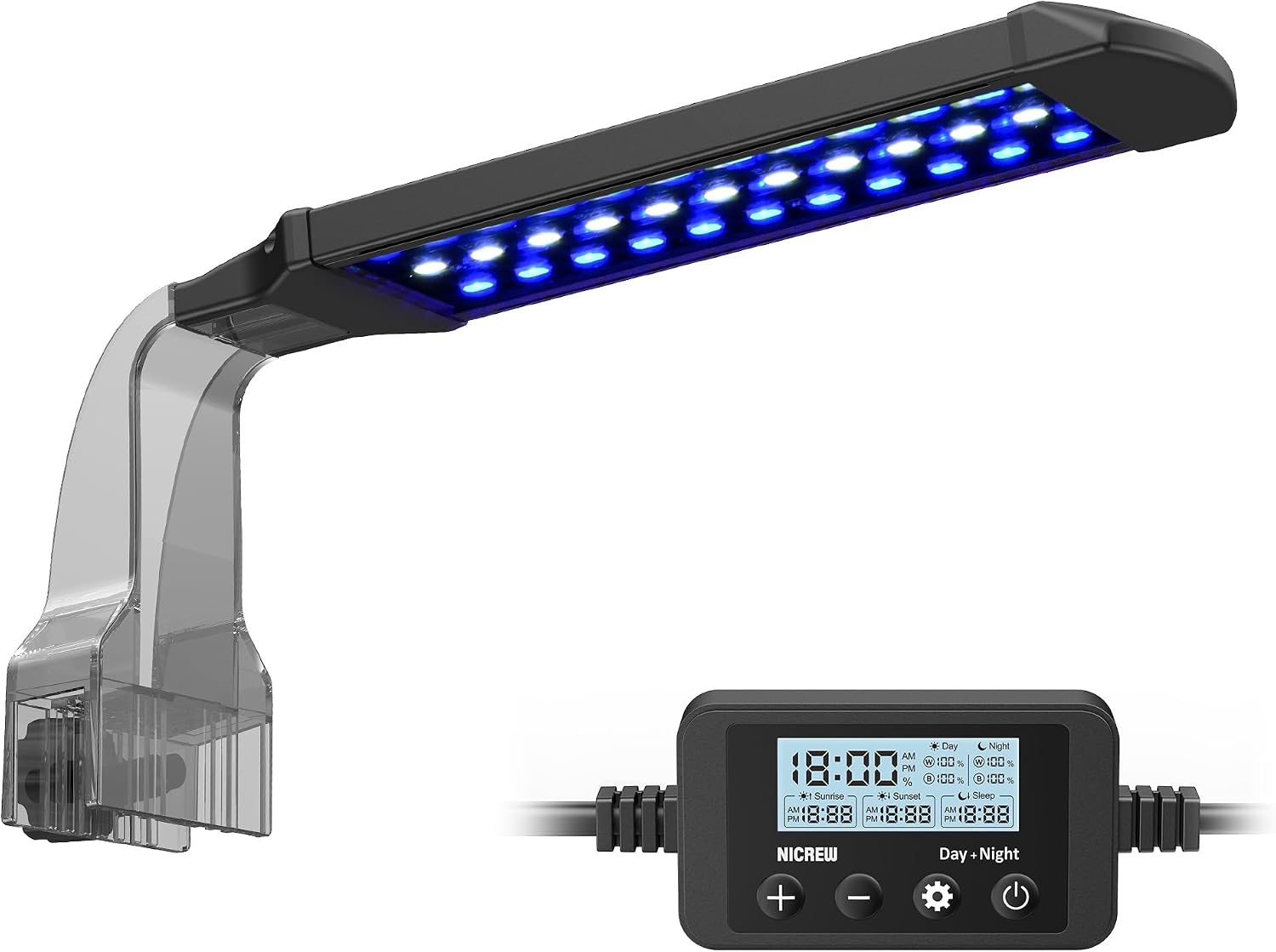
A reliable pick here is NICREW ClassicLED Plus.
 ★4.6
NICREW ClassicLED Plus planted aquarium light
Check Price on Amazon ★4.6The Cost Math Over 5 Years
Illustrative comparison for a 48-inch tank, 4-tube T5 HO vs mid-range LED bar — and independent planted-tank lighting guides consistently land on the same conclusion: match the fixture to PAR targets and control needs rather than legacy loyalty, because the 5-year ownership math below is hard to argue with.
- T5: fixture (used, ~$80) + tubes yearly (~$60–80/yr × 5 = $300–400) + higher electricity (~$40/yr more than LED × 5 = $200) ≈ $580–680.
- LED: fixture (~$200–300) + negligible maintenance + lower electricity ≈ $200–330.
The LED costs more on day one and roughly half as much over five years. T5's "cheap" reputation survives only if you ignore tubes and power — which is most of the cost.
Should You Keep Running Your Old T5 Fixture?
If you already own a working T5 setup with a tube source: keep it until the economics or availability force the switch. It grows plants beautifully, and replacing working equipment for fashion is wasteful. Practical guidance:
- Stockpile tubes if your fixture uses a common size — availability will only worsen.
- Replace tubes on schedule (9–12 months) even if they "still light up" — output and spectrum shift as phosphors degrade, and old tubes are a stealth cause of declining plant performance. Verify with a PAR meter if unsure.
- Manage the lack of dimming with hanging height and tube count (run 2 of 4 tubes during acclimation, for example).
- Plan the LED transition for when tubes become scarce or the ballast dies — don't wait for a crisis.
Buying Advice in 2026
- New setup: buy LED. There's no 2026 scenario where buying new T5 makes sense — the economics, control, and availability all point one way. See best aquarium lighting for current picks.
- Used T5 bargain: consider it only if the price is truly silly-cheap, tubes are currently available for it, and you understand the running costs. It's a fine stopgap, not a long-term platform.
- Special case — very wide shallow tanks: if you find a used multi-tube T5 fixture sized perfectly for a breeder-style tank, the evenness advantage is real. Still verify tube availability first.
- What about T8/CFL/power compact? Obsolete for planted tanks — less efficient than T5, bulkier, worse availability. Skip.
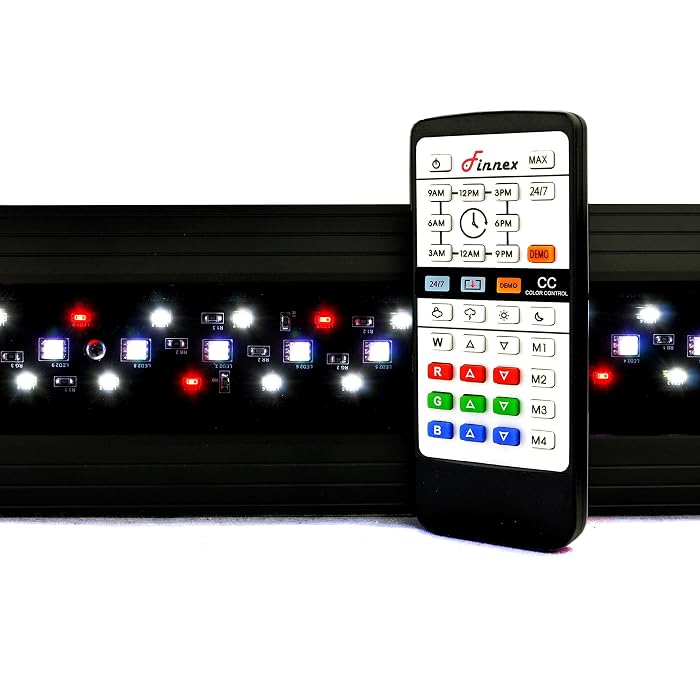
A reliable pick here is Finnex Planted+ 24/7 HLC.
 ★4.5
Finnex Planted+ 24/7 HLC LED Light
Check Price on Amazon ★4.5Retrofitting: LED Tubes in T5 Fixtures
A middle path exists: LED replacement tubes designed to fit T5 fixtures (bypassing or working with the ballast, depending on type). In theory you keep the fixture and gain LED efficiency with no tube-replacement treadmill. In practice, the results are mixed: output and spectrum vary wildly by brand, ballast compatibility is fiddly (ballast-bypass rewiring involves mains voltage — know what you're doing), and a retrofit rarely matches a purpose-built LED fixture's optics or dimming. It can make sense as a cheap life-extension for a fixture you already own and like, but buying a T5 fixture in order to retrofit it is false economy — just buy the LED fixture.
Frequently Asked Questions
Do plants grow better under T5 or LED?
At equal PAR and appropriate spectrum, plants can't tell the difference — photosynthesis doesn't care about the technology. Growth differences people report come from intensity, spectrum tuning, and control differences between specific fixtures, not from T5-vs-LED as categories. A well-chosen LED and a well-maintained T5 grow equally well; the LED just does it cheaper and with dimming.
How often do T5 tubes really need replacing?
Every 9–12 months for planted tanks. Tubes continue emitting visible light long after their PAR output and spectrum have degraded — "still bright" is not "still good." Mark the installation date on the fixture. If plant growth mysteriously declines in a T5 tank around the year mark, suspect the tubes before anything else.
Can I dim T5 lights?
Standard T5 HO fixtures: no — they're on/off. Dimmable T5 ballasts exist but are rare, expensive, and finicky in aquarium fixtures. In practice, T5 intensity control means tube count (run 2 of 4), fixture height, or photoperiod length. This lack of dimming is the technology's biggest practical disadvantage.
Are LED lights really cheaper long-term?
Yes — the math above shows roughly half the 5-year cost for a mid-range LED vs T5, driven by tube replacements and electricity. The gap widens for larger tanks (more tubes) and high electricity prices. T5 only wins on day-one price, and only on the used market.
What should I do with my old T5 fixture when I upgrade?
Sell it to a hobbyist who wants it (disclose the tube situation honestly), keep it as a quarantine/hospital tank light (low-stakes use where tube cost matters less), or repurpose for a terrarium/houseplant shelf. Don't landfill working equipment — and don't hoard it "just in case" for five years either.
Is there any new fluorescent technology worth considering?
No — fluorescent is a sunset technology across all industries, driven by efficiency regulations phasing it out globally. No meaningful R&D goes into aquarium fluorescents anymore. LED is the present and the foreseeable future; the only question is which LED.
The Verdict for 2026
T5 was a great technology that served the hobby brilliantly — and LED is better in nearly every way that matters now: control, running cost, heat, form factor, and future availability. Run your existing T5 fixture with pride and fresh tubes until the supply chain or the ballast says otherwise; but when you buy, buy LED. The king is dead; long live the king.