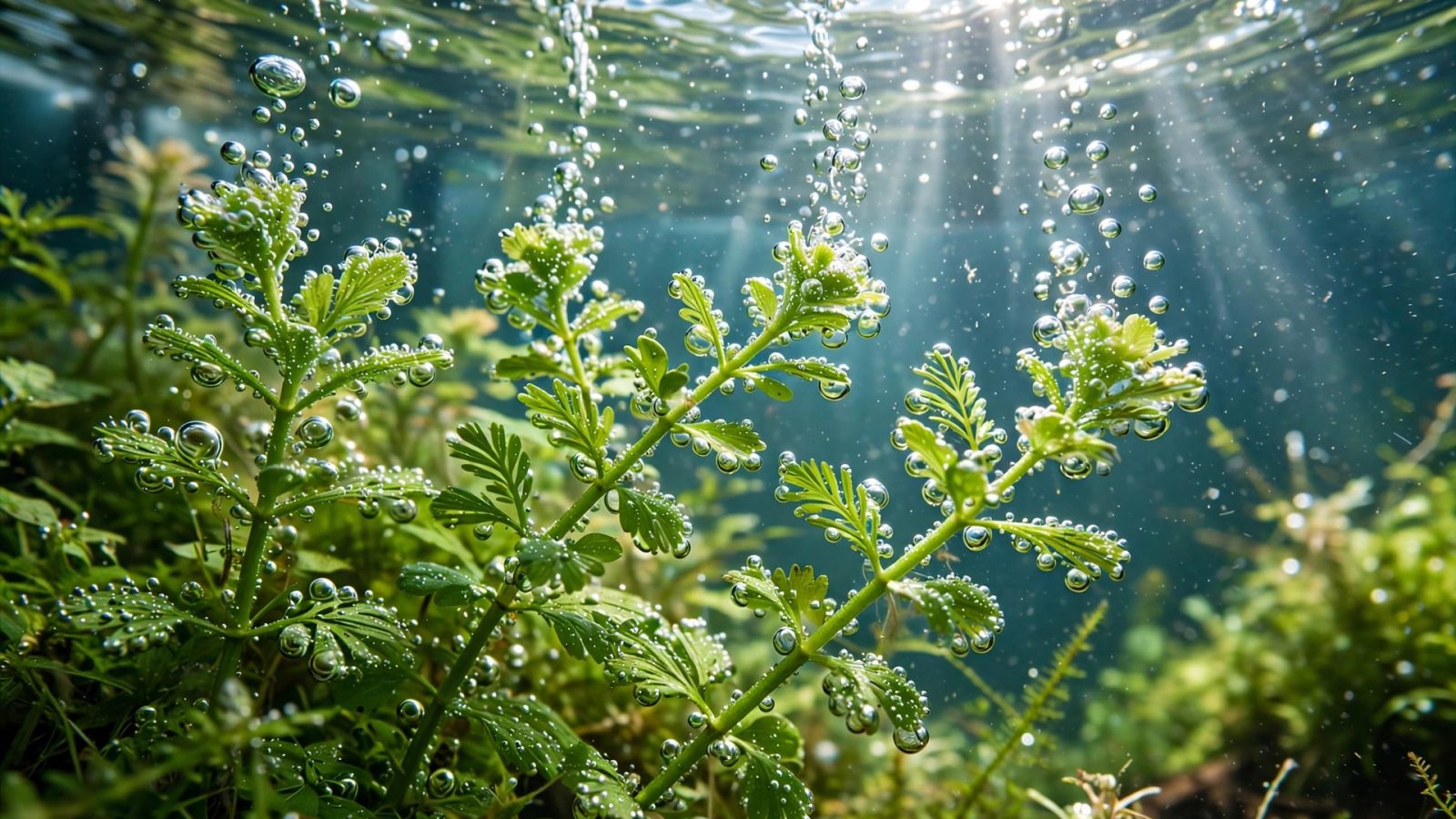
Tiny silver bubbles streaming from your plants’ leaves — aquarists call it “pearling,” and it’s one of the most photographed phenomena in the hobby. It looks like joy. But what does pearling actually tell you about your tank? The answer is more nuanced than “happy plants” — and understanding the science helps you read your tank more accurately.
What Pearling Is
Pearling is visible oxygen. During photosynthesis, plants split water and release O2. Normally that oxygen dissolves invisibly into the water. Pearling happens when oxygen is produced faster than it can dissolve — the water is already saturated with O2, so the excess forms visible bubbles on leaf surfaces.
Two distinct phenomena get called “pearling”:
- True pearling: bubbles form directly on leaf surfaces during the photoperiod, growing and occasionally detaching. Indicates the water is oxygen-saturated from active photosynthesis.
- Streaming: fine bubble streams rising from leaf edges or damaged tissue. Often just trapped gases escaping from cut stems after trimming, or air released from plant tissues — not photosynthesis at all. Freshly trimmed stems “pearl” dramatically for an hour; that’s mechanical, not metabolic.
The Science: Why Saturation Matters
Water holds limited dissolved oxygen (~8 ppm at typical tropical temperatures). When photosynthesis drives O2 above 100% saturation, bubbles nucleate on surfaces — preferentially on leaves, which are both the O2 source and convenient nucleation sites.
Key insight: pearling measures the rate of oxygen production relative to dissolution, not plant “happiness.” A tank pearls when photosynthesis is vigorous and the water can’t absorb more oxygen. Both conditions are needed — which is why pearling correlates with, but doesn’t guarantee, plant health.
What Pearling Tells You (and Doesn’t)
It does indicate:
- Active photosynthesis: the plant is photosynthesizing faster than baseline. In a CO2-injected tank with good light, midday pearling is the expected sign of a system running well.
- Adequate light and carbon: you don’t get vigorous photosynthesis without both. Pearling confirms the light–CO2 balance is in a productive zone.
- Oxygen-saturated water: great for fish and beneficial bacteria. Heavily pearling tanks are well-oxygenated by definition.
It does NOT indicate:
- Nutrient sufficiency: plants can pearl while developing deficiencies — photosynthesis continues until a missing nutrient actually limits it. Pearling with pinholes in leaves (potassium deficiency) is common.
- Long-term health: a plant can pearl vigorously while slowly starving of iron or micronutrients. Pearling is a snapshot of today’s photosynthesis, not a health certificate.
- That your parameters are ideal: algae-covered plants can pearl too. Judge the whole tank, not the bubbles.
Why Some Healthy Tanks Never Pearl
No pearling doesn’t mean problems. Common reasons healthy tanks stay bubble-free:
- Surface agitation: strong surface movement from filters or powerheads continuously off-gasses oxygen, preventing saturation. The plants photosynthesize just as vigorously — you just can’t see it. This is the most common reason.
- Low-tech setups: low-tech tanks photosynthesize more slowly; oxygen dissolves as fast as it’s produced. Perfectly normal.
- Cool water: cold water holds more dissolved oxygen, so saturation (and visible pearling) requires even more vigorous photosynthesis.
- Large water volume: big tanks dilute oxygen faster than small ones saturate.
Don’t chase pearling as a goal. It’s a side effect of vigorous photosynthesis under saturating conditions — nice to see, meaningless to pursue. A non-pearling tank with compact growth and clean leaves is healthier than a pearling tank with deficiencies and algae.
Pearling vs. “False Pearling”
Not all bubbles are photosynthesis:
- After water changes: fresh tap water is often supersaturated with gases (pressure changes in pipes). Micro-bubbles coat everything for hours — pretty, meaningless.
- After trimming: cut stems release trapped internal gases. Streams from cut ends, not leaf surfaces.
- Substrate disturbance: bubbles from the substrate are usually CO2 or nitrogen from bacterial activity, not plant oxygen.
- Newly submerged plants: air trapped in leaf structures releases over the first days.
True pearling forms on intact leaf surfaces during the photoperiod, builds gradually after lights-on, and repeats daily. Everything else is mechanical.
How to Encourage Pearling (If You Want the Show)
- Ensure CO2 is at target (25–35 ppm) — carbon is usually the limiter.
- Verify light is adequate for your species — medium-high PAR.
- Reduce surface agitation slightly during the photoperiod (keep enough for gas exchange — don’t suffocate the tank chasing bubbles).
- Dose complete fertilizer — photosynthesis needs all inputs, not just light and carbon.
- Wait until mid-photoperiod — pearling typically starts 2–4 hours after lights-on as oxygen builds.
The Bottom Line
Pearling is photosynthesis made visible — a sign of vigorous growth under saturating conditions, not a report card. Enjoy it when it happens, don’t worry when it doesn’t, and never use it as your only diagnostic. The plants’ growth form, color, and new leaves tell you far more about tank health than bubbles ever will.
Pearling Through the Day: The Timeline
In a CO2-injected tank with good light, pearling follows a daily rhythm:
- Lights-on to +1 hour: minimal. Plants are waking up; oxygen dissolves as produced.
- +2 to +4 hours: pearling begins on fast growers (stem plants, carpets). The classic photo window.
- +4 to +7 hours: peak pearling across the tank if conditions are strong. Streams rise steadily.
- Last hour: often continues — oxygen stays saturated even as photosynthesis winds down.
- Lights-off: stops within the hour. Overnight, plants consume oxygen (respiration), and levels fall.
If your tank pearls within 30 minutes of lights-on, conditions are very strong (or surface agitation is very low). If it never pearls despite CO2 and good light, check surface agitation first — it’s the usual explanation.
Photographing Pearling
Those stunning bubble-stream photos aren’t luck:
- Shoot 3–5 hours into the photoperiod, at peak pearling.
- Turn off filter outflow temporarily (30 seconds) so streams rise straight.
- Side lighting or a dark background makes bubbles pop; overhead tank light alone washes them out.
- Macro mode or a clip-on phone macro lens captures individual bubbles on leaves.
- Clean the glass first — every speck shows in macro.
Pearling and Algae: The Complicated Relationship
Here’s the nuance most guides skip: heavily pearling tanks can still grow algae, because pearling confirms photosynthetic rate, not system balance. Algae pearls too — BBA tufts and hair algae stream oxygen under strong light. If your plants pearl but algae thrives, the light energy exceeds what your plants can use given their nutrient and CO2 constraints. The answer is still balance (see too-much-light signs), not more pearling.
Conversely, the absence of pearling in an algae-free, steadily growing tank means nothing is wrong. Judge by growth and cleanliness, not bubbles.
Related Phenomena Worth Knowing
- Morning “breathing”: some plants release a burst of bubbles at lights-on — trapped overnight respiration gases, not photosynthesis. Fades within minutes.
- Hot-day pearling in low-tech tanks: warm water holds less oxygen, so saturation (and visible pearling) happens at lower photosynthetic rates. Summer pearling in a low-tech tank is physics, not a growth surge.
- Post-water-change fizzing: dissolved gases in fresh tap water coat every surface. Enjoy the sparkle; it’s not plant activity.
Pearling in Low-Tech vs High-Tech Tanks
The pearling experience differs fundamentally by setup:
- High-tech (CO2 injected): regular midday pearling on fast growers is normal and expected. If a previously pearling high-tech tank suddenly stops, something changed — CO2 interruption, light decline, or nutrient exhaustion. It’s a useful early-warning system for changes, not an absolute health metric.
- Low-tech: occasional pearling on sunny afternoons or after water changes is a pleasant surprise, not an expectation. Most healthy low-tech tanks rarely pearl visibly — oxygen dissolves as fast as it’s produced at their photosynthetic rates. Our no-CO2 guide sets the right expectations.
- Walstad/dirted tanks: soil decomposition consumes oxygen while plants produce it — these tanks often pearl less than their plant growth would suggest. Don’t judge them by bubbles.
Can Pearling Harm Fish?
Supersaturated oxygen (gas bubble disease) is theoretically possible but extraordinarily rare in aquariums — it requires sustained extreme supersaturation (>120%+) that planted tanks essentially never reach. The far greater risk is the inverse: heavily planted tanks consume oxygen at night, and pre-dawn oxygen dips stress fish more than midday supersaturation ever could. If fish gasp at dawn in a densely planted tank, increase surface agitation overnight — that’s the real gas-exchange concern, not pearling.
Pearling Myths
- “Only healthy plants pearl”: dying plants with intact chlorophyll pearl too. Algae pearls. Bubbles aren’t a health certificate.
- “More pearling = better tank”: beyond confirming active photosynthesis, intensity of pearling tells you little. A moderately pearling balanced tank beats a violently pearling imbalanced one.
- “Pearling means I can skip water changes”: oxygen saturation says nothing about nitrate, phosphate, or dissolved organics. Maintain the routine.
- “Fertilizer X makes plants pearl”: no additive directly causes pearling — they enable the photosynthesis that does. Marketing that promises “instant pearling” sells the side effect, not the cause.
Oxygen and Night: The Other Half of the Story
Pearling celebrates daytime oxygen production, but nighttime is when gas exchange matters most. After lights-out, every plant switches from photosynthesis to respiration — consuming oxygen. In densely planted tanks, pre-dawn oxygen can dip low enough to stress fish.
- The pre-dawn check: if fish gasp at 6am but are fine by 9am, overnight oxygen depletion is the cause — not disease.
- The solution: run an air stone or increase surface agitation on a timer overnight (opposite the light schedule). This is standard practice in heavily planted high-tech tanks.
- Why it matters for pearling fans: the same still-water conditions that maximize visible pearling (low surface agitation) maximize overnight oxygen risk. Balance the show against the night shift — your fish live through both.
A tank that pearls beautifully by day and runs an air stone by night is the complete picture: vigorous photosynthesis when the lights are on, safe respiration when they’re off.