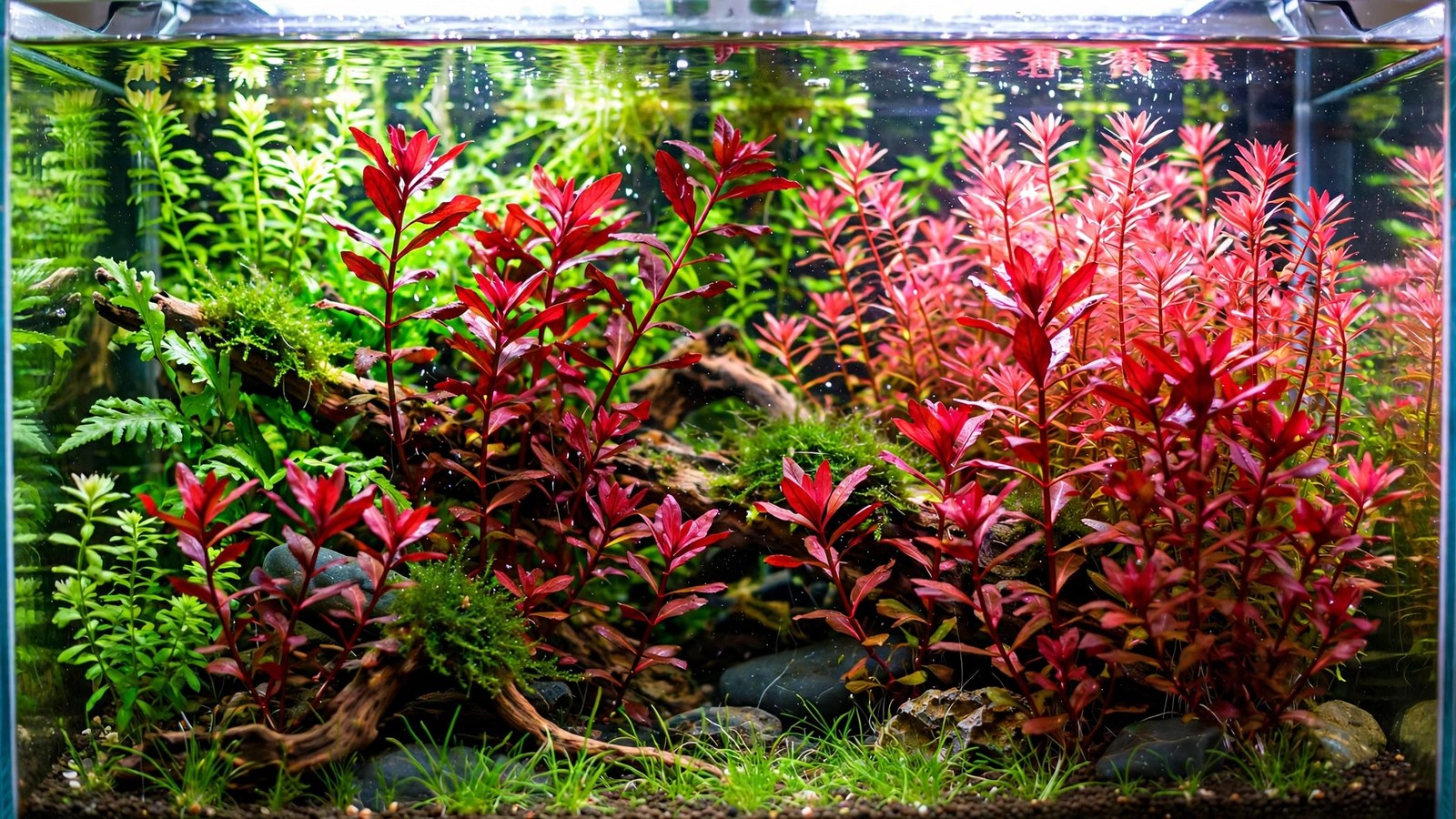
The best light for red aquarium plants isn't the brightest fixture you can afford — it's the one delivering the right spectrum at the right intensity where the plants actually sit. Ask any experienced scaper about the most expensive mistake in the hobby: it's buying a high-wattage white LED, cranking it to 100%, and watching a crimson Rotala macrandra fade to dull green within weeks. In this guide you'll learn exactly which spectrum settings, PAR targets, and RGB/W-RGB fixtures produce the deepest reds — and how to ramp up without turning your tank into an algae farm.
Why Red Plants Arrive Crimson and Leave Green
Nearly every hobbyist has lived the same disappointment. You unbox a bag of Rotala 'Blood Red' or Ludwigia sp. 'Super Red' shipped from a farm, drop it in your tank under the kit LED, and within three weeks the top leaves flush green. Nothing about your water changed. The plant didn't mutate — your light simply stopped telling it to be red.
Red pigmentation in aquarium plants comes mostly from anthocyanins, compounds the plant manufactures as a photoprotective response to intense light. At commercial farms, plants grow in shallow outdoor ponds or greenhouses blasted with full sun. Your 20-watt clip-on delivers a fraction of that. When light stress drops, the plant stops investing energy in sunscreen and reallocates it to chlorophyll. Green is the default; red is earned. To earn it in a glass box — where the same light also feeds algae — fixture choice and settings matter more than for anything else in the tank. This guide starts with the science and ends with concrete channel settings you can punch in tonight.
What Actually Makes Plants Red: Spectrum Science in Plain English
- Blue light (450–470 nm) is the main trigger for anthocyanin production — tanks with strong blue color up faster, while warm-white-only fixtures leave reds washed out.
- Red light (630–660 nm) is photosynthetically efficient and makes existing reds look deeper by reflecting more red back to your eyes. But red-only light grows lanky, weak plants — it must ride on a full spectrum.
- Green/white balance keeps growth compact with tight internodes. A plant getting 100% red and 20% everything else stretches and pales — the opposite of what you want.
The winning formula is a full-spectrum base with boosted red and healthy blue — exactly what tunable WRGB fixtures are built for. If you want the full breakdown of how aquarium light spectrum works, or the deeper theory in our RGB lighting guide for planted tanks, both cover how color-mixing affects growth, not just appearance.
PAR Targets for Popular Red Aquarium Plants
PAR (photosynthetically active radiation), measured in µmol/m²/s, is the only honest way to compare light levels between fixtures — wattage is useless across brands. Use these substrate-level targets when choosing and positioning your fixture; see how much light aquarium plants need and how to measure PAR for the full method.
| Plant | PAR at substrate | Difficulty | Notes |
|---|---|---|---|
| Rotala rotundifolia (reddish form) | 60–90 | Easy | The gateway red — colors up under moderate light |
| Ludwigia repens 'Super Red' | 70–110 | Easy | Deep crimson top leaves; tolerates no-CO2 setups poorly |
| Alternanthera reineckii | 80–120 | Medium | Needs the red channel high; pink under weak light |
| Rotala macrandra | 90–130 | Hard | Demands high PAR + CO2 + soft water to stay red |
| Ammannia gracilis | 90–120 | Hard | Gold-red under intense light; melts in unstable CO2 |
| Rotala 'Blood Red' | 90–130 | Medium | Holds color even under moderate light once established |
| Proserpinaca palustris | 60–100 | Medium | Orange-red serrated leaves; underrated easy red |
Notice the pattern: every true showpiece red wants high light plus injected CO2. The low end of the table can succeed without CO2, but colors never match a pressurized setup. If you're deciding which path fits your tank, low light + no CO2 vs high light + CO2 lays out the trade-offs honestly.
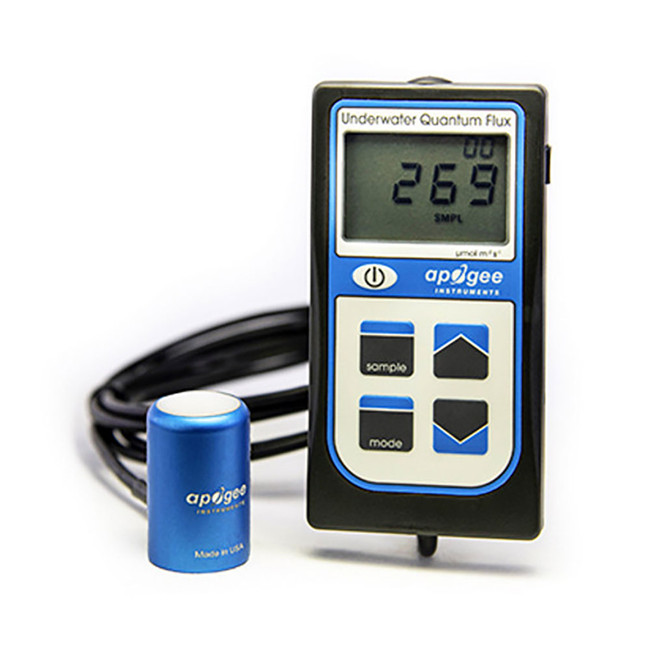 ★4.4
Apogee MQ-510 Underwater PAR Meter
Check Price on Amazon ★4.4RGB vs WRGB vs Full-Spectrum White: Which Fixture Wins for Reds?
Three fixture architectures dominate planted tanks in 2026, and they differ exactly where reds care:
- Fixed full-spectrum white LED (budget fixtures): grows plants fine, but you can't push the red channel independently — reds look flat and stay pinkish.
- RGB fixture (e.g., ADA Solar RGB style): reds render spectacularly, but the narrower spectrum needs careful CO2 and fertilization to keep growth compact.
- WRGB fixture (white + RGB channels): the sweet spot. The white channel carries efficient full-spectrum growth; independent RGB sliders let you crank red to taste. Most top scapers use WRGB.
Here's how the leading tunable fixtures compare for red-plant duty:
| Fixture | Type | Control | Best for |
|---|---|---|---|
| Chihiros WRGB II Pro | WRGB | App, per-channel | The red-plant benchmark; excellent red channel output |
| Twinstar S series | RGB-forward | Inline dimmer / app | Gorgeous red rendering; slightly narrower spectrum |
| ONF Flat One+ | WRGB | App presets | Premium build; strong reds, refined presets |
| Fluval Plant 3.0 | Full-spectrum | App, per-channel | Great value tunability; "Pink" preset flatters reds |
| Week Aqua A-series | WRGB | App | Budget WRGB with real channel control |
| Hygger full-spectrum | White + RGB accents | Remote | Cheapest entry; enough for easy reds |
Whatever you pick, the rule is the same: independent red-channel control is non-negotiable for a dedicated red tank — see our best aquarium lights for planted tanks roundup for full PAR-per-dollar rankings.
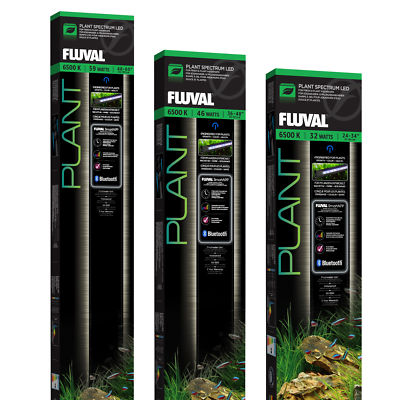 ★4.3
Fluval Plant 3.0 LED Aquarium Light
Check Price on Amazon ★4.3Dialing In Your Settings: Channel Percentages That Actually Work
Owning a tunable fixture and tuning it correctly are different skills. These profiles are where I start people — then we measure and adjust.
A starting WRGB profile (Chihiros / Week Aqua style)
- White: 100% — carries the growth spectrum
- Red: 90–100% — deepens red rendering and fuels photosynthesis
- Blue: 70–90% — triggers anthocyanin (the actual redness)
- Green: 55–75% — keeps the look natural and growth compact
Fluval Plant 3.0 equivalent
Pink: 100% / Warm white: 90% / Cool white: 70% / Blue: 75% — Fluval's "Pink" preset is essentially a red-forward version of the profile above and is a proven starting point for Ludwigia and Alternanthera. On RGB-forward fixtures like Twinstar, run the dedicated red mode at 80–90% of max rather than full blast — these are extremely red-dense and full power at close hanging height can bleach leaf tips.
Two rules govern every profile. First, ramp the photoperiod and intensity together — run your aquarium light schedule at 6 hours for the first week, then add 30 minutes every 3–4 days until you hit 7–8 hours. Second, intensity is position-dependent: raising the fixture 4 inches drops PAR at the substrate by 20–30%, a free dimmer. Our guide to raising light intensity without algae covers the full week-by-week method.
CO2 and Nitrate: The Other Half of the Red Equation
Here's the part most light-buying guides skip: light can only make plants red if they're growing fast enough to build pigment. That growth engine runs on CO2 and nutrients, and reds are picky about both.
- CO2 at 25–35 ppm is the biggest multiplier for red coloration. Plants under high light without CO2 hit a carbon bottleneck — growth tips melt and algae colonizes the weakened tissue. Read the complete CO2 guide for planted tanks before raising your light. Start at the low end of any CO2 range, raise it gradually over days, and watch your livestock — if fish gasp at the surface or hang near the outflow, back the CO2 off before touching anything else.
- Nitrates at 5–15 ppm (slightly lean) deepen reds in many species — it's part of the same stress-coloration response. Don't starve the tank: zero nitrates causes stunting and BBA. Dose lean, not absent.
- Iron gets the credit but rarely deserves it. Iron deficiency pales new growth, but extra iron does not turn green plants red. Keep iron at normal dosing levels and spend your attention on light and CO2.
Your 2-Week Plan to Deepen Reds
Put it all together with this schedule (assumes a tunable WRGB fixture and pressurized CO2 installed):
- Days 1–2: Set the channel profile above at 60–70% overall intensity, 6-hour photoperiod. Confirm CO2 hits 25–30 ppm one hour before lights-on with a drop checker. Trim algae-covered leaves so you're judging new growth, not old damage.
- Days 3–7: Watch new growth tips. Rotala and Ludwigia show color in new leaves within 5–7 days under adequate light — old leaves rarely change, so ignore them.
- Days 8–10: If no algae and growth looks healthy, raise intensity to 80% and extend the photoperiod to 7 hours. Drop nitrates to 5–10 ppm by trimming your nitrate fertilizer dose by a third.
- Days 11–14: Push to your full target profile and 8 hours. Easy reds should be visibly deeper by day 14; demanding species like macrandra need another 2–3 weeks at target settings.
If algae appears at any stage, hold intensity where it is for a week rather than pushing through — algae means the light-to-CO2 balance is off. Identifying what's growing helps: an aquarium algae identification chart matches the algae type to the imbalance behind it.
Using Reds as the Focal Point of Your Scape
Red plants are nature's exclamation marks — a little goes a long way. A single dense group of Alternanthera or Rotala 'Blood Red' at a rule-of-thirds intersection draws the eye more powerfully than reds scattered across the whole tank. Dense grouping has a practical payoff too: trim and replant tops regularly — colored new growth stays on display while leggy bottoms get recycled.
Frequently Asked Questions
Can red aquarium plants stay red in low light?
Mostly no — and this is the honest answer that saves you money. Easy reds like Ludwigia repens keep a pinkish blush under 50–60 PAR, but the deep crimson of contest tanks requires 80+ PAR at the substrate plus CO2. Under truly low light, red species revert to green and stretch. If you run low light but love reds, try Cryptocoryne wendtii 'Red' or red tiger lotus, which hold color at 30–50 PAR.
Do I need CO2 injection for red plants?
For the showpiece species — Rotala macrandra, Ammannia gracilis, Alternanthera reineckii — yes, pressurized CO2 is effectively required for full coloration. Forgiving species like Ludwigia 'Super Red' and Rotala rotundifolia color up reasonably in high-light tanks with liquid carbon, but never match injected-CO2 reds. Raise light without adding CO2 and you'll get algae instead of color.
Will pushing the red channel burn my plants?
The red channel itself doesn't "burn" plants — damage comes from total intensity (PAR), not color. A 100% red channel on a dim fixture is harmless; 100% on everything hanging 6 inches above the water can bleach leaf tips and trigger algae. Early warnings: translucent leaf tips, algae on the uppermost leaves first, and plants closing up hours before lights-out.
Why are only the new leaves on my red plants red?
That's normal and a good sign. Anthocyanin production ramps up in actively growing tissue, so fresh tips color first while older leaves — grown under previous conditions — stay green. It takes 2–4 weeks of consistent target settings for a full stem to turn. This is why trimming matters: cutting and replanting the red tops builds a dense crimson bush instead of a green stem with a red hat.
Do RGB and WRGB lights cause more algae than white LEDs?
No — algae responds to total light energy and nutrient imbalance, not fixture color technology. A WRGB fixture at 100 PAR grows exactly as much algae as a white LED at 100 PAR in the same tank. The real risk is psychological: owners crank every channel to maximum because they can. Run measured targets with proper CO2 and fertilization, and algae is no worse than under any other quality light.
Is a PAR meter really necessary, or can I just eyeball it?
You can get surprisingly far by eyeballing — plant response (color, compactness, pearling) is the ultimate meter. But a PAR meter removes the two costliest guesses: buying a fixture too weak for your tank depth, and running a strong one at algae-growing levels while wondering why.
The Best Light for Red Aquarium Plants: Your Action Plan
The best light for red aquarium plants comes down to three decisions: a tunable WRGB fixture with independent red-channel control, 80–120 PAR at the substrate verified with a meter rather than guessed, and the discipline to ramp up over weeks while CO2 and nitrates stay in their lanes. Get those right and Rotala, Ludwigia, and Alternanthera reward you with crimson that stops visitors mid-sentence. Start with the channel profile above, watch your new growth tips for two weeks, and adjust from data — not hope. For deeper reading, the 2hraquarist lighting guides and Tropica's plant database both offer species-specific light requirements worth cross-checking against your own measurements.
Related: our red stem plant color guide covers the varieties and the color formula behind them.