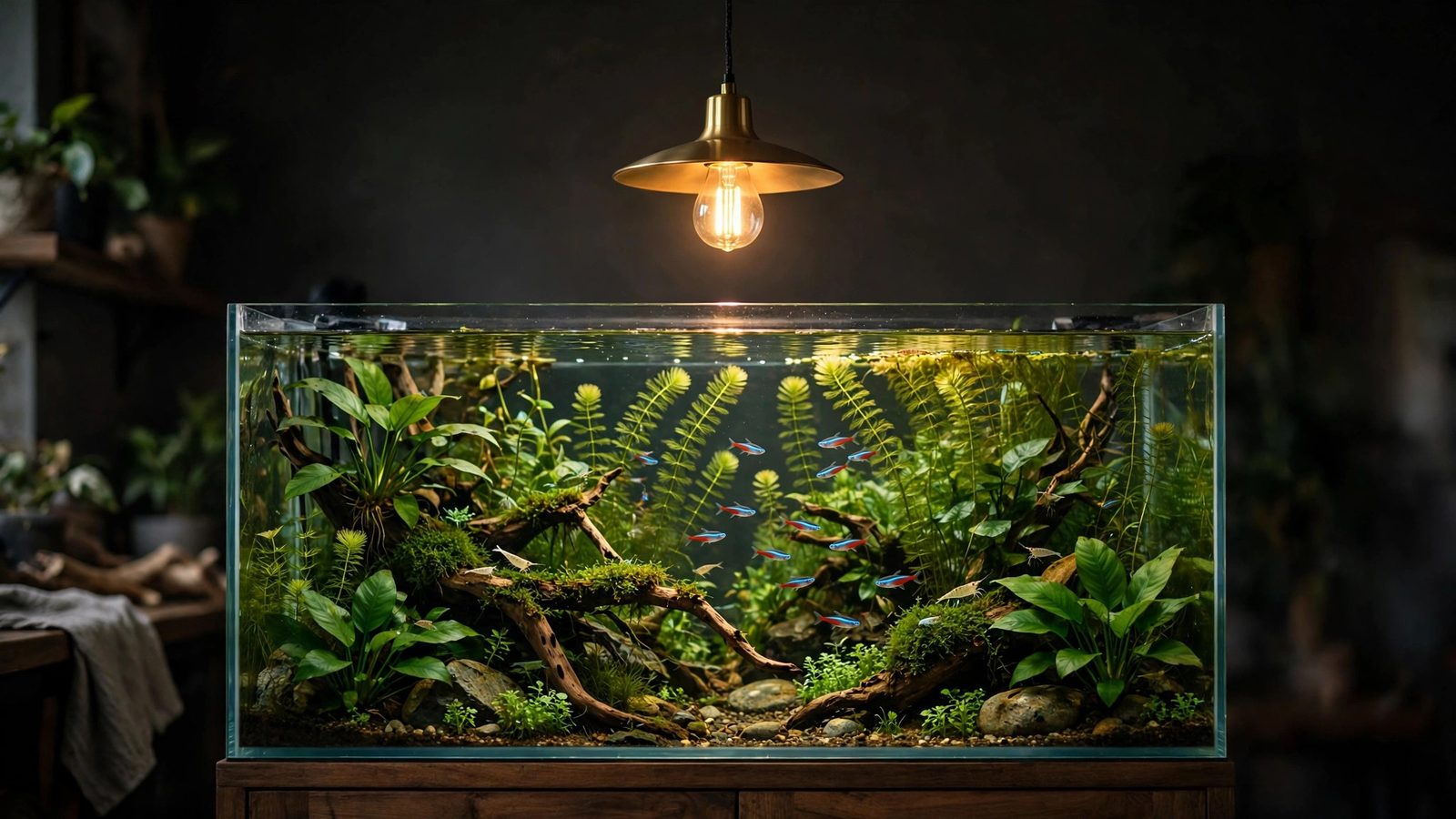
A rim-mounted bar fights you for access — every trim starts with lifting it away. Finding the best hanging light for planted tank use removes that fight: the fixture floats above an open top, you work underneath it, and the tank looks like furniture. Pendants differ sharply in beam width, control, and mounting, so choose by footprint first.
For most planted tanks, choose a wide-spread pendant panel for a single 60 cm tank, or one narrow-beam pendant per 45–60 cm of length on longer tanks. Prioritise dimming and proven PAR at your tank's depth: carpet plants generally need 50–100+ µmol/m²/s at the substrate, while most stems thrive at 30–50.
Best hanging light for planted tank setups, by footprint
Start with shape, not brand. A cube or 60 cm (24 in) tank suits a single pendant: light radiates from one point and tall hardscape gets dramatic side-lighting. A single narrow pendant over a 90 or 120 cm tank leaves dim ends, so plan on two or three units spaced evenly, or a wide panel pendant.
If you are still weighing pendants against bars and clip-ons, compare this shortlist with the best aquarium lighting for planted tanks overall first. Then return here once you have committed to hanging — the criteria below are pendant-specific.
PAR at depth and spread: the two numbers that matter
Judge every pendant by PAR at your substrate depth and how evenly it spreads. A focused optic concentrates its output into a narrower cone, so more of its PAR survives the trip to the substrate — suiting deep tanks and demanding carpets, provided the manufacturer's PAR map confirms it at your depth. The same focus over a shallow 30 cm tank creates a bright centre and dim corners.
For target ranges by plant type, use how much light aquarium plants actually need as your reference, and check manufacturer PAR maps against your real depth — not the headline figure measured in air. Our PAR rating guide for aquarium lights explains how to read those maps without being misled by one centre reading.
| Pendant class | Coverage | Strengths | Watch out for | Best for |
|---|---|---|---|---|
| Narrow-beam — Kessil A160 / A360 Tuna Sun class | 45–60 cm square per unit | Strong PAR at depth, natural shimmer | Hot centre, dim corners on wide tanks | Cubes, deep tanks |
| Wide panel — ONF Flat One pendant and ADA Solar RGB class | 60–90 cm per unit | Even spread, honest colour rendering | More light spill beside the tank | 60 cm aquascapes, carpets |
| Designer lines — Chihiros and Twinstar pendant class | 60 cm per unit, linkable in rows | Slim profiles, app control on many models | Features vary by model — check dimming | Long tanks, two or more units |
Spectrum, dimming, and control
Look for a spectrum built for plants, not just brightness: strong red and blue with enough green and white for honest colour rendering, so red stems look red rather than brown. Models in the Kessil Tuna Sun class let you tune colour and intensity separately, balancing growth against how the scape looks to you. Check the manufacturer's own specifications at Kessil Lighting before relying on retailer summaries.
Dimming is not a luxury on a pendant. Hung in open air with nothing diffusing it, full power is often too much for a new layout. You want smooth dimming, a timer or app schedule, and ideally a gentle ramp at lights-on and lights-off. High-tech layouts benefit most from that finer control, as covered in our guide to LED lights for high-tech planted tanks.
Mounting: wire, bracket, or gooseneck
Wire suspension from the ceiling or a wall-mounted arm gives the classic floating look and makes raising or lowering simple. Confirm the fixing can take the load and that cables hang vertically — angled wires pull pendants off-centre. Wall brackets and tank-side stands avoid ceiling drilling and suit renters, but check reach: the arm must place the light over the tank's centre, not its back edge.
Goosenecks work well for small pendants on nano tanks, flexing into position without drilling. On larger fixtures they sag, vibrate, and limit how high you can lift the light for maintenance. Whatever you choose, leave clearance for nets, scissors, and your forearm.
For the actual distances, do not guess: follow our dedicated hanging light height guide, which covers height, intensity, and evenness together. Height and dimming do the same job in different ways, and that guide shows how to use both.
Light spill and open-top living
Without a lid, more light escapes sideways, evaporation rises, and jump-prone fish are a genuine risk. Narrow-beam pendants spill least; wide panels light the room more. Sit in your usual viewing chair at night before finalising the setup — if the bare fixture is in your eyeline, raise it or choose a model with a shade accessory.
Maintenance becomes simple: no lid to remove, full access for trimming and water changes, and better surface gas exchange. For most aquascapers that outweighs topping up evaporated water once or twice a week.
Frequently Asked Questions
How many pendant lights do I need for a 120 cm planted tank?
Plan on two to three narrow-beam pendants, spaced evenly so each covers roughly 45–60 cm of length, or consider wide panel pendants with overlapping spread. A single central pendant will leave both ends noticeably dim, and carpets planted there usually stall, grow leggy, or get outcompeted by algae while the centre thrives.
Can a hanging pendant grow carpet plants?
Yes, provided it delivers enough PAR at the substrate — generally 50–100+ µmol/m²/s for demanding carpets — and spreads it evenly across the foreground. Focused pendants suit deep tanks, while wide panels suit shallow ones. Inject CO2, keep the photoperiod consistent, and dim the fixture up gradually rather than starting a new carpet at full intensity.
Is a gooseneck as good as hanging wires?
For a small pendant on a nano tank, a gooseneck is practical, adjustable, and avoids drilling. For larger or heavier fixtures, wires or a rigid bracket are better: goosenecks can sag over time, limit maximum height, and make it harder to lift the light clear for maintenance. Match the mount to the fixture's weight and your ceiling.
Do hanging lights cause more algae than bar lights?
Not inherently. Algae follows excess intensity and duration, not fixture shape. Pendants cause trouble when they are hung low and run undimmed, creating an intense centre patch. Use dimming, a sensible photoperiod, and the correct hanging height, and a pendant is no more algae-prone than any bar light delivering the same PAR.
Can I hang a pendant if I rent my home?
Usually, yes. Wall-mounted brackets, tank-side light stands, and goosenecks all avoid ceiling fixings entirely, and many landlords accept two small ceiling hooks that are easy to fill later. Check your agreement first, confirm any bracket reaches the tank's centre, and keep the power cable routed safely away from splashes and drips.
The short version
Choose by footprint first, PAR at depth second, and dimming third. One well-matched fixture over a cube or 60 cm tank, or a spaced row over a long tank, gives you the open-top access and clean look you wanted.