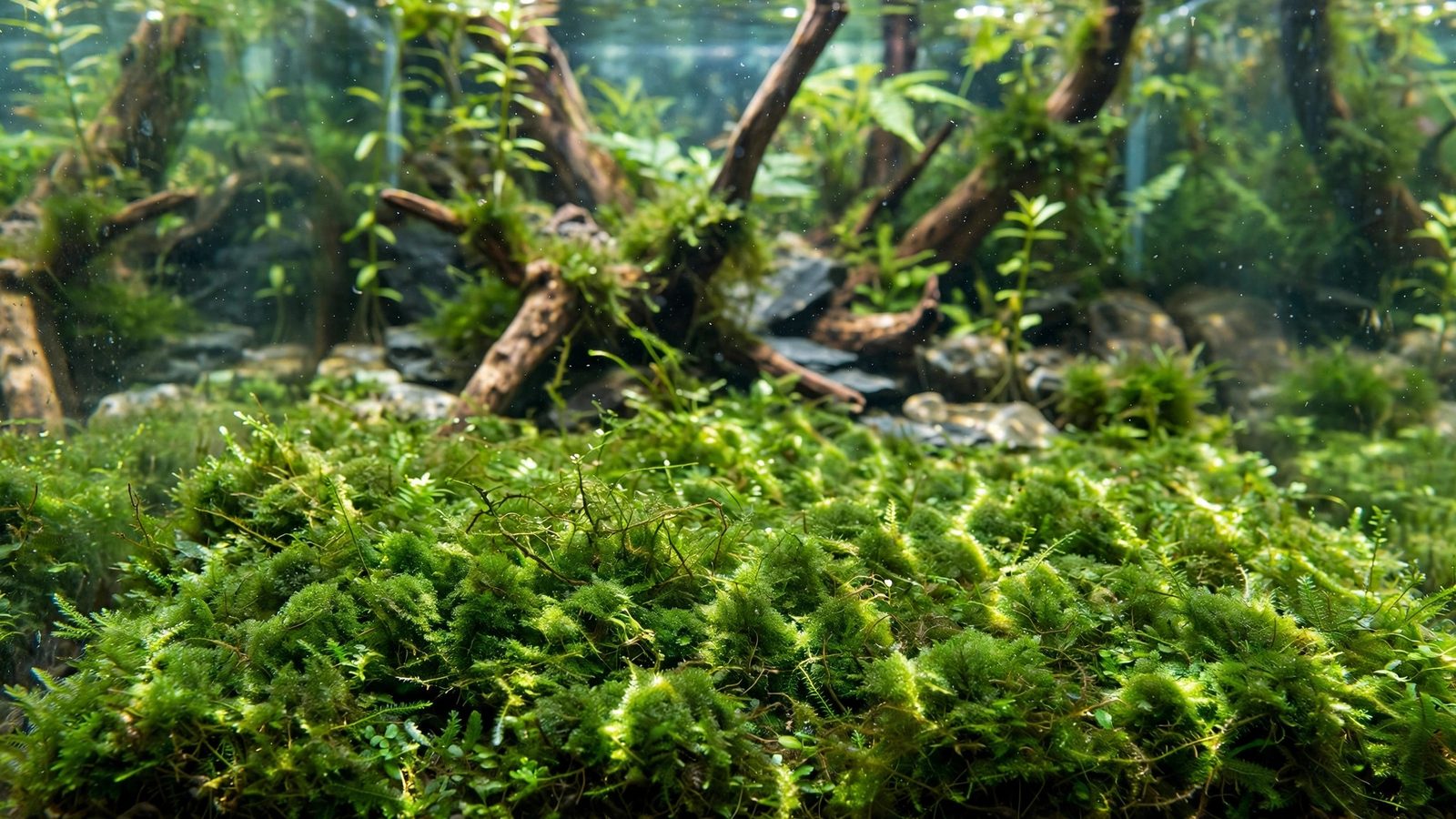
Most carpets fail before they even start — and Java moss fails the hardest. Drop a clump of it in the foreground, and within a week it's drifting around the tank like tumbleweed. But aquascapers who know the trick pin it down and grow carpets so lush that shrimp graze on them for hours. The difference isn't luck; it's the anchoring method. By the end of this guide, you'll know three proven ways to build a java moss carpet that stays exactly where you plant it.
Why Java Moss Wants to Escape (and How to Win)
Java moss (Taxiphyllum barbieri, described in Tropica's plant database) has no true roots — only rhizoids, the tiny hair-like anchors it uses to grip hardscape. On a flat substrate it has almost nothing to hold onto, so its buoyant fronds lift, drift, and tangle. The fix is simple in principle: hold the moss against the bottom until the rhizoids weave into a self-supporting mat, which takes roughly 3–4 weeks. Miss that window and you get a floating mess instead of a carpet.
If you haven't read it yet, our general guide to growing carpeting plants without CO2 covers the lighting and nutrient side of low-tech carpets — this article is the moss-specific method for the anchoring part. Java moss outcompetes many true carpeting plants in low-tech tanks: it survives neglect, shrugs off low light, and costs a fraction of a Monte Carlo mat.
The 3 Methods That Build a Java Moss Carpet That Stays Down
All three methods solve the same problem — keeping moss pressed to the floor for its first month. Pick based on how much area you're covering.
Method 1: The Mesh Sandwich (best for full coverage)
This is the workhorse technique for foreground carpets and the one contest aquascapers reach for most:
Cut two pieces of stainless steel mesh (1 × 2 mm holes) to your foreground shape — plastic craft mesh works too, but steel lasts. Spread the moss in a layer roughly 1–2 cm thick, press it flat, then lay the second mesh on top and secure the edges with fishing line, cotton thread, or small stainless cable ties. (Cotton rots away harmlessly by the time the moss takes over.) Set the sandwich on your substrate and bury the edges slightly. Within 2–3 weeks fronds grow through both screens; by week 4–6 the mesh vanishes under a green mat.
Method 2: Glue Dots (best for patches and edges)
For filling gaps between hardscape or touching up bare spots, the same cyanoacrylate techniques used on driftwood work on the tank floor. Dab gel super glue in pea-sized dots (gel formula, not runny liquid), press a small moss tuft into each, and hold 30 seconds. Space dots 2–3 cm apart — moss spreads to close the gaps. Best for carpet edges and patches, where mesh sandwiches look clumsy.
Method 3: Dry Start (fastest, flattest)
The dry start method gives Java moss an unfair advantage. Lay thin moss fragments directly on damp substrate, mist daily, and cover the tank with cling film to hold humidity. Without water to lift the fronds, moss grips the substrate from day one — flood in 3–4 weeks with nothing floating away. The trade-off: the tank sits livestock-free for a month.
| Method | Best for | Grip speed | Effort |
|---|---|---|---|
| Mesh sandwich | Large foregrounds | 4–6 weeks | Low after setup |
| Glue dots | Patches, edges, touch-ups | Immediate hold | Medium (tedious at scale) |
| Dry start | Whole carpets from scratch | 3–4 weeks | Daily misting |
Keeping It Flat: The Trimming Discipline
Getting moss to stay down is only half the battle — keeping it down is a maintenance contract. Untrimmed moss grows upward into a spongy 3–4 cm mound, traps mulm in its lower layers, and can lift off in one floating slab. Here's the rhythm that prevents that:
- First trim at 6 weeks: Cut the mat back to ~2 cm with curved aquascaping scissors. Proper trimming technique matters — snip, don't yank, or you'll lift the whole mat.
- Monthly from then on: Every 4–6 weeks, trim the top third. Each cut stimulates lateral growth, thickening the carpet instead of tallening it.
- Siphon the cuttings: Trim in front of a siphon or net every loose frond immediately. A single drifting piece will colonize your filter intake, driftwood, and rocks within weeks.
- Thin dense areas: If a patch browns underneath, pull a few tufts so light reaches the base.
Where Java Moss Carpets Shine (and Where They Don't)
A java moss carpet is unbeatable in three scenarios: low-tech tanks with no CO2 injection, shrimp-breeder tanks (baby shrimp graze biofilm off moss all day and hide in the mat), and forest-style layouts wanting a soft, organic floor. Moss carpets also cost almost nothing — one portion spreads across a surprising area.
Where to skip it: high-energy contest layouts that demand a crisp, even lawn. Moss will never match the precision of Monte Carlo or dwarf hairgrass, and it's slower — plan for realistic fill-in timelines before judging the final look. And in tanks with plant-uprooting fish like large cichlids, no moss carpet survives digging. For beginners, though, moss is the most forgiving first carpet — the common aquascaping mistakes that kill delicate carpets barely slow moss down.
Frequently Asked Questions
Can Java moss carpet grow without CO2 or fertilizer?
Yes — this is Java moss's superpower. It grows fine under low light with nothing but fish waste and water changes. A lean all-in-one fertilizer dose (half the bottle recommendation) speeds fill-in and deepens the green. Avoid overdosing: moss carpets collect algae faster than most plants when nutrients spike.
How long does it take for a Java moss carpet to fill in?
Under low light (15–25 PAR), expect a usable mat in 6–8 weeks; under medium light (30–40 PAR), 3–5 weeks. Dry-start tanks often shave a week off because the moss never has to fight buoyancy. Temperature matters too: growth stalls below about 20 °C (68 °F), so keep the tank warm for the first month.
Will a Java moss carpet trap too much waste?
Only if you let it grow thick. Mats kept under 2 cm thick and trimmed monthly shed detritus naturally, and shrimp colonies clean what remains — which is why shrimp tanks are the ideal home for a moss carpet. Thick, untrimmed mounds do collect mulm and can cause localized ammonia spikes, so the trimming schedule is non-negotiable.
Can I grow a Java moss carpet on sand?
Yes, and sand works particularly well because moss grips the fine grains as rhizoids spread. The mesh sandwich method is the most reliable on sand since the mesh distributes weight and stops the mat from shifting. Avoid very coarse gravel — the gaps are too wide for young rhizoids to bridge, and the carpet lifts at the first water change.
Does Java moss carpet need high light?
No — low to medium light is actually the sweet spot. High light makes moss grow leggy and stringy, and invites hair algae to colonize the carpet faster than the moss can fill in. If your light is strong, either dim it over the foreground zone or float some stem plants above to provide dappled shade.
Start Thin, Anchor Well, Trim Often
So: can Java moss be used as a carpet? Absolutely — as long as you treat the anchoring as the real project and the growing as the easy part. Pick your method (mesh sandwich for coverage, glue dots for patches, dry start for the flattest results), plant thinner than feels right, and commit to monthly trims. Do that, and within two months you'll have a lush, shrimp-covered floor at a fraction of the cost of any "proper" carpeting plant — and it survives conditions that would melt the expensive ones.