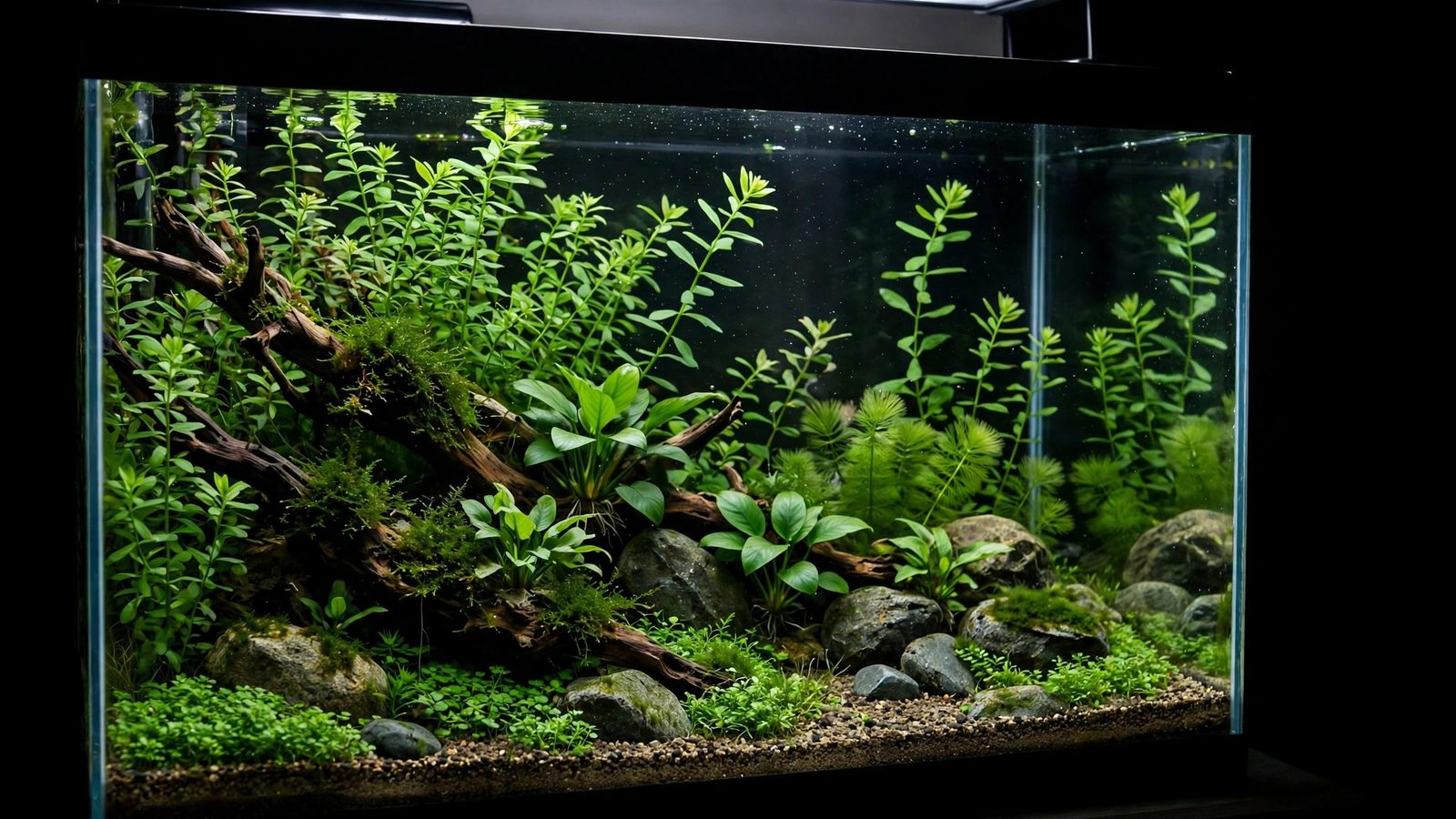
Peek through the front glass of any two showpiece tanks and the first thing you register isn't the plant species or the fish — it's the color behind everything. Choosing the right aquarium background, black or white, quietly reshapes fish coloration, plant contrast, perceived depth, and even how much algae you notice, so the decision deserves more than grabbing whatever film is cheapest. This guide covers how each color changes what you see, which materials hold up, and which suits your tank style.
Which should you choose: aquarium background black or white?
The rear glass is the largest surface in your composition, and it works like a stage backdrop. A black background recedes: your eye reads it as shadow, so plants, hardscape, and fish sit in front of it in crisp relief. Most competition scapes use black because it maximizes the contrast between green foliage and everything else. For a lightly planted aquarium setup, black gives even a sparse layout a finished feel with no extra effort.
A white background does the opposite. It reflects light back through the water, brightening low corners and giving the scene an open, modern feel. The trade-off: white hides nothing. Filters, heaters, tubing, and every speck of algae become visible, so it demands real discipline about maintenance.
Fish Coloration: Who Looks Better on What
Dark-bodied fish — cardinals, neons, deep-blue bettas — appear richer against black because the backdrop absorbs stray light and lets their colors carry the image. Against white, those same fish can look washed out, their outlines dissolving into the brightness.
Bright, metallic fish flip the equation: silver dollars and white-cloud minnows glow against white, where their light-catching scales contrast with the bright plane. There's also a behavioral wrinkle: shy fish feel more secure against black, which reads as depth and cover, while white can make skittish species hug the front glass. When planning a low-tech planted tank setup around a centerpiece fish, the background is part of the fish's comfort.
Depth, Light, and the Room Around the Tank
Black earns its reputation here: the rear wall disappears into shadow, so a 12-inch-deep nano tank reads far deeper than it is — plants fade into darkness rather than ending at an obvious wall. This is why negative space aquascaping works on black: empty dark areas look intentional, like water fading into an abyss.
White declares the back wall, so the tank can feel flatter — but it reflects room and tank light back through the water, softening shadows behind rockwork and lifting a dim room. In a bright living room, white feels seamless; in a dark home office, it can look like a glowing box. Judge it at the times you actually sit and watch the tank.
Black vs White: The Full Comparison
| Criterion | Black background | White background |
|---|---|---|
| Plant contrast | Excellent — greens glow against darkness | Good — but bright stems can blend in |
| Fish coloration | Best for dark, red, iridescent fish | Best for silver, white, metallic fish |
| Perceived depth | Deepens; back wall vanishes | Declares the back wall; feels flatter |
| Algae visibility | Low — green film barely registers | High — every speck shows |
| Light in tank | Absorbs light; corners stay moody | Reflects light; lifts dark corners |
| Equipment hiding | Excellent — hides heaters, tubes | Poor — everything shows through |
| Maintenance | Low — wipe rear glass monthly | High — wipe rear glass weekly |
| Photography | Forgiving — autoexposure settles easily | Tricky — easy to blow out highlights |
Materials: Film, Paint, and Card
You have three realistic options, differing mainly in reversibility. Static-cling background film is the default: cheap, repositionable, removable without residue. Apply it to the outside rear glass only — mist the glass lightly, smooth from the center outward with a credit card, and work in a dust-free moment, since trapped dust becomes permanent bubbles.
Exterior acrylic paint (outside the glass, never inside) gives the most even finish but is semi-permanent — removal means razor scraping. For auditioning colors first, borrow Tropica's layout tip to test background colors with colored card, since the same layout looks strikingly different against different colors.
Which Tank Styles Suit Which Color
Heavily planted and Dutch-style tanks almost always look best on black: it separates layered stem groups, makes red plants pop per our aquascaping color theory guide, and hides algae between scrapings. Biotope tanks — Amazon blackwater, Southeast Asian streams — also read more authentically on black, since shadow is part of the habitat's look.
White suits bright, minimal compositions: contest-photographed rock layouts, breeding and quarantine tanks where you need to see everything, and showroom tanks in bright spaces. Nano tanks can go either way — black adds fake depth, white adds brightness. One caution: white on a black cabinet creates a hard band at the base that can look unfinished, so carry the palette through your furniture.
Making the Final Call
If you photograph your tank, black is forgiving — autoexposure settles on a bright subject in front of darkness, while white tempts the meter toward the bright plane. Either way, keep the rear glass spotless before shooting, and check how your focal point placement reads against your chosen color. For textured foam panels that add physical dimension, see the 3D background guide.
Frequently Asked Questions
Does a black background stress fish?
No — most freshwater fish come from shaded, dark-bottomed habitats, and black reads as depth and cover. Shy species like tetras and dwarf cichlids often settle in faster and show bolder colors against black. The exception is fish kept mainly for bright display, like some koi varieties, which owners simply prefer to view on lighter colors.
Will a white background grow more algae?
The white itself doesn't grow algae — light and nutrients do. But a white rear glass makes every speck of green film glaringly obvious, so it feels like more algae even when levels are identical. Tanks with white backgrounds in bright rooms genuinely need more frequent rear-glass wiping, typically weekly instead of monthly.
Can I change a painted background later?
Yes, but it's work. Acrylic and latex paint on the outside rear glass comes off with a razor scraper and warm soapy water, or rubbing alcohol for stubborn patches. Drain the tank a few inches first so the scraper can't slip into the water, and never use paint thinner near an aquarium — fumes are the real risk.
Is black or white better for photographing fish?
Black is easier for most people. Phone and camera autoexposure handle a bright subject against a dark background gracefully, while white backgrounds cause overexposure and dark, muddy fish. If you shoot on white, dial in negative exposure compensation or switch to manual mode to keep the fish correctly lit.
Do I put the background film inside or outside the tank?
Always outside, on the rear glass. Inside placement exposes adhesives and inks to water, risks leaching chemicals, and traps waste behind the film. The same rule applies to paint: exterior application only, with the tank's inhabitants nowhere near the fumes or solvents.
What about blue backgrounds?
Gradient blue was the 1990s default and still suits marine tanks, where it mimics open water. For freshwater planted tanks it usually looks dated and fights the natural palette — it neither deepens like black nor brightens like white. If you love it, keep it, but most modern scapes have moved on to black.