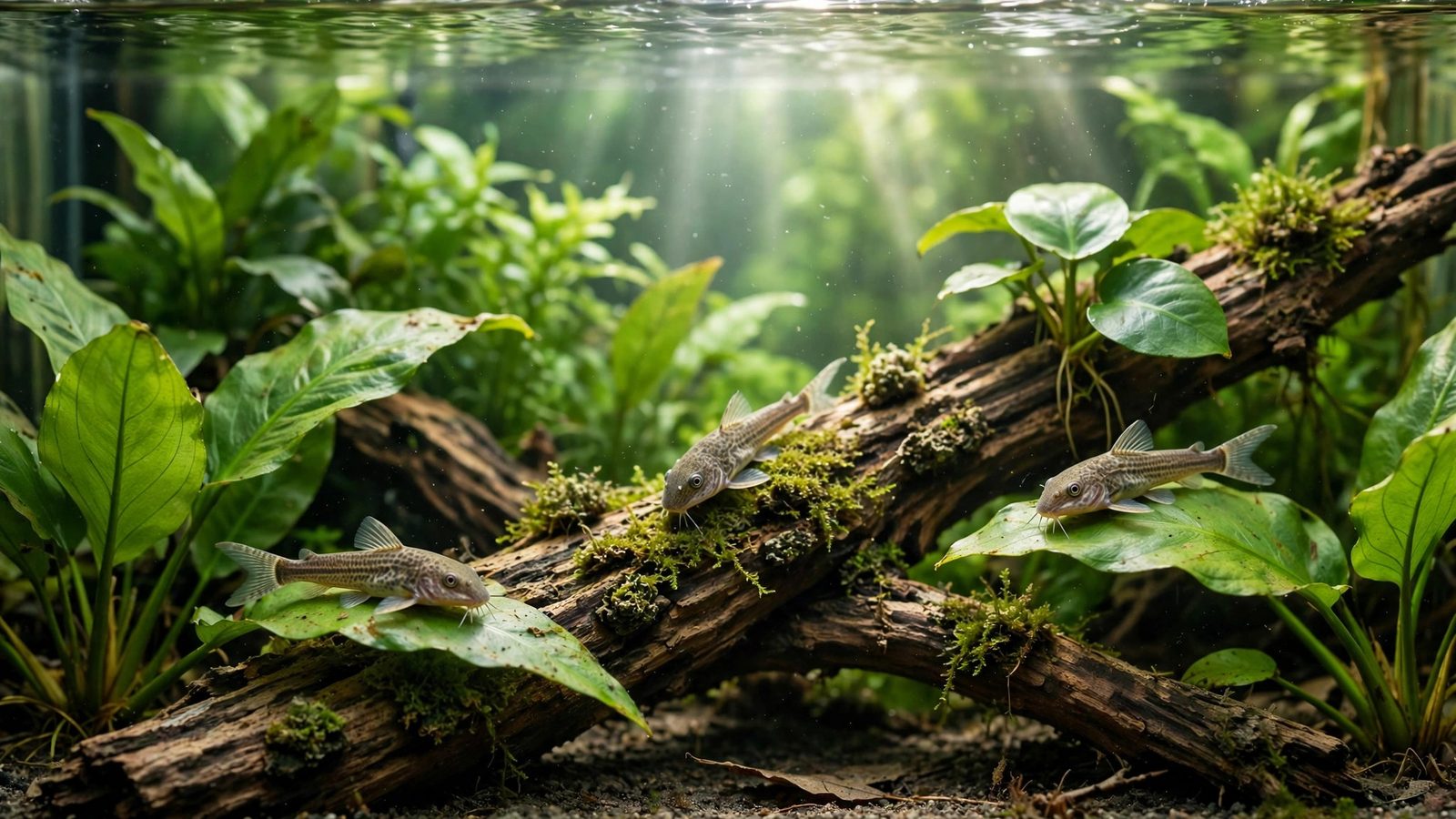
You bought six tiny algae-eating torpedoes, watched them vacuum your glass for a week, and then found two belly-up while the rest melted into the foliage. If that sounds familiar, you are not doing anything uniquely wrong — good otocinclus planted tank care starts months before the fish ever reach your tank, in South American rivers and the brutal supply chain that follows. This guide shows you how to pick otos that survive, acclimate them properly, and feed them so they live five years instead of five weeks.
Why New Otocinclus Die (and How to Beat the Odds)
Almost every otocinclus you will ever buy is wild-caught in South American river basins — the Amazon, Paraguay, and Orinoco systems. Between the river and your aquarium, a typical oto passes through a seine net, a crowded holding bucket, a wholesaler's bare tanks, an international flight, a distributor, and your local shop. At almost no stage does anyone feed them properly.
Otos have small stomachs and gut flora tuned to grazing soft algae and biofilm around the clock. When they go hungry for days, that gut flora dies off — and once it collapses, many fish can never restart it. They arrive at the shop with hollow, pinched bellies that no amount of tank algae can fix.
The collection trauma nobody talks about
Collection itself is rough. Otos are netted in fine-mesh seine nets, graded by hand, and packed densely for transport. In parts of the global ornamental fish trade, cyanide stunning and even dynamite fishing are still used to collect aquarium livestock, permanently damaging fish that survive the initial shock. Even where otos are simply netted, the stress, bruising, and days of fasting compound into a fish that arrives at your shop running on fumes. Assume every new oto is recovering from trauma, and treat it accordingly.
A quarantine protocol that actually saves them
Do not add new otos straight to your display tank. Set up a simple 10-gallon quarantine tank — cycled sponge filter, a few smooth river rocks already growing soft green algae — and hold every new group there for 2–4 weeks. Feed them the same day they arrive: a thin slice of blanched zucchini weighed down with a plant anchor, plus a crumbled algae wafer each evening. Watch for three things: bellies that plump up within a week, active grazing behavior, and normal dark feces. If a fish's belly stays pinched after 10 days of heavy feeding, it has irreversible starvation damage — not a disease you can medicate. During quarantine, avoid salt, copper-based medications, and harsh anti-parasitics; otos are scaleless and extremely sensitive to all three.
Buy Six (or More): Group Size and Picking Healthy Fish
Otocinclus are obligate shoalers. In the wild they live in groups of hundreds, and in your tank a lone oto — or even a pair — will spend its life frozen in fear behind the filter, refusing to eat and fading away. Six is the absolute minimum; ten or more is noticeably better. Never buy a single oto "to try them out" — a stressed, lonely fish tells you nothing useful about your tank.
Several species are sold under the plain name "oto." They all need the same care, but knowing which you have helps set expectations (the Otocinclus vittatus species profile is a handy ID reference):
| Species | Common name | Adult size | What to know |
|---|---|---|---|
| Otocinclus vittatus | Common oto | 1.5 in (4 cm) | Hardiest, most available, $3–5 each |
| Otocinclus affinis | Golden / dwarf oto | 1.2 in (3 cm) | Smaller, paler stripe; great for nano tanks |
| Otocinclus macrospilus | Dwarf oto | 1.2 in (3 cm) | Often mixed in with common otos at shops |
| Otocinclus cocama | Zebra oto | 2 in (5 cm) | Striking stripes, rarer, $15–25 each |
At the shop, pick like a surgeon. Choose only fish with visibly round bellies — the abdomen should look gently plump, never pinched or concave. Watch the tank for five minutes: healthy otos graze glass and leaves in short bursts and rest with fins spread. Reject any tank where fish gasp at the surface or sit motionless on the substrate. Ask when the shipment arrived; otos that have been in the store for 2+ weeks and are still plump have survived the hardest filter, and they are worth paying more for.
Otocinclus Planted Tank Care: Parameters Where Stability Beats Perfection
Here is the secret the parameter charts miss: otos do not need perfect water, they need unchanging water. A pH that sits rock-steady at 7.4 beats a pH that swings between 6.5 and 7.0 every water change. But the tank must be mature: never add otos to a tank younger than 6–8 weeks, and never during a cycle. Aim for these numbers:
| Parameter | Target range | Notes |
|---|---|---|
| Temperature | 72–79°F (22–26°C) | 74–76°F ideal; avoid sustained heat above 80°F |
| pH | 6.0–7.5 | Stability matters more than the exact number |
| General hardness | 3–10 dGH | Soft to moderately hard is fine |
| Ammonia / nitrite | 0 ppm, always | Otos are the first casualties of a mini-cycle |
| Nitrate | Under 20 ppm | 30% weekly water changes hold it there |
| Flow | Gentle to moderate | They come from calm backwaters, not rapids |
Two planted-tank specifics deserve attention. First, CO2 injection is fine with otos as long as your drop checker stays green and you never gas the tank — otos suffocate faster than tetras when CO2 spikes, so run a solenoid on a timer and keep good surface agitation at night. Second, fertilizers are safe at label doses (Seachem Flourish, NilocG Thrive), but never double-dose to beat algae — heavy metals in micro mixes stress scaleless fish. If you run a low-tech setup, our guide to aquarium plants that don't need fertilizer pairs perfectly with otos, since both thrive in the same gentle conditions.
The 2-Hour Drip Acclimation (Do Not Skip This)
Otos die from osmotic shock more readily than almost any common community fish. Float-and-dump acclimation — even a careful 30-minute version — kills a meaningful percentage of new otos. The drip method costs you two hours and a piece of airline tubing, and it is the closest thing to a guarantee this hobby offers:
- Dim the lights. Turn the tank lights off and keep the room dim. Stressed otos calm down faster in low light.
- Open the bag into a bucket. Pour the fish and their water into a clean bucket (never used with soap), keeping them fully submerged.
- Start the drip. Run airline tubing from the tank to the bucket with a loose knot or airline valve to get 1–2 drops per second.
- Wait 2 full hours. The bucket volume should roughly triple. If it gets too full, remove half the water and keep dripping.
- Net, don't pour. Lift the otos out with a soft net. Never pour shop water into your aquarium.
- Feed immediately. Drop in a blanched zucchini slice and a crumbled algae wafer the same evening — hungry otos that find food on night one have dramatically better survival odds.
Feeding: Your Tank's Algae Will Never Be Enough
This is the belief that kills more otos than any disease: "my tank has plenty of algae, they'll be fine." A healthy planted tank does not grow enough of the right kind of algae to feed six hungry otos. They eat soft green algae, brown diatoms, and the invisible biofilm (aufwuchs) coating every surface. They do not meaningfully eat black beard algae, green spot algae, staghorn, or hair algae.
Supplement on a fixed schedule, the same way you would feed any other fish:
| Day | Food | How much |
|---|---|---|
| Mon / Wed / Fri | Blanched zucchini or cucumber slice | One 2-inch slice, weighed down; remove after 24 hours |
| Tue / Sat | Algae wafer (Hikari Algae Wafers or similar) | ½ wafer per 3 otos, crumbled so everyone gets some |
| Thu | Blanched spinach or shelled peas | A small leaf or 2–3 peas, removed after 12 hours |
| Sun | Repashy Soilent Green gel | A pea-sized cube pressed onto the glass |
Blanch vegetables by boiling for 1–2 minutes until just soft, then cooling in cold water — raw vegetables are too tough for otos to rasp. Weigh slices down with a stainless plant anchor or veggie clip. And keep broad-leaf plants in the tank: otos graze Anubias leaves obsessively, so compare Anubias varieties and plant several — they double as feeding stations. Smart plant placement helps too: cluster broad leaves in the front third where you can watch bellies stay round.
Tank Mates That Work (and Three to Skip)
Otos are peaceful to the point of vulnerability: no spines, no attitude, and a habit of resting in the open. Everything in the tank must be small, calm, and uninterested in harassing a 1.5-inch algae grazer. In a planted tank this is easy — the classic nano community is practically built around them:
| Excellent tank mates | Why they work | Skip these |
|---|---|---|
| Ember tetras, chili rasboras, neon tetras | Small, peaceful, share the same parameters | Bettas — many will relentlessly hunt otos |
| Corydoras (pygmy or habrosus) | Peaceful bottom dwellers, never compete for algae | Tiger barbs and other nippy species |
| Amano shrimp, cherry shrimp, nerite snails | Zero conflict, shared cleanup mission | Large cichlids, goldfish, anything big enough to eat them |
| Honey gouramis, sparkling gouramis | Gentle surface dwellers that ignore otos | Chinese algae eaters — aggressive impostors |
Gouramis share the oto's love of calm, planted water — see our aquarium plants for gourami tanks for planting ideas that suit both. One caution: avoid tank mates that need sustained temperatures above 80°F, like discus. Otos fade fast in hot water, and a discus tank's 84°F is a slow death sentence for them.
Breeding Otocinclus: Rare, But Possible
Otos almost never breed in home aquariums — virtually all shop stock is wild-caught — but dedicated hobbyists do pull it off, and the trigger is well understood: simulate the rainy season. Do a 40–50% water change with water 4–6°F cooler than the tank, feed heavily on live and frozen foods (daphnia, microworms) for two weeks beforehand, and provide broad leaves or smooth glass for egg sites. Spawning usually happens in the early morning: the female lays 20–60 tiny adhesive eggs while the male fertilizes them.
Eggs hatch in 3–5 days. The fry are nearly microscopic and need infusoria or powdered spirulina for the first two weeks, then graduate to the same soft algae and blanched vegetables as the adults. Keep the fry tank pristine with 20% water changes every other day — even a handful of home-bred otos is a genuine achievement.
Frequently Asked Questions
How many otocinclus should I get?
Six is the absolute minimum, and ten to twelve is meaningfully better. Otos are shoaling fish that regulate their stress and feeding behavior around the group — a group of fewer than six will hide constantly, eat poorly, and die younger. In a 10-gallon tank, keep 6–8; in a 20-gallon, go for 10–12. Never buy a single oto to "test" your tank.
Why do my otocinclus keep dying in the first month?
Almost always starvation damage from the supply chain, not your water. Wild-caught otos often go unfed for weeks between capture and your tank, and once their gut flora collapses they cannot recover even with perfect care. Buy only plump-bellied fish, drip-acclimate for two hours, feed from day one, and quarantine for 2–4 weeks. Fish that survive the first month typically live for years.
Will otocinclus eat black beard algae?
No. Otos eat soft green algae, brown diatoms, and biofilm — they cannot rasp tough algae like black beard algae, green spot algae, or staghorn. If BBA is your problem, otos will not fix it; address the root cause (usually unstable CO2, poor flow, or excess organics) and consider a true Siamese algae eater instead. Do not starve your otos hoping they will "learn" to eat BBA.
Can otocinclus live on tank algae alone?
No — this is the most common and most fatal misconception about otos. A healthy planted tank does not produce enough soft algae to sustain a group, and most of the algae it does produce is the wrong kind. Supplement with blanched zucchini three times a week, algae wafers twice a week, and a gel food like Repashy Soilent Green weekly. Well-fed otos live 3–5 years; unfed ones rarely see month three.
Do otocinclus need a heater?
It depends on your room temperature. Otos need a stable 72–79°F year-round, so if your room never drops below 72°F you can skip it — but most homes dip cooler at night or in winter. A small adjustable heater set to 75°F with a reliable thermostat removes that risk entirely.
Are otocinclus safe with shrimp and snails?
Completely. Otos are among the safest fish you can keep with cherry shrimp, Amano shrimp, and nerite snails — they ignore shrimplets entirely and never harass snails. A tank combining otos, Amano shrimp, and nerites is the gold-standard planted-tank cleanup crew, with each species targeting different algae and detritus. Just make sure everyone gets supplemental food, not only the fish.
Five Years, Not Five Weeks
The tragedy of the otocinclus is that it is sold as a beginner's algae solution and dies like a specialist's challenge — but the gap between those two outcomes is entirely in the first month. Buy a real group, pick plump fish, drip-acclimate for two hours, quarantine them, and feed them like the job depends on it. Do that, and your otos will reward you with something few hobbyists ever see: a shimmering little shoal, bellies round, grazing your Anubias leaves five years from now.