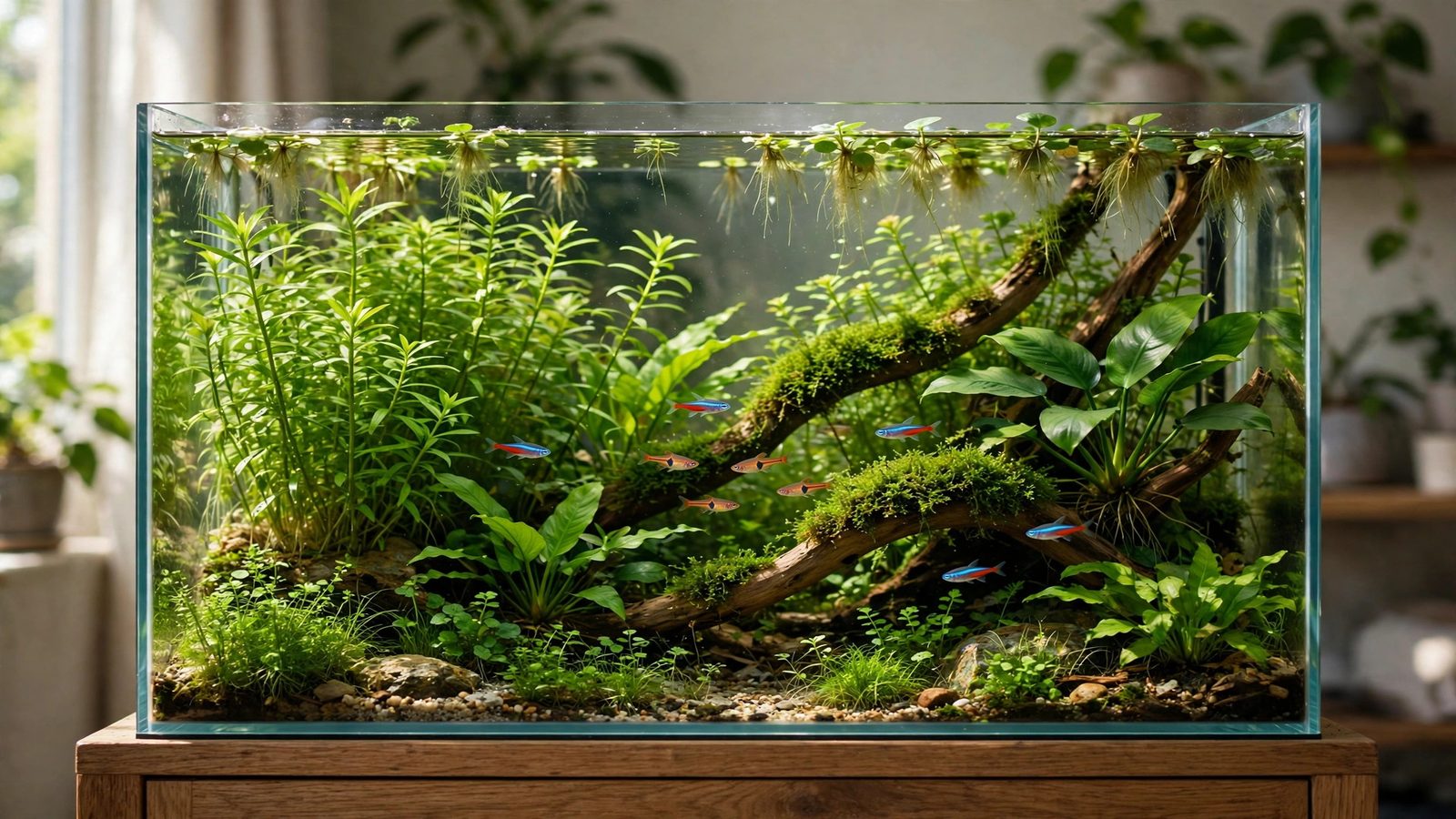
If you've been told that every planted tank needs a dosing schedule of liquid fertilizers and root tabs, here's the liberating truth: aquarium plants that don't need fertilizer genuinely exist, and plenty of them look spectacular doing it. A healthy, reasonably stocked fish tank is already a slow-release nutrient system — fish waste, detritus, and water changes supply the nitrogen, phosphorus, and minerals these plants need. Note that fertilizer is separate from CO2: fertilizer is about mineral nutrients, while CO2 is about carbon — and fertilizer is the only axis this guide covers.
Why Some Aquarium Plants Don't Need Fertilizer
A plant's fertilizer demand is really a question of growth rate versus available nutrients. Fast-growing stem plants can double in weeks, and building that tissue takes nitrogen, phosphorus, potassium, and iron in quantities fish waste alone rarely provides. Slow growers — a leaf or two a month — need a fraction of that, and a stocked tank produces it effortlessly. The biggest winners in a zero-fertilizer tank share one or more of these traits:
- Water-column feeders: Epiphytes like Anubias, Java fern, and Bucephalandra absorb nutrients directly through leaves and rhizomes. They never touch the substrate, so they can't use root tabs anyway — dissolved fish waste is their only food in nature.
- Slow growers: Cryptocorynes, Anubias, and many mosses grow so deliberately that even a lightly stocked tank generates enough nutrients for them.
- Floaters: Floating plants sit near the light and pull CO2 from the air. With abundant light and carbon, they soak up fish-derived nitrogen and phosphorus like a sponge — the hardest-working nutrient scrubbers in a no-fertilizer tank (see our guide to plants that absorb nitrates).
- Rooted plants in mulm-rich substrate: Swords, Vallisneria, and Cryptocoryne feed heavily through their roots. In an established tank, fish waste and mulm mineralize in the substrate into exactly what they want — effectively a built-in root tab.
The Species List: Plants That Thrive on Fish Waste Alone
| Species | Placement | Why it works without fertilizer |
|---|---|---|
| Anubias barteri (incl. var. nana) | Midground / hardscape | Glacially slow rhizome grower; feeds from the water column |
| Java fern (Microsorum pterotydes) | Midground / hardscape | Tied to wood or rock; tolerates lean water for years |
| Bucephalandra spp. | Midground / hardscape | Ultra-slow epiphyte; fish waste covers its modest needs |
| Java moss / Christmas moss / Flame moss | Hardscape / foreground | Absorbs dissolved nutrients across its whole surface |
| Amazon sword (Echinodorus amazonicus) | Background | Heavy root feeder; mines mineralized fish waste in substrate |
| Cryptocoryne wendtii & Cryptocoryne lutea | Midground / foreground | Slow root-feeders; spread for years in established substrate |
| Anacharis / Brazilian waterweed (Egeria densa) | Background | Opportunistic feeder; grows on fish waste alone |
| Hornwort (Ceratophyllum demersum) | Floating / background | Free-floating nutrient sponge; no roots needed |
| Water sprite (Ceratopteris thalictroides) | Floating / background | Floated or planted; devours nitrate from fish stocking |
| Frogbit / Dwarf water lettuce / Duckweed | Surface | Air-side CO2 + fish waste = growth with zero dosing |
| Vallisneria spiralis & V. americana | Background | Root-feeding runners colonize mulm-rich substrate |
| Pogostemon stellatus 'Octopus' | Background | Hardy stem that tolerates lean conditions well |
| Sagittaria subulata (dwarf sag) | Foreground | Low carpeting runner; spreads in aged substrate |
| Marimo moss balls (Aegagropila linnaei) | Foreground | Algae colony; thrives on ambient dissolved waste |
Background stems: the fish-waste workhorses
Anacharis (Egeria densa) is the classic no-fertilizer background plant: plant it or leave it floating — it absorbs nutrients along its entire stem and grows enthusiastically on fish waste alone. Hornwort has no true roots, so it never cared about substrate or root tabs; it suppresses algae while stripping nitrate. Vallisneria is a root-feeder whose runners mine the mineralized mulm layer that builds up under gravel or sand over months (see aquarium plants that grow in gravel for inert-substrate tips). Water sprite is the wildcard — plant it for a lacy background bush or float it as a nitrate vacuum. Pogostemon stellatus 'Octopus' is the one stem plant here: fast enough to outcompete algae yet content with fish-waste-level nutrients. (One responsibility note: Egeria densa is invasive or regulated in some regions, so check your local rules before buying it and never release aquarium plants into wild waterways.)
Midground rosettes: slow and steady
Cryptocoryne wendtii is the patron saint of low-nutrient tanks: plant it in established substrate and ignore it, and it spreads into a bronze-green carpet of broad leaves on nothing but detritus-derived nutrients. Cryptocoryne lutea behaves similarly at a smaller scale. One rule: don't move them — they feed from a slowly built root zone, and uprooting resets it.
Epiphytes: the ultimate zero-fertilizer plants
Epiphytes deserve their own spotlight because they cannot use root tabs even if you wanted them to. Anubias barteri var. nana grows on driftwood and rock with its rhizome in the open water — every nutrient it receives arrives dissolved, exactly what fish produce. Tropica's plant database notes it thrives in nearly any conditions and grows slowly enough that its leaves persist for years (see the Anubias barteri var. nana plant profile). Java fern and Bucephalandra work the same way: tie them to hardscape, keep the rhizome unburied, and let the fish do the fertilizing — they're also the backbone of tanks with no substrate at all.
Mosses: surface-area champions
Java moss, Christmas moss, and flame moss absorb nutrients across every filament of their surface. In a fish tank, ambient dissolved waste is a feast — mosses carpet driftwood and rock in unfertilized tanks where fussier plants stall, and they double as shrimp nurseries (see the best aquarium mosses for shrimp-safe picks). Keep light moderate; high light in a lean tank invites hair algae.
Floating plants: your nutrient safety net
Every no-fertilizer tank should have a floater section. Frogbit, dwarf water lettuce, and even duckweed grow with atmospheric CO2 and strong light, so their only limit is dissolved nutrients — precisely the nitrate and phosphate fish supply. They act as a buffer: when fish waste spikes, floaters absorb the excess and shade the tank, preventing algae outbreaks. Harvest a handful weekly to export the nutrients. Water sprite and hornwort serve the same role when floated in taller tanks.
Foreground without fertilizer
Dwarf sag (Sagittaria subulata) breaks the carpet rule: in an aged tank with mulm in the substrate, it sends runners across the foreground on fish waste alone. Marimo moss balls ask even less — colonies of algae surviving on whatever is dissolved in the water. Crypt lutea can also anchor the foreground edge of the midground.
Tank Conditions That Make a No-Fertilizer Tank Work
Choosing the right species is half the equation. The other half is running the tank so that fish waste becomes plant food instead of algae food.
Stock at a "plant-appropriate" level
Too few fish and plants starve; too many and algae takes over. Aim for moderate community stocking: a 20-gallon tank with 10–15 small tetras or rasboras plus a cleanup crew produces a steady, digestible stream of nitrogen and phosphorus. Heavy bioloads (goldfish, large cichlids) oversupply nutrients and make algae — not plants — the beneficiary. If water tests show zero nitrates for weeks while plants yellow, you may be understocked for your plant mass.
Feed the fish like you mean it
Fish food is plant fertilizer in disguise. Every flake a fish eats and excretes returns to the water as ammonia, which filter bacteria convert to plant-ready nitrate, plus phosphorus and trace minerals in the solid waste. Feed generously but sensibly — enough that fish thrive and produce waste, with minimal uneaten food rotting.
Water changes: the mineral refill
Water changes do more than remove nitrate — they add potassium, calcium, magnesium, and trace elements from your tap water. A 25–40% weekly water change is the sweet spot: frequent enough to resupply minerals, small enough to keep nitrate stable for the plants. Soft-water keepers get less mineral content per change, so plants suited to soft water are the safer picks there, while hard-water tanks get a free mineral subsidy (see aquarium plants for hard water).
Keep the lighting honest
Light is the throttle on nutrient demand. Under moderate light (6–8 hours of a modest LED), the plants on this list photosynthesize at a pace fish waste can support. High light and long photoperiods raise demand beyond what fish supply — deficiency symptoms appear while algae colonizes the surplus light. Match modest light to a modest nutrient budget and the tank stays in equilibrium. Shrimp tanks are the classic example — see our aquarium plants for shrimp tanks guide on why lean, stable parameters suit both shrimp and slow-growing plants.
Let the substrate age
Root-feeders like swords, crypts, and Vallisneria perform dramatically better in established substrate. Fresh gravel or sand is nutrient-sterile; six-month-old gravel with mulm worked into it is a slow-release fertilizer bed. Don't deep-clean every grain — hover the siphon over the surface and leave the deep mulm layer for the roots. Many aquarists report their swords "suddenly taking off" around the one-year mark; that's the substrate maturing.
Honest Limits: When You'd Still Need Fertilizer
No-fertilizer gardening is real, but it has real boundaries — being honest about them keeps you from blaming the wrong thing when a plant struggles.
- Red and pink plants: Alternanthera reineckii, Ludwigia 'Super Red', and Rotala macrandra need high iron and precise nutrient ratios to hold color. They survive lean tanks but fade to green — or melt. If reds are your goal, dose iron at minimum.
- High-light tanks: Strong light raises nutrient demand past what fish waste provides. Pinholes in older leaves (potassium deficiency) and stunted new growth (iron/nitrogen deficiency) are the classic signal to start dosing. Measured weekly nutrient uptake data from planted tanks shows how far high-light demand exceeds fish-waste supply.
- Dense stem-plant jungles: A tank packed wall-to-wall with fast stems consumes nutrients faster than any reasonable fish load produces. Heavy stem density plus zero dosing equals leggy, melting stems within a month or two.
- Very lean stocking: A betta in a 10-gallon with twenty plant species is asking the plants to live on almost nothing. Add a small school of tankmates, reduce plant mass with floaters, or accept that a little dosing is needed.
- New tanks: A tank cycled last week has no mulm layer, a young bacterial colony, and sparse fish waste. Give it two to three months before judging the method — early struggles are usually immaturity, not a verdict.
Deficiency symptoms are your dashboard: pale new growth, yellowing old leaves, and pinholes each point to specific nutrients, and you can always add a targeted half-dose to close the gap.
When the honest limit arrives, root tabs are the lightest intervention: Seachem Flourish Tabs.
Three Starter No-Fertilizer Tank Recipes
These combinations work in thousands of low-tech tanks. Each assumes moderate stocking, weekly water changes, and 6–8 hours of moderate LED light.
1. The Classic Community (20 gallons)
Background: Vallisneria spiralis along the back glass, Anacharis in one corner. Midground: Amazon sword as centerpiece, Cryptocoryne wendtii clusters flanking it. Hardscape: driftwood with Anubias nana and Java fern tied on, Java moss in the crevices. Surface: frogbit over a third of the top. Stock with neon tetras, corydoras, and shrimp.
2. The Hardscape Showcase (10 gallons)
Hardscape: one dramatic piece of spiderwood with Bucephalandra and Anubias 'Petite' attached, Christmas moss along the branches. Foreground: marimo moss balls and a Cryptocoryne lutea border. Surface: dwarf water lettuce. Stock with a betta or chili rasboras. Epiphyte-heavy by design — nothing here could use root tabs anyway. Many of these species also appear in our easiest aquarium plants that need no CO2, though that list solves for carbon while this one solves for nutrients.
3. The Shrimp Tank (15 gallons)
Background: hornwort floated in a thick corner raft. Midground: water sprite (half planted, half floated) and Java moss. Foreground: dwarf sag runners. Shrimp colonies produce constant, gentle waste — ideal slow-drip nutrition — while mosses shelter shrimplets.
Frequently Asked Questions
Can aquarium plants really survive with no fertilizer at all?
Yes — but only the right species under the right conditions. Slow-growing water-column feeders (Anubias, Java fern, mosses), root-feeders in aged substrate (swords, crypts, Vallisneria), and floaters (frogbit, hornwort) all grow for years on fish waste and weekly water changes. Fast-growing stems and red plants will not. The trick is matching plant appetite to the nutrients your fish produce, and keeping light moderate so demand never outruns supply.
Is fish waste enough fertilizer for aquarium plants?
For undemanding species, yes. Fish excrete ammonia that becomes nitrate, solid waste mineralizes into phosphorus and trace elements in the substrate, and tap water refills potassium, calcium, and magnesium at each change. Together that's a complete if lean nutrient diet, and it only breaks down when demand exceeds supply.
Do I need root tabs if I don't dose liquid fertilizer?
Not if you choose plants that don't depend on the substrate. Epiphytes (Anubias, Java fern, Bucephalandra) and mosses feed entirely from the water column, so root tabs do nothing for them. Root-feeders like Amazon swords and crypts get their substrate nutrition from mineralized fish waste in an established tank. Tabs only help heavy root-feeders in brand-new, sterile substrate — and even then, the need fades as the tank matures.
Why are my plants yellowing even though I have fish?
Yellowing usually means demand exceeds supply. Check in order: is your light too strong for a lean tank? Is the tank under three months old (substrate not yet mineralized)? Are you running fast stems or red plants (wrong species for the method)? Are you stocked very lightly? Fix the mismatch — dim the light, swap to slower species, or add fish — before reaching for a fertilizer bottle. Each of those fixes is free.
How long before a no-fertilizer tank stabilizes?
Expect two to three months of gradual improvement. The first month is the awkward phase: plants shed leaves grown in the nursery's rich conditions, and the substrate holds almost no stored waste yet. By month two, roots tap the developing mulm layer and fish waste output is steady. By month three, growth is visibly consistent. Tanks that look great at week two and collapse at week six usually ran on nursery-stored nutrients that ran out first.
Do floating plants reduce the need for fertilizer?
They reduce it and stabilize it. Floaters like frogbit, dwarf water lettuce, and duckweed absorb excess nitrate and phosphate, preventing algae blooms when fish waste spikes — effectively widening the safe range of your tank's nutrient budget. Think of them as a living overflow valve: they consume what rooted plants can't use yet. Skimming a handful each week permanently exports those nutrients.
The Takeaway
A no-fertilizer aquarium isn't a neglected tank — it's a balanced one. Fish feed the plants, plants clean the water, water changes refill the minerals, and moderate light keeps everyone's appetite in line. Start with epiphytes, mosses, floaters, and patient root-feeders, give the tank three months to mature, and you'll have a lush aquascape that never needed a fertilizer bottle.