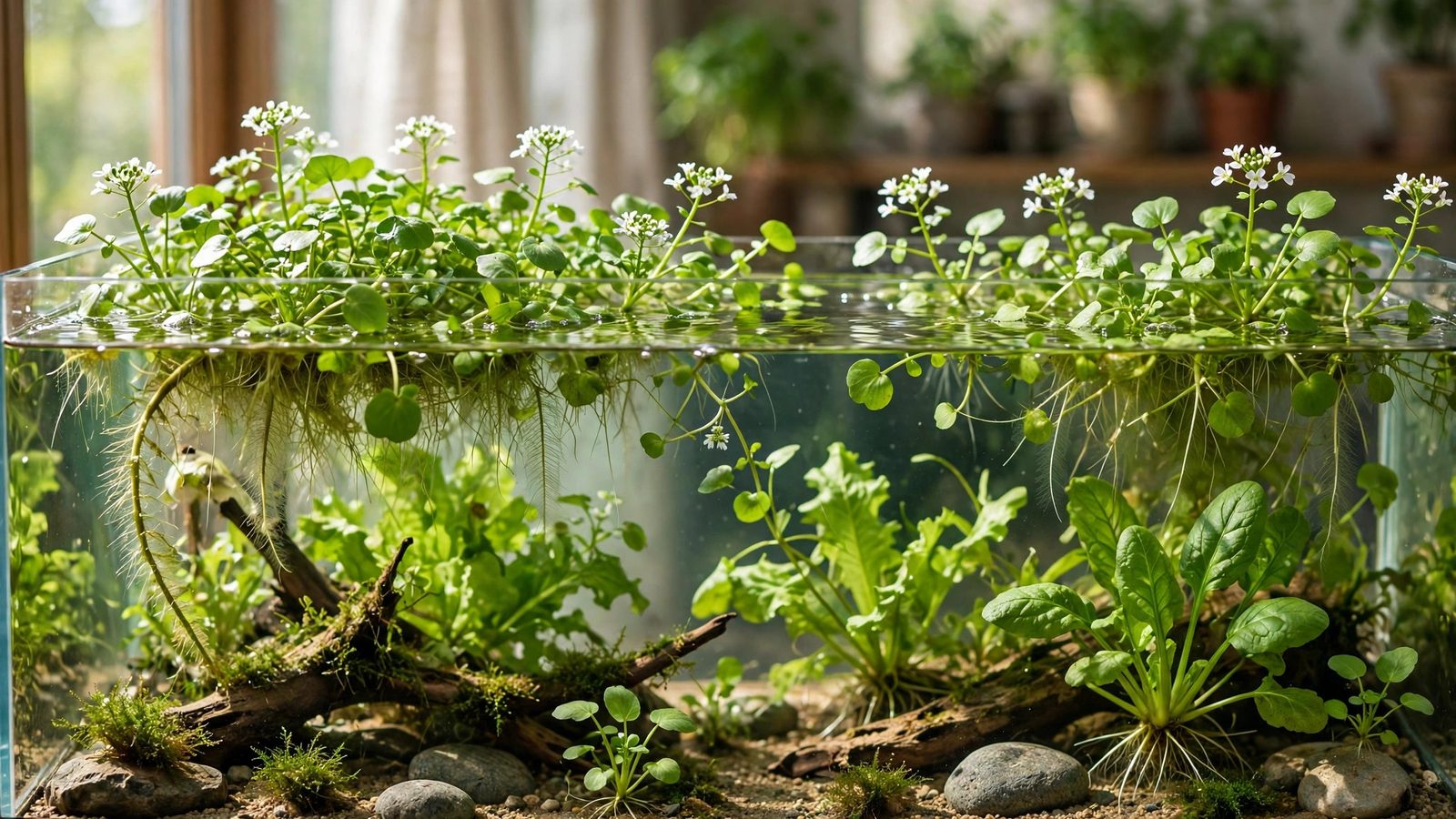
Most hobbyists grow aquarium plants for the view, but edible aquarium plants earn their keep twice: they clean your water during the week and end up on your plate on the weekend. Watercress snipped from a tank edge, gotu kola tossed into a morning salad, or a lotus root simmered into soup are all harvestable from the same tanks you'd scape for beauty. Growing food in your aquarium is genuinely practical — provided you treat the hobby like a garden that happens to hold fish, follow basic food-safety rules, and respect the single most important rule of edible aquatics: nothing you harvest ever gets released into a waterway.
Before You Eat Anything From Your Tank
Not everything that survives underwater is safe to swallow, and not everything safe in the wild is safe from an aquarium. Treat these guidelines as non-negotiable.
- Positive identification comes first. Many aquarium plants have toxic lookalikes. Only eat species you can identify with certainty — buy from reputable nurseries rather than wild-collecting, where misidentification is a genuine risk.
- Grow them for food, not as tank decoration by accident. Plants in a display tank absorb fish medications, algaecides, copper-based treatments, and fertilizer salts. If you intend to eat a plant, raise it in a dedicated grow-out tub or a tank zone that has never been dosed with anything you wouldn't put in soup.
- Wash and blanch. Aquarium surfaces host bacteria and parasites. Rinse harvests in clean water and blanch leafy edibles briefly in boiling water — it wilts textures nicely and reduces microbial risk.
- Check the law where you live. Several of the plants below are regulated or outright banned in parts of the United States because of their invasive potential. Edible does not mean legal everywhere.
A Warning You Must Not Skip: Never Release Aquarium Plants
This warning is mandatory because it is where good intentions cause real ecological damage. Many edible aquatics — watercress, duckweed, taro, water hyacinth relatives — are aggressive colonizers. A handful of duckweed rinsed down a drain or a bit of watercress tossed into a stream can establish a population that chokes out native species. Some states attach fines and criminal penalties to releasing regulated species into the wild.
Read our full guide to invasive aquarium plants and why you must never release them before you harvest anything, and check the US guide to banned aquarium plants to see which species are restricted in your state. The rule is simple: compost or trash your trimmings, never flush them, never dump tank water into a storm drain, and never "set free" a plant that grew too well.
Watercress (Nasturtium officinale)
Watercress is the most genuinely food-like of all edible aquarium plants: peppery, crisp, and nutritionally dense, with meaningful amounts of vitamins A, C, and K. It grows emersed or semi-submerged, so it does best in a shallow tray, a riparium-style setup, or a tank with a low waterline rather than fully submerged.
Give it cool water (18–22°C / 64–72°F) and strong light, and it grows fast enough to harvest weekly. Snip the top stems and let the lower nodes re-sprout — it behaves like a cut-and-come-again herb. The peppery bite intensifies in bright light and cooler water, which is why tank-grown watercress often tastes milder and sweeter than pond-grown. Utah State's extension service publishes a practical guide to growing watercress that covers its cool-season habits in more detail. Taste notes: fresh, mustardy heat at the back of the tongue, excellent raw in sandwiches or wilted into pasta at the last minute.
Bacopa monnieri (Brahmi)
Bacopa monnieri is one of the most forgiving stem plants in the hobby — it's on nearly every list of the easiest aquarium plants that need no CO2 — and it's also the famous Ayurvedic herb brahmi, traditionally used in teas and herbal preparations. In the aquarium it forms neat, succulent-leaved stems that root readily from cuttings, exactly as documented in Tropica's plant database entry for Bacopa monnieri.
The leaves are mildly bitter with a slightly soapy, herbal edge, so most people use them as a tea ingredient or chew a few fresh leaves rather than eating bowls of it. Food-safety note: bacopa is a known accumulator of heavy metals, which is exactly why it should come from a clean, medication-free grow-out tank and never from a tank that has seen copper-based ich treatments. It also grows vigorously enough to double as one of your fast-growing plants for new tanks, soaking up ammonia while it waits for harvest.
Gotu Kola (Centella asiatica)
Gotu kola, known in South and Southeast Asian cooking as mandukaparni or pegaga, is a creeping marginal plant with rounded, fan-shaped leaves that grows beautifully at the waterline. It's a staple green in Sri Lankan mallung (a coconut-and-lime chopped salad) and Thai and Vietnamese salads and juices.
In an aquarium setting, treat it as an emergent: plant it in substrate at the shallow end or let it creep along a tank with a low water level. Warmth and humidity are its friends. Taste notes: clean, grassy, and slightly bitter with a carroty undertone; the bitterness is the point — pair it with coconut, lime, and chili the way traditional recipes do. Like bacopa, harvest only from clean setups. If your tap water is hard and alkaline, it tolerates it, but soft to medium water produces more tender leaves.
Lotus and Taro Roots
When people think of edible aquatics, they picture lotus root — the crisp, lacy-sliced rhizome of Nelumbo nucifera — and taro (Colocasia esculenta), the starchy corm at the heart of poi, curries, and bubble-tea-adjacent desserts. Both can be grown in large aquariums, tubs, or outdoor pond plantings, and both reward patience: a single season of growth can produce harvestable roots.
Give each plant a wide, deep container of heavy soil capped with sand, strong light, and warm water — they are tropicals and sulk below about 20°C / 68°F. In temperate climates, plan to move them inside for winter, exactly as you would with other pond plants overwintered indoors. Preparation notes: lotus root is eaten sliced and crisp — stir-fries, soups, pickles — and stays crunchy after cooking. Taro is starchy and bland-raw, so always cook it thoroughly; it turns creamy and nutty, ideal for curries. Important: never collect wild taro or lotus from local waterways, both for legal reasons and because polluted sediment concentrates in the roots.
Duckweed (Lemna spp.)
Duckweed has a reputation as a nuisance — and in display tanks it often is — but it is also one of the most protein-dense leafy plants on Earth, with some species running 30–40% protein by dry weight, plus meaningful iron and vitamin A. It grows on the surface of nearly any tank, asks for nothing, and doubles every couple of days in good light.
The catch is texture and perception: it's tiny. Nobody eats a bowl of it. The practical approach is to harvest a cup, rinse it hard, and blend it into smoothies or stir it into soups where it vanishes into the background. If you're curious about keeping it, our duckweed care guide covers containment — and if you'd rather have floating plants you can admire instead, see our beginner's guide to floating aquarium plants. Do not eat duckweed from outdoor ponds or ditches — it concentrates whatever the water carries, including agricultural runoff.
Edible Aquarium Plants Compared
| Plant | How it grows | Part eaten | Taste | Harvest notes |
|---|---|---|---|---|
| Watercress | Emersed / shallow | Stems and leaves | Peppery, crisp | Cut-and-come-again; weekly harvest |
| Bacopa monnieri | Submerged stem | Leaves | Mildly bitter, herbal | Small quantities; tea or fresh leaf |
| Gotu kola | Emergent / waterline | Leaves | Grassy, bitter, carroty | Pick outer leaves; pair with lime/chili |
| Lotus | Rooted, deep container | Rhizome | Crisp, mildly sweet | One seasonal harvest; overwinter indoors |
| Taro | Rooted, deep container | Corm | Starchy, nutty when cooked | Always cook thoroughly |
| Duckweed | Floating | Whole plant | Nearly neutral | Rinse well; blend into smoothies/soups |
How to Set Up an Edible Corner in Your Tank
You don't need a second aquarium to start. A simple approach that works:
- Dedicate a zone. A hang-on breeder box, a shallow tray on a windowsill, or one corner of a medication-free tank. Keep fertilizers minimal — plain substrate and fish waste are enough for most edibles.
- Start with the forgiving ones. Bacopa and duckweed survive beginner mistakes; watercress and gotu kola want more light and attention.
- Harvest lightly at first. Take no more than a third of a plant's foliage so it keeps growing — and remember these plants are also oxygenating your water while they grow, so leaving plenty in place keeps the tank healthy too.
- Keep a harvest log. Note what you took, when, and how it tasted. It sounds fussy; it's how you learn which of your conditions produce the best flavor.
One Small, Real Detail
The habit that made this real for me: every Saturday, before the weekly water change, I scoop a mug of duckweed off the surface of my grow-out tub, rinse it under the tap, and whisk it into the morning's scrambled eggs. You can't taste it — it just turns the eggs a faint, improbable green — but the tub stays crystal clear, the fish underneath get their shade back, and breakfast feels like it came from somewhere. That's the whole pitch of edible aquarium plants: maintenance that feeds you.
Frequently Asked Questions
Is it really safe to eat plants grown in a fish tank?
It can be, with conditions. Grow edibles in a setup that has never been treated with fish medications, algaecides, or copper-based products, use minimal fertilizer, and always rinse and blanch leafy harvests. Plants absorb what the water carries, so a "clean" tank history matters more than any single washing step. When in doubt, use a dedicated medication-free grow-out tub.
Which aquarium plant is the easiest edible for a beginner?
Bacopa monnieri. It's already one of the toughest beginner stem plants, roots from cuttings with zero fuss, needs no CO2, and tolerates a wide range of water. You only need a few leaves at a time for tea or fresh chewing, so one healthy bunch supplies a steady, low-pressure harvest while you learn.
Can I eat duckweed from my aquarium?
Duckweed from a clean, indoor, medication-free tank is edible and notably protein-rich, but eat it blended into smoothies or cooked into soups rather than raw by the handful, and rinse it thoroughly first. Never eat duckweed collected from outdoor ponds, ditches, or public waterways, where it concentrates pollutants and agricultural runoff.
Are any edible aquarium plants illegal to grow?
Yes — "edible" and "legal everywhere" are different things. Watercress, taro, and some lotus relatives are regulated or banned in certain US states because of invasive risk. Check your state's noxious-weed and aquatic-plant lists before ordering, and read our banned plants guide. Buying from a nursery that ships to your state is a good sign but not a legal guarantee.
What do I do with trimmings I can't eat?
Compost them, bag them for the trash, or let them dry out completely before disposal. Never flush trimmings, never pour tank water into a storm drain, and never release plants into local waterways — even native-looking species can disrupt ecosystems, and the legal penalties for releasing regulated species are severe. When in doubt, the trash is the safe choice.
The Plate Is the Point
An aquarium that grows food changes your relationship with the hobby. Water changes stop feeling like chores when the trimmings go into dinner, and every plant earns its space twice — once in the water column, once on the plate. Start with bacopa or watercress, keep your setup clean, harvest thoughtfully, and let the tank feed the kitchen as faithfully as it entertains the living room.