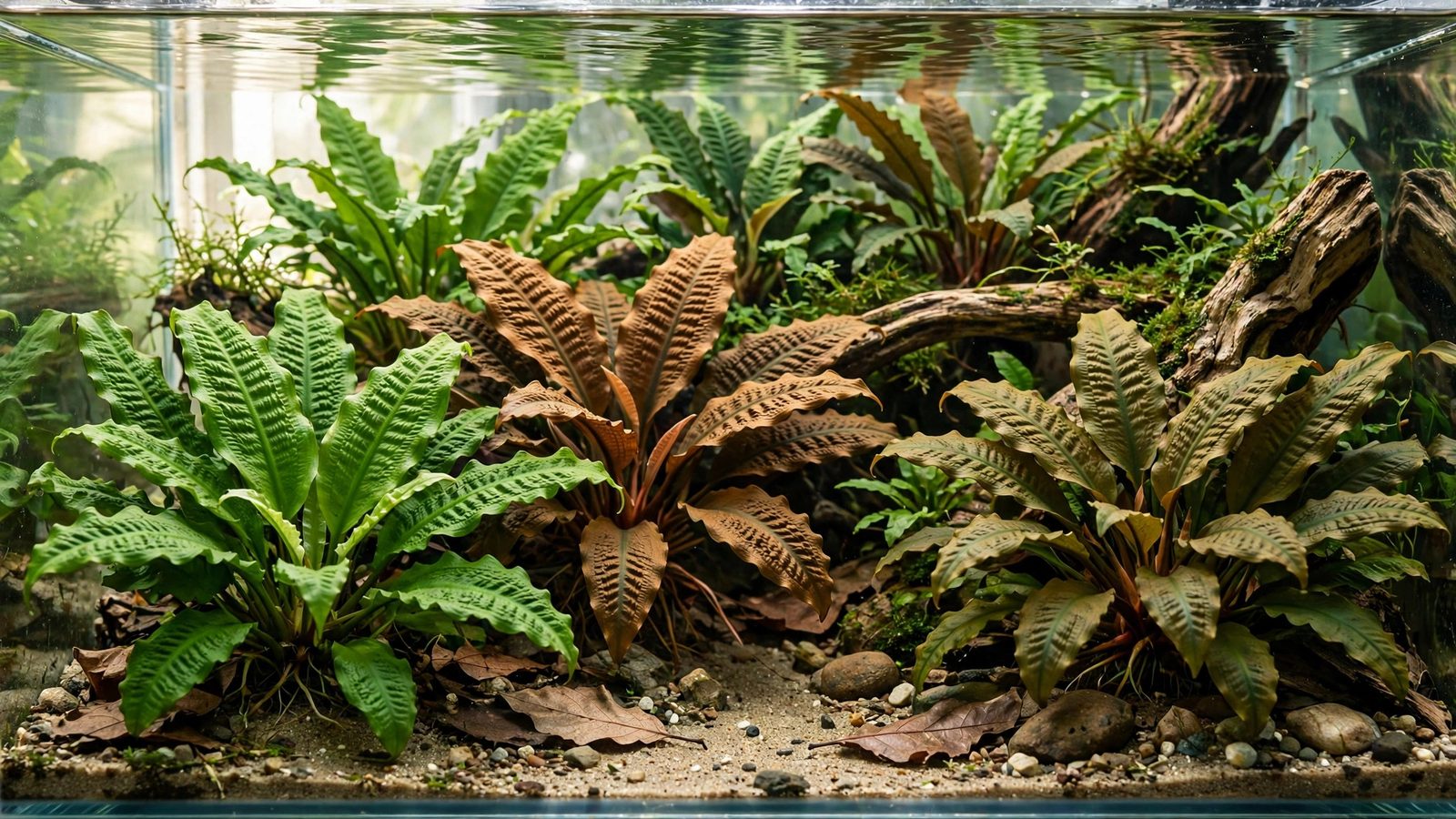
Here is the mistake nearly every beginner makes with crypts: they buy whichever looks prettiest in the shop tank, and two weeks later half the leaves have dissolved into mush. The truth is that the different types of cryptocoryne are not interchangeable — a 60 cm background giant and a 5 cm foreground carpet share a genus name and little else. Match the crypt to the spot it wants to live in, and they become the toughest, most forgiving plants you can own.
Types of Cryptocoryne, Organized by Tank Spot
Walk through a good plant shop and you'll count dozens of crypts, but a beginner realistically needs to know eight — arranged here front to back, the way you should arrange your tank. Heights are for established plants in low-tech conditions.
Foreground: Cryptocoryne parva
Parva is the smallest crypt in the hobby: a rosette of spoon-shaped leaves topping out around 5–8 cm that never needs trimming. Slow is the operative word — expect 6–12 months for a handful of plantlets to knit into a carpet. Buy more pots than you think you need, plant the crowns about 5 cm apart, and you get a foreground that stays put and shrugs off the parameter swings that melt flashier plants.
Midground: wendtii, beckettii, and lutea
The midground is where crypts shine, and three species own it. C. wendtii is the beginner's workhorse — green for broad rippled leaves 10–15 cm tall, brown and red forms for copper tones that deepen under medium light. One plant slowly widens into a 15–20 cm clump over the years. C. beckettii is its fussier-looking cousin: arrow-shaped leaves, olive tops, reddish undersides. C. lutea fills the low-light corners — slower and plainer, but it endures shade and neglect better than almost any other crypt.
Background: balansae, spiralis, and pontederiifolia
When a crypt wants height, it really wants height. C. balansae sends up crinkled, ribbon-like leaves 40–60 cm long that sway in the current — spectacular in tanks 45 cm or taller, ridiculous in a 10-gallon. C. spiralis is the classic corkscrew-leaved crypt, its twisted straps reaching 30–50 cm for the rear corners. C. pontederiifolia sits between at 20–35 cm, with broad heart-shaped leaves that look nothing like a "typical" crypt. If you want the tall-grass background look, our guide to background plants for tall tanks pairs well with this section.
| Crypt | Tank spot | Height (low-tech) | Light | Beginner notes |
|---|---|---|---|---|
| C. parva | Foreground | 5–8 cm | Low–medium | Carpets in 6–12 months; buy extra pots |
| C. wendtii 'Green' | Midground | 10–15 cm | Low–medium | The workhorse; widens yearly |
| C. wendtii brown/red forms | Midground | 10–20 cm | Medium | Copper tones in stronger light |
| C. beckettii | Midground | 10–15 cm | Low–medium | Olive tops, reddish undersides |
| C. lutea | Midground | 10–15 cm | Low | Near-indestructible in shade |
| C. pontederiifolia | Back of midground | 20–35 cm | Low–medium | Broad leaves; transitional height |
| C. spiralis | Background | 30–50 cm | Medium | Twisted straps; melts most easily |
| C. balansae | Background | 40–60 cm | Medium | Crinkled ribbons; needs a tall tank |
Which Crypts Melt the Least?
Crypt melt — leaves dissolving into translucent jelly days after a change — is the genus's signature drama, and some are far more dramatic than others. Hardy crypts still melt; they just recover faster. If melt is your nightmare, read our crypt melt-prevention guide before you buy — planting technique matters more than species choice.
| Hardiness rank | Crypt | Melt tendency | Recovery |
|---|---|---|---|
| 1 (hardest) | C. parva | Rarely melts | Steady regrowth from the crown |
| 2 | C. wendtii (all forms) | Occasional, mostly on arrival | New leaves in 2–4 weeks |
| 3 | C. lutea | Occasional | Slow but reliable |
| 4 | C. beckettii | Moderate on parameter swings | 4–6 weeks to rebuild |
| 5 | C. pontederiifolia | Moderate | 4–6 weeks; do not move it |
| 6 | C. balansae | Frequent after any change | 3–6 weeks if roots are intact |
| 7 (most delicate) | C. spiralis | Melts at a harsh glance | Allow 6–8 weeks from roots |
The single biggest melt trigger is relocation. A crypt that has been in your tank for two months won't melt at a water change — but dig it up to "tidy" the scape and every leaf may dissolve. For zone-by-zone arranging, see our aquarium plant placement guide.
Placing Crypts in Your Scape
A crypt-heavy layout should read like a gentle slope: parva carpet in front, a drift of wendtii and beckettii in the middle third, balansae or spiralis rising behind. Give each clump its final address on day one, with room for two years of widening — an 8 cm wendtii today will be 15–20 cm across next year.
Plant midground species in groups of three or five, and tuck a root tab under each clump at planting time. Crypts are heavy root feeders: they survive in plain gravel — see our guide to aquarium plants that grow in gravel — but spread far faster over a root tab or nutrient substrate. Keep the crown just above the substrate line; burying it invites rot.
What to Buy (and What to Skip)
For beginners, potted portions beat tissue-culture cups: the pots hold established root systems, and roots are what survive melt. One pot of wendtii splits into 2–3 clumps; a pot of parva splits into 5–8 plantlets. Push a root tab under each clump at planting — one tab feeds a wendtii for two to three months.
Skip the pink and patterned collector crypts (Pink Flamingo, nurii) for your first year. They want steadier CO2 and softer water, and they melt harder when conditions wobble. Master wendtii first. Crypts rank among the easiest aquarium plants for a beginner community tank, so expanding your collection is the easy part once the first clump settles.
Frequently Asked Questions
Can I mix different types of cryptocoryne in one tank?
Yes — mixing species is how most scapers use them. Combine parva in front, one or two midground species (wendtii, beckettii), and a tall background (spiralis or balansae) for a layered layout. Keep each species in its own clump rather than interplanting; crypts spread from the crown, so defined groups stay cleaner and are easier to feed with root tabs.
Why do my crypts melt right after planting?
Post-planting melt is a stress response to changed water, light, and handling — the plant sheds old leaves grown in different conditions and regrows adapted ones. It is normal, not failure. Trim dissolved leaves, leave the roots alone, and expect new growth in two to six weeks. Digging up a melting crypt to "check" the roots is the one thing that can actually kill it.
Do crypts need CO2 or special substrate?
No CO2 is needed for any of the eight beginner types — they thrive in low-tech tanks with moderate light. They do feed heavily through their roots, so nutrient-rich substrate or a root tab under each crown makes a big difference in growth speed. They can grow in plain gravel with tabs, but slower than in aquasoil or a dirted base.
Which crypt is best for a small tank?
For tanks under 40 liters, stick to parva in front and wendtii or lutea in the back corners. Balansae and spiralis are too tall — their leaves fold across the surface and shade everything below. Pontederiifolia can work as a single back-corner specimen in 40–60 liters. Plant sparsely; small tanks magnify every clump.
How fast do cryptocoryne plants grow?
Slowly — that is their defining trait. Wendtii produces a new leaf every one to two weeks in low-tech conditions; parva needs six to twelve months to carpet from a few pots. They repay the wait with longevity: an undisturbed crypt clump keeps widening for years with almost no maintenance. Think oaks, not weeds.
Start with two pots of wendtii and a pot of parva, plant them on day one, and leave them alone for two months — that patience is the entire secret of crypts. Our aquarium plants for fish tanks guide helps you stock around them. If you like this format, see our types of Anubias compared by tank spot, or browse Tropica's Cryptocoryne plant database for reference photos of every species above.