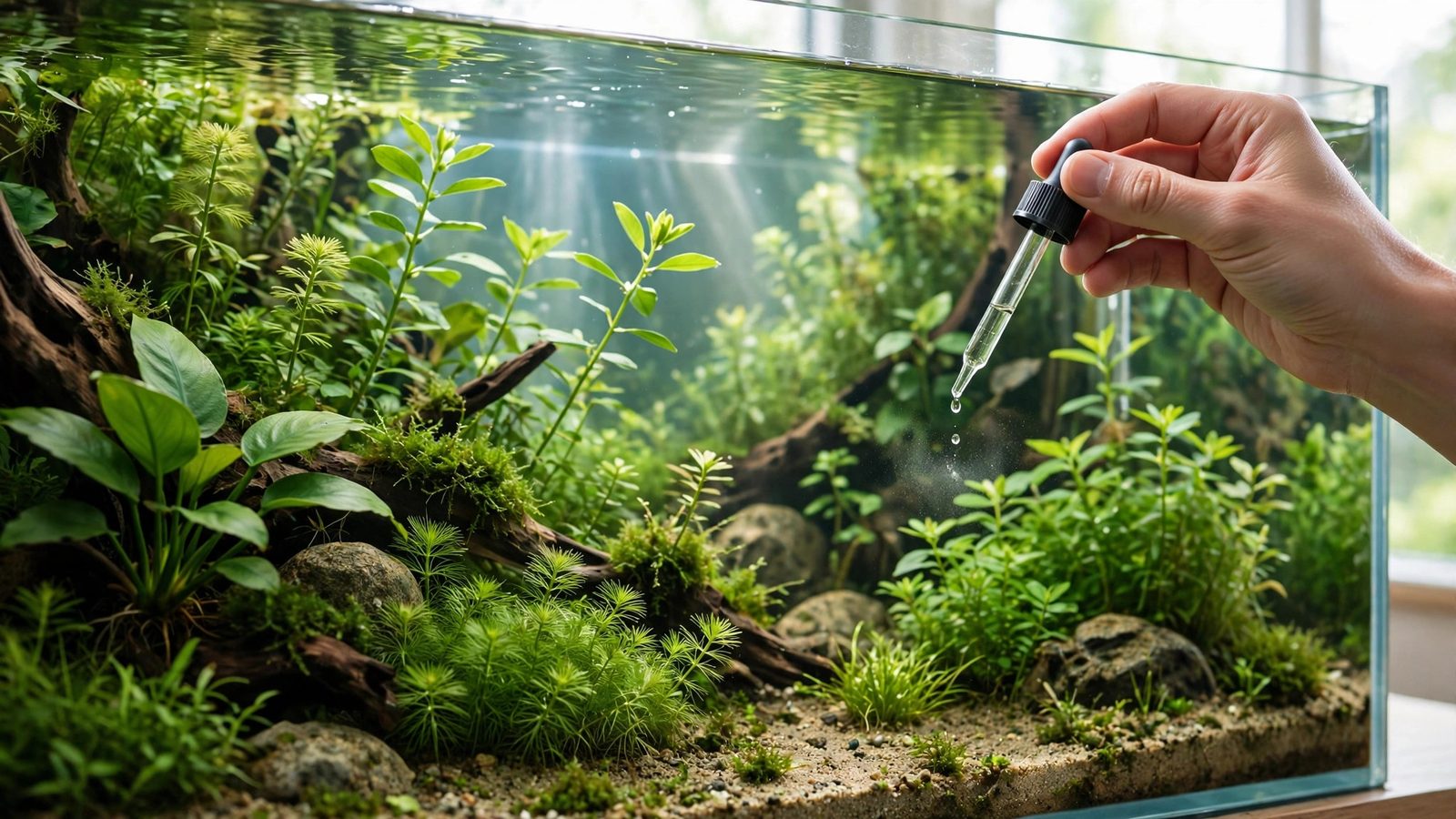
The blue crystals in your garage promise bigger plants — and deliver, on land. Dosing miracle gro aquarium plants water into a planted tank is tempting — a box costs less than one bottle of aquarium fertilizer. But a fish tank is not a flower bed: what garden soil flushes away, your fish breathe. The chemistry that makes Miracle-Gro explosive in a tomato bed turns it into an ammonia bomb underwater. Want the safe option? Start with what to use instead of garden fertilizer, then read the honest breakdown.
The short answer: no, not in a stocked tank
Dissolve Miracle-Gro into an aquarium and plants may perk up for a week. Then the algae arrives — and if you keep fish, trouble arrives with it. This is not about whether Miracle-Gro is good fertilizer; it is excellent for terrestrial plants. It is about nitrogen chemistry in water, where it fails the two tests that matter: will it poison livestock, and will it feed algae faster than your plants?
miracle gro aquarium plants: why the chemistry fails underwater
Miracle-Gro All Purpose is 24-8-16, and the guaranteed analysis on the product's own label tells the story: 3.5% of the nitrogen is ammoniacal and 20.5% is urea — about 85% is ammoniacal, with no nitrate at all. Urea converts to ammonium in water within a day or two (horticultural research on nitrogen forms treats urea as ammoniacal nitrogen for this reason). On land, soil bacteria convert ammonium to nitrate first. In your tank, filter bacteria do the same — but only if the biofilter handles the load, while every fish swims in free ammonia.
Nitrate, the nitrogen in proper aquarium fertilizers, is the safe end of the cycle: stable, plant-usable, and harmless to fish at the 10–20 ppm planted tanks target. Ammonium is the start. At typical aquarium pH, part of it exists as free ammonia (NH3), which harms fish above about 0.02 ppm — and plants and algae absorb ammonium faster than nitrate, so whatever your plants cannot eat within hours feeds algae. This is why aquarists also weigh whether aquarium plants really need fertilizer at all when fish waste already supplies some.
The dosing math that should scare you
Garden directions assume soil and drainage: one tablespoon per gallon, every 7–14 days. A level tablespoon weighs about 15 grams; at 24% nitrogen that is 3,600 mg. In a 10-gallon (38-liter) tank, that adds roughly 95 ppm of nitrogen — almost all of it as urea and ammonium. A planted tank targets about 5–7 ppm of nitrogen per week, so one garden-strength tablespoon delivers 15 to 20 weeks of nitrogen in a single dump. The ammoniacal portion alone is about 14 ppm total ammonia nitrogen; at pH 7.4, roughly 2–3% exists as free ammonia — around 0.3–0.4 ppm NH3, 15 to 20 times the level that starts killing fish.
"Just use a tiny pinch" does not save it: a 1-gram pinch in a 10-gallon tank still adds about 6 ppm of nitrogen — an ammonia load and algae trigger no stocked tank needs.
| Fertilizer | NPK | Nitrogen form | Safe in a stocked tank? |
|---|---|---|---|
| Miracle-Gro All Purpose (water soluble) | 24-8-16 | 3.5% ammoniacal + 20.5% urea — no nitrate | No |
| Miracle-Gro Shake 'n Feed (slow release) | 12-4-8 | Polymer-coated urea, leaches for months | No — worse; no off switch |
| Aquarium all-in-one liquid | Low-strength, nitrate-based | Nitrate; invert-safe trace copper | Yes, as directed |
| Dry EI salts (KNO3 + KH2PO4) | You set the ratio | Nitrate only | Yes — cheapest per dose |
The 0.07% copper sounds tiny, but at garden doses it can stress shrimp and snails, which are far more copper-sensitive than fish. Aquarium fertilizers chelate trace copper at invert-safe doses; garden products make no such promise.
The only two uses that are actually safe
Miracle-Gro is not useless to an aquarist — it just belongs nowhere near the water column. Two fishless contexts are genuinely safe.
Emersed grow-out tubs. Grow plants with roots wet and leaves in humid air, and terrestrial fertilizer rules apply. A weak Miracle-Gro solution in a plant-only tub is safe and effective — commercial growers use exactly this method. Read an emersed-grown aquarium plants guide first; humidity and transition matter more than the fertilizer.
Mineralized topsoil under a cap. The "dirted tank" method buries garden soil under an inch or more of sand or gravel, keeping fertilizer in the root zone, out of the water column. Safety depends on a thick, undisturbed cap: disturb it during a rescape and you release the ammonia.
What to use instead: the safe alternatives
All-in-one liquid fertilizers. Nitrate-based nitrogen, balanced macros, chelated micros at invertebrate-safe levels, pre-mixed at milliliter doses. One bottle treats hundreds of gallons — the simplest swap.
Dry fertilizer salts. Potassium nitrate and monopotassium phosphate, dosed by the Estimative Index method: cheapest per dose, pure nitrate nitrogen, and you control the ratio. Our DIY aquarium plant fertilizer walkthrough covers the measurements.
Root tabs. For heavy root feeders like swords and crypts, capsules pushed deep into the substrate feed roots directly with almost nothing entering the water column. Check the aquarium plant placement guide so tabs land under the plants that need them.
Frequently Asked Questions
Can you use Miracle-Gro for aquarium plants at all?
Yes, but only where livestock cannot reach it: fishless emersed grow-out tubs and mineralized topsoil sealed under a deep substrate cap. It must never be dosed into the water column of a stocked tank, where urea and ammonium nitrogen threaten fish and trigger algae.
Why does Miracle-Gro cause algae in aquariums?
About 85% of its nitrogen is urea and ammonium, which algae absorb faster than nitrate. Whatever your plants cannot consume within hours becomes algae food. One garden-strength dose can deliver 15–20 times a tank's weekly nitrogen target — a guaranteed green-water or hair-algae bloom.
Will Miracle-Gro kill my fish?
At garden doses, yes. One tablespoon per gallon works out to roughly 0.3–0.4 ppm free ammonia in a 10-gallon tank — 15 to 20 times the fish-killing threshold. Even a one-gram pinch creates an ammonia load no stocked tank needs. Dosed by accident, do large water changes and test ammonia daily.
Is Miracle-Gro safe for shrimp and snails?
No. Invertebrates are even more vulnerable than fish to ammonia, and Miracle-Gro's 0.07% copper is an extra risk at garden-dose levels — shrimp are famously copper-sensitive. Aquarium fertilizers chelate trace copper at invert-safe doses; garden products carry no such guarantee.
What is the cheapest safe alternative for aquariums?
Dry fertilizer salts: potassium nitrate and monopotassium phosphate, dosed by the Estimative Index method. A few dollars of salts lasts years on a single tank, the nitrogen is pure nitrate, and you control the dose. All-in-one liquids are the easier option if you prefer pre-mixed bottles.
Can I use Miracle-Gro soil under aquarium substrate?
This is the one tank-adjacent use with a track record: mineralized topsoil capped under an inch of sand or gravel, keeping nutrients in the root zone and out of the water column. Disturbing the cap during rescapes releases the trapped ammonia — plan your aquascape before you fill.
Miracle-Gro is a fine fertilizer doing a job it was never formulated for. Your plants want nitrogen in the water; your fish need it as nitrate, in small steady amounts. Aquarium fertilizers thread that needle — and simple setups may need nothing: undemanding species like the ones on our easiest aquarium plants with no CO2 list often thrive on fish waste alone.