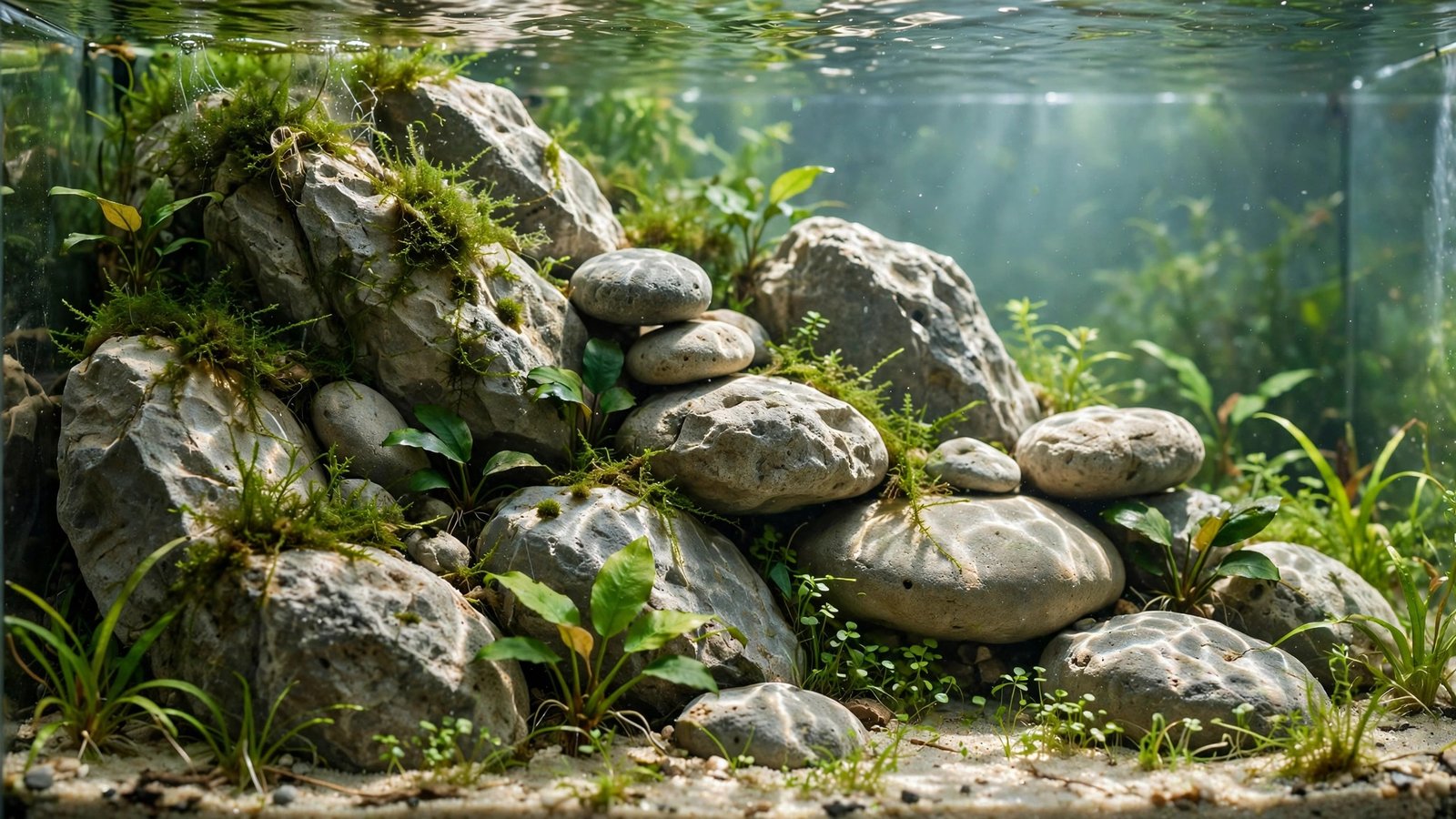
You bought the perfect aquascape stone — jagged, characterful, exactly the shape the layout needed — and within two weeks your soft-water tank reads pH 7.8, your Caridina shrimp are dying, and your Tonina is melting. That is the signature of a carbonate rock quietly dissolving into your water, and one of the most expensive beginner mistakes in the hobby. If you are shopping for rocks that don't raise pH in an aquarium, the rule is simple: choose inert, silica-based or volcanic stones, and verify every piece before it goes in. This guide covers which rocks are pH-neutral, which popular stones secretly are not, a two-minute home acid test, and how to prep and compose inert hardscape.
Why Your Rock Choice Shows Up in Your Test Kit
Carbonate rocks — limestone, marble, dolomite — are compressed calcium carbonate (CaCO3). In pure water they dissolve slowly; in slightly acidic water, exactly what a CO2-injected planted tank produces, they dissolve faster, releasing bicarbonate ions that raise carbonate hardness (kH) and drag pH upward. Silica-based and volcanic rocks — basalt, slate, petrified wood — contain virtually no carbonate and sit in your tank for years without shifting a test parameter.
The effect is gradual but relentless. A handful of Seiryu stone in a 60-liter soft-water tank can lift pH from 6.4 toward 7.4 within weeks and push kH up 2–4 degrees. That drift wrecks three setups: Caridina shrimp breeders (bee shrimp need pH 5.8–6.8, kH 0–2), soft-water plant growers (Tonina and Eriocaulon stall above pH 7), and CO2-injected tanks, where carbonic acid dissolves carbonate rocks faster so pH never settles. If you have wondered whether aquarium rocks raise pH, the answer is: the carbonate ones do, reliably.
Inert rocks also pair best with buffering soils: when your rock adds zero alkalinity, your aquasoil controls the chemistry instead of fighting it — see our complete guide to inert substrates. The reverse combination (carbonate rock plus buffering aquasoil) drains the soil's buffering lifespan twice as fast.
Rocks That Don't Raise pH in Your Aquarium: The Safe List
Every rock below shows no measurable effect on pH, kH, or GH in real planted tanks. That does not mean every bag labeled "dragon stone" is trustworthy — quarry variation and mislabeling are real — which is why the acid-test section exists. Buy from an aquarium retailer when you can, and test anyway.
| Rock | pH effect | Look | Price |
|---|---|---|---|
| Dragon stone (Ohko) | None | Reddish-brown, honeycomb pockets | $$$ |
| Lava rock | None | Black/red-brown, deeply porous | $ |
| Slate | None | Grey, flat layered plates | $ |
| Petrified wood | None | Wood grain in stone, brown-grey | $$ |
| Basalt | None | Dark grey-black, blocky | $$ |
| Pagoda / Mantis stone | None | Layered grey stacks | $$ |
Dragon stone (Ohko)
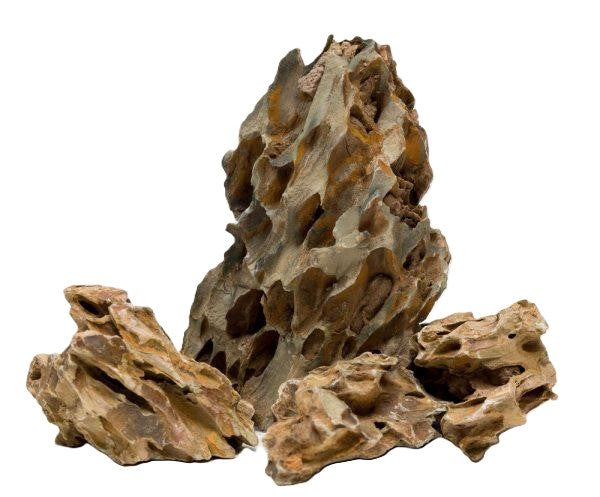
The industry standard. A clay-based sedimentary rock with honeycomb pockets perfect for wedging in Anubias and Bucephalandra — inert and lightweight at a premium price (roughly $8–14 per kg). Brush the pockets out before use; they arrive packed with clay dust. Our Dragon Stone (Ohko) guide covers selection and scaping in full.
Lava rock
The budget champion. Volcanic basalt — completely inert — whose porosity doubles as biological filtration media. Under $3 per kg at garden centers, with a dark color that makes green plants pop. Two caveats: it is sharp (wear gloves; keep it away from burrowing fish), and sourcing matters — see our lava rock in planted tanks guide for safe sources.
Slate
The unsung hero. Metamorphosed shale — layered, flat, grey, and chemically dead in aquarium water. Its plates make ideal caves and terraces, and it is the cheapest "real" aquarium rock (often under $2 per kg). Natural riverbed looks take deliberate stacking. Always vinegar-test raw landscaping slate — occasional batches contain limestone interlayers.
Petrified wood, basalt, and pagoda stone
Petrified wood is organic matter replaced molecule-by-molecule with silica — essentially quartz, fully pH-neutral, with growth rings and grain in every piece (roughly $5–9 per kg). It is heavy, so pad underneath. Basalt is lava rock's smoother, denser cousin: dark, blocky, inert, ideal for minimalist Iwagumi layouts. Pagoda (mantis) stone forms natural layered stacks — dramatic focal pieces with zero chemistry cost.
 ★4.5
Unocho Natural Dragon Stone Ohko Rocks
Check Price on Amazon ★4.5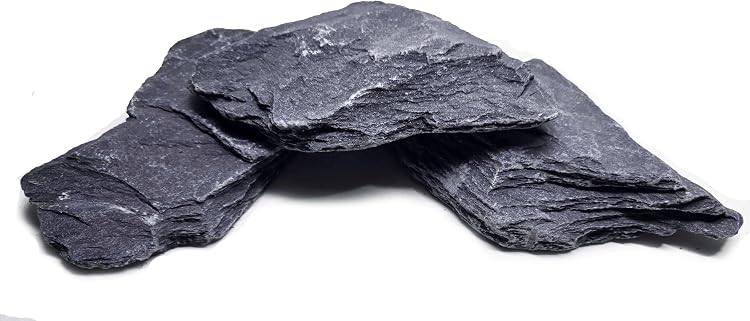 ★4.4
Unocho Natural Slate Stone
Check Price on Amazon ★4.4Rocks That Will Raise Your pH (Know the Enemy)
These are beautiful, popular, and genuinely useful — for the right tank. Hard-water setups (African cichlids, livebearers) want carbonate rocks: they buffer pH exactly where those fish need it. The problem is only when they land in a soft-water planted tank by accident, which happens constantly because several look nearly identical to inert alternatives.
| Rock | pH drift | The confusion trap |
|---|---|---|
| Seiryu stone (limestone) | Often +0.5–1.5 pH | Sold beside dragon stone; nothing alike chemically |
| Texas holey rock | Significant | "Holey" look resembles dragon stone pockets |
| Limestone / marble | Significant | Sometimes sold generically as "aquarium rock" |
| Tufa rock | Significant | Looks like lava rock — test before trusting |
| Coral rock / shells | Significant | Marine-origin, sometimes used decoratively |
Seiryu deserves special attention: the single most misused stone in planted aquascaping. Blue-grey with white calcite veining, gorgeous — and unambiguously limestone, dissolving measurably faster in CO2-injected tanks. Our Seiryu stone guide covers intentional use where the pH lift is harmless. Read our dragon stone vs Seiryu stone comparison before buying: the two are shelved side-by-side, and only one belongs in a Caridina tank.
The Vinegar Test: Two Minutes of Certainty
No fizz, no carbonates, no pH creep. Test every new rock, every time — quarry variation means last year's inert batch says nothing about this one.
How to run it properly
- Rinse the rock first. Dust and surface grime can give false positives. Scrub, rinse, then let the surface dry — fizz is easier to see on dry stone.
- Apply white vinegar (5% acetic acid) to a fresh break or scratched spot with an eyedropper, on two or three different faces. Scratch an inconspicuous corner first — fresh surfaces react more honestly than weathered ones.
- Watch for 60 seconds, close up. Vigorous fizzing means significant carbonate — reject the stone for soft-water use. A faint sizzle in one spot can mean a carbonate vein: carve out or reject that piece. Silence means clear.
- Escalate for certainty. Household vinegar can miss low-carbonate stones. For shrimp breeding tanks, diluted muriatic acid (pool acid, used outdoors with gloves and ventilation) gives a definitive answer.
- Soak-test valuable setups. Place the rock in a bucket of tap water for 7 days, testing kH and pH on day 1 and day 7. A rise of 1+ degree kH confirms slow carbonate release the acid test underplayed.
The chemistry: dissolved CO2 forms weak carbonic acid, which reacts with limestone to release bicarbonate — the process the University of Tennessee's aquaculture buffering guide describes for limestone watersheds. As this UKAPS discussion of hardscape stone and hard water notes, carbonate stone plus injected CO2 dissolves fastest.
Preparing Inert Rocks Before They Go In
Inert means the rock will not shift your chemistry — it says nothing about the dust, clay, or grime coating it. Budget 30 minutes of prep per batch.
- Dry brush first. A stiff brush (an old toothbrush for crevices) knocks off loose dust and clay — dragon stone pockets and lava rock pores hold remarkable amounts.
- Hot water rinse and scrub. Hottest tap water, every face. Never use soap or bleach on porous rock — residues lodge in pores and leach later.
- Inspect under bright light. Reject pieces with metallic veins (brassy, coppery, or silvery streaks — copper is lethal to shrimp), crumbly pockets, or paint/dye.
- Pressure-wash if available. A hose on jet setting blasts pores clean far better than hand scrubbing.
- Skip boiling porous rock. Trapped steam can crack layered or porous stone — sometimes violently. Hot water plus elbow grease is the safe standard.
- Final vinegar spot-check on any fresh surfaces exposed during scrubbing, then place the rock — with egg crate padding under anything heavy.
Foraged river rocks need the same treatment plus a quarantine mindset: runoff can leave pesticides, fertilizer, or oil residue. Only collect where you are certain of clean water.
Aquascaping with Inert Rocks: Contrast and Texture
Choosing inert rocks is chemistry; making them beautiful is design. Some of the world's most celebrated aquascapes are built entirely on dragon stone and lava rock — but they reward deliberate composition.
Commit to one rock type per layout. Mixing dragon stone, slate, and basalt in one tank is the fastest route to an amateur look. Pick a single stone and buy 30–50% more than you need — having twelve pieces to choose seven from is how professionals get that effortless look.
Build contrast with wood and substrate. Dark lava rock against light sand reads dramatically; pale dragon stone pops against dark aquasoil. Match wood undertones: reddish dragon stone with spider wood, grey slate and basalt with dark manzanita. Keep the substrate a single tone — a rock that contrasts with the wood but matches the substrate disappears.
Use texture as your second stone. Dragon stone's honeycomb, lava rock's porosity, slate's strata, petrified wood's grain — huge range without a second rock type. Vary piece size instead: one dominant "father stone," two supporting pieces at two-thirds its height, small rubble at the base. Set the main stone off-center (about 60/40) and slope the substrate for depth — see our best rocks for aquascaping roundup for these techniques across nine stones.
Let plants soften the stone. Epiphytes wedged into dragon stone pockets or lava crevices do more than any extra rock. During the dry layout, leave gaps where Anubias nana petite, Bucephalandra, or mosses will spill over the faces. For caves or breeding shelters rather than display rockwork, terracotta pots are a cheap, fully inert alternative — covered in that guide.
Frequently Asked Questions
Do dragon stones raise pH in aquariums?
No. Genuine dragon stone (Ohko) is a clay-based sedimentary rock with no carbonate content — it will not raise pH, kH, or GH. Confusion usually comes from mislabeled stone: Seiryu and Texas holey rock look vaguely similar and absolutely do raise pH. Vinegar-test every piece to confirm what you actually bought.
Is lava rock safe for shrimp tanks?
Yes, with sourcing care. Lava rock is inert and will not shift pH or hardness, making it chemically ideal for Caridina shrimp. Buy from an aquarium shop or garden center, inspect for metallic veins, and scrub it thoroughly — its pores trap dust. One caution: it is sharp, so pick smoother pieces if shrimp will graze every surface.
Can I use Seiryu stone in a planted tank at all?
You can if your livestock and plants tolerate harder, more alkaline water — community tanks, livebearers, and African cichlids do fine with it. The problem is only in soft-water planted tanks, CO2-injected layouts, and Caridina shrimp tanks, where the carbonate content fights your chemistry. Know your target parameters first.
How long does the vinegar test take?
About two minutes per stone. Apply white vinegar to a fresh, dry surface and watch for 60 seconds — vigorous fizzing means carbonates. For breeding-grade certainty, follow up with diluted muriatic acid and a 7-day bucket soak with kH/pH testing on day 1 and day 7.
Will inert rocks lower my pH?
No — inert means inert. pH-neutral rocks neither raise nor lower pH; they simply do not participate in your water chemistry. Lowering pH is the job of buffering aquasoil, botanicals, or RO water, not your hardscape. The value of inert rock is exactly this neutrality: your substrate and water source stay in full control.
Do I still need to test rocks from an aquarium shop?
Yes. Reputable shops are far more reliable than landscaping yards, but mislabeling and quarry variation happen everywhere — one Seiryu chunk in a dragon stone bin can creep your kH upward for months. The test takes two minutes and costs pennies; test the largest pieces at minimum, and every piece for Caridina tanks.
Buy the Rock for the Water You Want
Rock choice is one of the few decisions you make once and live with for years — pulling a carbonate stone out of a mature, stocked tank is a miserable job. For soft, slightly acidic water, build on dragon stone, lava rock, slate, petrified wood, basalt, or pagoda stone, and verify every piece with vinegar before it touches your water. Pair inert hardscape with a buffering aquasoil, and the test kit stays quiet for years — the sound of a tank whose chemistry was designed, not discovered.