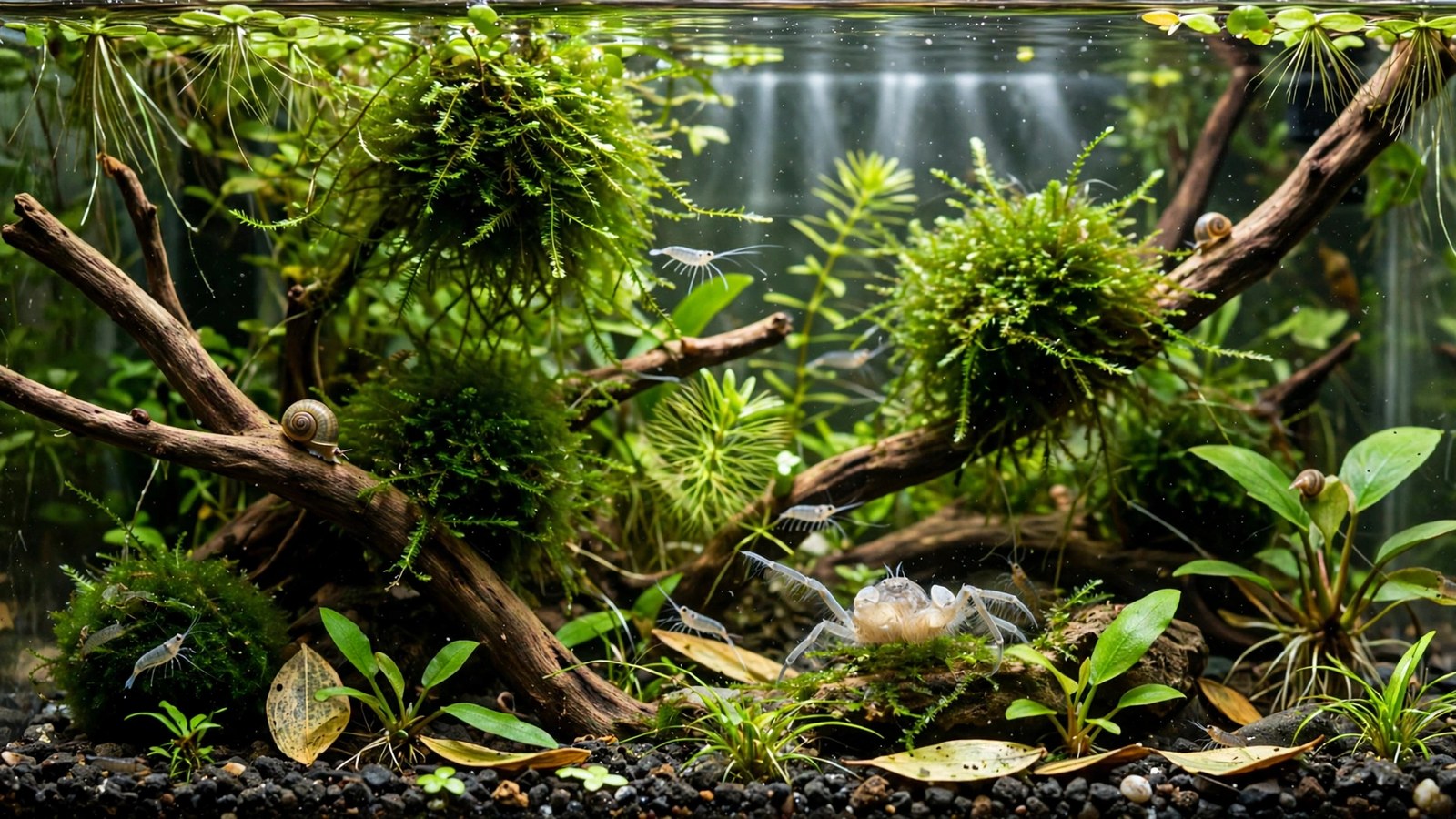
You could watch your tank for a month and still miss them — then one evening you'll spot a fingernail-sized shadow in your floater roots, feathered legs fanned into the current. The Thai micro crab, Limnopilos naiyanetri, is one of the only fully aquatic freshwater crabs in the hobby, tops out around a centimeter, and filter-feeds like a bamboo shrimp. A thai micro crab planted tank built around that behavior is one of the strangest, most rewarding nano setups you can keep.
A thai micro crab planted tank is a freshwater planted nano aquarium — 5 gallons minimum — built around Limnopilos naiyanetri, a 1 cm filter-feeding crab endemic to Thailand's Tha Chin River. Set it up at pH 6.5–7.5 and 72–82°F (22–28°C), with dense moss, floating-plant roots, and a sponge-covered intake; feed powdered microfoods every 2–3 days in a tank matured 4–6 weeks for biofilm. No land or brackish water is needed at any life stage.
How to set up a thai micro crab planted tank
Thai micro crabs fail in generic nano tanks because keepers treat them like tiny scavengers. In the wild, Limnopilos naiyanetri is a filter feeder — it perches on a leaf or root, stretches its hairy claws into slow-moving water, and sieves out microscopic particles. Your whole scape should serve that behavior: perches, gentle current, living biofilm.
The shell: size, lid, and substrate
Five gallons is the honest minimum for 5–10 crabs; a 10-gallon gives steadier parameters and more perch space. Use a tight-fitting lid — escape attempts are well documented — and fine sand or smooth gravel to protect their delicate legs. Don't panic if your new colony vanishes into the plants at first — they're nocturnal and shy. These nano planted tank ideas adapt to a crab colony with almost no changes.
The canopy: floating-plant roots are their natural home
Cover a third to half of the surface with frogbit, red root floaters, or dwarf water lettuce so long roots dangle into the water column — perches, feeding stations, and cover in one. Light the midground low to moderate; Thai micros prefer shaded corners. The species in our floating aquarium plants for beginners guide all work; root structure matters more than the species name.
Moss, wood, and the biofilm engine
Wrap 40–60% of your driftwood in java moss, Christmas moss, or pelia — fuzzy surfaces grow the thickest biofilm, and biofilm is the calorie base of this tank. Angle a few branches into gentle flow so crabs can perch in the current. The best aquarium mosses for this job are the fine, branching ones.
Cycle like you mean it: 4–6 weeks of biofilm
Run the planted tank empty for at least 4–6 weeks so biofilm coats every surface. Seed with a bacterial starter and feed the empty tank a dusting of powdered food twice a week. When the wood looks slightly fuzzy and the glass needs its first scrape, it's ready — the same logic behind how biofilm fuels a shrimp tank.
Filter-feeding: what actually reaches them
A settled crab climbs to a perch, extends its hairy claws and legs into the current, and holds still. Particles stick to the fine setae; every few minutes it combs a claw clean — a behavior retailers describe the same way on Aquatic Arts' Thai micro crab care page. Whole pellets mostly rot before these mouths can work through them, so keep a steady drift of micro-particles passing their perches.
| Food | How to offer it | Frequency |
|---|---|---|
| Powdered shrimp food | A few grains dusted upstream of perches | Every 2–3 days |
| Crushed algae wafer dust | Grind a wafer corner; sprinkle into gentle flow | 2× per week |
| Newly hatched baby brine shrimp | Rinse, release near the filter outflow | 2× per week |
Keep a gentle, directional current — a sponge filter, or a hang-on-back on its lowest setting, is ideal. Strong flow dislodges them; no flow means food settles out of reach. Non-negotiable: a sponge pre-filter sleeve over every intake, rinsed weekly. Standard intakes will pin and kill a 1 cm crab.
Tankmates: shrimp yes, most fish no
Thai micro crabs are completely peaceful and can't threaten adult shrimp. They pair beautifully with Neocaridina and Caridina colonies — crabs fan-feed in the water column while shrimp work the surfaces below, sharing the same preferred parameters. Small snails are equally safe. Fish are where it goes wrong: even small fish outcompete the crabs for powdered food, and anything with a bigger mouth — bettas included — is a predation risk. A colony of 8–10 crabs with 15–20 cherry shrimp in a planted 10-gallon is the sweet spot; our planted shrimp tank setup guide covers the shared parameters.
The pom-pom confusion: freshwater means freshwater
Search the trade for "pom-pom crab" and you'll find freshwater-labeled crabs that actually need brackish water to complete their life cycle — larvae that die in pure freshwater. That confusion has burned buyers for years. Limnopilos naiyanetri is not one of those crabs: fully freshwater from hatching to death — no land, no brackish phase, no paludarium shelf. Vampire crabs are semi-terrestrial and belong in a paludarium, a completely different build.
| Parameter | Target | Notes |
|---|---|---|
| Temperature | 72–82°F (22–28°C) | Stability beats a perfect number |
| pH | 6.5–7.5 | Slightly acidic to neutral |
| GH / KH | 5–15 / 2–8 | Enough minerals for molting |
| Ammonia / nitrite | 0 ppm | Test weekly |
| Water changes | 20–30% weekly | Avoid big swings |
A failed molt usually means mineral-poor water — keep GH above 5, add cuttlebone for very soft tap water, and skip copper-based medications. Females carry eggs, but no hobbyist has raised larvae past about nine days — buy a display colony and refresh it every 18 months or so.
Frequently Asked Questions
Do Thai micro crabs need land or brackish water?
No. Limnopilos naiyanetri is fully aquatic and fully freshwater for its entire life cycle, unlike confusingly named pom-pom crabs that need brackish water to breed, and unlike semi-terrestrial vampire crabs. A standard submerged planted tank with a lid is all they need.
How many Thai micro crabs can I keep together?
Five to ten in a 5-gallon tank is standard. They are genuinely social — a lone crab hides constantly, while a group of eight fans out across the plants and feeds openly. They don't fight or claim territories, so crowding means more visible behavior. Scale to 10–15 in a 10-gallon.
Can Thai micro crabs live with cherry shrimp?
Yes — the classic pairing. Adult Neocaridina and Caridina shrimp are completely safe with Thai micro crabs and vice versa; the crabs are too small and too specialized as filter feeders to threaten shrimp. They share the same water parameters and feed in different niches.
Why did my Thai micro crabs disappear?
They are nocturnal, translucent, and only a centimeter wide — functionally invisible by design. Check at night with a dim flashlight aimed at floating-plant roots and moss in gentle current; that's where they fan-feed. If the tank is lidless, check the floor behind the stand first.
Will Thai micro crabs breed in my tank?
Effectively no. Berried females release free-swimming larvae, but nobody has raised them past about nine days — the required conditions are still unknown. Treat the colony as a display group with a 12–18 month lifespan and budget for replacement stock.
A tiny crab with an outsize payoff
A thai micro crab planted tank asks for patience more than money: six weeks of cycling, a canopy of floating plants, moss on everything, the lightest touch with powdered food. What you get back is a creature most aquarists have never seen — a centimeter of translucent crab, fanning the current like it owns the river it came from.