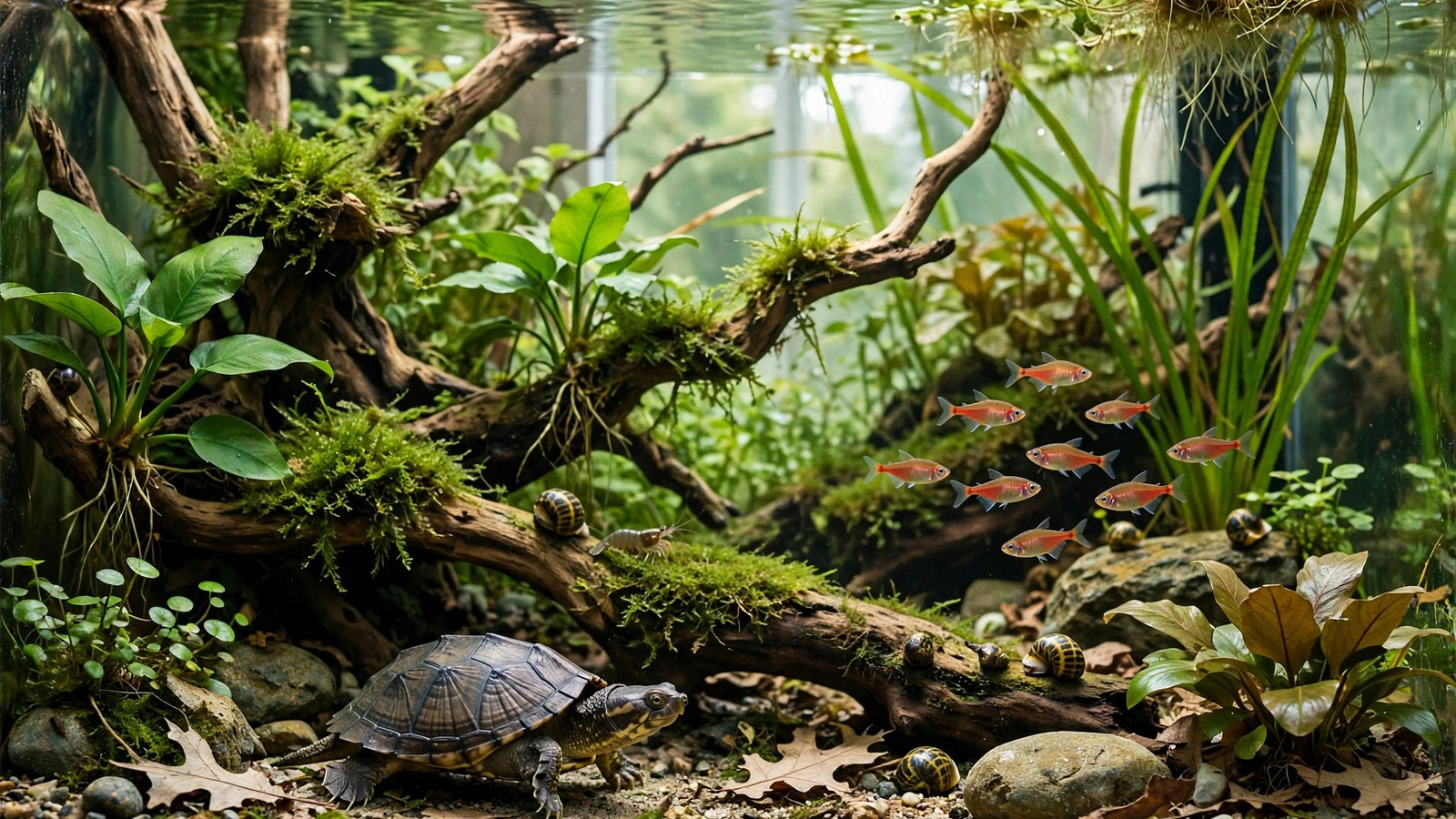
Fill a tank to the rim, drop in a floating dock, and your musk turtle may never touch that dock — in the worst case, it can drown struggling to reach the surface. Musk turtles are bottom-walkers, not swimmers, and the most common mistake keepers make is designing for fish instead of the turtle. A good musk turtle planted tank flips that logic: shallow-to-moderate water, an easy climb to the surface, a hot basking spot, and plants tough enough to take a beating.
Live plants here do far more than look nice. They steady the water chemistry under a heavy bioload, give a shy bottom-dweller cover, and double as browsing material. Start your plant list with the best aquarium plants for turtle tanks, then build the layout below around the turtle's habits.
Why a musk turtle planted tank needs a different layout
Every decision in this tank starts from one fact: Sternotherus turtles walk along the bottom. Nearly fully aquatic yet clumsy swimmers, they must reach the surface to breathe without exhausting themselves — a deep, open water column is the opposite of their habitat. Plant-choice advice like the Aquarium Plants for Fish Tank Guide still helps, but run the layout through the Low-Tech Planted Tank Setup method: a turtle tank needs stability and toughness, not peak growth rates.
Tank size and layout for each musk turtle species
Three pet-trade species all suit a planted setup. The Savannah River Ecology Lab species account notes musk turtles favor shallow, vegetated water with soft bottoms — recreate that with a wide breeder-style tank rather than a tall one.
| Species | Adult size | Minimum tank | Notes |
|---|---|---|---|
| Common musk (Sternotherus odoratus) | 3–5 inches | 40-gallon breeder | Hardiest species; the "stinkpot" |
| Loggerhead musk (Sternotherus minor) | 3–5 inches | 55 gallons | Powerful snail-crushing jaws — respect the bite |
| Razor-backed musk (Sternotherus carinatus) | 5–6 inches | 75 gallons | Largest of the three |
Water depth, filtration, and the basking spot
Keep hatchlings in 4–6 inches of water, adults at 12–18 inches, with something to rest on within a body length of the surface — a sloped branch, flat rock, or suction-cup ledge. This one detail prevents the exhaustion drownings that kill more pet musk turtles than disease.
Musk turtles are messy feeders, so run a canister filter rated for at least double the tank volume, with a pre-filter sponge on the intake. Cycle a planted tank faster with a fishless cycle first — turtle waste punishes an immature biofilter.
Basking is non-negotiable: a haul-out platform at 90–95°F under a heat lamp, with a 5.0 UVB tube running 10–12 hours a day overlapping the same spot. Zilla's musk turtle husbandry handbook confirms the recipe, including bulb replacement every 6 months — skipping UVB invites metabolic bone disease.
Article makes 5.0 UVB 10-12 hrs/day plus bulb replacement every 6 months non-negotiable; the UVB lamp is the #1 buying decision for a turtle keeper: a ReptiSun 10.0 compact UVB bulb ★4.5.
The toughest plants for musk turtles
Your turtle will bulldoze, uproot, and taste-test your plants — treat it as enrichment, not failure. Pick species that taste bad, root too deep to matter, or outgrow the damage, and tie epiphytes to hardscape. Plant heavily on day one (see how many plants a new aquarium actually needs) so damage spreads instead of killing a few plants.
| Plant | Placement | Why it survives |
|---|---|---|
| Java fern | Tied to driftwood or rock | Tough, bitter leaves turtles ignore |
| Anubias | Tied or glued to hardscape | Leathery, nearly indestructible leaves |
| Amazon sword | Deep in substrate, behind rocks | Massive roots; recovers fast from nibbling |
| Hornwort | Free-floating | Outgrows any browsing |
| Frogbit, salvinia | Floating | Shade and cover; multiply faster than eaten |
Substrate and hardscape
Use 1–2 inches of pool-filter sand — turtles root and dig constantly, and waste sits on top for easy siphoning. Angle driftwood ramps from the bottom toward the surface, add a flat rock or two as rest stops, and keep the center open as a bottom-walking "highway" with plants pushed to the back and sides.
Tank mates — one turtle is usually best
The safest musk turtle tank holds exactly one turtle. Musk turtles are feisty biters, and anything that fits in those jaws — tetras, guppies, shrimp — will be eaten. Never house two males together; even male-female pairs can harass each other. Pond snails make the best tank mates: they graze algae and double as prey.
Feeding and weekly maintenance
Musk turtles are carnivorous bottom-feeders: offer sinking pellets, earthworms, bloodworms, and snails in the water. Feed juveniles daily, adults every other day — only what disappears in 10 minutes — plus cuttlebone (hard backing removed) for self-serve calcium. Weekly: 25–30% water change, rinse the pre-filter sponge, re-anchor evicted plants. Nitrates over 40 ppm means overfeeding or under-filtering.
Frequently Asked Questions
How deep should the water be in a musk turtle planted tank?
Keep hatchlings in 4–6 inches and raise adults to 12–18 inches, never deeper without resting structure. Musk turtles are bottom-walkers and weak swimmers, so every depth needs driftwood, ledges, or rocks within easy reach of the surface. Deep water with nothing to rest on can exhaust and drown even an adult.
Do musk turtles really need UVB if they rarely bask?
Yes — UVB is non-negotiable. Run a 5.0 UVB tube 10–12 hours a day with a heat lamp holding the basking spot at 90–95°F. Without UVB, musk turtles cannot synthesize vitamin D3 properly, which leads to metabolic bone disease over their 30–50 year lifespan. Replace the tube every 6 months as output fades.
Will musk turtles destroy all my plants?
They damage delicate plants but cannot destroy a well-chosen planting. Use Java fern and Anubias tied to hardscape, Amazon swords rooted behind rocks, and fast floaters like hornwort, frogbit, and salvinia. Expect some uprooting and nibbling as normal enrichment, and re-anchor evicted plants during weekly maintenance.
Can I keep fish with a musk turtle?
One turtle alone is the safest setup. Anything small enough to fit in its jaws — tetras, guppies, shrimp — will eventually be eaten. Some experienced keepers try large, fast fish like giant danios, but treat them as a gamble, never a plan. Pond snails are better tank mates: they clean algae and serve as natural prey.
How often should I change the water?
Change 25–30% weekly without fail. Musk turtles are messy feeders with a heavy bioload, and even an oversized canister filter plus live plants cannot replace water changes. If nitrates stay above 40 ppm between changes, you are overfeeding, under-filtering, or overdue for filter maintenance.
Can two musk turtles live together?
It is not recommended. Musk turtles are territorial and aggressive — two males will fight, and even male-female pairs can harass each other in a tank. A single turtle in a 40–75 gallon planted tank is calmer, healthier, and easier to feed correctly. Set up a second tank rather than doubling up.
Design for the turtle first and the plants will do the rest: steady the water, soften the light, and turn a glass box into the shallow, weed-choked pond your musk turtle evolved for.