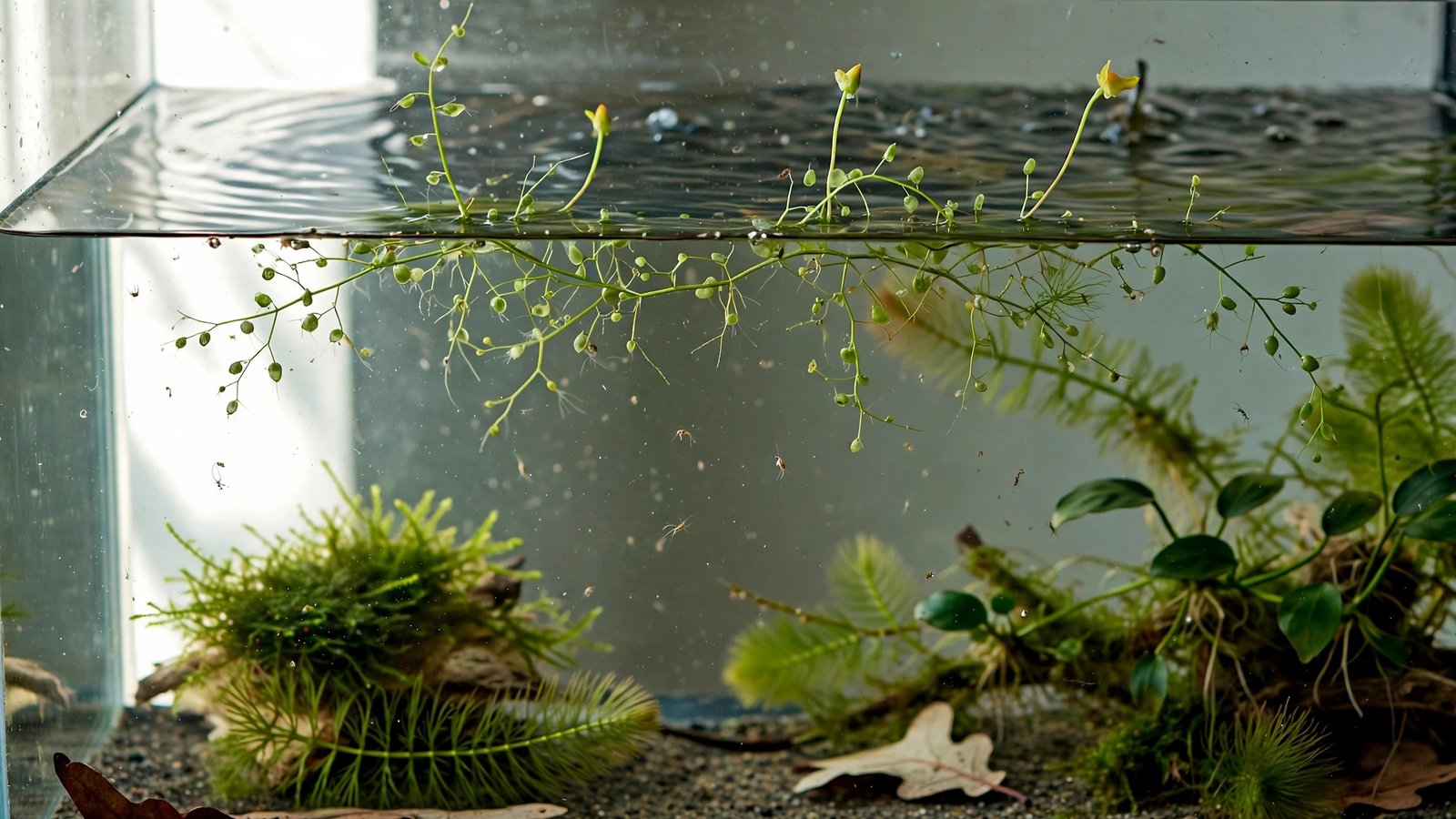
There may already be a carnivorous plant hunting in your tank — and you probably never bought it. Utricularia gibba slips into aquariums uninvited on new plants, threading through moss and carpets while its tiny bladder traps vacuum up infusoria too small to see. Mastering utricularia gibba care means deciding whether this floating hunter earns a place — or an eviction.
Utricularia gibba (humped bladderwort) is a free-floating carnivorous plant that feeds on infusoria and other microorganisms through bladder traps barely 1–2 mm wide. Each trap snaps shut in roughly half a millisecond — one of the fastest movements in the plant kingdom — yet it is completely safe for shrimp and even shrimplets, which are far too large to be caught. It needs no fertilizer, no CO2, and about six hours of light a day; pH 5.5–7.5 and ~25°C suit it well, and unlike many carnivorous plants it requires no dormancy.
Why Utricularia Gibba Care Is Easier Than Its Name Suggests
Unlike its carnivorous cousins — Venus flytraps demand dormancy, sundews demand rainwater purity — Utricularia gibba wants almost nothing: no fertilizer (it feeds itself), no CO2, just clean water, six-plus hours of light, and gentle flow. Nurseries list it as "easy to grow, no dormancy required" — and it shares the low-maintenance pitch of the floating plants for beginners your tank may already hold.
| Parameter | Target |
|---|---|
| Light | 6+ hours per day, medium–high intensity |
| Temperature | ~25°C (tolerates 20–28°C) |
| pH | 5.5–7.5 |
| Water hardness | Soft to moderately hard; nutrient-poor is fine |
| Fertilizer | None needed — it eats microorganisms |
| CO2 | Not required |
| Substrate | None — it floats freely |
| Water flow | Gentle to moderate; strong currents shred the stems |
How It Catches Food (and What It Actually Eats)
Every strand carries dozens of translucent bladders, each barely 1–2 mm long, sitting under negative pressure with a trigger-hair gate. When an infusorian or rotifer brushes the hairs, the gate buckles, water rushes in, and the prey is sucked inside in roughly half a millisecond — one of the fastest plant movements ever measured. Then the bladder digests its catch and resets.
That's the whole feeding program, running invisibly in your tank. A healthy colony constantly sweeps the water for the micro-life that fish food and plant debris generate — denting infusoria populations, handy in breeding tanks, where fry eat the same infusoria. Unlike its carpeting cousin Utricularia graminifolia, which roots in the substrate, gibba never anchors — it drifts.
Will It Eat My Shrimp or Fry? The Honest Answer
Plainly: no. The traps are built for prey measured in micrometers to a millimeter — infusoria, rotifers, water fleas. A newly hatched shrimplet is several millimeters long and strong enough to walk out of trouble; standard hobby experience is that gibba is completely shrimp-safe, and many keepers run it in breeding tanks deliberately. Even a newborn guppy is orders of magnitude too large for a trap designed to catch organisms you need a microscope to see.
The realistic "risk" runs the other direction: in a fry tank, gibba competes with your fry for the same infusoria — not a safety problem, worth knowing. Its tangled stems double as cover for baby shrimp, much like the mosses in peacock moss shrimp tank setups.
How to Grow Utricularia Gibba on Purpose
Propagation is comically easy: drop a fragment in the tank — any green piece regenerates. Float a loose tuft on the surface of a well-lit tank and let it drift; within weeks it forms a tangled mat that shades whatever sits below it, so plan for that if you have light-hungry plants underneath.
It also weaves itself into moss and carpet lawns on its own — a gibba-threaded Java moss patch looks wilder, and the plant trims the patch's micro-fauna. It's a guest tangling through the host, and it can be teased out strand by strand if you change your mind.
Don't chase it with fertilizer — that feeds competing algae, not gibba. Nutrient-poor water with six-plus hours of decent light is the whole recipe. In warm, bright conditions it may send up small yellow blooms above the waterline — confirmation that your "weed" is thriving.
How to Control or Remove Utricularia Gibba
Gibba's superpower — regenerating from fragments — is also its worst habit. Trimming it with scissors is how it multiplies: every clipped strand becomes a new colony — something the guides for the easiest beginner aquarium plants never cover.
Removal has to be total. Turn off your filter first (fragments clog the media), then lift the whole mat out by hand in one slow motion. Then inspect moss patches, carpet edges, and filter intake foam for stray green thread and pull every piece — a single forgotten fragment restarts the colony within weeks. Dry out everything you pull and bin it — never rinse it down a drain or release it into local waterways, where it can turn invasive.
Long-term control is simpler: confine it. A floating ring of airline tubing corrals a tuft to one corner, containing the tangle and its shade. And quarantine everything new — gibba overwhelmingly arrives as a hitchhiker on store plants, and a week of observation in a separate container reveals the telltale threadlike stems.
 ★4.6
Pawfly 4" Aquarium Shrimp Net
Check Price on Amazon ★4.6Frequently Asked Questions
Is Utricularia gibba safe for shrimp?
Yes. U. gibba traps are built for prey 1 mm or smaller — infusoria, rotifers, water fleas. Even newly hatched shrimplets are too large and strong to be caught, and breeding-tank hobbyists confirm it is shrimp-safe. Its tangled stems actually give baby shrimp extra cover. The only caveat: in a fry tank, gibba competes with fry for the same microscopic food.
Will Utricularia gibba eat my fish fry?
No. Even newborn fry like guppies or endlers are far too large and mobile for traps designed to catch organisms measured in micrometers. Fry are completely safe. What the plant consumes is the infusoria that many fry feed on, so in a breeding setup you may need to supplement first foods slightly — but the fry themselves are never at risk.
Does Utricularia gibba need fertilizer or CO2?
Neither. U. gibba is carnivorous — it gets its nitrogen and phosphorus from captured microorganisms, so liquid fertilizer is unnecessary and mostly feeds competing algae. CO2 is equally unnecessary; it grows perfectly well in low-tech tanks. The whole routine is: six-plus hours of medium–high light daily, pH 5.5–7.5, and temperatures around 25°C.
How do I get rid of Utricularia gibba completely?
Remove it by hand, all at once. Turn off the filter, then lift out every strand in one slow motion and pick through moss, carpet edges, and filter foam for leftovers — any fragment regenerates within weeks. Never trim it as a control method; clipping multiplies it.
Can Utricularia gibba grow in a pond or outdoors?
Yes — it is native to ponds and wetlands worldwide, and botanical references call it perfect for ponds and bog gardens. In warm climates (consistently above ~20°C) a loose tuft thrives in a container pond or tub, where it may even flower with small yellow blooms. Check local regulations first: in some regions it is an invasive weed and must never be released into wild waterways.
Should You Welcome It?
If you like a little wildness in your tank — a plant that hunts its own food and asks for nothing — gibba is a gift that arrived free with your last plant order. If you run a manicured aquascape, its tangles will drive you mad. For the science, see the NC State Extension profile of Utricularia gibba or the sarracenia.com FAQ on U. gibba.