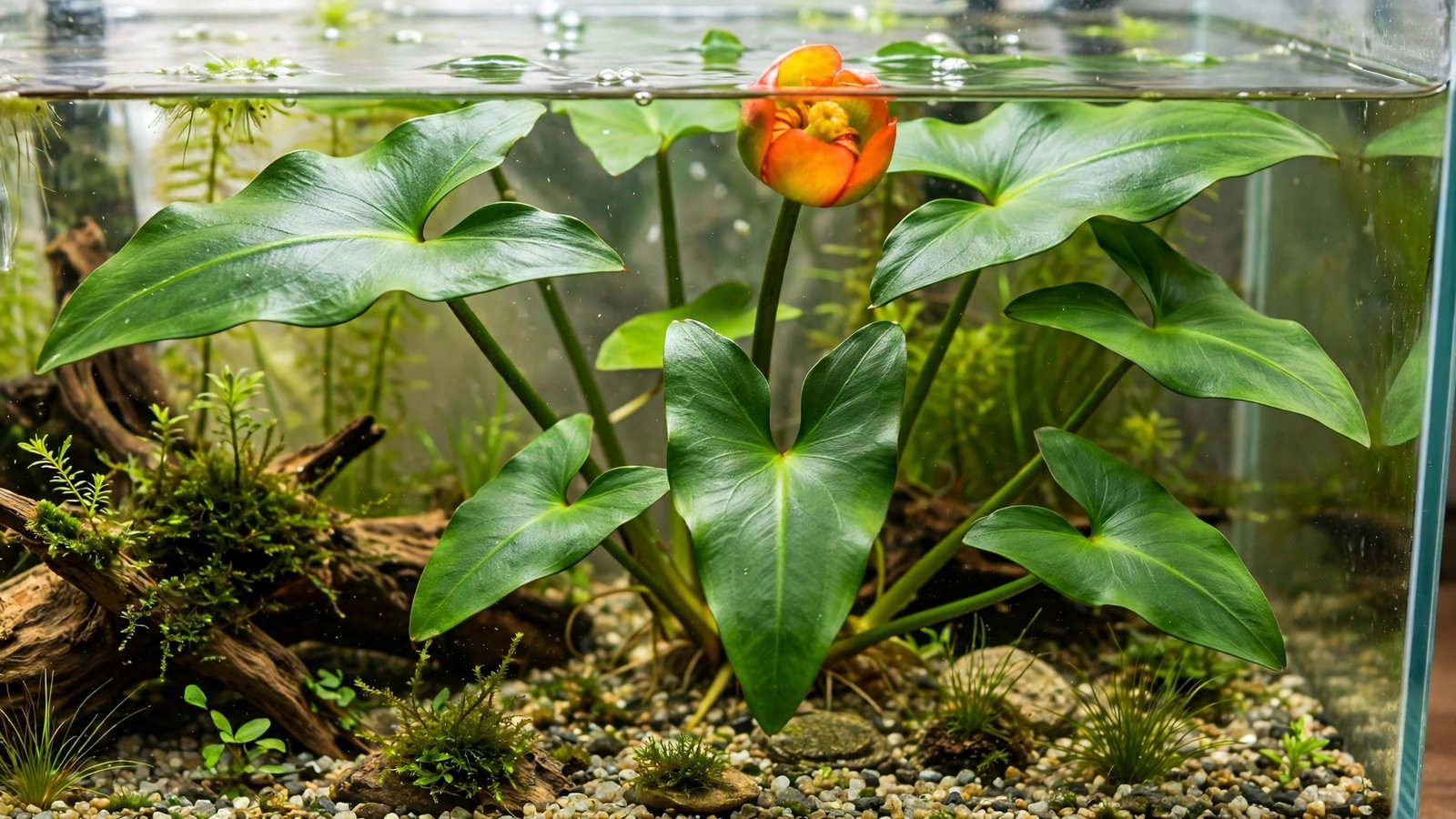
A reader wrote in a panic: the "dwarf pond lily" tucked into a 10-gallon tank had, in four months, pressed floating leaves against every wall, shaded out everything below, and was lifting the lid with a bud. That plant was Nuphar japonica, the Japanese spatterdock — and its tank was about a tenth the size it needed. This nuphar japonica care guide starts there: this is a magnificent, hardy, pond-scale plant that rewards a big container and punishes a small one.
A Pond Plant That Tolerates Aquariums
Japanese spatterdock is a member of the water-lily family, Nymphaeaceae, and behaves like one: a thick, creeping rhizome sends up long stalks topped with broad, leathery floating leaves, and in summer it opens small cup-shaped yellow flowers with a faint fermenting-fruit scent, followed by bottle-shaped seed pods. Outdoors it is nearly indestructible, shrugging off cold winters and thriving in full sun. That toughness is the trap: "hardy" gets misread as "fits any tank," when the real meaning is "fits any climate."
Want lily looks in an ordinary aquarium? The honest answer is the dwarf aquarium lily — a fraction of the size and genuinely tank-sized. Reserve Japanese spatterdock for where a 2–4 ft leaf canopy is a feature: a pond, a 100+ gallon patio tub, or a truly large indoor aquarium with it as the single centerpiece. Confirm you're buying true Nuphar japonica, not a lookalike sold under a vague "pond lily" label; the Japanese species has narrower, more arrow-shaped leaves than the common European yellow pond lily.
Planting the Rhizome: Horizontal, Barely Covered
All rhizome planting comes down to one rule: lay it horizontally on the substrate and cover it with no more than 1–2 cm of soil or gravel — or wedge it between two stones until new roots anchor it. The rhizome needs water and light around its crown; within weeks, thick white roots grow down and pin it in place.
Ponds
Use a wide, shallow aquatic basket: line with landscape fabric, fill with heavy clay loam (not light compost, which floats away), lay the rhizome at the surface, and top with 1–2 cm of pea gravel. Set the basket so the crown sits 15–45 cm below the surface — shallow water warms faster and encourages flowering. Space plants 60–80 cm apart.
Large aquariums
Plant into a nutrient-rich bed 5–8 cm deep, in open water away from the filter outflow. Add root tabs beneath it at planting and every 3–4 months; in bare sand it will stall. Keep it clear of hardscape so leaves reach the surface unobstructed.
nuphar japonica Care: Light, Water, and Feeding
Planted correctly, nuphar japonica is refreshingly undemanding. Light is the dominant variable: the floating leaves are its only real solar panels, so they must get strong light from above. Outdoors, full sun is ideal. Indoors, hang a strong full-spectrum light 20–30 cm above the water; a dim lidded setup yields leggy stalks and small dark leaves.
| Parameter | Pond | Large aquarium |
|---|---|---|
| Light | Full sun, 6+ hours | Strong overhead light, no lid shadow |
| Temperature | Hardy below freezing | 18–28°C (65–82°F) ideal |
| Water movement | Still or gently circulating | Low-flow zones; baffle strong filters |
| Substrate | Clay loam in basket | Nutrient-rich bed + root tabs |
| Depth over crown | 15–45 cm | 20–40 cm |
| Feeding | Pond tablets in spring | Root tabs every 3–4 months |
Water chemistry is a non-issue: it adapts to soft or hard water and pH 6.0–8.0. Goldfish and koi may sample the leaves, but mature foliage is tough enough to survive — unlike delicate beginner floating plants such as frogbit and water lettuce, which goldfish devour. Keep the leaves clean; algae films block light and stall growth, so treat the algae, not the plant. Trim yellowing leaves at the stalk base, never more than a third of the canopy at once.
 ★4.3
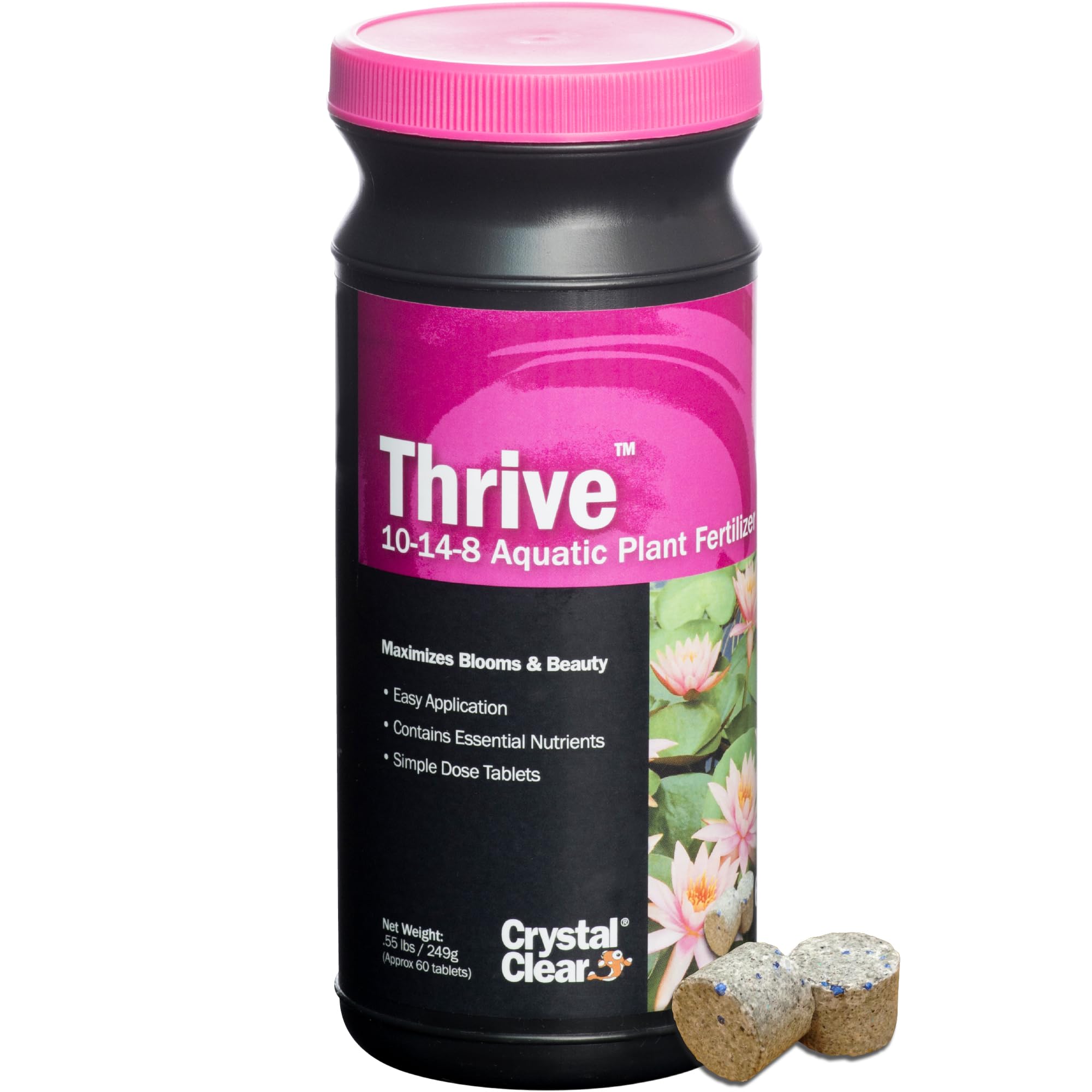
CrystalClear Thrive Pond Plant Food
Check Price on Amazon ★4.3Seasonal Dormancy: Let It Rest
In temperate climates Japanese spatterdock goes dormant from roughly November to March. Leaves yellow, collapse, and sink — the plant looks dead, but the rhizome is simply resting and will push new leaves once water warms past about 12–15°C (54–59°F) in spring. In a heated indoor tank it may stay evergreen, though growth slows in winter even under constant light.
Outdoors it needs almost nothing: cut back dead foliage and keep the crown below the frost line — 45–60 cm of depth lets it overwinter in place. In shallow tubs that freeze solid, move the basket somewhere frost-free for winter. Never fertilize a dormant plant; it can't use it, and the excess only feeds algae.
Why It Is Not a Nano-Tank Plant
Say it plainly: a mature plant covers 60–120 cm of surface with flat floating leaves that block light to everything below. Under about 75 gallons, one plant becomes the entire aquascape within a season. Trimming doesn't fix it — removed leaves are simply replaced, and cutting the rhizome is propagation, not pruning.
For the floating-leaf look at small scale, stay in the family with the dwarf aquarium lily, or try the compact banana plant, the beginner lily relative — lily pads without the pond footprint. For tall background foliage in the big tank you freed up, consider the tall Cryptocoryne balansae background plant or vallisneria, the classic background grass. For authoritative botanical detail, the RHS profile of Nuphar japonica confirms its pond-scale habit and hardiness.
Frequently Asked Questions
How big does Nuphar japonica actually get?
A mature plant spreads 60–120 cm (2–4 ft) of floating leaves across the surface, leaves 10–20 cm across, and the rhizome reaches 30–60 cm over a few years. Hence the honest minimum: 75–100 gallons indoors, or about a square metre of pond surface per plant outdoors.
Can it grow fully submerged in an aquarium?
Not happily. It occasionally makes small submerged leaves, but its habit is built around floating foliage. In a deep tank it stretches long stalks to the surface and weakens without strong overhead light. Shallow setups — 20–40 cm of water over the crown — suit it far better than deep tanks.
Why are the leaves melting after planting?
Most likely the rhizome is buried too deep; at 8–10 cm under the substrate it suffocates and rots. Lift it so the crown sits at or just 1–2 cm below the surface. Some melt is normal transplant shock — with a firm, correctly positioned rhizome, new leaves usually appear within 2–4 weeks.
Does Japanese spatterdock survive winter outdoors?
Yes. The rhizome is fully cold-hardy and survives under ice, dormant from about November to March before resprouting in spring. The crown must sit below the frost line — roughly 45–60 cm of water depth — or the basket should be moved somewhere frost-free for winter.
How do I propagate Nuphar japonica?
Divide the rhizome in early spring before new growth. Cut sections with a sharp knife so each has at least one growing tip and some roots, then replant each piece horizontally at the surface. Divisions establish quickly and often flower in their first season.
In the right container, Japanese spatterdock is one of the most forgiving water plants you can grow — a hardy rhizome, glossy pads, and cheerful yellow flowers with almost no intervention. The entire secret is scale: give it a pond, a patio tub, or a big tank, plant the rhizome shallow, and let it do what it was built to do. Respect its size and it rewards you for decades; fight it in a small tank and you'll lose every month.