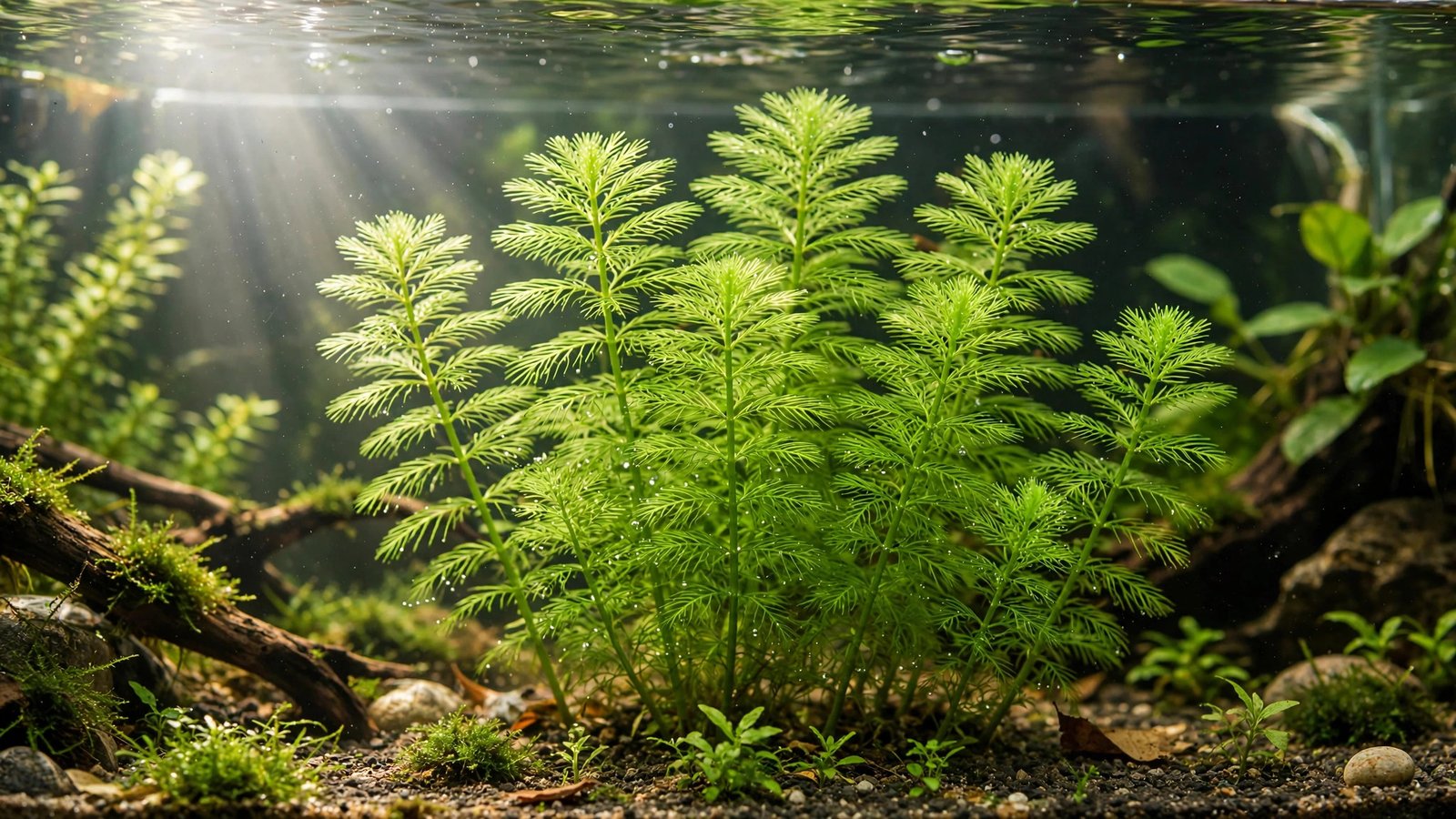
Some stem plants punish neglect; this one negotiates. Give Mattogrossense milfoil decent light and a steady diet of liquid nutrients and it hands you a feather-green forest in weeks. Starve it and it goes leggy, pale, and brittle — and it tells you exactly what's wrong before it gives up. For aquarists researching myriophyllum mattogrossense care, that readable feedback loop is the appeal: a fast, honest grower that rewards consistency over expensive equipment.
How do you care for Myriophyllum mattogrossense? Plant it midground to background in medium–high light (30–50+ PAR at substrate level), keep water between 68–82°F and pH 6.0–7.5, dose a complete liquid fertilizer on schedule, and trim tops every 2–3 weeks, replanting them to thicken the stand. CO2 is recommended but not required. Its signature trait: it feeds through its leaves, so white shoot tips are the plant's own flag for iron and micronutrient deficiency — and like other fast-growing stem plants like hornwort, it rewards you once you settle whether aquarium plants really need fertilizer — through the water column, it does.
Myriophyllum Mattogrossense Care: The Species in a Nutshell
Mattogrossense milfoil — sold as Myrio Green — is named for Brazil's Mato Grosso region, where it grows in slow Amazon tributaries, ranging across western South America into Peru, Ecuador, Colombia, and Bolivia. It stands apart with finely pinnate, feathery bright-green foliage on slightly reddish stems, in dense whorls that fan out under good light. If you've read our broader milfoil genus guide, think of mattogrossense as the bright, hungry, fast-feeding specialist of the family.
Its "good starter plant" reputation is earned but incomplete. It forgives missed water changes and tolerates a wide pH range, yet it has one non-negotiable demand: it eats from the water, not the ground. Once you accept that liquid fertilization is the main event rather than a supplement, the plant is genuinely easy — and its brisk growth makes it one of the best nutrient sponges for outcompeting algae in a new setup.
Light and CO2: The Two Dials That Matter
Light decides the plant's personality. At medium light (roughly 30–50 PAR at the substrate), you get compact, bushy growth with the classic fan-shaped leaf spread. Below that, the plant stretches: internodes lengthen, lower leaves shed, and you're left with bare stalks topped by a green tuft — the "leggy when starved" look.
CO2 is the honest middle ground. Tropica rates it a moderate need (6–14 mg/L): injected CO2 gives denser, faster, greener growth, but the plant grows respectably without it. Medium light and no CO2 puts you at the moderate end of its range; add CO2 or stronger light and it shifts to fast. Just don't add CO2 without feeding — a fast, well-lit plant with no water-column nutrients melts its tips.
Feed the Water, Not Just the Substrate
Here is the most important fact about this species: Myriophyllum mattogrossense is a water-column feeder. Its fine, abundant foliage absorbs dissolved nutrients directly, the way Bacopa monnieri does. Root tabs help, but they are a footnote. A complete all-in-one liquid fertilizer — macros plus micros — dosed on the bottle's schedule is the baseline that keeps it green and dense.
Practical rhythm for a medium-light, non-CO2 tank: start at half the bottle's dose for two weeks, then raise to full as new growth appears. In high-light or CO2 tanks, dose full strength from day one — uptake outpaces lean dosing within days. Nitrates of 10–20 ppm are a comfortable zone. If new growth looks good and older leaves hold color, your dosing is right.
Reading Your Plant: White Tips and What They Mean
The diagnostic hook of this species is its shoot tips. New growth emerging white or washed-out instead of bright green flags an iron or micronutrient shortage — days before real damage. Treat pale tips like a dashboard light: dose micros that week. New growth greens up within 7–10 days; already-white leaves rarely recover, so judge by the tips.
| Symptom | Likely cause | Fix |
|---|---|---|
| White or pale new shoot tips | Iron / micronutrient deficiency | Dose micros; add minerals if water is soft |
| Long bare stems, sparse leaves | Light too low | Raise to medium–high or move the plant |
| Lower leaves melting, top fine | Too dense / self-shading | Thin the stand; replant healthy tops |
| Stems snapping at the nodes | Rough handling | Use tweezers; plant gently, don't force |
| Stalled growth, dark old leaves | Macro shortage or cold water | Raise all-in-one dosing; stay above 68°F |
Trim on a Schedule, Not When You're Annoyed
Left alone, this plant rockets to the surface and shades everything below — including itself. Lower leaves melt in the shade, giving the bare-stalk look people blame on nutrients when it's really neglected scissors. The fix: every 2–3 weeks, cut stems two-thirds of the way up and replant the healthy tops beside the old bases.
Two handling notes. First, the foliage is brittle — stems snap at nodes if gripped hard or shoved into substrate. Use tweezers, grip low, slide rather than stab. Second, replant tops instead of letting stumps regrow: stump regrowth is slower and scragglier, while a replanted top roots within days. Each trim is free plants — one bunch becomes two stands in a month.
The Dutch-Style Feather-Green Backdrop
This is where mattogrossense earns its keep: its fine, bright-green texture is the classic Dutch-aquascape backdrop behind bolder focal plants. It contrasts beautifully with broad-leafed Cyperus helferi and rounded Ranunculus inundatus in front — that texture gradient is what makes Dutch layouts read as deep rather than flat.
For the backdrop effect, plant stems in a staggered grid about 1.5–2 inches apart rather than one dense clump — each stem gets light and flow, and the stand fills evenly instead of melting in the middle. Tropica's species sheet (a solid reference for mattogrossense basics) confirms it suits the background and needs frequent trims to stay bushy. Trim the back row slightly taller than the front for a stepped slope that photographs beautifully.
Frequently Asked Questions
Is Myriophyllum mattogrossense good for beginners?
Yes, if you commit to liquid fertilization. It tolerates wide temperature and pH ranges, grows without CO2, and recovers quickly from mistakes. But beginners who skip fertilizers watch it go leggy and pale. Dose a complete all-in-one liquid from day one and it is one of the easiest fast growers you can own.
Why are the shoot tips on my plant turning white?
White new tips signal an iron or micronutrient deficiency — this species flags it earlier than most. Dose micros or increase your all-in-one liquid, especially in soft water where trace minerals run lean. Judge recovery by the newest growth, which should green up within 7–10 days; already-white leaves rarely color back up.
Does Myriophyllum mattogrossense need CO2?
No, but it appreciates it. Without CO2 it grows at a moderate pace under medium light and stays healthy. With CO2 (around 6–14 mg/L) growth turns fast, denser, and greener. If you add CO2, raise your liquid fertilizer dosing too — faster growth empties the water column of nutrients quickly.
How do I propagate Myriophyllum mattogrossense?
Cut a healthy stem two-thirds up and replant the top with tweezers, spacing stems 1.5–2 inches apart. The cutting roots within days, and side shoots sprout from cut nodes too. Each 2–3 week trim doubles your stock — share extras with other hobbyists rather than binning them.
Can I grow it floating or emersed?
It grows floating and even emersed in humid setups, but performs best planted as a stem. Floating stems lose the tidy fan-shaped leaf arrangement and tangle easily, thanks to the brittle foliage. Planted midground-to-background is the classic approach.
Mattogrossense milfoil rewards one idea: feed the water column, trim on schedule, read the shoot tips. Get those three habits right and this Brazilian native pays you back with the lushest feather-green backdrop in the hobby — proof a plant needn't be difficult to be spectacular.