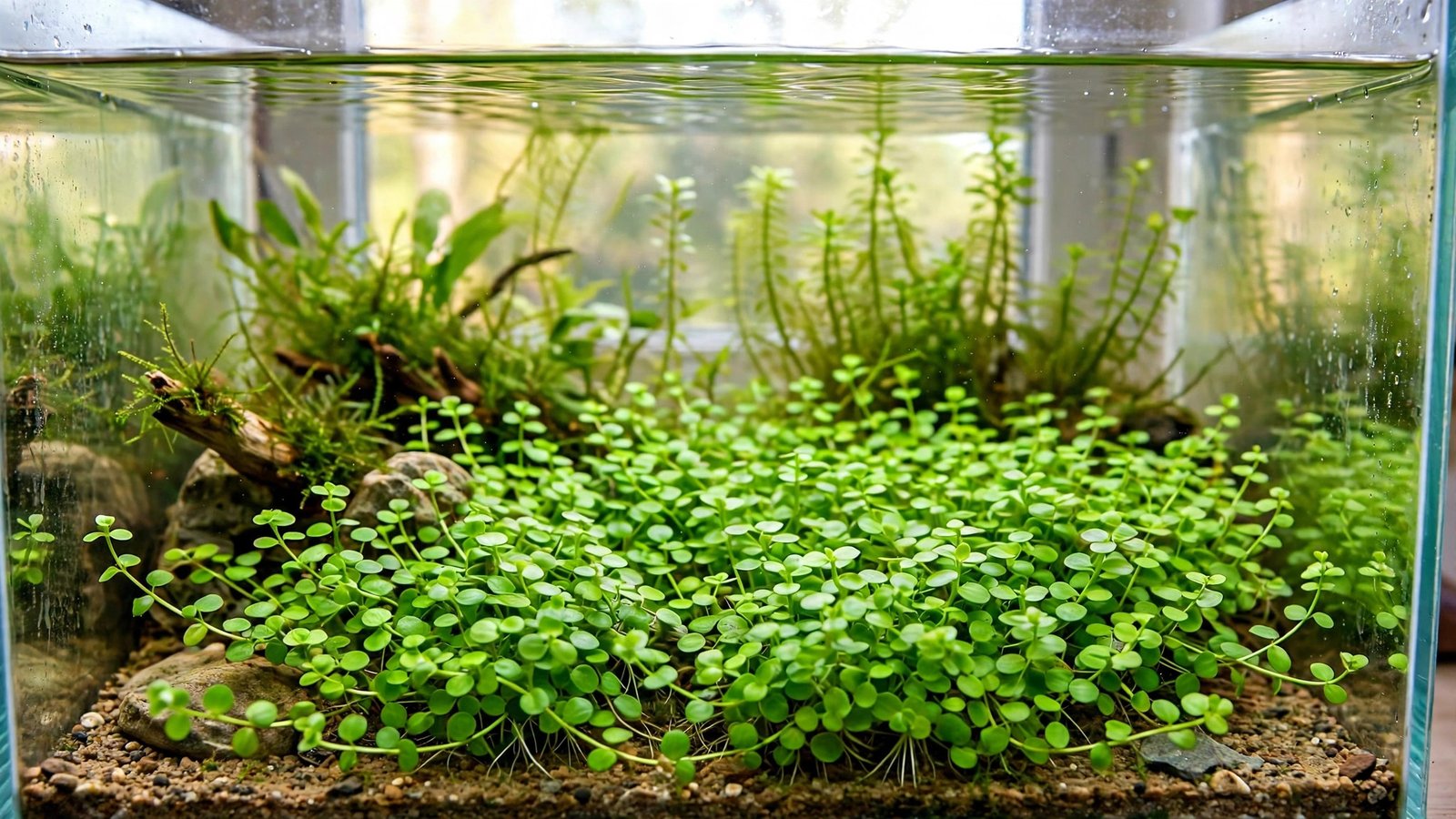
Most carpeting plants hand you an ultimatum: buy a CO2 rig or watch your foreground melt. Giant Baby Tears refuses. Micranthemum umbrosum carpets on medium light alone and rewards CO2 with explosive growth. Master micranthemum umbrosum care — one of the few low-tech carpets — which earns it a spot on our roundup of foreground carpeting plants for beginners. Below: planting, the trimming rhythm, a pearl weed comparison, and three fixes.
Micranthemum Umbrosum Care: The Complete Low-Tech Playbook
Sold as Giant Baby Tears, Micranthemum umbrosum is a North American native with small, round, coin-like leaves. The "easy carpet" label is honest here: it tolerates missed fertilizer doses, wobbly parameters, and zero injected CO2. The one thing it will not forgive is neglected scissors — left alone it climbs 10–15+ cm as a leggy stem, pinched regularly it creeps sideways into a dense mat. Bright light spreads it sideways; dim light grows it upward. It sits comfortably among the easiest aquarium plants for a beginner community tank.
How to Plant Giant Baby Tears
Good planting decides everything: bad planting floats up within days, good planting roots in a week. Work with the tank filled only a few centimeters, or mist heavily while you plant:
- Unpack and clean. Remove the pot, lead weight, or foam; rinse rockwool or gel from tissue-culture cups.
- Strip the lower stems. Pull off the bottom 2 cm of leaves — buried leaves rot and loosen the planting.
- Divide into bundles. Split into bundles of 3–5 stems. One big clump rots in the middle.
- Plant with pinsettes. Push each bundle 2–3 cm deep at a slight angle, about 1 inch apart. Tighter spacing fills faster; wider spacing + bright light encourages creep.
- Fill gently. Flood slowly over a plate so the flow does not uproot your work.
A nutrient-rich aqua soil speeds establishment; plain gravel works with root tabs underneath (replace every 2–3 months). Expect some melting in the first 1–2 weeks as emersed-grown stock converts — trim the mush, keep parameters stable, and new growth follows.
Does Giant Baby Tears Need CO2?
No — and that is the honest headline. Giant Baby Tears carpets low-tech tanks on medium light and a healthy fish load — just slower and looser. Buce Plant calls CO2 optional but recommends 6–14 ppm for dense carpets; at that level growth turns tight and horizontal. If you add CO2, start low and observe your livestock for stress before raising it — 6–14 ppm is enough for a dense carpet here. See Buce Plant's Giant Baby Tears care notes for the full rundown. But CO2 never replaces light or trimming: CO2 plus dim light still grows leggy stems, while strong light and regular trimming still make a low-tech carpet. Compare Monte Carlo, which demands CO2 — Giant Baby Tears merely grows slower.
Trimming: The Secret to a Thick Carpet
Trimming is not maintenance here — it is the technique. Cutting each stem's top breaks apical dominance and forces low side shoots that weave the carpet. Under high light, trim the top third every 2–3 weeks; under medium low-tech light, every 3–4 weeks. Siphon clippings out before they rot, and never throw the tops away: strip their lower leaves and replant them as new bundles — they root within a week, doubling your patch each cycle.
Giant Baby Tears vs Pearl Weed
Retailers constantly compare the two: both are small-leafed, fast, forgiving stem plants that carpet under trimming. The difference is the leaf — Giant Baby Tears carries larger, round, coin-like leaves for a bolder texture; pearl weed (Hemianthus micranthemoides) has smaller, narrower leaves and a finer look. See our Pearl Weed care guide for its playbook.
| Feature | Giant Baby Tears (M. umbrosum) | Pearl Weed (H. micranthemoides) |
|---|---|---|
| Leaf shape | Larger, round, coin-like | Smaller, narrower, oval |
| CO2 demand | Optional; denser with 6–14 ppm | Optional; similar behavior |
| Growth rate | Moderate to fast | Fast |
| Difficulty | Easy, beginner-friendly | Easy, beginner-friendly |
| Best use | Foreground carpet, midground bush | Foreground bush, background filler |
Do not confuse either with HC Cuba — Hemianthus callitrichoides is a different species with tiny leaves and genuinely demanding CO2 and light requirements, and that confusion melts a lot of beginner foregrounds. Tropica's plant database entry for Micranthemum umbrosum lists medium light and medium CO2 demand — a useful baseline.
Troubleshooting: Melting, Leggy Growth, and Algae
Three problems cover nearly every Giant Baby Tears complaint:
| Problem | Cause | Fix |
|---|---|---|
| Melting in the first 1–2 weeks | Emersed-grown stock converting to submerged leaves | Trim the mush, keep parameters stable, stop replanting — new growth emerges from the nodes |
| Tall, leggy, see-through growth | Light too weak or shaded by neighbors | Raise intensity to 30–50+ PAR, thin the canopy, cut stems to 3–4 cm and replant the healthy tops |
| Algae on slow patches | Photoperiod longer than the growth rate can use | Drop light to 6–8 hours, keep weekly 30% water changes, let shrimp graze the patches clean |
Propagation: Free Plants From Every Trim
Propagation is the same motion as trimming. Snip healthy tops 5–8 cm long, strip the lower 2 cm of leaves, and push the bare stems into the substrate in small bundles — roots form within about a week. A single portion can carpet a whole foreground within months, with plenty left over to trade.
Frequently Asked Questions
Is Micranthemum umbrosum the same as HC Cuba?
No — they are different species, and confusing them is the costliest beginner mistake. HC Cuba is Hemianthus callitrichoides, with much smaller leaves and demanding CO2 and high-light requirements. Micranthemum umbrosum has larger, rounder leaves and carpets happily in low-tech tanks. Check the leaf size before buying.
How fast does Giant Baby Tears grow?
Moderate to fast once established. Under medium-high light with CO2, a patch can close in about 4–6 weeks; in a low-tech tank, expect 8–12 weeks. Growth stalls in the first two weeks while emersed-grown stock converts to submerged leaves, so judge speed from week three.
Can Giant Baby Tears grow floating?
It survives floating but grows upward and stringy instead of carpeting. Floating only suits temporary holding — keeping trimmings alive a few days before replanting. For a dense foreground mat, stems must be rooted in the substrate; float them only as a short-term stopgap.
Will shrimp and snails eat Giant Baby Tears?
No. The leaves are fully safe with cherry shrimp, Amano shrimp, and common snails — fine for community and shrimp tanks. Shrimp are helpful: they graze algae off the dense leaf mat. Only melting leaves get eaten, and those should be trimmed anyway.
Why is my Giant Baby Tears melting?
Usually it is the emersed-to-submerged transition: nursery stock grown above water sheds old leaves during the first 1–2 weeks underwater. Trim the mush, keep parameters stable, and new growth appears from the stem nodes. Melting after months of healthy growth points to a sudden parameter swing or a tank move.
Is Giant Baby Tears Right for Your Tank?
If you want a genuine carpet without a CO2 system — and without the heartbreak of melted HC Cuba — Giant Baby Tears is the easiest yes in the hobby. It asks only for decent light, a nutrient base under its roots, and a trim every few weeks, and pays back with one of the fastest-filling beginner foregrounds. More hands-off still, Dwarf Hairgrass sends runners through almost anything. But for speed, forgiveness, and that bright coin-leaf look, few plants beat a well-trimmed mat of Giant Baby Tears.