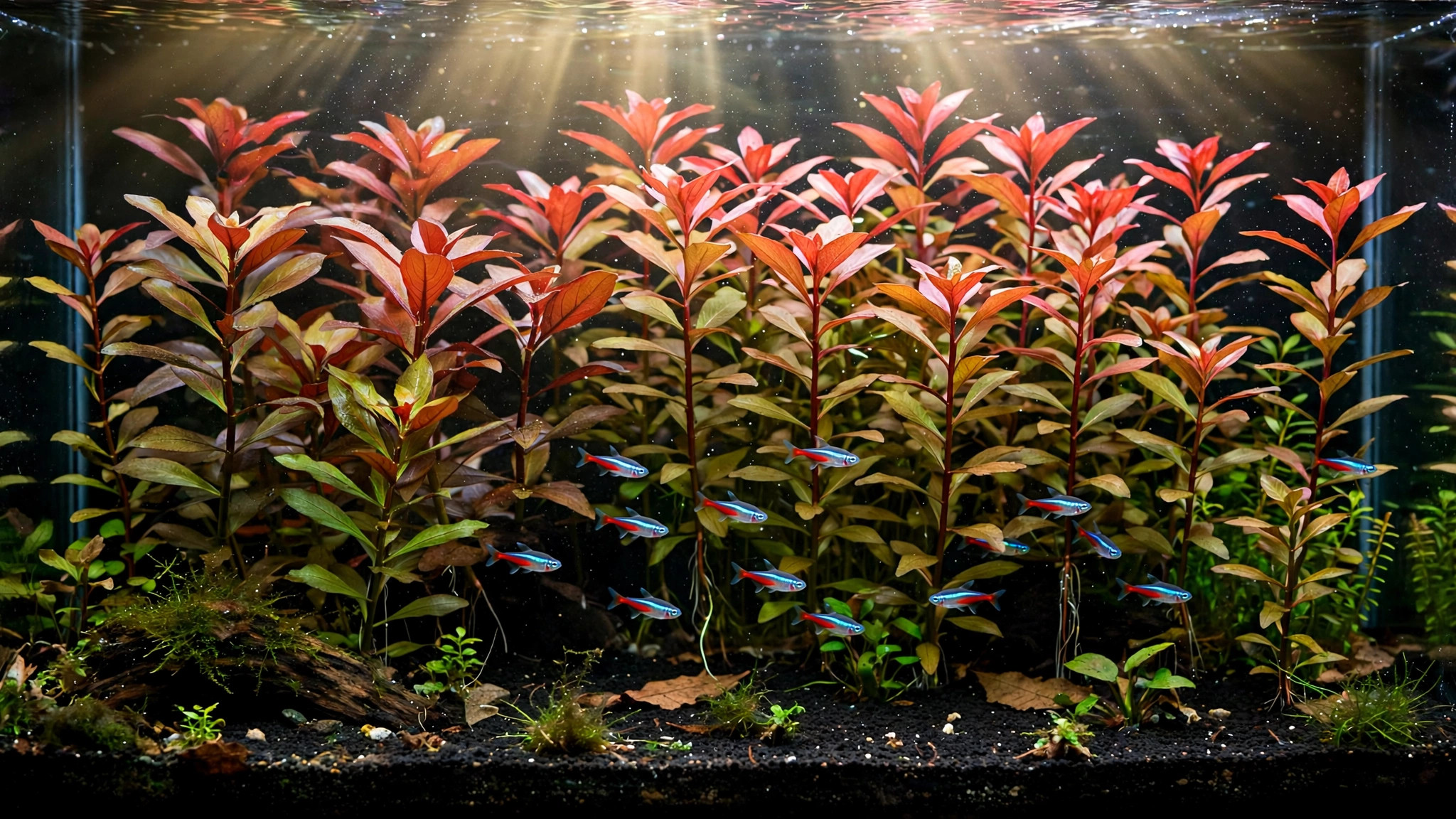
You bought it for the red. The shop photo showed sunset-orange tops, but in your tank the same plant grows fast, healthy — and stubbornly green. That gap is not bad luck, and it usually is not a sick plant.
Ludwigia repens turns red for a reason: strong light triggers protective red pigments called anthocyanins in its newest leaves. When any part of that chain is weak — light, nutrients, or placement — the plant defaults to green, because green chlorophyll is cheaper to run. Fix the chain in the right order, and the red comes back.
Why your Ludwigia repens stays green
Red in this plant is a sunscreen response, not its resting state. Under strong light, upper leaves produce anthocyanins that shield them from excess light energy. Under moderate light there is nothing to shield against, so the plant invests in chlorophyll instead and stays green. A fast-growing, lush green Ludwigia repens is usually a healthy plant in a tank that is simply not bright enough at the top of the stems.
That also explains the classic disappointment: red in the shop, green at home. Shop display tanks run intense lighting, and much of what you buy was grown emersed — out of water — where leaves are rounder and greener. Once the plant converts to submerged growth under your lighting, its true color shows. For the full baseline on planting, parameters, and propagation, see our Ludwigia repens care guide.
Light: the first and biggest lever
Start here, and do not move on until light is genuinely strong. As a rough guide, Ludwigia repens grows well from about 30 PAR, starts to blush around 40 PAR, and colors strongly at 50 to 70 PAR measured at the plant tops — not at the substrate or the water surface. A light that looks bright to your eyes can still be weak at depth, especially in a tall tank or under a dirty lid.
Raise intensity, not hours. At high light, a 7 to 8 hour photoperiod is plenty; stretching to 10 or 12 hours mostly buys algae, not redder leaves. If your fixture has no dimmer, move it closer to the water, remove whatever shades the stems, or upgrade to a stronger full-spectrum fixture in the 6500K to 7000K daylight range. If your current light cannot reach the PAR range above, a high-output full-spectrum light like the NICREW ClassicLED Plus ★4.6 is the single upgrade most likely to change the color.
Disclosure: links to Amazon on this page are affiliate links. If you buy through them, AquaVerdia may earn a small commission at no extra cost to you.
| Factor | Stays green | Turns red |
|---|---|---|
| Light at plant tops | Under 40 PAR | 50–70 PAR |
| Photoperiod | Long hours, low intensity | 7–8 hours, high intensity |
| Nitrate | High (fast green growth) | Moderate to lean (never zero) |
| Iron and micros | Deficient, pale new growth | Sufficient, steady dosing |
| Placement | Shaded by floaters or neighbors | Tops in direct, unfiltered light |
Nitrate: the second lever — handle with care
Once light is strong, nitrate is the next dial. High nitrate drives fast, green growth: the plant has abundant nitrogen for chlorophyll and puts energy into getting bigger, not redder. Growers who keep nitrate lean — around 5 ppm, with phosphate present at roughly 1.5 to 2 ppm and iron and micronutrients sufficient — report the deepest reds, as documented in the Flowgrow plant database entry for Ludwigia repens.
But lean is an advanced tool, not a beginner shortcut, and it has a hard floor: never drive nitrate to zero. A starved plant stalls, drops leaves, and invites algae. If you are new to this, keep nitrate at 10 to 20 ppm, fix light first, and accept a handsome orange-red rather than chasing deep crimson. If you do experiment with leaner nitrate, change one thing at a time, test weekly, and lower it gradually through water changes and lighter feeding — never by cutting fertilizer to nothing overnight.
Iron and micronutrients: support, not a magic fix
Iron is the most oversold red-plant fix in the hobby. As Buce Plant puts it in their guide to why Rotala and Ludwigia turn green instead of red, extra iron alone rarely fixes the problem when light stays weak — the plant needs the whole growth environment to support strong growth before iron can matter.
Iron still matters, just in its proper place: sufficiency. Pale, yellowish new growth is the classic iron-deficiency signal; if you see it, dose. A comprehensive liquid like Seachem Flourish ★4.7 covers iron plus the other micronutrients in one steady weekly dose, which is enough for most low-tech tanks. Reach for a dedicated iron supplement only when deficiency is confirmed, and never stack two iron products at once — excess iron feeds algae faster than it reddens leaves.
Placement and shading: give the tops unfiltered light
Red develops at the top of the stem, so anything between the light and those top leaves is a color thief. Floating plants are the usual culprit — a thick mat of frogbit or duckweed can halve the light reaching the stems below. Corral floaters to one side, thin them weekly, or keep the Ludwigia in open water away from the mat. The same applies to a lid filmed with condensation and mineral deposits: wipe it, and you may gain back more light than any settings change.
Spacing matters too. Stems planted in a tight bunch shade each other's lower leaves, which then yellow and drop. Plant individual stems roughly an inch apart so light penetrates the group, and put the cluster where the fixture shines directly — never tucked behind hardscape that casts a permanent shadow over the crown.
Trimming: reset color from the top down
Here is the part most guides skip: old green leaves almost never turn red, because anthocyanins form in new tissue as it grows. So the fix has two stages — first change the conditions, then replace the display growth. Once new leaves show a pink or orange tinge, cut the stem above a healthy node and replant the colored top; the rooted lower stem will usually push out side shoots, giving you a bushier group.
Set your expectations on a four-week clock. Weeks one and two should show a pink tinge on the newest leaves; by week three or four the tops should be clearly orange-red if the levers are right. If nothing has changed after four weeks, light is still the problem — recheck shading and PAR before touching fertilizer again.
Companion article: the same stay-green problem on a floating plant is covered in Why Your Red Root Floater Stays Green Instead of Turning Red — different plant, different fixes.
Frequently asked questions
Can Ludwigia repens turn red without CO2?
Yes. CO2 speeds growth and deepens color, but strong light alone brings out orange-red tones in a low-tech tank — softer and slower than with CO2, but real red.
Will my old green leaves turn red?
Almost never. Color forms in new growth, so judge progress by the newest leaves and trim and replant the colored tops to replace old green growth.
Does dosing more iron make Ludwigia repens redder?
Only up to sufficiency. If iron is deficient, correcting it helps; beyond that, extra iron does nothing without strong light, and excess iron encourages algae.
How long does it take to see red after fixing the light?
New leaves should start blushing within 2 to 3 weeks, with clearly red tops by week four. If nothing changes in four weeks, recheck light intensity and shading first.