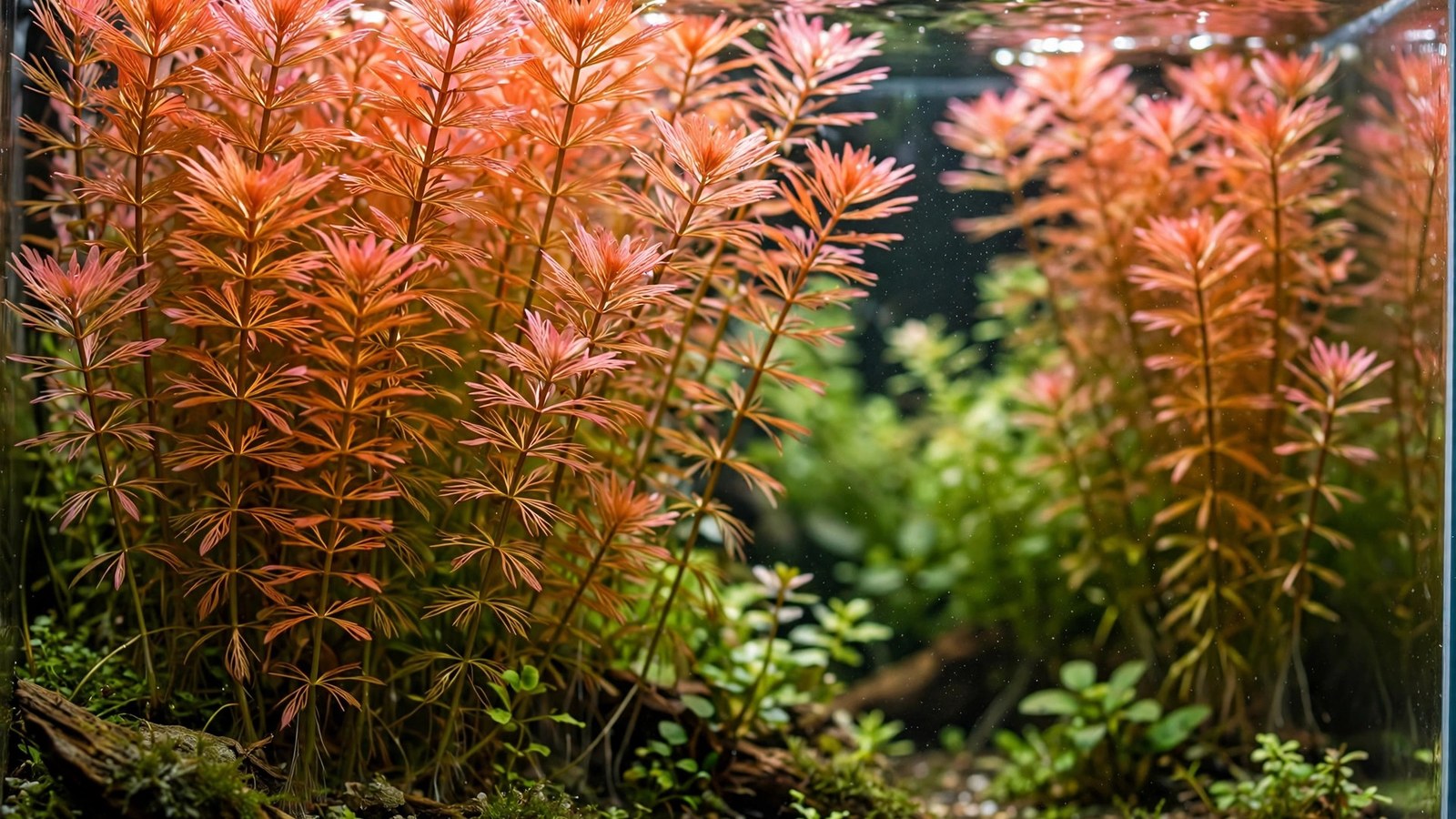
Ludwigia Pantanal humbles experienced aquascapers. Buy a bunch glowing orange-red in the shop, plant it in a good tank, and within days it can fade to green, stunt, or melt. This is a boom-or-bust plant: give it everything it wants and it grows inches a day; miss one requirement and it tells you within a day.
That sensitivity is also its appeal: fine, whorled, feathery leaves in orange, pink and deep red. If your tank already runs high light and pressurised CO2, Pantanal is one of the most rewarding background plants you can grow. If it does not, read the requirements first.
Direct answer: Ludwigia Pantanal (Ludwigia inclinata var. verticillata 'Pantanal') needs soft water under 3 dKH, high light of 100+ PAR at the substrate, CO2 at 30 ppm or more, and heavy, consistent fertilisation. Without all four, it greens, stunts or melts. It is an advanced plant, not a beginner stem.
What makes Pantanal different
Pantanal is an orange-red form of Ludwigia inclinata from South America. Its leaves are its signature: narrow and fine, arranged in whorls around the stem for a feathery texture no broad-leaved Ludwigia matches. In peak condition lower leaves read orange-pink and the crown burns deep red; under weak conditions the plant greens from the bottom up.
One buying note matters most. A variety sold as 'Meta' looks almost identical but tolerates far lower CO2 — around 10 ppm rather than 30 ppm — and is much easier to grow. If your tank runs modest CO2, take 'Meta' if offered. Mislabelled stock is common, so buy from a seller who names the variety.
Light and CO2: the non-negotiables
Pantanal wants 100 micromols of PAR or more at the substrate, with colour improving toward 200–300. Below that, lower leaves green out and stems stretch leggy. Run an 8-hour photoperiod to start; longer light without matching CO2 and nutrients buys algae, not colour. Fertiliser cannot compensate for dim light here. A proven high-output option is NICREW ClassicLED Plus ★4.6, suited to medium-to-large tanks.
CO2 is the stricter gate: 30 ppm or more, delivered steadily from lights-on, with good circulation through the group. A drop checker reading green-to-yellow-green through the photoperiod is the target; one still blue at midday means the plant is starving. Low or fluctuating CO2 is the most common cause of stunted tips.
Water, substrate and feeding
Pantanal requires soft water, at 3 dKH or below, and tolerates general hardness of roughly 2–10 dGH. In harder, alkaline water it typically stalls regardless of light and CO2, so test KH before planting: tap water well above 3 dKH means remineralised RO water or a different red stem. Keep pH at 5.0–7.0 and temperature steady at 22–28 °C.
Feed it heavily in both places at once. Nutrient-rich aquasoil gives the roots a strong base, and regular water-column dosing covers the leaves — Pantanal responds well to ammoniacal nitrogen through the substrate as well as nitrate in the water column. Keep nitrate measurable (around 5 ppm is a working floor) and do not starve the tank chasing redder colour: deficiency shows as stunting, not better reds. As an Amazon Associate I earn from qualifying purchases. A comprehensive liquid fertiliser forms the base of most routines, and Seachem Flourish ★4.7 dosed consistently covers the trace elements that affect tip shape and colour.
Planting, trimming and propagation
Plant Pantanal as a background group in a tall enough tank — a poor fit for shallow nanos. Push stems into the substrate with tweezers, a couple of centimetres apart so light reaches lower leaves. New stems often sulk for a week; judge them by new crown growth, not older leaves.
Then get comfortable with scissors: a happy Pantanal grows a couple of inches or more per day. Trim weekly, cutting the top third of each stem and replanting the tops, and let cut bases branch or pull tired lower stems and replace them with fresh tops. Left untrimmed, the group shades its own base and you end up with bare stalks and a red tuft at the surface. One bunch becomes a full background group within a month.
Pantanal vs its relatives
The choice comes down to CO2 and attention:
| Plant | Difficulty | CO2 needed | Water | Why pick it |
|---|---|---|---|---|
| Pantanal | Advanced | 30+ ppm | Under 3 dKH | Finest texture, most intense orange-red crown |
| 'Meta' variety | Moderate | 10+ ppm | Soft preferred | Near-identical look, far more forgiving |
| Ludwigia repens | Easy | Optional | Wide range | Reliable red colour in low-tech tanks |
| Ludwigia 'Cuba' | Advanced | High | Soft preferred | Larger, bolder stems; less fine-textured |
Troubleshooting: why it stunts, greens or melts
Tips stunt or distort. Check CO2 first: poor circulation, a checker still blue at midday, or CO2 that swings day to day. Improve flow before changing anything else.
Leaves turn green. Light is too low, or stems shade each other. Thin the group and confirm CO2 is at target — green Pantanal in a bright tank is usually a CO2 story.
Lower leaves drop. Normal for an untrimmed group; replant tops, remove spent bases. If it happens fast across the whole group, suspect a parameter swing or an exhausted substrate.
Whole plant melts. Emersed-to-submersed transition melt is common with shop stock. Leave stems in place if crowns are still firm — Pantanal often regrows from the crown. Soft, transparent stems throughout usually mean CO2 or KH is out of range.
Bottom line: buy Pantanal only after your tank meets its four requirements — soft water, strong light, high CO2 and heavy feeding.
Frequently asked questions
Can Ludwigia Pantanal grow without CO2? Not well. Without injected CO2 it greens, stunts and deteriorates. The 'Meta' variety is the realistic choice for low-CO2 tanks.
Why did my Pantanal turn green after I brought it home? Almost always light or CO2 below shop-tank levels, or harder water than it needs. Check KH first, then confirm CO2 reaches 30 ppm and light delivers high PAR.
How fast does Ludwigia Pantanal grow? Very fast in a dialled-in tank — a couple of inches or more per day, hence the weekly trimming routine.
Is Pantanal harder than Ludwigia repens? Much harder. Repens colours up in moderate light with or without CO2; Pantanal demands soft water, high light, high CO2 and heavy feeding.
Further reading: the 2HR Aquarist guide to growing Ludwigia 'Pantanal' and Tropical Fish Hobbyist Magazine's Ludwigia inclinata profile.