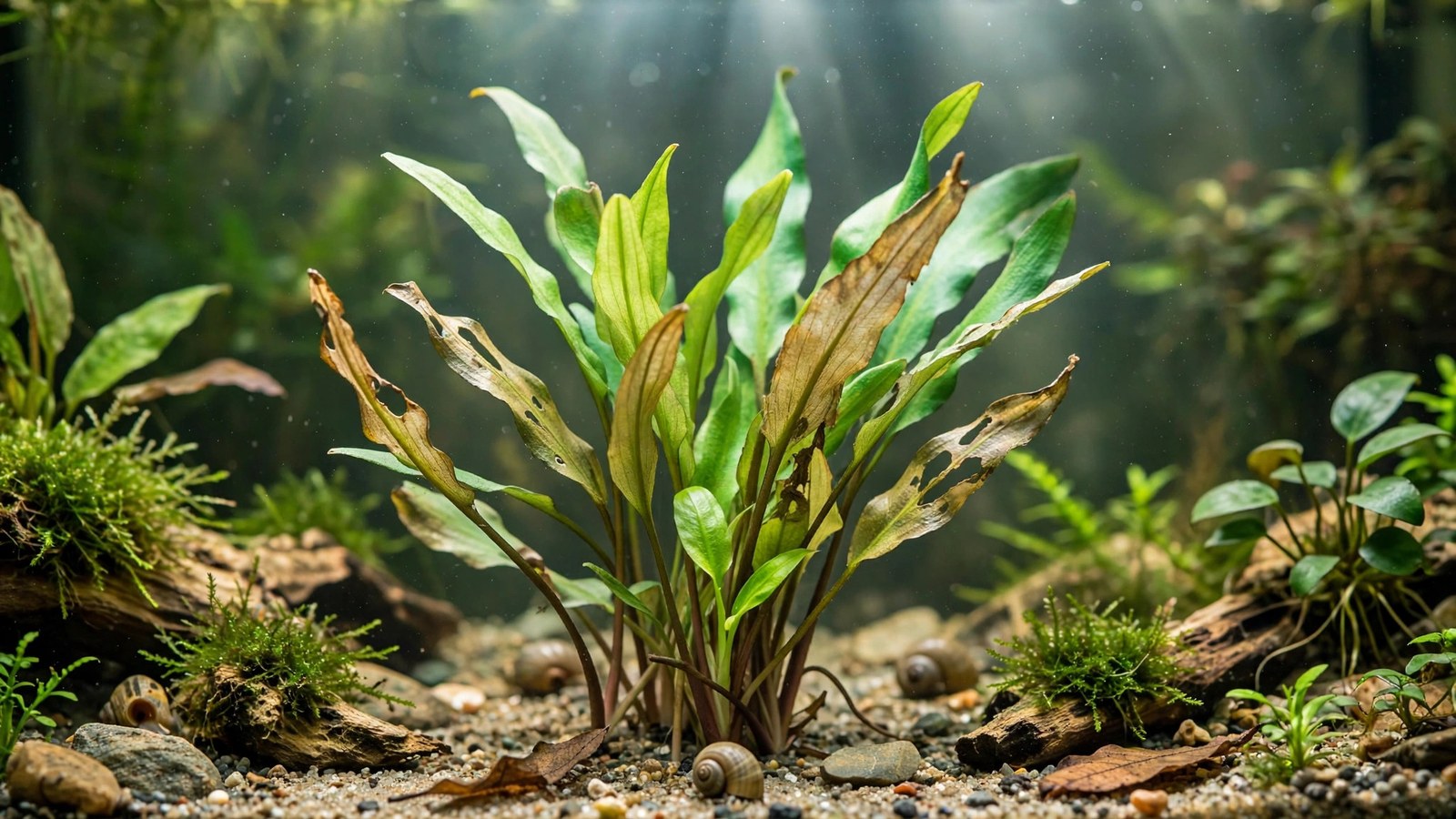
Three days after you plant it, your new crypt looks like a wilted salad. Every leaf turns glassy, droops, and dissolves — and the most common mistake is yanking the "dead" plant out. Don't. Learning cryptocoryne lutea care starts with one rule: a melting crypt is usually a recovering crypt, and its roots are almost always alive under the substrate.
The short answer: Cryptocoryne lutea is a hardy Sri Lankan crypt for the midground that thrives in 72–82°F water with low–medium light and a nutrient-rich substrate. As a heavy root feeder, it needs aquasoil plus root tabs (one tab per 4–6 inch radius, replaced every 2–3 months). New plants typically melt within 3–10 days, push fresh growth in 2–4 weeks, and fully recover by 6–10 weeks — leave the roots undisturbed.
What Cryptocoryne Lutea Actually Is (And Isn't)
The label says Cryptocoryne lutea, and in the trade that name is stable and honest — not a re-labeled Cryptocoryne wendtii or beckettii. One footnote: taxonomists often fold it under C. walkeri, so scientific sources may disagree with the shop label. For your aquarium, the trade name is what matters.
You can tell it apart by the leaves. True lutea forms an upright rosette of lance-shaped leaves with distinctly ruffled, wavy margins, coloring from olive-green to warm bronze. Wendtii leaves are broader and floppier; beckettii stays smaller and darker. At 4–8 inches tall, it's a natural midground rosette — check it against your complete guide to freshwater aquarium plants shortlist before buying.
It comes from the slow-moving, shaded streams of Sri Lanka, where it grows both submerged and along muddy banks. That heritage explains its personality: tough, adaptable, unimpressed by CO2 — but it hates instability. Move it or swing your water parameters, and it melts.
Cryptocoryne Lutea Care: Light, Substrate, and Water
Light is the easy part. Cryptocoryne lutea wants low to medium light, roughly 20–40 PAR — what a basic LED delivers at substrate level on a 20-gallon tank. More light speeds growth slightly and brings out bronze tones, but 60+ PAR invites algae on the slow-growing leaves. It never needs a high-light slot.
Substrate is where most people under-deliver. This is a heavy root feeder — most of its nutrition comes through its roots, not the water column. Plant it in nutrient-rich aquasoil, and push one root tab into the substrate within 4–6 inches of the crown every 2–3 months. If you're still deciding whether aquarium plants really need fertilizer, crypts are the case for root feeding: liquid fertilizer helps the tank broadly, but lutea's growth visibly stalls without root-zone nutrition.
Water parameters are forgiving: 72–82°F, pH 6.0–7.5, soft to moderately hard water. Stability matters more than exact values — a steady 76°F beats a fluctuating range every time. Plant the crown (where leaves meet roots) just above the substrate surface; burying it invites rot. Fellow root feeders like the Amazon sword make good tank neighbors.
| Parameter | Target | Notes |
|---|---|---|
| Temperature | 72–82°F | Stability beats exact value |
| pH | 6.0–7.5 | Adapts; avoid swings >0.3/day |
| Light | Low–medium (20–40 PAR) | 6–8 hour photoperiod to start |
| CO2 | Optional | ~15 ppm speeds growth; not required |
| Root tabs | 1 per 4–6 in radius | Replace every 2–3 months |
| Tank size | 10+ gallons | Rosette reaches 4–8 in wide |
The Crypt Melt Recovery Protocol
Here's why new crypts melt. In the wild and in nurseries, lutea grows partly emersed — leaves in humid air. Those leaves cannot survive underwater, so when you submerge the plant, it abandons them and grows new submersed leaves with a different structure. The melt isn't damage. It's a scheduled renovation. Follow this timeline and do nothing dramatic:
| When | What you'll see | What to do |
|---|---|---|
| Days 1–3 | Leaves look fine, maybe slightly limp | Nothing. Keep lights and schedule steady. |
| Days 3–10 | Leaves turn translucent, then mushy | Trim mushy leaves at the base; leave the crown. |
| Weeks 2–4 | Tiny new leaves unfurl from the center | Still nothing. Resist "helping" with ferts. |
| Weeks 6–10 | Full rosette re-established | Resume normal root-tab schedule. |
The only thing that kills a melting crypt is you. Uprooting it to "check the roots" restarts the shock cycle, and it will melt again. Keep water parameters boring and the photoperiod consistent, and let the root system — which survives melt just fine — do its job.
When do you actually worry? Melt is leaves-only; rot reaches the rhizome. After week three with no sprouts, gently brush substrate away from the crown. Firm, white-to-cream roots and a solid rhizome mean it's alive — wait two more weeks. A soft, crumbling, or swampy-smelling rhizome is genuine rot: remove the plant and replant a fresh specimen with the crown above the substrate. Nine out of ten "dead" crypts are just mid-renovation.
Propagation: Runners, Not Seeds
Once settled — usually after 2–3 months — lutea spreads the crypt way: underground runners. A daughter rosette appears 1–3 inches from the parent. Let it grow 4–6 leaves (about 6–8 weeks), then snap or snip the runner under the substrate and replant the daughter crown-up elsewhere.
A healthy parent sends out 1–2 runners per month. For a dense midground cluster, leave three to five daughters attached — lutea looks best as a loose group of 5–7 rosettes. Trim the oldest outer leaves at the base every month or two.
Emersed-to-Submersed Transition
Most shop-bought lutea arrives emersed-grown: broader, sometimes glossier leaves raised in humid nursery air. Your tank will replace every one of them. Submersed leaves come in narrower, more ruffled, and often more bronze — don't mistake the change for a problem; it's the plant finishing its move-in.
You can ease the transition, but you can't skip it. Plant into a cycled, stable tank, run a modest 6-hour photoperiod for the first two weeks, and hold off on liquid fertilizer until you see new growth. Root tabs at planting time are fine, since they feed the surviving roots directly. The Cryptocoryne care overview covers this same pattern across the genus if you keep multiple crypts.
A Crypt Worth the Wait
Put it in the midground, feed its roots, keep the water steady, and survive the first month without panicking. Lutea rewards patience more than equipment — no CO2, no fancy light, just good substrate and a hands-off owner. Dennerle's Cryptocoryne lutea plant profile has nursery-grade growth data to compare against your tank.
Frequently Asked Questions
Is Cryptocoryne lutea a good beginner plant?
Yes — one of the most forgiving crypts. It tolerates low light, needs no CO2, and adapts to a wide pH range. The only beginner trap is the melt: plants look dead within days, and beginners throw them away. Leave it alone for a month and it's easy.
Why is my Cryptocoryne lutea melting?
Melt is the plant replacing its nursery-grown emersed leaves with submersed ones — a normal transition, not disease. It starts 3–10 days after planting and finishes within 2–4 weeks. Keep parameters stable, trim mushy leaves at the base, and never uproot the plant to check on it.
Does Cryptocoryne lutea need CO2?
No. It grows well in low-tech tanks without CO2, producing 1–2 new leaves per month. Adding CO2 at 15 ppm speeds growth and deepens bronze coloration, but it's a bonus, not a requirement — unlike carpeting plants that stall without it.
How long does it take to recover from melt?
Expect the first new leaves 14–28 days after planting, with a full rosette by 6–10 weeks. If nothing sprouts by week four, check that the rhizome is firm — firm means alive, so keep waiting. Only soft, smelly rhizomes indicate real rot that needs removal.
Can I grow Cryptocoryne lutea in plain gravel?
You can, but growth will be slow and pale. Lutea is a heavy root feeder, so in inert gravel it needs a root tab within 4–6 inches of the crown, replaced every 2–3 months. For best results, use nutrient-rich aquasoil with gravel only as a thin cap.