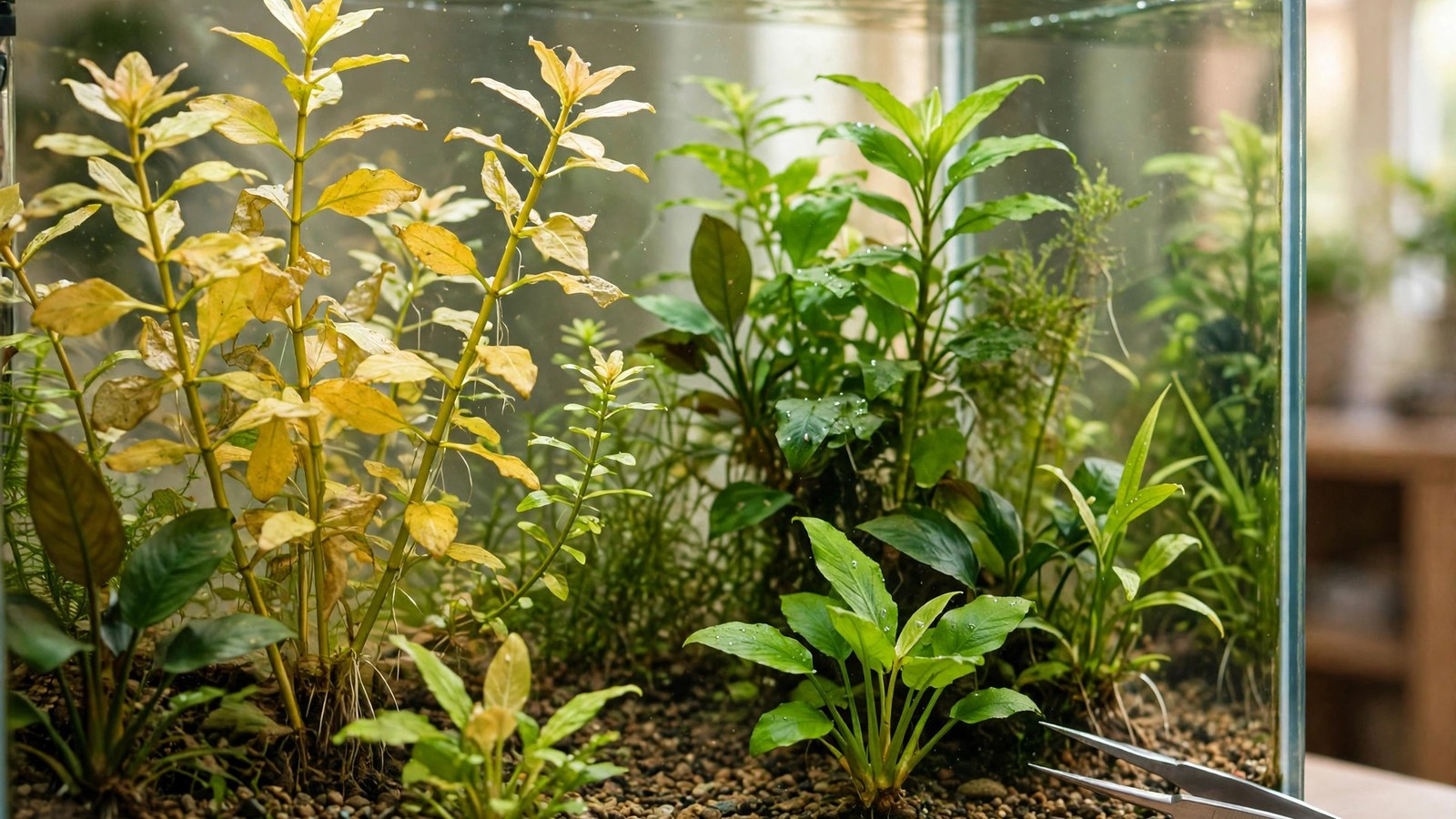
When aquarium plant leaves turn yellow, the tank is sending you a message written in its own grammar. Yellowing is almost always a nutrition story: your plants are rationing scarce resources, and the pattern of where the color fades first — old growth, new shoots, leaf edges, or between the veins — points directly at the nutrient that's running short. Learn to read that pattern and you can fix most yellow-leaf problems in a few weeks without tearing the tank apart.
Before we dive in, a quick boundary: this guide is about yellowing caused by nutrient gaps. Leaves that are melting to translucent mush, fuzzy brown coating on leaves, or black spots on Java fern are different conditions with different fixes, and they deserve their own guides. Here, we focus on one question: which nutrient is missing, and how do I replace it?
How Plants Move Nutrients (and Why It Matters)
Plants divide their nutrients into two classes, and the split is the single most useful idea in leaf diagnostics. Mobile nutrients — nitrogen, potassium, and magnesium — can be pulled out of old leaves and shipped to new growth. When the tank runs low on one of these, the plant sacrifices its older, lower leaves first, stripping them of chlorophyll and leaving them yellow while the newest shoots stay green.
Immobile nutrients — iron, calcium, and manganese among them — cannot be relocated once they are built into tissue. When one of these is scarce, the plant cannot cannibalize its older leaves to supply the new ones, so the newest growth suffers: fresh leaves emerge pale, washed-out, or yellow between green veins. This single distinction — old leaves versus new leaves — narrows almost every yellow-leaf case down to a short list before you test a single drop of water.
There is one more wrinkle worth knowing. Carbon dioxide and light drive the whole engine: fast-growing plants under strong light burn through nutrients far quicker than slow growers in a dim tank. A tank that was perfectly balanced six months ago can slide into deficiency simply because the plants grew denser and now consume more than they used to. Yellowing that appears gradually, weeks or months into a tank's life, is the classic fingerprint of a demand that outgrew the supply.
Reading the Pattern: What Each Kind of Yellowing Means
Grab a notepad and look at your tank the way a detective reads footprints. Answer two questions for every affected plant: which leaves are yellowing (oldest, newest, or everywhere?) and exactly what the yellowing looks like (uniform fade, veined pattern, yellow edges, yellow with holes?). Then match what you see against the four deficiencies below.
| Deficiency | Which leaves | What it looks like | Extra clues |
|---|---|---|---|
| Nitrogen (N) | Oldest leaves first | Uniform pale-green to yellow fade, starting at lower leaves | Stunted growth, thin stems, overall pale tank |
| Iron (Fe) | Newest leaves first | Yellow tissue with veins staying green (interveinal chlorosis) | New shoots nearly white in severe cases |
| Potassium (K) | Oldest leaves first | Yellowing at leaf edges and tips; pinholes that expand | Holes appear in otherwise green tissue |
| Magnesium (Mg) | Oldest leaves first | Marbled or mottled yellowing between veins | Leaves may curl before falling |
Nitrogen deficiency: the uniform fade from the bottom up
Nitrogen is the nutrient plants consume in the largest quantity, so it runs out first in most tanks. The signature is a slow, even loss of color that starts on the lowest, oldest leaves and climbs upward. Leaf tissue goes pale green, then straw-yellow, and the affected leaves eventually detach. Growth slows across the whole tank: stems stay thin, new leaves are small, and fast stem plants that used to race for the surface start sulking.
Low-tech tanks are the most vulnerable because fish waste alone often cannot supply enough nitrogen once plants fill in. If your nitrates test at zero for weeks while plants grow, the plants are eating every scrap of nitrogen as fast as it appears. For the deep version of this one, including dosing math and nitrate targets, see our guide to nitrogen deficiency in aquarium plants.
Iron deficiency: yellow new leaves with green veins
Iron is the classic immobile nutrient, so its pattern is the mirror image of nitrogen's. The newest leaves at the growing tips emerge pale or yellow while the veins themselves stay green — interveinal chlorosis. In severe cases new shoots come in almost white. Older leaves, built when iron was still available, keep their color, which is the telltale contrast that separates iron from the mobile-nutrient deficiencies.
Iron is also easy to lose without using it: in hard, alkaline water (pH above ~7.5) many iron compounds precipitate and become unavailable, and water-column iron is consumed within a day or two of dosing. Our iron deficiency in aquarium plants guide covers chelated iron types and how pH affects availability.
Potassium deficiency: yellow edges and pinholes
Potassium deficiency usually announces itself with yellowing that starts at leaf edges and tips and creeps inward, often accompanied by small pinholes in otherwise green tissue that grow larger over days. The holes are the giveaway: few other problems punch clean holes through the middle of a green leaf. Older leaves take the hit first because the plant ships potassium upward to new growth.
Potassium is rarely supplied by fish waste or water changes in useful amounts, so tanks that rely on fish-only fertilization are common victims. When pinholes spread from leaf to leaf while the rest of the plant looks vigorous, potassium is your prime suspect. Details and dosing ranges are in our potassium deficiency symptoms article.
Magnesium deficiency: the marbled look on old leaves
Magnesium sits at the center of every chlorophyll molecule, so a shortage shows up directly as loss of green. The pattern is a mottled, marbled yellowing between the veins on older leaves, sometimes with leaf margins curling upward before the leaf drops. It is less common than nitrogen or iron deficiency, and it is often missed because it can look like early potassium trouble — but potassium yellowing concentrates at edges and holes, while magnesium produces an even marbling across the leaf face.
Very soft water and certain reverse-osmosis setups without remineralization are the usual suspects, since magnesium mostly arrives through the water supply. Our guide to magnesium deficiency in planted tanks walks through GH readings, Epsom-salt dosing, and remineralizer options.
Rule Out the Look-Alikes Before You Dose
Not everything yellow is a deficiency, and dosing fertilizer into a tank that doesn't need it creates a second problem. Before you change your fertilization, check three things. First, light: leaves buried under dense growth or in a shaded corner yellow simply from darkness; if only the shaded leaves are affected and everything else is green, prune or rearrange rather than dose. Second, CO2 and carbon: slow, pale, stunted growth with yellowing across all leaves can be carbon limitation masquerading as a nutrient issue, especially in high-light tanks without CO2 injection.
Third, transition stress: newly planted specimens, particularly those grown emersed at the farm, shed their old leaves in the first one to three weeks as they adapt to submerged life. That shedding can look alarmingly yellow, but it is the plant converting its leaves for a new environment, not a deficiency, and it resolves on its own once new submerged growth appears. Only reach for the fertilizer bottle when yellowing is progressive, patterned, and happening to established plants.
Confirm nitrates and pH before dosing; the article's own first rule: API Freshwater Master Test Kit.
The Step-by-Step Diagnostic Routine
- Photograph and map. Take a clear photo of the affected plants and note which species, which leaves (old or new), and what the yellowing looks like.
- Test the water. Run nitrate, phosphate, pH, GH, and KH. Zero nitrates with established, growing plants points at nitrogen. Very hard, high-pH water strengthens an iron case. Very low GH strengthens a magnesium case. A reliable test kit for planted tanks is the cheapest diagnostic tool you own.
- Check light and CO2. Confirm photoperiod (8–10 hours), that bulbs are under a year old, and that shaded plants get some light. If you inject CO2, verify the drop checker is green during the photoperiod.
- Match the pattern. Use the table above against your notes. If two deficiencies fit, fix the strongest match first — correcting one often reveals whether the second pattern was real or a side effect.
- Dose and wait. Start a complete fertilizer and give it a full two to three weeks. Old yellowed leaves will not turn green again — no nutrient can revive dead tissue — so judge progress only on new growth. If new leaves come in green and healthy, you have solved it.
- Trim the damage. Once healthy growth resumes, prune away the yellowed leaves so the plant stops wasting energy on them and you get a clean visual reset.
One critical expectation to set: you are diagnosing from the newest growth, not the oldest. Every day spent waiting for an already-yellow leaf to recover is a day wasted, because chlorophyll loss in mature leaf tissue is permanent. Watch the tips.
How to Fix Aquarium Plant Leaves Turning Yellow
The simplest and safest correction for most tanks is a complete all-in-one liquid fertilizer dosed per the label, because it supplies the full macro and micro menu and prevents you from fixing one gap while creating another. Spot-treating a single nutrient makes sense only when the pattern is unambiguous: nitrate salts for nitrogen, chelated iron (gluconate or DTPA, depending on your pH) for iron, potassium sulfate for potassium, and a magnesium source such as Epsom salt or a GH booster for magnesium.
Heavy root feeders — swords, cryptocorynes, and similar plants — take a large share of their nutrients through their roots, so pushing fertilizer into the water column sometimes helps their leaves only slowly. For these plants, add root tabs near the base alongside your liquid dosing. This is especially effective when the yellowing is concentrated in one or two heavy root feeders while stem plants nearby look fine.
Dose conservatively at first. More fertilizer is not better fertilizer: excess nutrients fuel algae and, in high enough concentrations, damage roots and stress livestock. Start at the label dose (or half if your fish load is heavy), test nitrates weekly, and raise the dose only if new growth still shows deficiency signs after three weeks. Two references worth bookmarking: the planted-aquarium fertilizer guide, which details how each macro and micronutrient behaves and what its shortage looks like, and Tropica's own note that pale leaves often indicate lack of nutrition. If you overshoot, our article on the signs you have over-fertilized your tank explains how to recognize and correct it. For a broader map of every deficiency and how they interact, keep the full nutrient deficiency guide bookmarked alongside this one.
For species-specific quirks — Anubias, for instance, yellows for reasons that often have little to do with the water column — see our guide to why Anubias leaves turn yellow.
Micro-nutrient baseline the yellowing fix starts from: Seachem Flourish.
Root feeding for heavy root feeders showing yellow old growth: Seachem Flourish Tabs.
Prevention: The Weekly Routine That Stops Yellowing
Yellow leaves are a maintenance failure more often than a mystery, and a light weekly routine prevents almost all of them. Once a week, do a 25–30% water change, dose your fertilizer on a consistent schedule (same days, same amounts — plants respond to routine), and test nitrates monthly.
Trim aggressively. Dense stem thickets shade their own lower leaves, and shaded lower leaves yellow from darkness regardless of your dosing — no amount of iron fixes a light problem. Regular trimming keeps light reaching the lower canopy and keeps nutrient demand in line with what you supply. Finally, log what you change. A one-line note — "doubled potassium, Oct 3" — turns guesswork into science when you evaluate new growth three weeks later.
Frequently Asked Questions
Will yellow aquarium plant leaves turn green again after I fix the deficiency?
No. Chlorophyll loss in mature leaf tissue is permanent — once a leaf has gone fully yellow, it will never regain its green color no matter what you dose. Judge your fix entirely on new growth: if the freshest leaves and shoot tips come in green and healthy, the deficiency is resolved. Prune away the permanently yellowed leaves once new growth confirms the fix, so the plant stops spending energy on dying tissue.
How long does it take to see improvement after dosing fertilizer?
Expect two to three weeks before new growth shows a clear change, and a full month before you can confidently declare a deficiency solved. Plants build new leaves from the nutrients available today, so tissue formed during the deficient period will always carry the damage. If nothing changes after three to four weeks of correct dosing, recheck your diagnosis — you may be fighting a look-alike like low light, carbon limitation, or transition shedding rather than a nutrient gap.
Can too much light cause yellow leaves?
Indirectly, yes. Excess light accelerates plant metabolism, which burns through the available nutrients faster and turns a previously balanced tank deficient — yellowing follows from the nutrient crash, not from the light itself. The more common light-related yellowing is the opposite: shaded lower leaves fading from darkness under a dense canopy. In both cases the fix starts with adjusting light or trimming, not blindly adding fertilizer.
Is yellowing always a nutrient deficiency?
No. Shading, carbon limitation, emersed-to-submerged transition in new plants, and natural aging of the oldest leaves all produce yellowing without any nutrient shortage. That is why pattern-reading matters: deficiency yellowing follows the mobile-versus-immobile rules (old leaves for N, K, Mg; new leaves for Fe), progresses steadily, and responds to fertilization. Random or one-sided yellowing that ignores those rules usually has a different cause.
Should I use liquid fertilizer, root tabs, or both?
Use both if your tank mixes plant types. Liquid all-in-one fertilizers feed stem plants, mosses, and rhizome plants through the water column and are the best first step for general yellowing. Root tabs placed near heavy root feeders like Amazon swords and cryptocorynes supply the root zone that water-column dosing reaches only slowly. If yellowing concentrates in root feeders while everything else is green, root tabs alone often solve it.
Yellowing Is a Conversation, Not a Catastrophe
Yellow leaves feel like failure, but they are really just feedback. Your plants are telling you precisely which resource ran short and where, in a code that is remarkably consistent once you know it: old leaves for the mobile nutrients, new leaves for the immobile ones, edges and holes for potassium, marbling for magnesium. Work the diagnostic routine — observe, test, match, dose, and watch only the new growth — and most yellowing resolves within a month. The tanks that stay greenest are not the ones with the most expensive fertilizer; they are the ones whose owners learned to read the leaves.