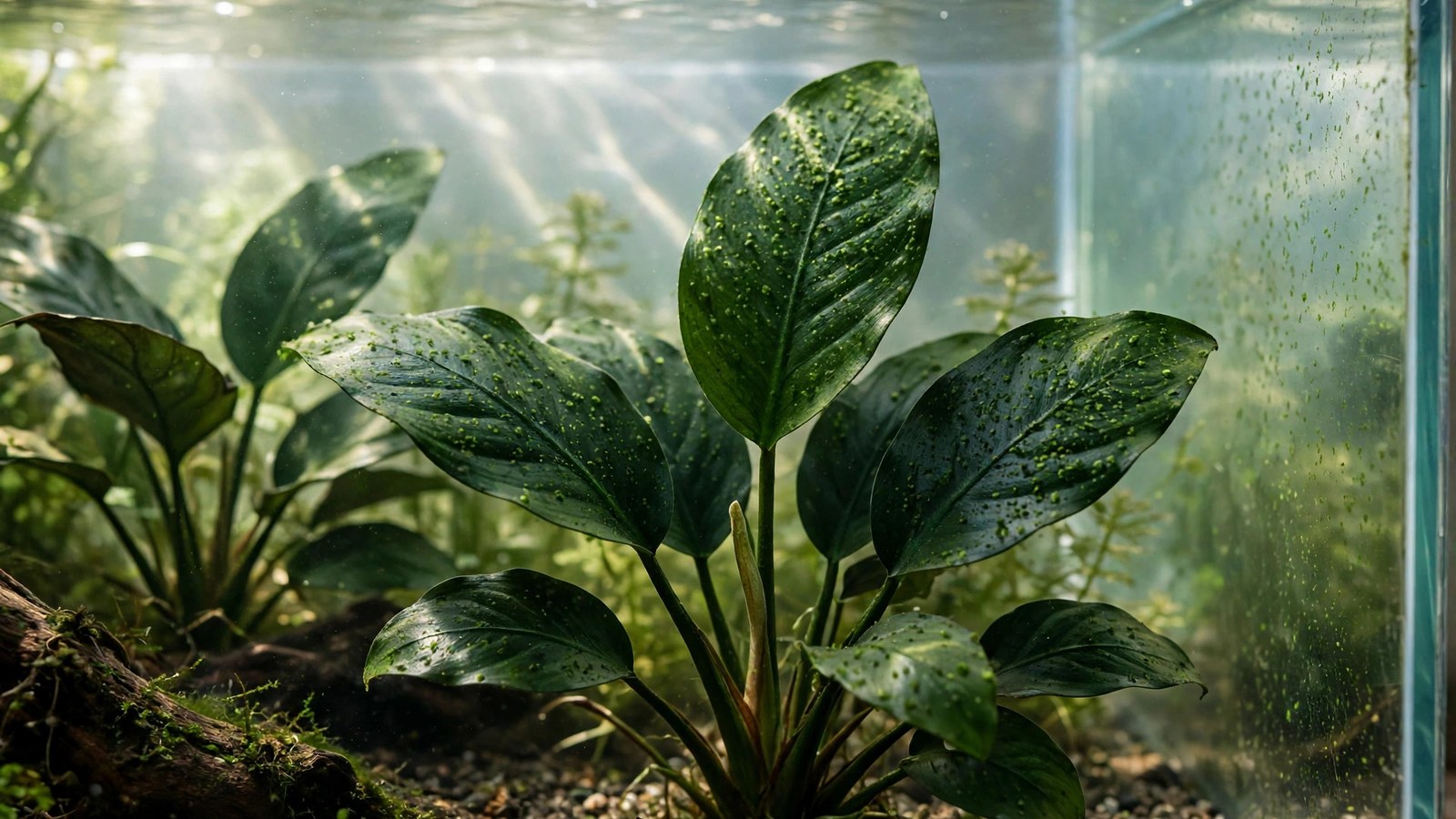
Your aquarium plants stopped growing, their older leaves are darkening to an almost purple hue, and tiny green dots are colonizing your Anubias — and the culprit is the one nutrient almost nobody tests for. Phosphate deficiency in aquarium plants is the quietest of the macronutrient deficiencies: unlike nitrogen, it rarely announces itself with dramatic yellowing, and unlike potassium, it never punches holes in leaves. By the end of this guide, you'll recognize its exact symptoms, read a phosphate test kit like a pro, and fix the deficiency with precise KH2PO4 dosing that brings growth back without triggering an algae bloom.
What phosphate does for your plants
Phosphate (PO4) is one of the three macronutrients — nitrogen, phosphorus, and potassium — that plants consume in the largest amounts. Inside the leaf, phosphorus is a core building block of ATP, the molecule that powers photosynthesis, and of DNA and cell membranes. When phosphate is missing, the entire energy economy of the plant slows: new cells can't form, root growth stalls, and the plant starts cannibalizing its own older tissue to keep the growing tips alive.
The cruel twist: heavily planted, lightly stocked tanks with efficient filtration strip phosphate out while fish-heavy tanks add it. Planted aquasoils bind it, and the plants themselves lock it into their tissues. High-light, CO2-injected tanks burn through it fastest — exactly where a deficiency does the most damage. And it goes unnoticed because most hobbyists test ammonia, nitrite, nitrate, and pH, but never PO4. It's the one number missing from their diagnostic picture.
The classic signs of phosphate deficiency in aquarium plants
Phosphorus is a mobile nutrient: the plant moves it from old growth to new growth when supply runs short. That's why symptoms always appear on the older, lower leaves first — the plant is stripping them to feed the growing tips. This one fact is your most powerful diagnostic tool.
Look for this progression, in order:
- Growth stalls. Stem plants stop extending their internodes; carpeting plants stop sending runners. This often predates visible leaf symptoms by days or weeks — if your plants aren't growing but look "fine," test phosphate. See our guide on stunted growth in aquarium plants for the full diagnostic process.
- Leaves darken. Older leaves take on an unusually dark, almost blue-green color as chlorophyll keeps accumulating while leaf expansion stops.
- Purpling appears. Stems and leaf undersides develop dusky red-purple tones — anthocyanin stress pigments. Deficiency purpling looks dull and concentrates on old growth, unlike the vivid reds of healthy red plants.
- Old leaves die off. The lowest leaves yellow, then brown, then melt away. A tank in chronic starvation shows a gradient: bare lower stems, purplish mid leaves, stunted but green new tips.
One qualifier: light-starved plants also grow slowly, but they come out pale and stretched. Phosphate deficiency produces dark green to purple discoloration with old-leaf die-off — the opposite look.
Green spot algae: phosphate deficiency's calling card
This is the symptom that makes phosphate deficiency famous. Green spot algae — hard, round, crusty dots on glass and leaf surfaces that won't rub off with your thumb — is the planted tank's classic low-phosphate signal. When phosphate is the limiting nutrient while light and CO2 remain available, green spot algae colonizes slow-growing surfaces like Anubias leaves and the tank glass.
Why? Green spot algae is remarkably efficient at scavenging trace phosphate. When PO4 is nearly absent, your higher plants starve, but the algae exploits the scraps. Raise phosphate to healthy levels and the plants recover while the algae loses its competitive edge. Many aquarists find that bringing PO4 into the 1–2 ppm range stops new green spots from forming, even in tanks where they seemed permanent. Check your Anubias first — its slow-growing leaves are the canary. For the algae side of this relationship, read our green spot algae on Anubias guide.
Phosphate vs. the other deficiencies: how to tell them apart
This article completes our nutrient deficiency series, so let's place phosphate exactly where it belongs. All mobile nutrients show symptoms on old growth first; iron and calcium hit new growth. Each leaves a distinct fingerprint — use this table before dosing anything, since dosing the wrong nutrient wastes money and can tip the tank into over-fertilizing symptoms.
| Nutrient | Old or new growth | Signature symptom | Companion algae |
|---|---|---|---|
| Nitrogen (N) | Old | Uniform pale yellowing from the bottom up; thin translucent leaves | None specific |
| Phosphorus (P) | Old | Dark green to purple leaves; stunted growth; old-leaf die-off | Green spot algae |
| Potassium (K) | Old | Yellowing leaf edges; pinholes with yellow rims | None specific |
| Magnesium (Mg) | Old | Interveinal yellowing — green veins, pale tissue between | None specific |
| Iron (Fe) | New | New leaves emerge pale or white; old leaves stay green | None specific |
| Calcium (Ca) | New | Twisted, deformed new growth; crinkled leaf tips | None specific |
The most common confusions, spelled out:
- Phosphate vs. nitrogen: pale = nitrogen, dark/purple = phosphorus. Full breakdown in our nitrogen deficiency guide.
- Phosphate vs. potassium: potassium deficiency adds its unmistakable signature — pinholes through the leaf blade with yellow halos. No pinholes? Suspect phosphate. (See our potassium deficiency guide.)
- Phosphate vs. magnesium: magnesium yellowing is interveinal; phosphate darkening is uniform across the leaf. (Covered in our magnesium deficiency guide.)
- Phosphate vs. iron: iron hits new leaves, phosphate hits old ones. (Details in our iron deficiency guide.)
When in doubt, test. Our complete aquarium plant nutrient deficiency guide walks through the full diagnostic sequence.
Step 1: Diagnose with a phosphate test
Never dose phosphate blindly. Phosphate is cheap, powerful, and easy to overdose — excess fuels green dust algae and cyanobacteria outbreaks. Diagnosis takes ten minutes and saves you from trading one problem for a worse one.
Run the test correctly
Test at a consistent time of day — phosphate drifts after dosing and water changes. Draw water mid-depth, away from the filter outflow, and follow your kit's development timing exactly; reading early or late skews results. If you don't own a proper kit yet, choose one with a low-range scale (0–5 ppm) so you can tell the difference between starvation and health.
Read the results
| PO4 reading | What it means | Action |
|---|---|---|
| 0–0.5 ppm | Starvation range. Plants cannot meet basic metabolic needs. | Dose KH2PO4; retest in 48 hours. |
| 0.5–1 ppm | Marginal. High-light tanks will show symptoms. | Increase dosing slightly; monitor new growth. |
| 1–3 ppm | The sweet spot for almost every planted tank. | Hold the line; test monthly. |
| 3–5 ppm | High but tolerable in CO2-injected, dense tanks. | Reduce dosing; watch for green dust algae. |
| Above 5 ppm | Excess. Algae risk climbs sharply. | 50% water change; pause phosphate dosing a week. |
Watch for one trap: a test can read 1–2 ppm while plants still starve if phosphate is consumed within hours of each dose — common in very dense, fast-growing tanks. Test one hour after dosing, then again 24 hours later: if PO4 crashes to zero between doses, your dosing frequency is the problem, not the dose size.
Step 2: Fix it with the right dose
Option A: KH2PO4 dry fertilizer (most control)
Potassium phosphate (KH2PO4) is the standard dry phosphate source — pure, cheap, and precise. As a bonus, it adds potassium, often welcome in the same tanks that run low on phosphate.
The dosing math is simple: 0.1 grams of KH2PO4 in 100 liters of water raises PO4 by roughly 0.7 ppm.
- Calculate your water volume in liters (L × W × depth in cm ÷ 1,000), then subtract 10–15% for substrate and hardscape displacement.
- For a corrective dose, raise PO4 by 1–2 ppm — roughly 0.15–0.3 grams KH2PO4 per 100 liters. Dissolve in tank water before adding; undissolved granules can burn leaves on contact.
- Dose 2–3 times per week, alternating with macro dosing days if you run a split routine. Dose after lights-on so plants take it up immediately.
- Retest 24–48 hours after the first dose. Back under 1 ppm? Continue. Climbing past 3 ppm? Cut the dose.
For exact gram amounts across any tank size and target ppm, the Rotala Butterfly nutrient calculator is the standard tool planted-tank keepers use for dry fertilizer math.
Option B: All-in-one liquid fertilizer (simplest)
Quality all-in-ones like Tropica Specialised Nutrition, APT Complete, or NilocG Thrive come pre-balanced with phosphate — which is why most beginners never see this deficiency at all. Note that many "micro-only" fertilizers contain no phosphate or nitrogen by design. If you're running one in a heavily planted tank, the missing phosphate is exactly why your plants are stalling; switching to the "complete" version of the same line often fixes it with no further math. Tropica's fertilizer guide explains which product fits which tank type.
Dose daily or every other day rather than once weekly — smaller, frequent doses keep PO4 stable instead of spiking and crashing.
EI dosing ranges for phosphate
Under the Estimative Index method, the standard phosphate target is 1–3 ppm maintained, with weekly totals around 3–4 ppm including the 50% weekly water change that resets the tank. In practice: roughly 1–1.5 ppm three times weekly in CO2-injected, high-light tanks. Low-tech tanks without CO2 usually need none — fish food covers it.
How long until recovery
Damaged leaves never recover — prune the purple, melted old growth. Watch the new growth instead: within 2–3 weeks, fresh leaves should emerge normal green and stems resume extending. Green spot algae should stop spreading within a week or two of stable phosphate (existing spots may need scraping). If nothing changes after three weeks at confirmed 1–3 ppm PO4, something else is limiting — revisit CO2 and lighting.
Avoiding overcorrection: phosphate's dark side
The most common phosphate mistake is panic-dosing: reading 0 ppm, dumping in a huge corrective dose, and landing at 8 ppm. Within days, green dust algae films the glass and cyanobacteria mats the substrate. Above ~3 ppm, extra phosphate doesn't grow plants faster — it only feeds algae.
- Never raise PO4 by more than 2 ppm in a single dose. Two small doses a week apart beat one large shock.
- Retest before every corrective dose. Your tank's consumption rate is unknown until you measure it.
- Keep the 50% weekly water change. It's the safety valve preventing any nutrient from accumulating.
- Watch the glass, not just the test. If green dust algae (a thin, wipeable film — different from hard green spot algae) starts spreading, you've overshot. Cut dosing and let plants pull levels down.
- Balance macros together. Phosphate alone can't drive growth if nitrogen is at zero — dose it alongside your nitrate dosing day.
Frequently Asked Questions
Can phosphate deficiency occur in a tank with lots of fish?
Rarely, but yes. Heavy feeding usually supplies ample phosphate — the main reason low-tech community tanks seldom need dosing. But a heavily planted tank with efficient filtration, frequent water changes, and phosphate-absorbing media can still run dry. If symptoms appear despite full stocking, test before assuming the fish are covering it.
Will adding phosphate cause algae?
Not at proper levels. The myth that "phosphate causes algae" comes from overdosing, not from the 1–3 ppm range plants need. Green spot algae actually retreats when phosphate is corrected. Blooms follow phosphate excess (above 5 ppm) or wild swings from dosing too much, too rarely.
How do I dose phosphate if I use root tabs?
Root tabs feed the substrate, not the water column, so they don't reliably raise measured PO4. Water-column feeders like Anubias, Java fern, and mosses respond to liquid KH2PO4 dosing regardless of root tabs. For rooted stem plants, root tabs plus water-column dosing covers every feeding style.
Do I need phosphate in a low-tech tank without CO2?
Usually no. Low-tech tanks grow slowly enough that fish food and waste provide sufficient phosphate, and adding more mainly risks algae. Test first: if PO4 holds above 0.5 ppm and plants grow steadily, leave it alone. Supplement only if a test confirms true depletion with matching symptoms.
Are commercial phosphate boosters worth it?
They work, but they're expensive per dose compared to dry KH2PO4, and some contain extras you don't need. For a single small tank they're fine. For anything above 100 liters, dry KH2PO4 pays for itself within weeks and gives cleaner control over the exact ppm you're adding.
My PO4 reads fine but plants still look deficient. What's wrong?
Three possibilities. First, timing: phosphate may crash to zero between weekly doses — test 24 hours after dosing, not just before. Second, another nutrient is the real limiter; revisit the comparison table, since nitrogen or potassium deficiencies can mask a resolved phosphate issue. Third, CO2 or light is the bottleneck — no fertilizer fixes a tank where plants can't photosynthesize efficiently.
Get phosphate right and the tank balances itself
Phosphate deficiency is the final piece of the mobile-nutrient puzzle: nitrogen yellows, potassium punches holes, magnesium fades between the veins, and phosphorus darkens and purples the old growth. Test your water, dose KH2PO4 in small measured amounts, hold the 1–3 ppm band, and give it three weeks. The green spots stop spreading, the new leaves come in clean green, and the stalled tank starts growing again — the quiet recovery of the last missing nutrient clicking into place.