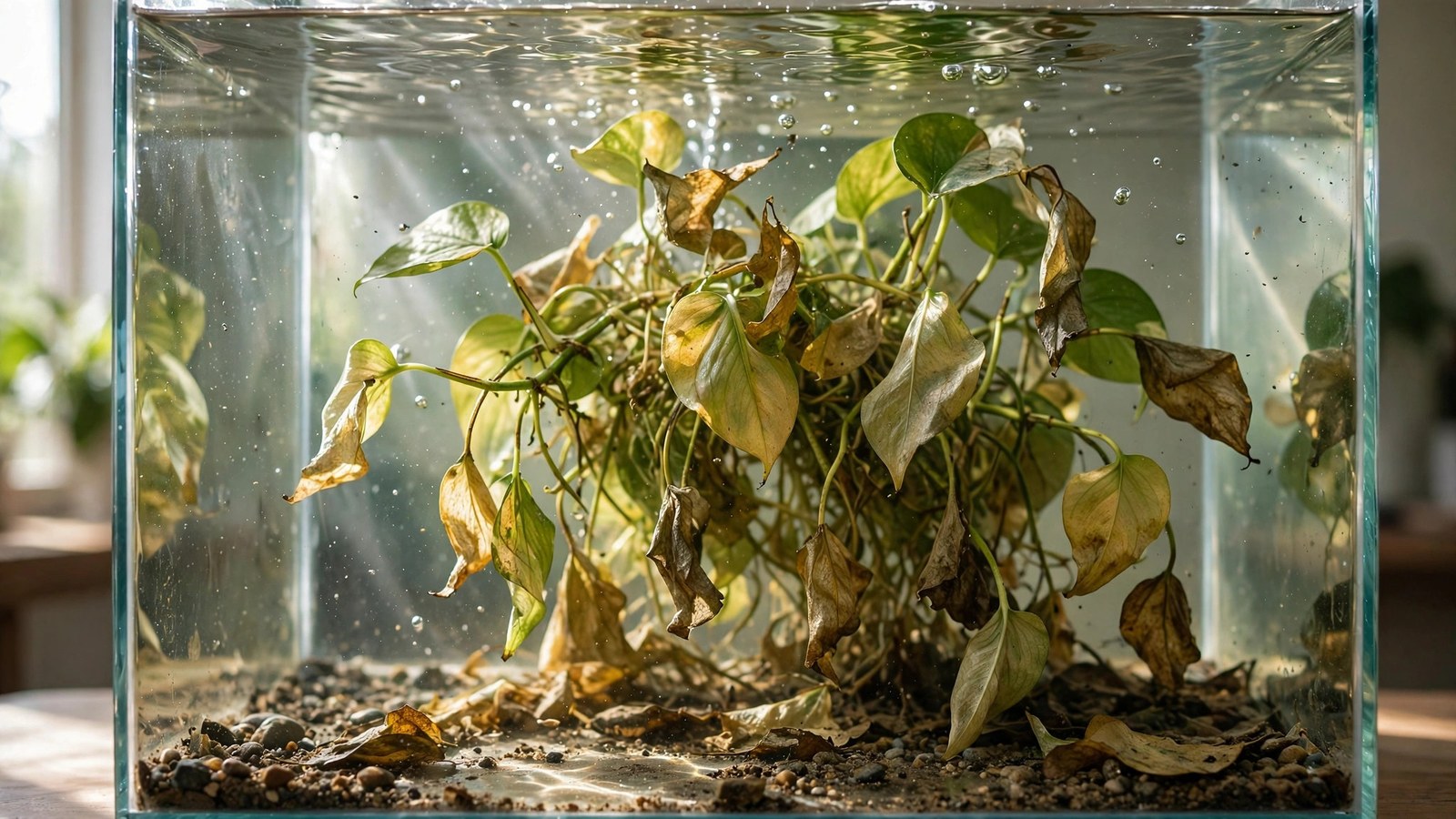
That lush green plant in the tube at the pet store might be a houseplant in disguise. Non-aquatic aquarium plants are terrestrial species packaged and sold for fish tanks, and every single one rots underwater — usually within two to eight weeks, fouling your water as it dies. Here are the 7 impostors to recognize on sight, the 30-second tests that expose them before you pay, and the real aquatic plants to buy instead.
Why Non-Aquatic Plants End Up in Fish-Store Tubes
It's economics, not conspiracy. Terrestrial plants are mass-produced in greenhouses for pennies, ship dry in sealed tubes, and sit on the shelf for weeks looking perfect. Real aquatics need wet packaging, faster turnover, and knowledgeable staff — all of which cost more. So suppliers ship mixed "assorted aquarium plants" tubes, staff stock them by the betta cups, and nobody checks whether the species can actually live submerged.
Same buyer-beware family as the magic carpet seeds scam: packaging promising an underwater garden that biology can't deliver — except these die slowly enough that you blame yourself first.
The 7 Worst Offenders: Know Them on Sight
These seven show up in big-box pet stores and local fish shops constantly. Memorize the table before you buy anything grass-like or fern-like in a tube.
| Store name | Real species | Submerged lifespan | Plant this instead |
|---|---|---|---|
| Mondo grass | Ophiopogon japonicus | 3–6 weeks, then mush | Dwarf sagittaria, Helanthium tenellum, Blyxa japonica |
| Ribbon plant / "lucky bamboo" | Dracaena sanderiana | 4–8 weeks | Vallisneria spiralis or jungle val |
| Aluminum plant | Pilea cadierei | 2–4 weeks — rots fast | Anubias 'Pinto' for patterned leaves |
| Peacock fern | Selaginella willdenowii | 1–3 weeks — melts fastest | Bolbitis heudelotii (African water fern) |
| Peace lily | Spathiphyllum wallisii | 3–5 weeks | Anubias barteri for broad leaves |
| Purple waffle | Hemigraphis exotica | 2–4 weeks | Alternanthera reineckii for purple-red color |
| Arrowhead plant | Syngonium podophyllum | 2–5 weeks | Echinodorus amazonicus (Amazon sword) |
Mondo grass is the most-reported fake in hobbyist forums: sold for betta tanks, green for a month, then collapse. For that grassy foreground look, buy tissue-culture cups of dwarf sagittaria, Helanthium tenellum, or Blyxa japonica instead — true aquatics that carpet the way mondo packaging promises.
How to Spot Non-Aquatic Aquarium Plants at the Store
Five quick checks catch nearly every fake before money changes hands:
- Leaf texture. Terrestrial leaves feel thick, waxy, or leathery with a glossy coating that repels water. True aquatic leaves are thinner and more delicate, because they don't need waterproofing.
- Stems and canes. Woody canes (ribbon plant), stiff upright stems, or anything that looks like it belongs in a flowerpot is a red flag. Aquatic stems are soft and flexible.
- The label test. Real aquatic plant packaging names the species — Anubias nana, Cryptocoryne wendtii. Impostor tubes say "assorted aquarium plants," "tropical foliage," or just a pretty common name with no Latin anywhere.
- Roots and medium. Peek through the tube: a dense terrestrial root ball or peat/soil medium means it was grown in a greenhouse, not a nursery tank.
- The database check. If the species isn't listed in the Tropica plant database, treat it as guilty until proven innocent. It takes ten seconds on your phone.
What Happens When They Rot: Ammonia, Algae, and Fish Stress
A dying impostor doesn't just look sad — it actively poisons the tank. As leaves and roots turn to mush, decomposition releases ammonia directly into the water column. In a 10-gallon tank, one rotting mondo grass clump can push ammonia to 0.25–0.5 ppm within days — enough to burn fish gills while your test kit still shows "a little ammonia, probably fine."
The visual warning signs follow a pattern: leaves going transparent from the tips inward, then whole sections turning brown and slimy to the touch. Within a week of visible decay, expect a hair-algae or green-water bloom feeding on the released nutrients, and fish hanging near the surface or clamping their fins from the ammonia stress.
Bought One Already? The 48-Hour Rescue Plan
Already planted the evidence? Don't wait to see if it "adapts" — terrestrial plants never convert to submerged growth. Act within 48 hours:
- Pull it now. Every day it sits rotting is another day of ammonia leaching. Remove the whole plant, roots and all.
- Repot it as a houseplant. Almost every impostor on the list — mondo grass, peace lily, aluminum plant — makes an excellent houseplant. You've bought a pot plant; give it a pot.
- Change 30–50% of the water and test ammonia. Treat the tank like it just had a mini cycle crash: test daily for three days, and do water changes any time ammonia reads above zero.
- Replace it with a true aquatic. Use the swap column in the table above — your tank gets the look you wanted, from a plant that can actually live there.
One important distinction: a true aquatic that melts after planting is a different, fixable problem. Anubias melting during its emersed-to-submersed transition recovers with stable conditions, and a true aquatic that stalls instead of rotting usually needs light or nutrient adjustments — not the trash bin.
Frequently Asked Questions
Is mondo grass really not an aquatic plant?
No. Mondo grass (Ophiopogon japonicus) is a terrestrial landscaping plant from East Asia, grown for garden borders and ground cover. It tolerates wet soil and brief flooding, which is why it survives a few weeks submerged and fools buyers. But it cannot grow new leaves underwater, so once the original foliage exhausts itself — typically 3–6 weeks — the whole clump collapses into mush.
How long can a ribbon plant survive underwater?
Ribbon plant (Dracaena sanderiana, the same species sold as "lucky bamboo") usually lasts 4–8 weeks fully submerged — longer than most impostors, which makes it especially deceptive. The leaves stay green while the submerged cane slowly softens from the base up. Once the base turns brown and mushy, the whole stalk follows within days. Grown with its leaves above the waterline, though, it thrives indefinitely.
Can I grow these plants with just their roots in the water?
Yes — and this is the legitimate use most impostors are actually good for. Ribbon plant, peace lily, arrowhead plant, and pothos all grow vigorously as riparium plants with roots submerged and foliage in the air, and their roots absorb nitrates. The scam is only the claim that they'll live fully underwater. Keep leaves above the surface and you've got a free nitrate filter.
Why do pet stores keep selling non-aquatic plants as aquarium plants?
Margins and shelf life. Terrestrial plants are greenhouse-grown for pennies, ship dry in sealed tubes, and look perfect on the shelf for weeks. True aquatics need wet packaging and faster turnover, which costs more. Most store staff genuinely don't know the difference, and suppliers label tubes "assorted aquarium plants" rather than naming species — so the mislabeling sails through unchecked.
My new "aquarium plant" is turning brown after 3 weeks — dying or adjusting?
At three weeks with browning from the tips and a slimy texture, it's almost certainly a non-aquatic rotting, not adjusting. True aquatics transitioning from emersed growth melt older leaves but push out new submerged leaves at the same time — look for fresh growth at the base or crown. No new growth plus mushy stems means the plant was never aquatic. Pull it, do a water change, and replace it.
Buy the Plant, Not the Packaging
The tube says "aquarium." The Latin name — or its absence — tells the truth. Check the species, learn the seven faces above, and you'll never pay aquarium prices for a houseplant's slow funeral again.