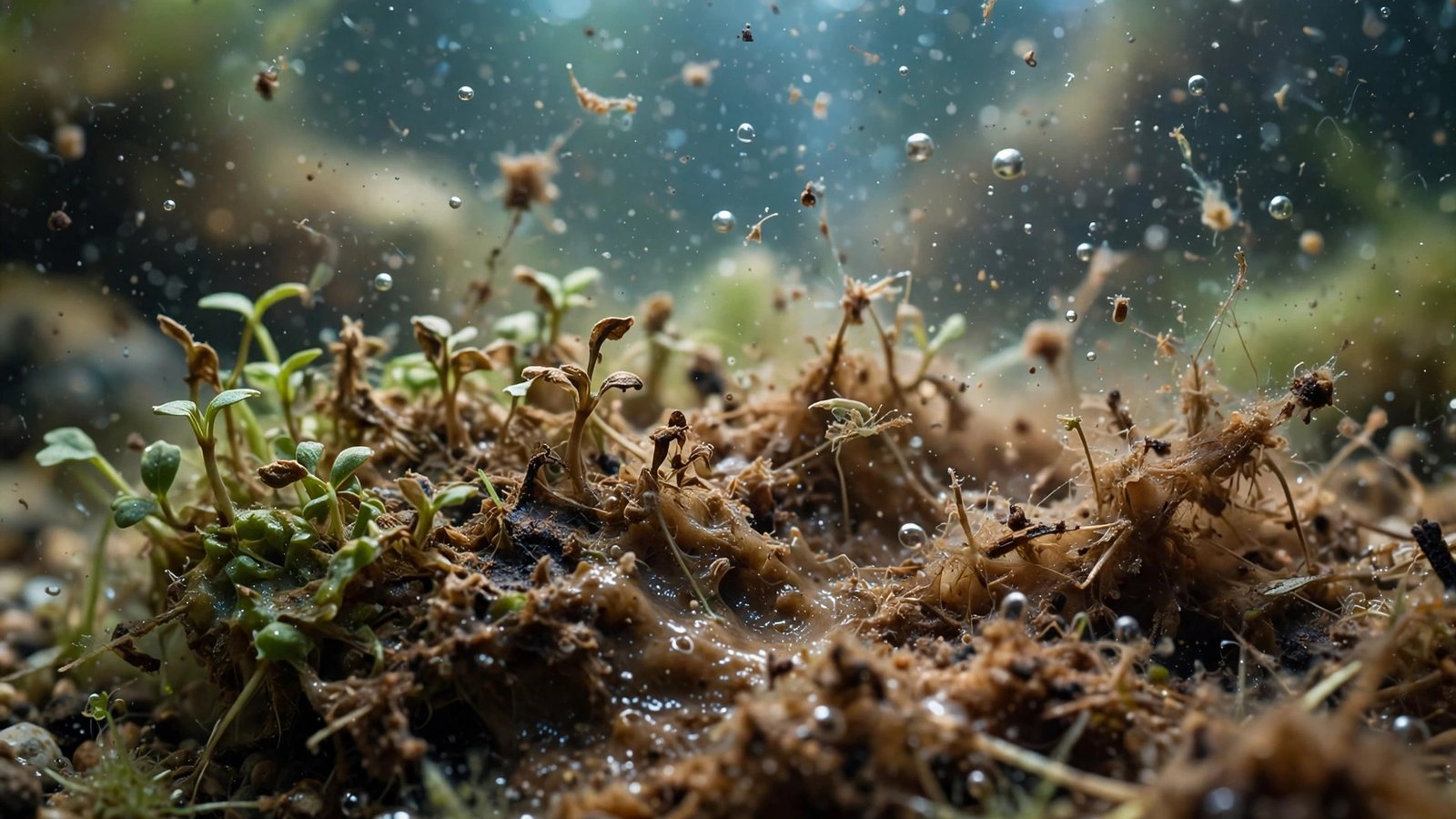
If you've been researching how to carpet an aquarium, you've almost certainly seen them: packets of aquarium plant seeds promising a thick, emerald-green carpet in two weeks — "Magic Carpet Seeds," "Dwarf Baby Tears seeds," "Pearl Grass seeds" — all for the price of a coffee. The product photos show flawless glowing-green lawns and the reviews rave about explosive growth. Here's the part nobody in the listing tells you: these seeds almost never grow true aquatic carpet plants. What sprouts from the packet is usually a terrestrial or semi-aquatic land plant that germinates happily in damp air, then rots and melts within weeks of being flooded. This guide explains how the scam works, the biology behind the inevitable melt, and — most importantly — how to grow a real carpet that actually stays underwater.
What "Magic Carpet Seeds" Actually Are
Genuine aquarium carpet plants — Monte Carlo, dwarf hairgrass, HC Cuba, Marsilea — are propagated commercially by division, cuttings, or tissue culture, not by seed. There is a practical reason for this: true carpeting species either flower and set seed rarely in captivity, or their seeds are extremely difficult to germinate underwater in a way that produces a useful lawn. No major aquatic plant nursery sells seeds for its carpeting species. That single fact is the giveaway that should make any buyer suspicious.
So what is in those packets? Independent hobbyist grow-outs around the world have repeatedly found the same answer: the seeds are typically fast-germinating terrestrial plants — often species in the sesame or carpet-weed families, or generic pasture grasses — selected purely because they sprout quickly and look grassy in a damp tray. The seeds are cheap agricultural or lawn stock, repackaged with fantasy labels like "Dwarf Baby Tears," "Small Cow Hair," or "Pearl Grass." They are not selected for submerged life, and many are not even named species on the packaging — just "aquarium plant seeds" or "foreground grass seeds."
The sellers never commit to a Latin name. That's deliberate. A real plant product lists Micranthemum tweediei or Eleocharis parvula because the identity is the selling point. A scam packet lists a mood — "magic," "miracle," "lucky" — because the actual species would betray it on contact with Google. If you cannot find a scientific name anywhere on the packet or listing, you are not buying a known aquarium plant.
How the Seed-Carpet Scam Works
The marketing playbook
The listings follow a formula. First, stolen or staged photos: lush carpeted aquascapes copied from contest winners, presented as "customer results." Second, impossible promises: full carpet in 10–15 days, no CO2 needed, grows in any tank. Third, urgency: flash sales and bulk discounts that make the price nearly symbolic. Fourth, and most cleverly, the product is engineered to deliver a satisfying first act — the seeds really do sprout fast. A buyer sprinkles them, keeps the tank dry-started for a week or two, and watches a green fuzz erupt. The review gets written during that honeymoon window, before the flood. The melt happens later, quietly, after the review window has closed and refunds feel like more trouble than they're worth.
Why the reviews look so good
This timing trick explains the paradox that traps so many beginners: a product with thousands of five-star reviews that experienced aquascapers universally warn against. Most positive reviews describe germination, not submersion. "Sprouted in 3 days! Amazing!" is a review of a seed packet's ability to sprout in damp air — which any grass seed can do. The failure phase, why aquarium plants melt after planting, arrives one to four weeks after flooding, long after most buyers have moved on. Negative reviews do accumulate, but they're drowned by volume and by the algorithm's love of fresh positive ratings — and when one listing collects too many one-star warnings, the same seeds reappear under a new brand with a new fantasy label.
Why They Sprout Beautifully — Then Melt Underwater
Emergent vs. submerged: the biology nobody mentions
The seeds in these packets are not defective. They do exactly what land-plant seeds do: germinate in warm, damp conditions with access to air. Most sellers even instruct you to plant them during a dry start — spread them on damp substrate, mist daily, cover the tank with cling film. Under those conditions, terrestrial seedlings thrive. They have access to unlimited atmospheric CO2 (about 400 ppm, vastly more than dissolved CO2 in water), full-spectrum air, and no water pressure on their tissues. The result looks incredible — and it teaches the buyer exactly the wrong lesson.
True aquatic plants have specialized adaptations for submerged life: thin cuticles, leaves built to absorb CO2 and nutrients directly from water, and tissues that stay rigid underwater. Terrestrial seedlings have none of this. Their leaves are built for air. When flooded, their stems can't exchange gases efficiently, their leaves suffocate, and the entire mat collapses. That collapse is called melting, and with these seeds it's not a transition phase — it's the death of the plant.
What the timeline actually looks like
| Week | What you see | What's really happening |
|---|---|---|
| 1–2 (dry) | Fast, even germination; bright green fuzz | Terrestrial seedlings exploiting free atmospheric CO2 |
| 3 (flood) | Carpet looks perfect for a few days | Seedlings are suffocating but still structurally intact |
| 4–5 | Yellowing patches, leaves going translucent | Cell death spreading; roots rotting in the substrate |
| 6–8 | Brown slime, foul smell, ammonia spike | Mass decomposition; water chemistry destabilizing |
| 8+ | Bare substrate, possibly an algae bloom | The "carpet" is gone; the tank restarts from zero |
This timeline is the scam's cruelest feature: the buyer does everything right, follows the instructions perfectly, and is rewarded with two weeks of beauty followed by a tank-wide crash. The decomposing mat can release enough ammonia to trigger algae outbreaks, including hair algae that colonizes the dying mat itself.
7 Red Flags That Expose Fake Aquarium Plant Seeds
Before you click "buy," run the listing through this checklist. Any single red flag should stop you; these listings usually wave all seven:
- No Latin name anywhere. Real plant products name the species. Fantasy names like "magic carpet" or "mini dwarf pearl" with no scientific identity are a confession.
- Impossible speed claims. "Full carpet in 10 days" — even tissue-culture Monte Carlo under high light and CO2 needs 4–8 weeks. Biology has a speed limit.
- Photos that look like contest winners. If the "result" photos show an aquascape far beyond what a $3 seed packet could produce, they've been lifted from somewhere else.
- Sold only on marketplaces, never by plant nurseries. Tropica, Dennerle, and ADA — the companies that actually breed aquarium plants — sell zero seeds. That should tell you everything.
- Instructions center on dry-start germination. Legitimate carpeting methods (tissue culture, potted plants) plant directly underwater or tolerate either. Seed instructions depend on the air phase because the plants can't live submerged.
- No mention of CO2, light, or species needs. Real carpet plants have real requirements. A product that claims to need nothing is selling a fantasy, not a plant.
- Reviews praise germination, not carpets. Read the five-star reviews critically: if they all describe sprouting within days and none show a thriving submerged carpet months later, the reviews are documenting the setup, not the result.
What to Do If You Already Planted Seed "Carpets"
Don't feel foolish — this scam catches thousands of experienced-looking beginners every month, and the marketing is genuinely deceptive. Here's the recovery plan, in order:
- Remove the mat before it fully rots. As soon as you see widespread translucency and browning, siphon or peel the dying seedlings out. Waiting lets decomposition spike ammonia and stalls the plants you actually want growing. Wear gloves; the slime smells awful.
- Do a large water change and test. After removal, change 50% of the water and test ammonia and nitrite. A rotting seed mat in a small tank can produce a measurable spike, so test daily for a few days and change water as needed.
- Clean the substrate surface. Seed husks and root fragments left behind continue to decay. Gently vacuum the top layer of substrate without uprooting anything else.
- Watch for algae for two weeks. The nutrient dump from a melting mat is prime fuel for algae. Keep lighting moderate, stay on top of water changes, and address any outbreak early rather than hoping it fades.
- Start over with real plants. Resist the urge to try a different seed brand — it's the same scam with new packaging. The next section shows you what actually works.
If your seedlings are merely yellowing at the edges but mostly green, you can confirm the diagnosis fast: pull one seedling and look at the leaves. True aquatic carpet leaves are thin and flexible; seed-scam seedlings feel like tiny blades of grass — stiff, waxy, terrestrial. That grass feeling is your verdict.
How to Grow a Real Carpet That Actually Stays Underwater
A genuine carpet takes longer than two weeks, but it persists for years and actually improves your tank's ecosystem. Here are the three proven routes:
Option 1: Tissue-culture cups (best for beginners)
Tissue-culture plants are grown sterile in labs and sold in sealed cups — pest-free, algae-free, and already adapted to submerged life. Split the gel-grown clump into small portions with tweezers and plant them in a grid, 2–3 cm apart. They'll look sparse at first, then spread via runners. Monte Carlo and dwarf hairgrass in tissue-culture form are the closest thing to a foolproof carpet for a beginner. A step-by-step tissue-culture planting guide walks through the rinse-and-divide technique that makes the difference between melting cups and thriving carpets.
Option 2: Potted plants, split and replanted
Potted carpeting plants from a nursery are grown emersed (in humid air) and need a transition period after planting — some Monte Carlo melting after planting is normal here, but unlike seed scams, the roots survive and push new submerged leaves. Split each pot into 6–8 portions, plant in a grid, and give it 2–3 weeks. This is the most economical route for larger tanks.
Option 3: The dry-start method — with real plants
The dry start itself isn't the scam; using it on land seeds is. With genuine carpeting species, a dry start (planting in damp substrate under a covered, humid tank for 3–6 weeks before flooding) builds dense root systems that explode into growth once flooded. Monte Carlo and HC Cuba are classic dry-start candidates. The key difference: you're starting with a real aquatic species, not mystery grass.
5 Genuine Carpet Plants vs. the Seed Lie
Here is what the seed packets are pretending to be — real species, with real requirements and real, permanent results:
| Real plant | Growth speed | Light needs | CO2 | Difficulty |
|---|---|---|---|---|
| Monte Carlo (Micranthemum tweediei) | Medium | Medium–high | Helpful, not required | Easy–medium |
| Dwarf hairgrass (Eleocharis parvula) | Medium | Medium–high | Helpful, not required | Easy–medium |
| HC Cuba (Hemianthus callitrichoides) | Fast (with CO2) | High | Required | Advanced |
| Dwarf water clover (Marsilea hirsuta) | Slow–medium | Low–medium | Not required | Easy |
| Glossostigma (Glossostigma elatinoides) | Fast (with CO2) | High | Required | Medium |
Notice what every real carpet plant has in common: a Latin name, known requirements, and honest timelines measured in weeks and months. If your carpet plants stall and stop spreading, that's a solvable problem with light, CO2, or nutrients — a real plant responding to real conditions, not a doomed seedling. That's the difference between a hobby and a scam: real plants give you feedback you can act on.
Frequently Asked Questions
Will aquarium plant seeds ever grow back underwater after melting?
No. Once the terrestrial seedlings from a scam seed packet melt, they are dead — there is no dormant aquatic form waiting to recover. This differs from true aquatic plants like Cryptocoryne, which can melt their emersed leaves and regrow submerged ones from surviving roots (Cryptocoryne melt recovery is genuinely possible). The seeds sold as "magic carpet" are land plants with no submerged growth stage, so regrowth is biologically impossible. Remove the dead mat, stabilize your water, and replant with a genuine carpeting species.
Are any aquarium plants legitimately grown from seed?
Almost none in the commercial hobby. A few species like certain Echinodorus swords can technically be grown from seed, but nurseries don't sell them that way — germination is slow and unreliable compared to division or tissue culture. No recognized aquarium plant nursery sells seeds for carpeting species, which is exactly why any packet marketed as "carpet seeds" should be treated as a scam until proven otherwise.
Why did my seeds sprout so well if they're a scam?
Because the product is engineered to sprout, not to survive. The seeds are fast-germinating terrestrial species that thrive in the warm, humid, CO2-rich air of a dry start — conditions no aquarium provides once flooded. Impressive germination proves only that the seeds are alive, not that they're aquatic. Sellers exploit this by encouraging reviews during the sprouting phase, before the inevitable underwater melt reveals what the seeds actually are.
Can I salvage a failing seed carpet by keeping the tank half-filled?
Keeping the tank emersed will keep terrestrial seedlings alive, but then you don't have an aquarium — you have a terrarium with a puddle. The moment you fill the tank to a normal level, the same suffocation and melting begins. There is no water level at which a land plant becomes an aquatic carpet. If you enjoy the emersed look, commit to a paludarium with genuinely semi-aquatic species instead of fighting biology.
What's the fastest legitimate way to carpet a tank?
Buy tissue-culture cups of Monte Carlo or dwarf hairgrass, split them into many small portions, and plant densely in a grid — heavy initial planting is the real shortcut. Add moderate-to-strong light and CO2 if you can, and expect a solid carpet in 6–10 weeks. It's slower than the seed packet's fantasy timeline, but the carpet stays, spreads, and can be trimmed and replanted for years instead of dissolving in month two.
The Bottom Line
The aquarium plant seed scam works because it sells the one thing every aquascaper wants — instant results — and delivers a convincing preview before the bill comes due. Now you know the pattern: mystery seeds, no Latin name, miraculous germination, and a melt that arrives right after the review window closes. Spend that same few dollars on a tissue-culture cup of a real carpeting species instead. You'll wait a little longer for your lawn, but you'll only ever have to grow it once — and you'll never again mistake a sprouting windowsill for an underwater meadow.
Tissue-culture plants are the exception — they’re grown in sterile gel and adapt with minimal melting, which is part of what you’re paying for. Plants bought submersed from another hobbyist’s tank also transition with little melt, since they’re already in the right form.
Which Plants Melt Most (and Least)
Heavy melters (expect significant leaf loss)
- Cryptocorynes — infamous for “crypt melt,” sometimes dropping every leaf after any disturbance. They almost always recover from the roots within weeks.
- Stem plants grown emersed — rotala, ludwigia, and hygrophila often shed lower emersed leaves while the growing tips transition.
- Amazon swords — emersed-grown swords typically lose their broad oval aerial leaves and replace them with longer submersed ribbon leaves.
Light melters
- Anubias, java fern, bucephalandra — slow-growing rhizome plants transition gradually; occasional old-leaf melt but rarely dramatic.
- Vallisneria — usually transitions well, though it dislikes the move itself and may sulk for a week.
- Floating plants — minimal melt since their leaves were already at the air-water interface.
The Acclimation Protocol
Step 1: Quarantine or dip first
Before acclimating to your tank’s conditions, make sure you’re not acclimating pests along with the plant. Run new arrivals through our quarantine and dip protocol — it adds days upfront but prevents months of regret.
Step 2: Float to temperature-match (30 minutes)
Float the bag or container in your tank for 20–30 minutes to equalize temperature. Plants are less temperature-sensitive than fish, but a 10°F shock on top of transplant stress is an avoidable insult.
Step 3: Trim before planting
Remove any leaves that are already damaged, yellowing, or heavily algae-covered — they won’t recover and they’ll rot in your tank, feeding algae. For stem plants, trim off the bottom inch and any emersed leaves that look unlikely to adapt; the plant wastes energy maintaining leaves it’s going to shed anyway. Keep the healthy growing tips — that’s where recovery starts.
Step 4: Plant correctly the first time
Follow our planting guide — right depth, crown exposed on rosettes, rhizomes unburied on epiphytes. Every uprooting and replanting restarts the acclimation clock, so get placement right on the first attempt. Decide where each plant goes before it goes in the water.
Step 5: Run a gentle first week
For the first 7 days after planting:
- Moderate light — run your normal photoperiod but consider dropping intensity 20–30% if your light is dimmable. Blast-level light on a melting plant grows algae on the dying leaves, not recovery.
- Stable CO2 — if you inject CO2, keep it consistent. Fluctuating CO2 during acclimation is a melt accelerator. If you’re low-tech, this doesn’t apply — see growing without CO2.
- Half-strength fertilizer — new plants with damaged leaves can’t use full dosing, and the excess feeds algae. Ramp to full strength over 2–3 weeks per our fertilizer schedule.
- No disturbance — don’t move, trim, or “check on” new plants for at least two weeks. Every touch resets root establishment. This is especially critical for crypts.
Step 6: Remove melt, keep the base
As emersed leaves melt, remove the mushy material promptly — decaying leaves release ammonia and grow fungus that can spread to healthy tissue. But never discard the plant while the crown, rhizome, or roots are firm and alive. A crypt that’s lost every leaf but has firm roots is a plant that’s about to recover, not a dead plant. Give it 3–4 weeks before judging.
Telling Normal Melt From Real Problems
Normal transition melt:
- Affects oldest/emersed leaves first, newest growth last
- New submersed leaves emerge even as old ones dissolve
- Roots and crown stay firm and white/green
- Timeline: 1–4 weeks, then obvious new growth
Concerning melt (see our full melting diagnosis guide):
- New growth also melts or emerges deformed
- Rhizome or crown turns mushy and brown — this is rot, not transition
- Entire plant dissolves within days with no new growth after 4+ weeks
- Melting spreads to established plants that weren’t recently moved
Buying Tips to Minimize Melt
- Buy submersed-grown when available — hobbyist-grown cuttings transition with almost no melt.
- Choose tissue culture for sensitive species — crypts and delicate stems establish far more reliably from sterile cups.
- Avoid plants already melting in the store tank — some melt is normal, but a plant that’s mostly mush at purchase has less energy for recovery.
- Transport carefully — keep plants damp and out of direct sun/heat. A plant that dries out or cooks in a hot car melts far worse than one transported properly.
The First-Month Timeline: What to Expect Week by Week
Knowing what’s normal when removes most acclimation anxiety. Here’s the typical timeline for a healthy plant adapting to a new tank:
Week 1: The quiet week
Almost nothing visible happens. The plant is growing roots you can’t see and assessing its new environment. Some species (vallisneria, stem plants) may start shedding their lowest leaves. This is normal. Resist the urge to “help” — no moving, no extra fertilizer, no light changes. The most common beginner mistake is intervening during a week when the correct action is nothing.
Week 2: Melt peaks
This is when emersed leaves give up in earnest. Crypts may drop everything; swords shed their broad aerial leaves; stem plants lose lower foliage. It looks catastrophic and it’s usually fine. Keep removing mushy material, keep conditions stable, and watch the crown and growing tips — if those are firm and green, recovery is already underway.
Week 3: The turn
New submersed-adapted leaves emerge — smaller, thinner, often a slightly different shade of green than the emersed foliage. Stem plant tips start growing visibly; crypts push tiny curled leaves from the crown; swords unfurl narrow ribbon leaves. This is the moment most beginners exhale for the first time.
Week 4+: Established
New growth outpaces melt, and the plant is functionally yours. You can resume full-strength fertilizer, normal trimming, and stop treating it as fragile. Some slow growers (anubias, bucephalandra) take 6–8 weeks to show obvious progress — that’s their normal speed, not a problem.
Acclimating Different Plant Formats
Tissue-culture cups
Sterile, pest-free, and already adapted to high-humidity (not emersed) growth — tissue cultures melt the least of any format. Rinse the agar gel off gently (leftover gel rots and feeds fungus), split the portion into small plantlets, and plant per our planting guide. They establish slowly for the first two weeks, then accelerate. No dip needed, minimal acclimation stress — this is the premium experience you’re paying for.
Potted plants
Remove the pot and strip away the rockwool completely — leftover rockwool traps debris and rots. Tease the root mass apart gently; if it’s a dense mat, splitting it into 2–3 smaller portions actually establishes faster than planting one big clump (more growing points, better water flow around roots). Potted plants are usually emersed-grown, so expect the standard 2–4 week melt cycle.
Bare-root / bunched stems
Typically sold as weighted bunches. Remove any bands, foam, or weights, strip the lower leaves, and plant stems individually or in small groups. Bunched stems from the store are often already transitioning — check for new submersed growth at the tips, which tells you the plant is mid-adaptation and will settle quickly.
Hobbyist cuttings
Already submersed-grown and the fastest to establish — often showing new growth within days. The main acclimation factor is water-parameter difference between the two tanks. Float to temperature-match, plant promptly, and they’ll usually take off with minimal melt. This is why experienced hobbyists prefer trading cuttings over buying potted plants.
Frequently Asked Questions
Should I use a “plant starter” or transplant fertilizer?
Products marketed for transplant shock are mostly B-vitamins and mild hormones. They don’t hurt, but there’s no strong evidence they help aquarium plants specifically. Stable conditions and patience outperform any bottle. Save the money for more plants.
My new plant melted completely — bare crown, no leaves. Is it dead?
Probably not, if the crown or rhizome is firm. Crypts and swords routinely lose 100% of their leaves and regrow from the base within a month. The test is firmness: firm and pale/green means alive; mushy and brown/black means rot. Give firm-but-leafless plants a full 4 weeks before declaring them dead.
Can I speed up acclimation with extra light or CO2?
No — and trying usually backfires. A melting plant can’t use extra light; the excess just grows algae on its dying leaves. Keep light moderate and CO2 stable (not boosted) during acclimation. Growth speed comes from the plant’s own adaptation timeline, which you can’t rush, only avoid delaying.
Should new plants go straight into my main display tank?
After quarantine/dipping, yes — there’s no benefit to a separate “growing-in” tank for most plants. They acclimate to your water fastest in the tank they’ll live in. The exception is very delicate species going into a tank with boisterous fish; give those a few weeks in a calm corner or breeder box first.
The Patience Rule
The single most important acclimation skill is restraint: plant it right, set gentle conditions, remove decay, and then leave it alone for a month. The hobbyists with the best plant growth aren’t doing something clever in week one — they’re simply not interfering in weeks two through four while the plants do what they’ve evolved to do. Melt looks like failure and feels like failure, but in most cases it’s the visible part of a plant successfully becoming yours.