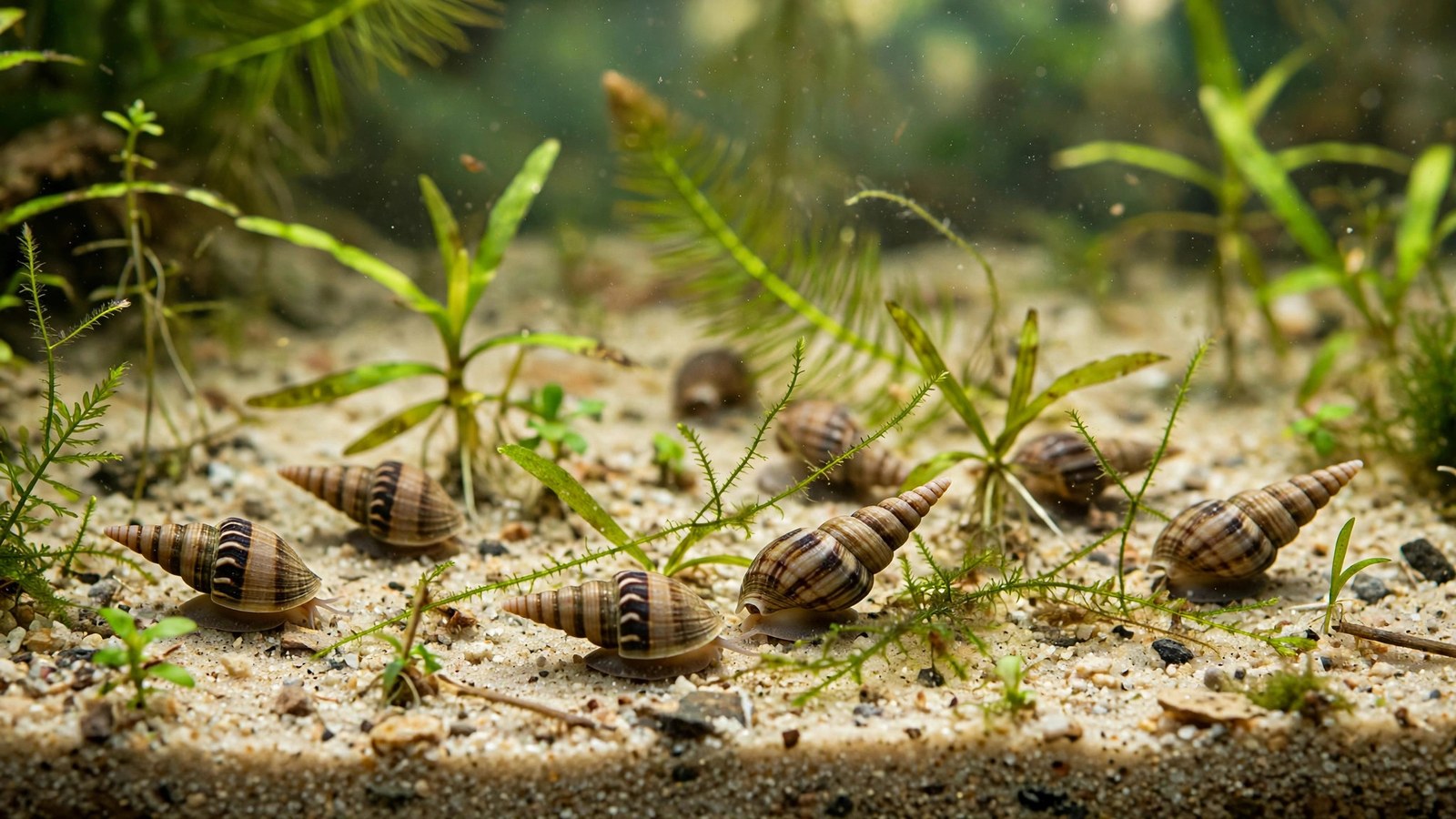
You didn't invite them. One day you spot a single tiny spiral shell on a new plant leaf, and three months later your substrate is crawling with cone-shelled snails that only emerge after lights-out. Malaysian trumpet snails (MTS) are the most divisive animal in planted aquariums — half the hobby calls them a free cleanup crew, half calls them an infestation. This guide gives you a clear verdict for your tank, plus the control methods that work — and if your verdict is "bad," the proven biological fix: assassin snails, their natural predator.
malaysian trumpet snails: the honest verdict
MTS are neither good nor bad in the abstract — they're a self-regulating cleanup organism whose population mirrors your tank's waste load. In a lightly-fed, mature planted tank you'll see a modest crew of a few dozen doing useful work invisibly. In a tank where food hits the substrate daily, you'll see an explosion. That explosion is information, not misfortune: it's the earliest signal that you're overfeeding or detritus is building up in a dead-flow zone.
What they get right: the real pros
The headline benefit is substrate aeration. MTS spend their days burrowed 2–4 cm deep, tunneling through sand and fine gravel. Every tunnel lets oxygen reach zones that would otherwise go anaerobic — the same dead zones where hydrogen sulfide builds up and rotting roots start. In deep sand beds (3–5 cm), this unpaid labor genuinely reduces the black, sulfurous patches that kill root systems from below.
They're also excellent scavengers. New tanks dealing with a diatom bloom in the first weeks often clear noticeably faster with an established MTS crew grazing the hardscape at night. And crucially — this separates them from pond snails — they do not eat healthy plant tissue. They'll polish a dying leaf, which aquascapers actually like, because it keeps decaying matter from fouling the water column. Where they thrive also tells you something: MTS burrow happily in sand and fine gravel but struggle in coarse gravel, so their presence (or absence) is itself a read on whether your substrate choice suits a planted tank.
Where they go wrong: the real cons
Now the case against. MTS reproduce parthenogenically — every individual is a self-cloning female, and they bear live young rather than laying eggs, so there's no clutch to scrape off. In warm tanks (24–28°C) with regular feeding, one hitchhiker becomes several hundred within 2–3 months. That core complaint is legitimate.
- Filter intake clogging. Large populations explore everywhere, including intakes and impellers. A 20–30 PPI pre-filter sponge solves it, but it costs flow and needs weekly rinsing.
- Shrimp competition. In breeding tanks, hundreds of snails graze the same biofilm and outcompete shrimplets for algae wafers and powdered foods. If you breed shrimp seriously, MTS are a liability — and they're nearly impossible to remove by hand since most of the colony lives underground.
- Near-impossible eradication. Chemical treatments foul planted tanks; manual removal never gets the buried juveniles. You manage a population, not win a war.
| Problem | How serious | Fix difficulty |
|---|---|---|
| Population explosion | Moderate — mostly a food problem | Easy (feed less) |
| Filter intake clogging | Low — one sponge pre-filter solves it | Easy |
| Shrimp food competition | High in breeding tanks only | Medium (biological control) |
| Full eradication | Low unless repurposing the tank | Hard |
| Eats healthy plants | Not a real problem | — |
The decision framework: welcome or fight?
- Is this a breeding tank? If you breed shrimp or raise fry where every speck of food matters, fight them. The competition cost is real. Otherwise, continue.
- Can you commit to feeding discipline? Feed once daily what fish eat in 2 minutes, skip a day weekly, remove uneaten food — and you can hold the population at crew level indefinitely. If feeding is inconsistent (auto-feeders, generous housemates), expect explosions.
- Do you value substrate health? In low-tech tanks with sand caps you don't rescape monthly, the aeration is genuinely valuable. In high-turnover aquascapes you disturb the substrate yourself and don't need them.
Welcome them if you answered no / yes / yes. Control them hard if it's a breeding setup or feeding discipline is unlikely. Note that tanks where plants stall for no clear reason sometimes reveal the hidden half of this story — compacted, anaerobic substrate the snails would have been aerating.
Population control that actually works
Control works because the population is food-limited. Reduce the food and the colony shrinks on its own:
- Feed every other day for 3–4 weeks. Healthy adult fish handle this fine, and MTS numbers visibly crash as the food supply dries up. The single most effective lever.
- The vegetable trap. Blanched zucchini or lettuce in a jar overnight, lifted at dawn — dozens of snails in one shot. Repeat twice weekly during the crash phase.
- Gravel-vac the dead zones. A 30% weekly water change with the siphon worked under hardscape removes the detritus the colony lives on.
- Assassin snails. Anentome helena hunts MTS at roughly 1–2 snails per day each; a group of 5–6 visibly dents a colony over 6–12 weeks. Details on stocking ratios and what happens when prey runs out are in our assassin snail guide for planted tanks.
Aim for balance, not zero — a crew of a few dozen doing invisible work, not a carpet of shells on the glass. Zero is how you end up reaching for copper and regretting it.
Frequently Asked Questions
Do Malaysian trumpet snails eat aquarium plants?
No. MTS eat detritus, leftover food, algae film, and dead or dying plant tissue — never healthy leaves. If you see them on a plant, they're cleaning a leaf that was already failing. They're the cleanup crew, not the criminal.
How did Malaysian trumpet snails get into my tank?
Almost always as hitchhikers on new plants — tiny juveniles hide in leaf axils and root masses, invisible at a glance. Because they're parthenogenic livebearers, a single individual starts a colony. Inspect new plants in a separate container before adding them.
Can Malaysian trumpet snails live with shrimp?
They coexist peacefully with adult shrimp — no aggression either way. The issue is competition: in breeding tanks, large MTS populations outcompete shrimplets for biofilm and powdered foods. In a display shrimp tank with a small MTS population, the impact is negligible.
How fast do Malaysian trumpet snails reproduce?
Very fast with warmth and food. Each female is a self-cloning livebearer — no egg stage to interrupt, no mate required. In well-fed tanks at 24–28°C, one snail can seed hundreds within 2–3 months. Cooler water and strict feeding slow them to a stable, modest population.
Will assassin snails eat Malaysian trumpet snails?
Yes — assassin snails (Anentome helena) are the standard biological control. Expect roughly 1–2 MTS per assassin per day, with a visible dent in 6–12 weeks for 5–6 assassins in a 20-gallon tank. Move any nerites or mystery snails you value first, since assassins can take small ornamental snails too.
The bottom line
MTS are a mirror, not a menace. A modest, stable population usually means good substrate health and sensible feeding — and the snails helped build both. An explosion is telling you, visibly, that feeding or maintenance needs attention. Welcome the crew, read the signal, and control numbers with feeding discipline rather than chemicals. For reference, the USGS tracks Melanoides tuberculata as a nonindigenous aquatic species in US waters, and the GBIF species page documents their burrowing, nocturnal ecology.