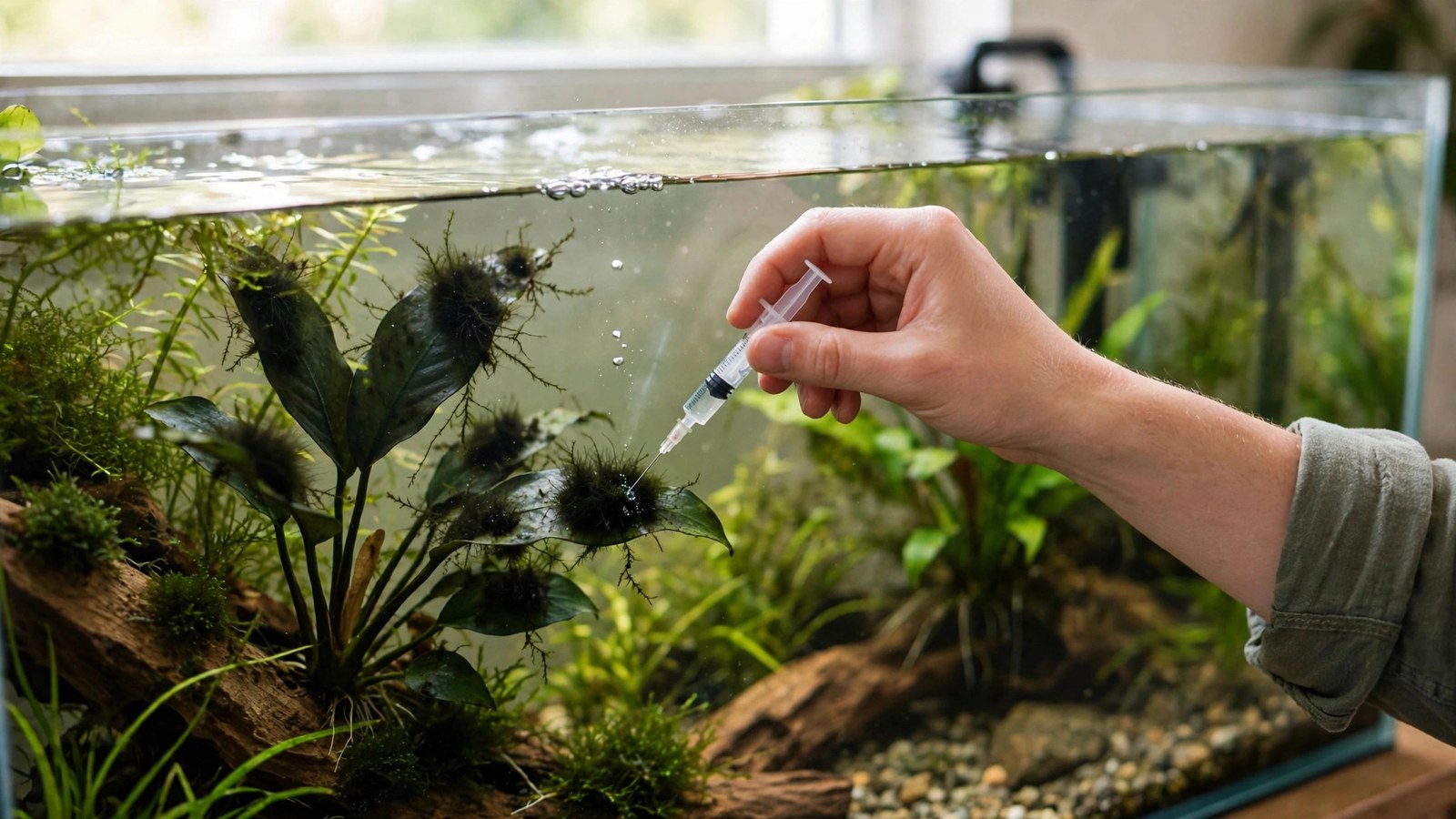
The tufts came back after trimming and came back after scrubbing, and now you're eyeing the brown pharmacy bottle. Black beard algae hydrogen peroxide spot-treatment is the hobby's most reliable in-tank answer: a syringe, still water, a measured dose. Not a plant dip, not a whole-tank pour. Here is the safe procedure — what to buy, the dosing ceiling, the livestock rules, and the mistakes to avoid.
New to this algae? Start with our black beard algae removal guide — identification, the causes to fix first, and where spot-treatment fits in the full plan.
When spot-treatment is the right tool
Hydrogen peroxide is a contact oxidizer: it destroys what it touches, then breaks down into water and oxygen within hours. That makes it perfect for a targeted kill — tufts on driftwood, filter intakes, anubias leaves, equipment a syringe can reach. It's the wrong tool when BBA coats half the tank; at that scale you can't hit every tuft without approaching the whole-tank ceiling, and the real fix is the underlying cause plus manual removal. Whole-tank dosing is blunter, riskier to livestock, and less effective on tough tufts. A still-water syringe shot puts full-strength peroxide exactly where the algae lives. This article covers in-tank spot-treatment only — plant dips are a separate method.
What you need
The kit is cheap: 3% hydrogen peroxide from the pharmacy (the brown first-aid bottle — not 6%, 10%, or 35% grades), a syringe without a needle (5–20 ml) with a blunt tip or airline tubing for reach, and your normal water-change gear. Do a 25–30% change an hour or two before: peroxide degrades fast in dirty, organic-rich water. Know your actual water volume — a "40-gallon breeder" often holds only ~32–34 gallons once substrate and hardscape displace water.
A long spot-dosing pipette for precise application directly onto BBA tufts: dosing syringe ★4.0.
Spot-Treating Black Beard Algae With Hydrogen Peroxide: The SOP
1. Water change first. 25–30% fresh, dechlorinated water an hour or two before. Clean water means the dose survives to reach the algae.
2. Filters off, water still. Switch off filters, wavemakers, and airstones for about an hour — livestock are fine without flow that long. Any current dilutes the puff to uselessness.
3. Syringe the tufts. Draw your dose (table below), submerge the syringe, and puff peroxide onto each tuft, tip 1–2 cm away. Gentle fizzing is the oxidation working. Spread the total across tufts; pause if a shrimp or fish parks on your target.
4. Wait an hour, restart filtration. 45–60 minutes of still-water contact, then filters back on — it degrades into water and oxygen on its own within hours.
5. Read the color change. Treated tufts turn pink, red, or white within 24–48 hours — the kill confirmation. A tuft still black after 3 days didn't get enough contact; retreat it in the next daily session rather than upping the dose.
6. Let the crew finish. Dead BBA is suddenly edible — Amano shrimp, nerites, and Siamese algae eaters graze the pink remains within days. Trim dead tufts off slow growers like anubias — cut the leaf, don't just pick at it.
Dosing reference
First session: start at 1.0 ml/gal, observe livestock for 24 hours, step up only if needed. Never stack multiple ceiling doses in one day. Treat daily (or every other day in sensitive tanks) for 5–7 days; stop as soon as the tufts are dead.
| Tank water | Start (1.0 ml/gal) | Daily ceiling (1.5 ml/gal) |
|---|---|---|
| 5 gal | 5 ml | 7.5 ml |
| 10 gal | 10 ml | 15 ml |
| 20 gal | 20 ml | 30 ml |
| 30 gal | 30 ml | 45 ml |
| 50 gal | 50 ml | 75 ml |
| 75 gal | 75 ml | 112 ml |
Livestock-safety rules
Start low, observe your livestock. First session at 1.0 ml/gal or below; for 24 hours watch for shrimp going still or climbing, fish gasping or flashing, snails sealing shut. Back off a full step at any of these. Never dose onto an animal — the fizz that kills algae irritates gills and eyes. Protect the biofilter: under the ceiling, peroxide rarely troubles nitrifying bacteria in a mature filter, but over-ceiling or marathon dosing knocks them back — so treat for a week, then stop. Shrimp, fry, and sensitive species: 0.5 ml/gal, half the tufts per session, sessions 48 hours apart.
Three mistakes that ruin spot-treatment
1. Overdosing. "If 30 ml is safe, 60 ml must work faster" is how livestock die. Above 1.5 ml/gal, peroxide strips slime coats, stresses gills, and knocks back the biofilter — while the tufts don't die any faster. Measure with the syringe, every time.
2. Treating with the filter running. Flow dilutes the puff to trace levels before it oxidizes anything: no fizz, no color change in 48 hours. Filters off for the contact hour is non-negotiable.
3. Killing tufts without fixing the cause. Peroxide resets the visible outbreak and does nothing about the conditions that grew it: unstable or low CO2, too much light for the CO2 available, organic waste buildup. New tufts appear in 3–4 weeks. Keep the drop checker steady green all photoperiod, trim rotting leaves weekly, siphon mulm from the substrate.
Troubleshooting
| Symptom | Cause | Fix |
|---|---|---|
| Tufts still black after 3 days | Poor contact — flow diluted the dose | Re-treat with filters fully off; use the curved-tip trick |
| Shrimp sluggish or climbing | Dose too high for the stocking | 30% water change; drop to 0.5–0.75 ml/gal; 48 h between sessions |
| Fish gasping after treatment | Oxygen dip plus peroxide stress | Restart filtration, add an airstone, partial water change |
| Ammonia/nitrite spike days later | Biofilter knocked back by over-ceiling dosing | Stop peroxide; daily water changes; re-test before treating again |
| BBA returns within a month | Cause unfixed — CO2, light, or waste | Stabilize CO2, cut photoperiod 1–2 h, clean the substrate |
Pair the strike with the campaign
Confirm the ID with the aquarium algae identification chart — BBA's wiry dark tufts get confused with staghorn algae and the soft strands in our hair algae removal guide. Thread algae answers to manual removal plus nutrient balance; green water and green dust algae barely notice peroxide. For hobby-level technique nuance, Arowana Planted Tank's peroxide walkthrough and this FishLore BBA discussion converge on the same consensus this SOP follows.
Frequently Asked Questions
Is hydrogen peroxide safe for fish and shrimp?
At 1–1.5 ml of 3% peroxide per gallon per day, yes for most established tanks — it breaks down into water and oxygen within hours. Start at 1.0 ml/gal, observe livestock for 24 hours before raising it, never dose onto animals directly, and back off at the first stress sign like shrimp climbing or fish gasping.
How do I know the peroxide killed the black beard algae?
Dead BBA turns pink, red, or white within 24–48 hours. No color change means the tuft didn't get enough contact — usually flow diluted the dose. White is fully dead, pink-red is dying. Shrimp and snails graze the dead remains within days.
Should I turn the filter off when spot-treating?
Yes — filters, wavemakers, and airstones off for about an hour. Still water keeps the peroxide concentrated on the tuft so it oxidizes the algae instead of diluting away. Treating with flow running is the most common reason spot-treatment fails.
Why does black beard algae keep coming back?
Peroxide kills visible tufts but not the cause: unstable CO2, too much light for your CO2 level, or organic waste in the substrate. BBA returns within weeks if those stay broken. Stabilize CO2, trim rotting leaves, siphon mulm, and add a clean-up crew to suppress regrowth.
The bottom line
A syringe, still water, a measured daily dose, and a color change that tells you it worked — spot-treatment with 3% peroxide is both gentle and decisive. Run the SOP for a week, let the crew finish the pink remains, then put the bottle away. The real victory comes next: stable CO2, right-sized light, clean substrate.