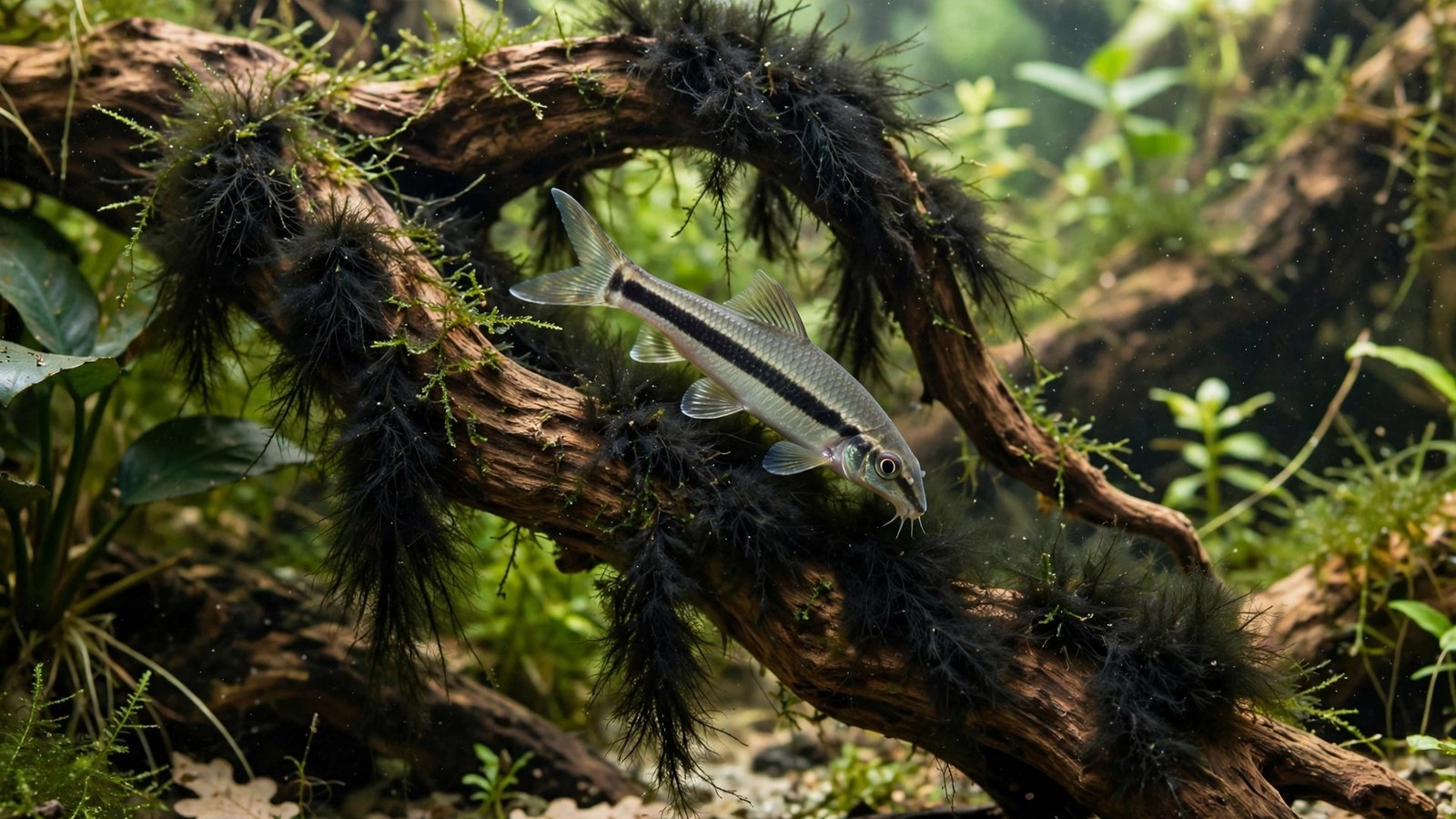
Half the "algae eaters" sold to desperate hobbyists won't touch a single strand of black beard algae — and the ones that do often give up within a month. If you're asking what eats black beard algae, the honest answer is narrow: only a handful of species have a genuine appetite for it, and even they can't clear an established outbreak alone. Here's what the hobby has learned through decades of trial and error — which livestock actually work, which are a waste of money, and how to combine the real eaters with spot-treatment so BBA stays gone.
If you're new to this stubborn red-tufted algae, start with our black beard algae removal guide — identification, causes, and the spot-treatments this article builds on.
What eats black beard algae: the only fish that really do
The true Siamese algae eater (Crossocheilus siamensis) is the most documented BBA eater in the hobby. Juveniles under 3–4 inches graze soft new tufts on leaves, driftwood, and equipment — 3–5 in a 30-gallon tank visibly trim new growth within 7–10 days when kept slightly hungry. The catch: appetite fades with age. A 5-inch adult fed twice daily will ignore BBA completely. Stock juveniles, feed modestly, and replace individuals after 12–18 months. These social fish reach 6 inches, so give them at least 30 gallons, a tight lid, and some current.
How to tell a true SAE from the lookalikes
This is where money gets wasted. Shop tanks often hold three nearly identical striped fish, and two of them are useless against BBA — one is actively destructive.
Check three features: the true Siamese algae eater's jagged black stripe runs through the tail fin, its fins are clear with no colored tint, and its mouth faces downward. The flying fox (Epalzeorhynchos kalopterus) has a smoother gold-edged stripe that stops before the tail — it ignores BBA and gets territorial with age. The Chinese algae eater (Gyrinocheilus aymonieri) has a mottled stripe, grows past 10 inches, stops eating algae as an adult, and latches onto slow fish to rasp their slime coat. Compare photos in our Siamese algae eater vs flying fox identification guide.
Shrimp and snails: what they actually eat
Amano shrimp (Caridina multidentata) are the best invertebrate option. Two-inch adults tear at short tufts and — more importantly — graze the microscopic early stages on leaves before they become visible. Stock 5–10 per 20 gallons and you get a crew that works leaf surfaces fish can't reach. They won't demolish a thick beard on driftwood, but they're the most effective prevention animal the hobby has found — Tropica's algae guide singles out a large Amano population as the first defense against stubborn red algae.
Cherry shrimp (Neocaridina davidi) don't eat established BBA, though a large colony picking at biofilm slows new colonization. Nerite snails walk over mature tufts without a bite — but as film-algae grazers they clear spores and detritus that feed BBA, so they earn a supporting role.
First confirm your ID with the aquarium algae identification chart — BBA is often confused with staghorn algae, and the treatments differ.
The full comparison: eaters vs. impostors
| Species | BBA appetite | Min tank | Caveats |
|---|---|---|---|
| Siamese algae eater (true C. siamensis) | Strong (juveniles on new tufts) | 30 gal | Appetite fades after ~18 months |
| Amano shrimp | Moderate (short tufts + early growth) | 10 gal | Fish may eat small ones |
| Florida flagfish | Moderate (picks at tufts) | 20 gal | Males territorial |
| Flying fox | None | 30 gal | Common mis-sell |
| Chinese algae eater | None (adults) | 55 gal | Grows 10"+; harasses fish |
| Otocinclus | None | 10 gal | Diatoms/film algae only |
| Nerite snails | None (established tufts) | 5 gal | Good for spores/film algae |
| Common pleco | None | 75 gal | Huge waste; outgrows tanks |
Why livestock alone won't fix an outbreak
Mature BBA tufts are tough, wiry, and anchored with holdfasts — even the true SAE mostly manages young, soft growth. No animal clears a bearded tank in a realistic timeframe. The method the hobby has converged on: spot-treat the existing tufts first, then let the eaters suppress regrowth.
For the chemical half, our hair algae removal guide covers the syringe spot-dosing technique that transfers directly — hydrogen peroxide or liquid carbon aimed into the tuft works the same on BBA. Dose in the evening with filters running and watch tufts turn pink-red over 3–5 days as they die, then let your SAEs and Amanos finish the weakened remains. (Tropica's algae control guide uses the same order of operations: biological control first, chemicals only when necessary.)
Stocking a BBA cleanup crew that actually works
For a typical 30–40 gallon planted tank mid-outbreak: 3 juvenile true SAEs, 8–10 Amano shrimp, 3–4 nerite snails. Timeline: spot-treat week 1, tufts die back weeks 2–3, the crew holds regrowth at zero from week 4 — if you fix the cause.
The cause is almost always one of three things: CO2 that swings instead of holding steady, decaying organic matter (uneaten food, dying leaves, substrate mulm), or light the plants can't use. Plants starved of steady CO2 grow slowly and leak nutrients — the vacancy BBA colonizes. Don't confuse BBA with brown diatom algae in new tanks (resolves on its own) or the soft green strands in our thread algae treatment — the wrong ID wastes weeks on the wrong fix.
Frequently Asked Questions
Do Siamese algae eaters really eat black beard algae?
Yes — the true species (Crossocheilus siamensis) is the only widely available fish with a documented BBA appetite, mainly for young tufts. Juveniles under 4 inches work best; appetite drops after 12–18 months. Stock young fish, feed modestly, and verify the stripe runs through the tail fin.
Will Amano shrimp eat black beard algae?
Amanos eat short young tufts and graze the early growth stages on leaves before they're visible — but they can't clear thick mature beards. Stock 5–10 per 20 gallons, spot-treat existing tufts first, and they'll suppress regrowth. Cherry shrimp do not eat established BBA.
Do nerite snails eat black beard algae?
No — nerites walk over mature tufts without biting. They excel at film algae, diatoms, and the spores and detritus on hardscape and glass, which cuts the organic load BBA feeds on. Worth keeping as supporting crew, but not a BBA solution on their own.
How many Siamese algae eaters do I need per gallon?
One juvenile per 8–10 gallons — 3–4 for a 30-gallon tank. They're social and work better in groups, and they reach 6 inches. Don't overstock hoping for faster cleanup; extra fish just add waste. The real fix is still spot-treatment plus stable CO2.
What kills black beard algae if livestock can't finish the job?
Direct spot-treatment with hydrogen peroxide or liquid carbon (glutaraldehyde) — tufts turn pink-red and die within days. Trim dead leaves after 3–5 days, fix unstable CO2 or excess organic waste, and let your crew handle regrowth. See our black beard algae removal guide for the full method.
Why did my Siamese algae eater stop eating algae?
Usually three reasons: it's past the hungry juvenile stage (12+ months), it's overfed on flakes and pellets, or it's a mis-sold flying fox or Chinese algae eater that never ate BBA. Cut supplemental feeding for a week and confirm the ID before buying replacements.
The bottom line
Buy true Siamese algae eaters young, add Amano shrimp, spot-treat the tufts they can't chew, and fix the unstable CO2 or waste that invited BBA in. Livestock is the maintenance crew, not the demolition team — together with direct treatment, you'll go from bearded to clean in under a month.