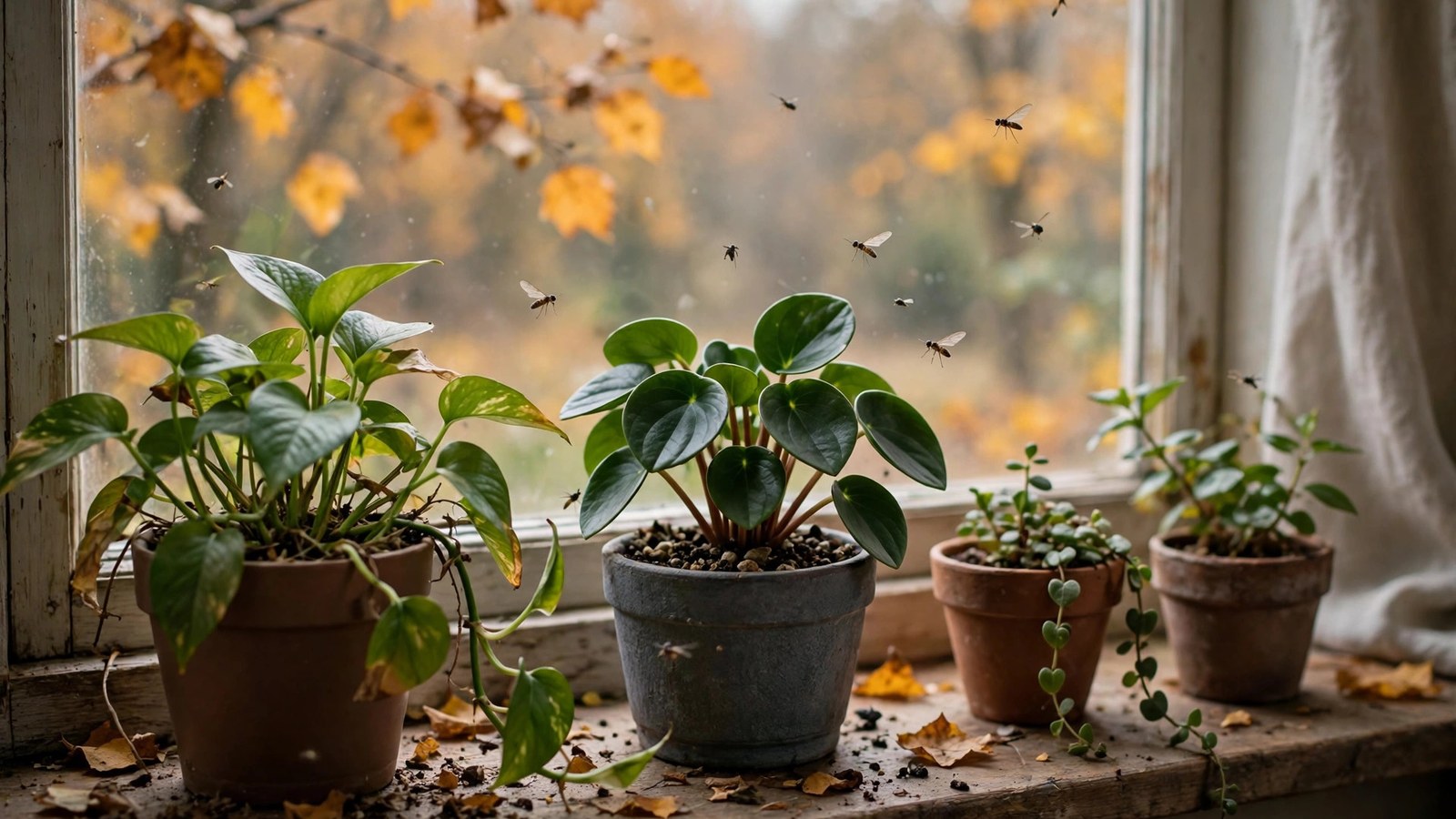
You notice them first near the window: tiny dark specks drifting up every time you brush the leaves of your monstera. Within a week, your whole plant corner has a low, restless cloud of them. If fungus gnats on houseplants have crashed your cozy fall plant season, you're not alone — these soil-borne flies spike in autumn for very specific reasons, and once you understand their life cycle, getting rid of them is straightforward. Here's why fall is peak gnat season and a complete, layered kill protocol — drying the soil, BTI drenches, traps, and top-dressing — that actually works.
Why fungus gnats spike every fall
Fall creates a perfect storm for fungus gnats. Shorter days mean less evaporation, so soil stays moist longer. Plants moving inside from summer patios bring larvae and egg-laying females with them — often in the top layer of soil, where you'd never think to look. Meanwhile, indoor heating hasn't kicked in yet in early fall, so cool, damp pots stay exactly as moist as the larvae like them. A new generation hatches every two to three weeks at room temperature, so populations can explode from a few strays to hundreds of flies in under a month.
The single biggest trigger is bringing houseplants inside for winter without a pest treatment and transition plan. Every pot that spent the summer on a shaded porch has been exposed to gnats all season; the warm, still air indoors then becomes an incubator. Quarantining new or incoming plants for two to three weeks before they join your collection is one of the highest-leverage habits you can build this fall.
How to tell if you actually have fungus gnats
Adult fungus gnats are delicate, dark flies about 1/16 to 1/8 inch long — roughly the size of a mosquito but weaker fliers, with long segmented antennae. They run across the soil surface and rest on leaves, windowsills, and nearby walls. The larvae live in the top 1–2 inches of potting mix: translucent, legless worms with shiny black heads, feeding on fungi, algae, and decaying organic matter (and, in heavy infestations, on root hairs).
Signs of an infestation:
- Tiny dark flies rising from the soil when you water, tap the pot, or disturb the plant.
- Adults running across the soil surface rather than flying far — fungus gnats are weak fliers and stay near their pot.
- Yellow sticky traps catching dark flies with clear wings (place one near suspect pots to confirm).
- Seedlings or young plants that wilt despite moist soil, or that grow slowly — larval root feeding can stunt them.
- In severe cases, shiny slime trails on the soil surface left by large larval populations.
Don't confuse them with other small flies
Shore flies look similar but have short bristle-like antennae and sturdier bodies — they're associated with algae rather than houseplant soil and don't damage roots. Fruit flies have red eyes and hover around fruit and drains, not potting mix. If your flies ignore the apple cider vinegar trap by the bananas and swarm the monstera instead, you're dealing with fungus gnats. Confirming the pest matters, because treatments for one fly do little for the other — a common reason people "try everything" with no result.
The fungus gnats houseplants kill protocol: six steps that work
Here's the hard truth that changes the whole fight: adults only live about a week, and most of the gnat's life is spent as eggs and larvae in the soil. Methods that target only the flying adults (sprays, zappers) can never win. The University of California's IPM pest notes on fungus gnats make the same point: control must target the immature stages in the soil. So we run a layered protocol — dry out the nursery, trap the breeders, kill the larvae — for at least four to six weeks, covering two full life cycles.
Step 1: Let the top soil dry out
This is the foundation of everything else. Fungus gnat larvae need consistently moist organic matter; eggs can't hatch on dry soil. Let the top 1–2 inches of potting mix dry completely between waterings — stick a finger or a wooden chopstick into the soil to check before you water. For most fall houseplants this also prevents overwatering damage, since growth slows with the light. Water from the bottom where practical: bottom watering keeps the top layer dry, which is exactly where females lay their eggs. Empty saucers promptly so pots never sit in standing water.
Step 2: Deploy yellow sticky traps
Place one or two yellow sticky traps per infested pot, pushed into the soil so the sticky surface sits just above the mix. These traps do two jobs: they confirm where the infestation is worst, and they capture egg-laying females, breaking the breeding cycle. Check them weekly; a trap that stops catching after a few weeks is your first sign the population is collapsing. Sticky traps alone won't eliminate gnats (they miss the larvae entirely), but combined with larval control they're powerful.
Step 3: Drench the soil with BTI (mosquito bits)
Bacillus thuringiensis subspecies israelensis (Bti) is a naturally occurring bacterium that produces proteins toxic only to fly larvae — mosquitoes, black flies, and fungus gnats. When larvae eat it, they stop feeding and die within days. It's the single most effective home tool against the larval stage, and it's essentially nontoxic to people, pets, and plants.
How to apply it: soak Bti granules (sold as Mosquito Bits) in your watering can for 30 minutes to a few hours, strain out the corn-cob carrier, and water the soil surface thoroughly. Repeat every 5–7 days for at least three to four applications. Why repeat? Bti doesn't persist long in soil, so one drench misses eggs that hatch later. Combined with traps and drying, you should see adult numbers drop sharply by the second or third week. Always follow the product label directions.
Step 4: Top-dress the soil surface
Females prefer to lay eggs in damp, exposed potting mix. A 1/4- to 1/2-inch layer of coarse horticultural sand or fine gravel over the soil creates a dry, inhospitable landing strip. Sand doesn't feed fungi the way organic top layers do, and it dries within hours of watering. This step is optional if you're consistent with drying, but it's a great passive defense for plants that must stay evenly moist (ferns, calatheas). Keep housekeeping in mind too: scrape off any green algae crust on the soil surface and remove fallen leaves promptly, since decaying matter feeds the fungi the larvae eat.
Step 5: Isolate and inspect before spreading the problem
Don't move infested plants into rooms with clean plants — emerging adults will colonize new pots. If one plant is dramatically worse than the rest (a trap fills in days while others stay clean), that plant is the source nursery; consider repotting it in fresh, pasteurized potting mix, discarding the old soil in a sealed bag outdoors. Note that pest snails on aquarium plants are a different kind of hitchhiker problem — if you keep planted tanks too, don't assume one pest's treatment fits the other.
Step 6: Keep it going for 6 weeks
This is the step everyone skips, and why infestations "come back." Adults can keep emerging for weeks from pupae already in the soil, and eggs keep hatching in overlapping waves. Maintain the full routine — dry tops, traps, weekly Bti drenches — for four to six weeks minimum. When sticky traps stay nearly clean for two consecutive weeks, you've broken the cycle. Then keep the cultural habits (drying, bottom watering, fresh pasteurized mix when repotting) permanently, because prevention is far easier than another cure.
BTI granules kill the larvae in the soil where sprays can't reach: Summit Mosquito Bits.
Treatment comparison: what works, how fast, how safe
| Treatment | Targets | Speed | Cost | Pet/child safety |
|---|---|---|---|---|
| Letting soil dry + bottom watering | Larvae, eggs | 2–4 weeks | Free | Completely safe |
| Yellow sticky traps | Adults (monitoring) | Immediate catch, weeks to reduce | Low | Safe if placed out of reach; keep away from curious pets |
| Bti soil drench (Mosquito Bits) | Larvae | Larvae die within days; colony collapses in 3–4 weeks | Low–moderate | Low toxicity to people and pets; follow the label |
| Beneficial nematodes (Steinernema feltiae) | Larvae | 2–3 weeks to establish | Moderate | Non-toxic; harmless to people, pets, and plants |
| Sand top-dressing | Egg-laying sites | Passive; supports other methods | Low | Safe |
| Pyrethrin sprays | Adults only | Fast knockdown of adults | Moderate | Only use products labeled for houseplants; move plants outdoors to treat and ventilate before returning |
Notice the pattern: the most effective treatments target larvae and cost almost nothing, while sprays that target adults are the least effective long-term. If you only do two things, make them drying and Bti.
What NOT to do (and why people keep failing)
- Don't rely on apple cider vinegar traps. Those catch fruit flies, not fungus gnats. Your gnats will walk right past them to the soil.
- Don't fog the room or spray adults in flight. Adult sprays give satisfying knockdown but don't touch the soil stages, so the population returns within a generation. UC IPM specifically advises against aerial fogging indoors.
- Don't keep the soil wet "to flush them out." Constant moisture is the cause, not the cure. Soaking the pot drowns nothing and feeds the next generation.
- Don't repot everything immediately. Repotting stressed plants mid-infestation spreads gnats to fresh mix and stresses roots further. Reserve repotting for the worst source pots.
- Don't reach for broad-spectrum insecticide granules in the soil. They can harm beneficial organisms, are rarely warranted in homes, and carry real risks around children and pets. If you use any pesticide, use one labeled for houseplants and follow the label exactly.
- Don't assume hydrogen peroxide drenches are a free fix. Weak solutions are sometimes suggested online, but they can damage fine root hairs and beneficial soil life while missing eggs — drying and Bti are more effective with no such trade-off.
A note on pets, children, and plant safety
The core of this protocol — drying soil, sticky traps, sand top-dressing — involves no chemicals at all. Bti is a biological product with very low toxicity to mammals; still, store any product sealed and out of reach, apply only per the label, and keep treated pots away from toddlers and pets that chew soil or leaves. And check the basics first: in planted aquariums, yellowing usually points to nutrient deficiency rather than pests, and the same logic applies to houseplants — poor drainage and overwatering cause more wilting than larvae ever will.
Frequently Asked Questions
How long does it take to get rid of fungus gnats completely?
Expect four to six weeks of consistent treatment. Because eggs, larvae, and pupae coexist in the soil in overlapping generations, adults keep emerging for weeks even after you start. Maintain drying, sticky traps, and weekly Bti drenches until traps stay clean for two straight weeks — stopping early is the most common reason infestations seem to "come back."
Are fungus gnats harmful to my plants?
Adults are harmless — they don't bite or feed on plants. Larvae feed mainly on fungi and decaying matter, but large populations chew root hairs and can stunt seedlings and young plants, sometimes causing wilting. Established, healthy houseplants usually tolerate moderate populations, which is why gnats are primarily a nuisance pest rather than a plant killer.
Can fungus gnats spread to other rooms or plants?
Yes. Adults are weak fliers but can drift to neighboring pots and lay eggs in any moist soil. That's why you should isolate heavily infested plants, treat all nearby pots preventatively, and avoid moving infested plants into clean rooms. One badly infested "nursery" pot can re-seed an entire collection, so find and treat the worst pot first.
Do mosquito bits (Bti) really work for fungus gnats?
Yes — Bti is one of the most effective and safest tools against the larval stage. The bacterium's proteins are toxic only to fly larvae, which stop feeding and die within days of ingesting it. University extension programs recommend it for home use. Apply as a soil drench every 5–7 days for at least three to four applications, since it doesn't persist long in soil and new eggs keep hatching.
Will sand on top of the soil kill fungus gnats?
Sand doesn't kill gnats directly, but a 1/4- to 1/2-inch layer of coarse horticultural sand makes the soil surface dry and inhospitable, discouraging females from laying eggs there. It works best as part of the layered protocol alongside drying, traps, and Bti. Make sure to use horticultural-grade sand, not play sand, which can compact and trap moisture.
Why do I only see fungus gnats in fall?
Fall brings shorter days, slower evaporation, and plants returning indoors — all of which keep soil moister for longer. Plants that summered outdoors arrive carrying eggs and larvae, and the cool, still indoor air becomes an ideal nursery. New generations hatch every two to three weeks at room temperature, so a few hidden eggs in September become a cloud by October. Quarantining and treating plants as they come inside — see this fall transition checklist — prevents most fall flare-ups.
Make fall gnat-proof from here on
Fungus gnats are a symptom of one underlying condition: soil that stays too wet for too long. The kill protocol — dry tops, yellow traps, weekly Bti drenches for six weeks — reliably clears them. But the habits (bottom watering, letting the top layer dry, inspecting and quarantining plants as they come inside) are what keep them gone. Pair this with a proper fall transition routine each autumn and you may never need the full protocol again.