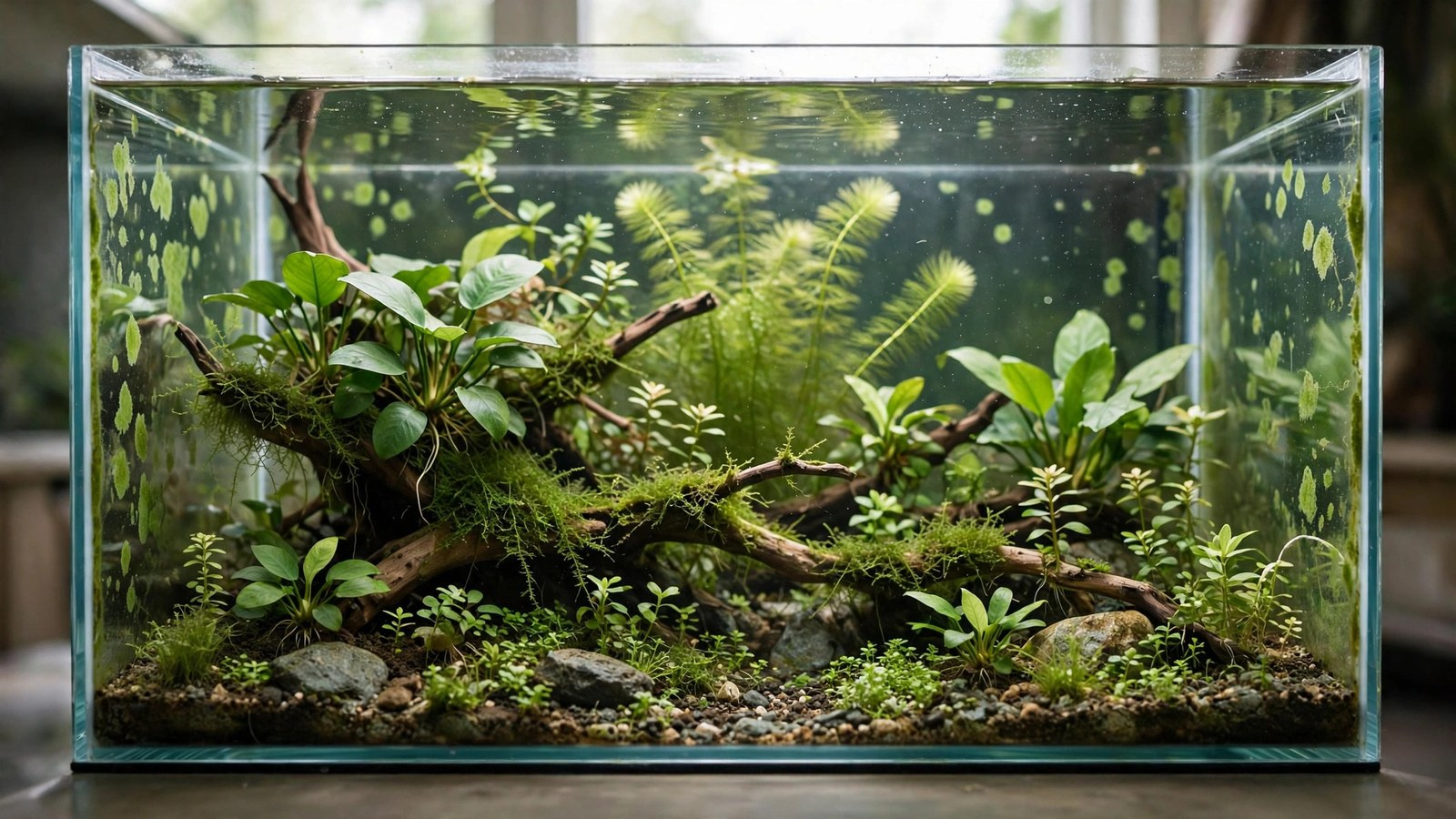
You scraped green dust off your aquarium glass this morning and wondered: does algae mean a healthy tank, or is your tank failing? Hold on. Before you reach for the algaecide, you should know that nearly every thriving planted tank on earth grows some algae — and a completely algae-free tank is often the suspicious one. By the end of this guide, you'll know exactly how to read your algae like a dashboard: what kind you have, what it's telling you about your water, and whether to celebrate, adjust, or act.
Does Algae Mean a Healthy Tank?
Short answer: usually, yes — a little. Algae grows wherever there is light, water, and even trace nutrients, so a tank that supports fish and plants will almost always support some algae too. Think of it the way you'd think of grass on a lawn: its presence means the environment can sustain life; a bare, scorched yard is the thing that should worry you.
The crucial skill is telling the difference between background algae — the harmless film every healthy tank grows — and nuisance algae, the kind that signals something is out of balance. First, identify which algae you have first — the color, texture, and location tell you everything about what your tank is doing.
What Your Algae Is Actually Telling You
Different algae appear under different conditions, so the species on your glass is a free water test. Here's what the most common types are saying:
| Algae type | What it looks like | What it means |
|---|---|---|
| Brown diatoms | Dusty brown film that wipes off easily | Tank is new and still cycling — very normal, almost always fades on its own |
| Green dust / film | Fine green coating on glass | Mature, stable system; wipe weekly and carry on |
| Green spot | Hard green dots that resist scrubbing | Often a phosphate or CO2/light-balance signal on slow-growing leaves |
| Hair / thread | Long green strands waving in the current | Excess light or nutrients relative to plant growth |
| Black beard (BBA) | Dark tufts on edges, wood, slow leaves | Unstable CO2 or poor flow — the most persistent kind to correct |
| Green water | Pea-soup water you can't see through | Free-floating bloom: excess light plus nutrient spike — the real warning sign |
If you're seeing the first two rows, congratulations: your tank is doing what healthy tanks do. The brown dusty stage of brown diatom algae in new tanks resolves on its own within a few weeks, and a faint green dust film on the glass is simply part of a working ecosystem.
When Algae Is a Good Sign
Some algae presence tells you things are going right:
- Your cleanup crew is fed. Otocinclus, nerite snails, and Amano shrimp graze constantly on soft algae; a light film keeps them working.
- Biofilm is established. That faint green sheen on wood and rocks is part of the microbial foundation that processes waste.
- Plants are winning. When fast-growing plants are healthy, algae stays on glass and hardscape because the plants outcompete it for nutrients.
When Algae Is a Warning Sign
Not all algae is benign. Treat these as dashboard warning lights:
- Green water blooms. Water so green you can't see the back glass means a free-floating algae explosion, usually from too much light combined with a nutrient spike. It's the one form that genuinely indicates poor water conditions — see how to clear a green-water bloom before it stresses your fish.
- Black beard algae spreading. BBA is the toughest common algae to beat and nearly always points to unstable CO2 levels or dead spots in your water flow. Learn to handle black beard algae on plants before it smothers slow growers like Anubias.
- Sudden explosion after a change. Algae that appears within days of a new light, a fertilizer increase, or a rescape is your tank telling you the new settings overshoot what the plants can use. Dial back the light first — it drives everything.
- Algae plus dying plants. If leaves are yellowing or melting at the same time, the algae is a side effect. Check whether you're over-fertilizing, then diagnose the plant problem itself.
Reading the Trend, Not Just the Moment
Keep a simple habit: note the date when you wipe the glass, and notice how long it takes for the film to return. In a balanced tank, it's roughly a week. If it shrinks to two or three days, you've caught an imbalance early — cut your light period by an hour or reduce feeding before it becomes a bloom. That's the real superpower algae gives you: the earliest warning system in your tank, and it costs nothing.
For a deeper understanding of the nutrient side, Tropica's plant-care guides explain how light, CO2, and fertilizer interact — the same triangle that determines whether algae stays in its lane. And if your plants are struggling alongside the algae, 2HR Aquarist's planted-tank guides have excellent walkthroughs of the light/nutrient balance from a high-tech perspective.
Frequently Asked Questions
Is it normal to have algae in a new tank?
Yes — completely. New tanks almost always grow brown diatoms in the first 2–6 weeks while the nitrogen cycle establishes and silicates leach from fresh substrate. It wipes off easily and usually disappears on its own once the tank matures. Don't fight it with chemicals; keep up normal water changes and let the cycle finish.
Should I aim for zero algae in my aquarium?
No. A truly algae-free tank is nearly impossible to maintain and isn't a sign of better health — it often means conditions are too sterile to sustain much life at all. The realistic, healthy goal is algae that stays on the glass and hardscape where you can wipe it weekly, while your plants stay clean. That balance is what successful aquarists actually maintain.
What does algae growing on my plant leaves mean?
It's a sign your plants are losing the competition for nutrients or light. Healthy, fast-growing plants starve algae by absorbing nutrients first; when plants stall — from low CO2, poor light, or a nutrient deficiency — algae colonizes their leaves. Fix the plant problem (light, CO2, fertilization) and the leaf algae usually recedes.
Does algae hurt fish?
Common surface algae on glass, wood, and rocks is harmless to fish — many species graze on it. The exception is a severe green-water bloom, which can swing oxygen levels and stress fish, and toxic cyanobacteria (blue-green "algae"), which is actually a bacteria that can release toxins. Normal green, brown, and spot algae are fine.
How long should it take for algae to return after I clean the glass?
About a week in a balanced tank. Treat this as your personal gauge: if the film comes back in two or three days, something has shifted — usually too much light, overfeeding, or fertilizer outpacing plant growth. Shorten your photoperiod by an hour or feed a little less before it becomes a real problem.
Is green water a sign of a healthy tank?
No — green water is the one algae form that points to a genuine imbalance. Unlike the harmless film on glass, a pea-soup bloom means free-floating algae are exploding on excess light plus a nutrient spike, and they can swing oxygen levels at night. Reduce light, check for overfeeding or ammonia, and clear the bloom with a blackout or UV rather than ignoring it.
The Bottom Line
Algae isn't the enemy of a healthy tank — it's the instrument panel. A light film on the glass says your water can sustain life; a sudden bloom says something drifted out of tune. Stop judging your tank by whether algae exists, and start judging it by which algae exists and whether it's spreading. That's a tank with a dashboard — fix problems weeks before they show anywhere else.