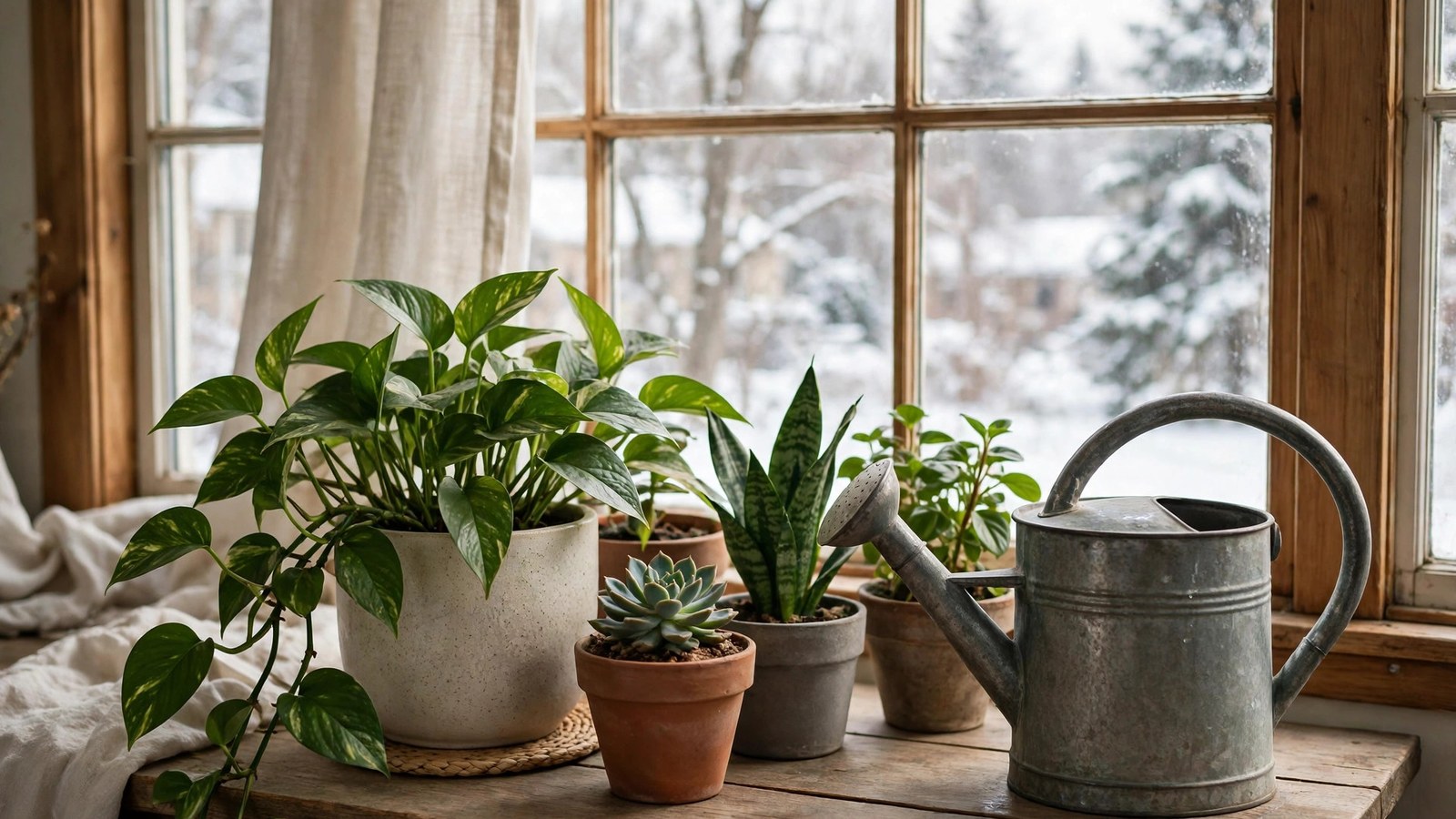
When the days shorten and the furnace kicks on, most houseplants die of kindness — too much water, not too little. If you're wondering how often to water houseplants in winter, the honest answer is: less often than you think, and never on a calendar. Winter changes almost everything about your home's indoor climate — weaker light, cooler windowsills, bone-dry heated air — and your plants' thirst changes with it. This guide explains why winter watering is different, how to read soil moisture, what each plant group needs, and the early warning signs that tell you to back off or water up.
Why Winter Watering Is a Completely Different Game
Plants don't drink because it's Tuesday. They drink because they're photosynthesizing, and photosynthesis runs on light. In winter, a north-facing windowsill may deliver a third of the light it got in June, and even a south-facing window delivers fewer hours of it. Less light means slower growth — or, for many species, a near-dormant state — which means the roots are drawing a fraction of the water they did in summer.
That alone would argue for lighter watering. But winter adds two complications that pull in opposite directions:
- Dry heated air. Forced-air heating can drag indoor humidity from a comfortable 50% down to 20% or less. That dry air pulls moisture from leaves and from the soil surface, so the top of the pot dries out fast — even though the root zone below may still be wet. The top-dry look is winter's biggest lie.
- Cold surfaces and cool roots. Windowsills, tile floors, and drafty corners keep the potting mix colder than the room air. Cold soil holds water longer because roots barely absorb at low soil temperatures, and evaporation slows. A pot that dried out in three days in July may stay wet for three weeks in January.
The takeaway: winter is when the gap between how soil looks and how wet it is gets widest. Watering on a summer schedule in winter is the most common way plants die — roots sit in cold, airless mud and rot sets in long before spring.
The One Rule That Replaces a Schedule
There is no safe answer to "water every X days in winter" — a small pot on a radiator-warmed shelf and a big pot on a cold windowsill are in different universes. The rule that works every time: check the soil, water only when the root zone is dry enough, and water thoroughly when you do. Everything else in this guide is how to apply that rule to your home.
How to Check Soil Moisture Properly
The finger test works for small pots, but in winter it needs a technique upgrade — the fast-drying surface hides what's really going on.
The Finger Test, Done Right
Push your index finger in to the second knuckle (about 2 inches / 5 cm). In winter the surface crust should feel dry before you even consider watering — but the real question is what you feel at depth:
- Cool and damp: soil is still wet. Wait. Check again in 3–4 days.
- Dry and room-temperature: time to water for most tropicals.
- Soil pulling away from the pot edges: the mix is very dry — water carefully, since dried-out mix can resist absorbing water at first.
For pots deeper than 6 inches, the finger test isn't enough. Use a wooden skewer or chopstick: push it all the way down, leave it for 10–15 minutes, then pull it out. Damp soil stains the wood darker; dry soil leaves it clean. It's the cheapest moisture meter that actually works.
Should You Buy a Moisture Meter?
A probe-style moisture meter (1–10 dial) can help in winter, especially for large floor plants you can't easily lift. Read the whole dial: a reading of 1–2 is the watering window for most tropicals, 3–4 is still fine, and 5+ means wait. Two cautions: cheap meters are notoriously inaccurate in dense, salty mixes — check against the skewer test — and don't leave the probe in the soil, since it corrodes and reads worse over time.
The Lift Test
Get to know the weight of your pots. Right after a thorough watering, lift the pot and register its heft. When the soil has dried to the right level, the pot feels noticeably lighter — dramatically so for small pots. In winter this is one of the most reliable checks: it reports on the whole root ball, not just the surface or one spot.
Winter Watering by Plant Group
Not all plants want the same winter dryness. Grouping plants by watering needs makes winter care easier — check each group on its own rhythm rather than guessing plant by plant.
Tropical foliage plants (monsteras, philodendrons, pothos, ferns)
This is the biggest group and the one most people overwater. In winter, let the top 1–2 inches of soil dry out before watering thoroughly — roughly half the summer frequency; if you watered weekly in August, expect every 2–3 weeks now. Ferns are the exception within this group: they hate drying out even in winter, so check them twice as often and don't let them go fully dry.
Watch where these plants sit: plants under supplemental grow lights in winter grow more and drink more — a pothos under a lamp may need its usual schedule while the same plant in a dark corner needs half.
Succulents and cacti
Desert plants are built for winter drought — in their native habitats, winter is the dry season and many go fully dormant. Let the soil dry out completely between waterings, and wait a few extra days beyond that. A typical winter schedule is once every 3–6 weeks depending on pot size. When you do water, soak thoroughly so water runs from the drainage holes, then empty the saucer. The killers here are frequent sips and pots sitting in water.
Ferns, calatheas, and humidity lovers
These are winter's hardest plants: they want consistently moist soil and high humidity, in a season that provides neither. Keep the soil lightly moist — water when the top inch is dry — and consider running a humidifier nearby or grouping them together so they share humidity. Brown, crispy leaf edges are almost always low humidity rather than underwatering; don't drown the roots trying to fix a humidity problem.
Winter growers (some succulents, cyclamen)
A few plants flip the script and grow actively in cool weather. Cyclamen is the classic: it blooms through winter and wants consistently moist soil — water when the top half-inch dries. Some winter-growing succulents also appreciate regular water in the cool months. If you own cyclamen, water from the bottom to keep the tuber dry; a wet tuber rots fast.
| Plant group | Winter watering cue | Rough winter frequency* |
|---|---|---|
| Tropical foliage (monstera, philodendron, pothos) | Top 1–2" dry | Every 2–3 weeks |
| Ferns & humidity lovers | Top 1" dry | Every 1–2 weeks |
| Succulents & cacti | Soil fully dry + a few days | Every 3–6 weeks |
| Cyclamen & winter growers | Top ½" dry | Every 1–2 weeks |
| Slow indoor palms & ZZ plants | Top 2–3" dry | Every 3–4 weeks |
*Starting points only — always check the soil first; pot size, light, and room temperature matter more.
The Warning Signs: Overwatered vs. Underwatered
Winter overwatering and underwatering can look frustratingly similar — yellow leaves appear in both. Here's how to tell them apart:
Signs of winter overwatering
- Mushy, translucent lower leaves that fall off with a gentle touch — soft and waterlogged rather than dry.
- Yellowing that starts from the bottom up, with leaves dropping one after another over weeks.
- Soil that smells musty or sour and stays damp for weeks after watering — root rot is likely already underway.
- Fungus gnats hovering around the pot. They breed in constantly wet top soil; a winter gnat swarm is practically a confession of overwatering.
- Stems that feel soft or wobbly at the base — advanced rot. If the stem is still firm above the damage, take cuttings immediately.
Signs of winter underwatering
- Crispy, papery leaf edges that crumble when touched — dryness, not softness.
- Soil shrinking away from the pot sides, sometimes with a visible gap. At this point water may run straight through the pot without wetting the root ball.
- Wilting that recovers within hours of watering — if it perks up, it was thirst, not rot.
- Lower leaves dropping while staying green or browning from the tips, rather than turning yellow and mushy.
- Very light pot + dry skewer test — trust the lift test; it's the clearest confirmation.
The Emergency Fixes
For an overwatered plant: stop watering immediately and move it to its brightest spot with good airflow. If the soil is still soggy days later, slide the root ball out and let it air-dry on newspaper. Cut away any black, mushy roots before repotting, then don't water until the mix genuinely dries.
For a bone-dry plant: bottom-water it. Set the pot in room-temperature water for 20–30 minutes so the mix rehydrates evenly. Top-watering a shrunken root ball just channels down the sides. This also pairs well with watering houseplants with aquarium water, which adds gentle nutrients during the occasional winter feeding.
How Often to Water Houseplants in Winter: Sample Schedules
These are starting points to calibrate, not calendars to follow blindly — adjust for your soil, light, and pot size.
Warm apartment, moderate light (typical living room)
- Pothos/monstera in 6" pot: check every 10–14 days; water when top 2" dry.
- Snake plant in 8" pot: check monthly; water only when fully dry.
- Boston fern in hanging basket: check twice weekly; water when top 1" dry.
Cool sunroom or drafty window (15–18°C / 59–65°F)
- Almost everything: halve the warm-room frequency. Check soil every 2–3 weeks; succulents may go 6–8 weeks.
- Keep plants off cold sills at night — slide them back a few inches or use a plant stand so roots don't sit against freezing glass.
Plants under grow lights
- Actively growing plants under lights drink closer to summer rates. Check weekly and water on the summer cue (top 1–2" dry for tropicals).
- Succulents under strong lights still want a winter rest — keep them dry even if they're growing a little.
Common Winter Watering Mistakes
- Misting as a substitute for watering. Misting raises humidity around leaves for minutes but does not water roots — never count it as watering.
- Watering on a schedule. "Every Sunday" works in summer growth; in winter it's a slow drowning. The soil decides, not the calendar.
- Using cold tap water. Icy water on cool winter soil shocks roots. Use room-temperature water — fill the watering can the night before.
- Leaving water in saucers. In summer a saucer dries by evening; in winter it sits for days, keeping the bottom of the root ball waterlogged. Always empty it.
- Repotting in deep winter. Damaged roots in cold, wet soil are a rot invitation. Wait for spring unless the plant is in crisis.
- Fertilizing on schedule. Most plants don't need feeding in winter — growth has stalled and salts accumulate in soil that isn't being flushed. Resume feeding when you see new growth in spring.
- Ignoring drafts. A blast of furnace air on one side of a plant dries that side's soil fast while the rest stays wet, confusing your checks. Rotate pots and check moisture on more than one spot.
Winter care doesn't end at the watering can — temperature swings stress plants too, so read up on how temperature swings stress houseplants alongside your watering routine. And if you're leaving town over the holidays, plan ahead with a vacation plant care plan so your plants don't swing between drought and overwatering while you're gone. A simple weekly plant-check routine — adjusted for the slower winter pace — makes it easy to catch problems early.
Frequently Asked Questions
How often should I water houseplants in winter?
Most tropical houseplants need water every 2–3 weeks in winter, succulents every 3–6 weeks, and ferns every 1–2 weeks — starting points, not rules. Light, temperature, pot size, and heating all change the answer. Always check the soil is dry enough first (finger test, skewer, or moisture meter) and water thoroughly when it is.
Should I water less in winter?
For most plants, yes. Weaker light and cooler temperatures slow growth dramatically, so roots take up far less water. The exception is plants under strong grow lights that are still actively growing. Also, heated air dries the soil surface fast, which can trick you into watering while the root zone is still wet — always check deeper than the surface.
Why are my houseplant leaves turning yellow in winter?
The most common cause is overwatering: cold, wet soil suffocates roots, and leaves yellow from the bottom up, feeling soft and mushy. Underwatering also yellows leaves, but those tend to be dry and crispy, starting at the tips and edges. Check soil moisture and pot weight before acting — watering an overwatered yellow plant makes it worse. Rule out pests and drafts too.
Is it OK to mist houseplants in winter?
Misting gives a brief humidity boost that lasts minutes — a weak fix for dry heated air that does nothing for root moisture. It's fine as a supplement, but it doesn't replace watering. Grouping humidity-loving plants together, using a pebble tray, or running a small humidifier are far more effective.
Should I fertilize houseplants in winter?
Generally no. Most houseplants barely grow in winter, so they can't use the nutrients — unused salts build up in unflushed soil and can burn roots. The exception is winter-active plants like cyclamen and those under strong grow lights. For everything else, wait for spring's new growth, then resume at half strength.
How do I water a plant that's completely dried out?
Bottom-water it: set the pot in a basin of room-temperature water for 20–30 minutes so the mix rehydrates evenly from below. Top-watering a shrunken root ball usually channels down the sides without wetting anything. After the soak, let it drain fully and empty the saucer. This is also a good moment to confirm with the lift test how heavy a properly watered pot feels.
Trust the Soil, Not the Season
Winter watering looks complicated on paper, but it comes down to one habit: checking before you pour. Learn what dry-enough soil feels like for each plant group, respect that cold soil holds water longer, and resist loving your plants to death with the watering can. Do that, and your plants will be primed to grow the moment the light returns in spring. For deeper reading, the University of Minnesota Extension's guide to watering indoor plants and the University of Missouri Extension's Caring for Houseplants guide cover the science and winter-specific issues in depth.