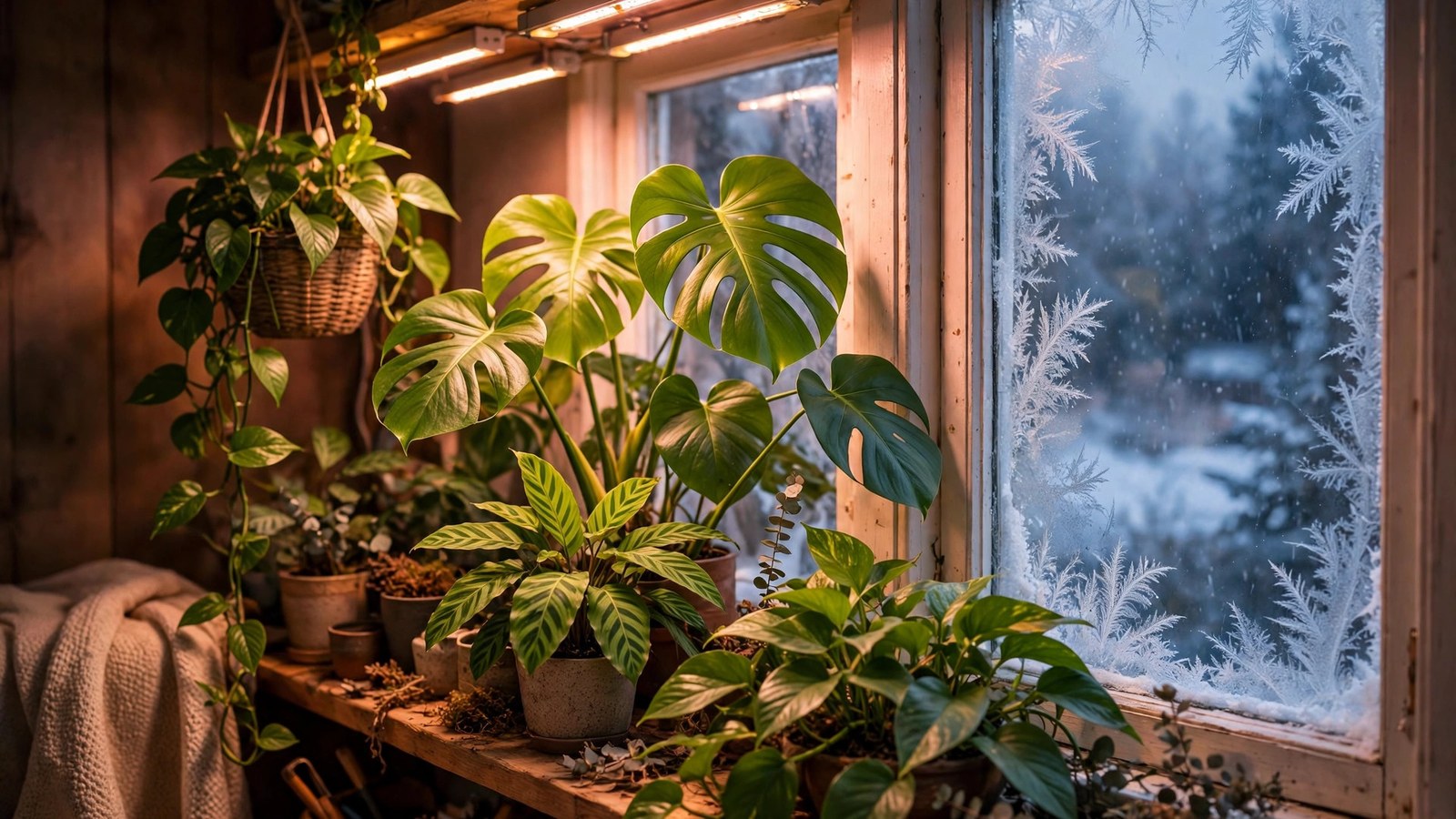
By mid-October, the light streaming through your windows has already changed. The sun sits lower, days are visibly shorter, and houseplants that thrived in summer are about to enter the hardest stretch of their year. Adding grow lights for houseplants is the single most effective winter intervention you can make — far more impactful than extra fertilizer or misting. A modest LED setup, run on a timer, can keep tropicals growing, stop succulents from stretching into leggy shadows of themselves, and carry your whole collection to spring with vigor instead of mere survival.
Why Winter Light Falls Short
Your plants don't just experience shorter days in winter — they receive dramatically less usable light even during the hours the sun is up. First, the sun's arc drops low, so its rays strike windows at a shallow angle and bounce off more than they pass through. Second, day length near the solstice shrinks to nine or ten hours, nearly half of a June day.
A south-facing sill that basked in direct sun all summer may catch only a weak couple of hours by December, and north-facing rooms become near-darkness for plant purposes. Window glass, screens, and grime shave off still more. Most houseplants are tropical understory species or desert succulents — both evolved for far stronger light than a northern living room offers in winter.
How Much Light Houseplants Actually Need in Winter
You don't need a physics degree to size up your plants' needs, but two simple measurements are worth knowing because every credible light guide uses them.
Foot-candles: measuring brightness
A foot-candle is simply how much light falls on a surface. A bright summer day outdoors is around 10,000 foot-candles; a typical living room corner sits at 25–50. Extension guides group houseplants into three bands:
- Low light (25–75 foot-candles): snake plant, pothos, ZZ plant, cast-iron plant, parlor palm.
- Medium light (75–150 foot-candles): philodendron, dracaena, peace lily, rubber plant, Boston fern.
- High light (150–1,000+ foot-candles): succulents, cacti, fiddle-leaf fig, croton, most flowering plants.
A free smartphone light-meter app won't give lab-grade numbers, but it will tell you whether your "bright" corner is really 60 foot-candles — too low for anything but the low-light list. The Mississippi State University Extension guide on indoor plant light matches foot-candle ranges to common species.
DLI: measuring the full day's dose
Brightness isn't the whole story, because plants also care about duration. The daily light integral (DLI) is the total light a plant receives over 24 hours — brightness multiplied by time. A dim room lit for 16 hours can deliver the same DLI as a brighter spot lit for 8 hours. This is the secret behind grow-light timers: a modest LED run for 14 hours can out-perform a winter windowsill that only gets 4 hours of real sun.
Winter targets at a glance
| Plant group | Winter goal | Practical setup |
|---|---|---|
| Low-light foliage (pothos, ZZ, snake plant) | Survive near windows; supplement if rooms go dark | One low-watt LED bulb 2–3 ft away, 8–10 hrs |
| Medium-light tropicals (philodendron, monstera, calathea) | Maintain growth; prevent pale, leggy new leaves | LED panel or bar 1–2 ft away, 12–14 hrs |
| High-light succulents & cacti | Keep compact form and color | LED bar 6–12 in away, 14–16 hrs |
| Flowering plants (orchids, African violets) | Support buds and blooms | LED panel 1 ft away, 12–14 hrs |
Types of Grow Lights for Houseplants
Four main options await you in stores and online listings. Here's an honest breakdown of what each actually does for a home collection.
Full-spectrum LED bulbs
These screw into an ordinary lamp socket — the easiest entry point. A 10–15 W full-spectrum LED in a desk lamp or clip light supplements a small cluster. Pros: cheap, plug-and-play, low heat, long lifespan. Cons: narrow beam covers only a few plants. Best for first-timers and single shelves.
LED panels and bars
Flat panels or slim bars spread light evenly over a shelf or bench. Pros: best coverage per dollar, very efficient, slim profile hides under shelves. Cons: need a mounting method (shelf, hanging kit, stand). Best for shelves of succulents, propagation stations, bigger collections.
Fluorescent tubes (T5/T8)
The old workhorse still works. Cool-white tubes 2–4 inches above seedlings grow excellent starts. Pros: very cheap fixtures, proven results. Cons: bulkier, tubes need replacing every 1–2 years as output fades, use more power than LEDs. Best for seed starting or fixtures you already own.
What to avoid
Incandescent and halogen bulbs waste most energy as heat and can scorch leaves — they are not grow lights, whatever the packaging claims. Purple "blurple" LEDs work, but they make your living room look like a nightclub and hide plant health problems; full-spectrum white LEDs grow plants just as well with normal-looking light. This Mississippi State Extension piece on LED grow lights explains why even standard LEDs can work fine without specialty marketing.
| Light type | Pros | Cons | Best for |
|---|---|---|---|
| LED bulb | Cheapest start, fits any lamp | Narrow coverage | 1–3 plants, first setup |
| LED panel / bar | Even coverage, efficient, slim | Needs mounting | Shelves, propagations, bigger collections |
| Fluorescent T5 | Very cheap, proven | Bulky, tubes fade, less efficient | Seed starting, existing fixtures |
| Incandescent / halogen | None for plants | High heat, poor spectrum, fire risk | Avoid |
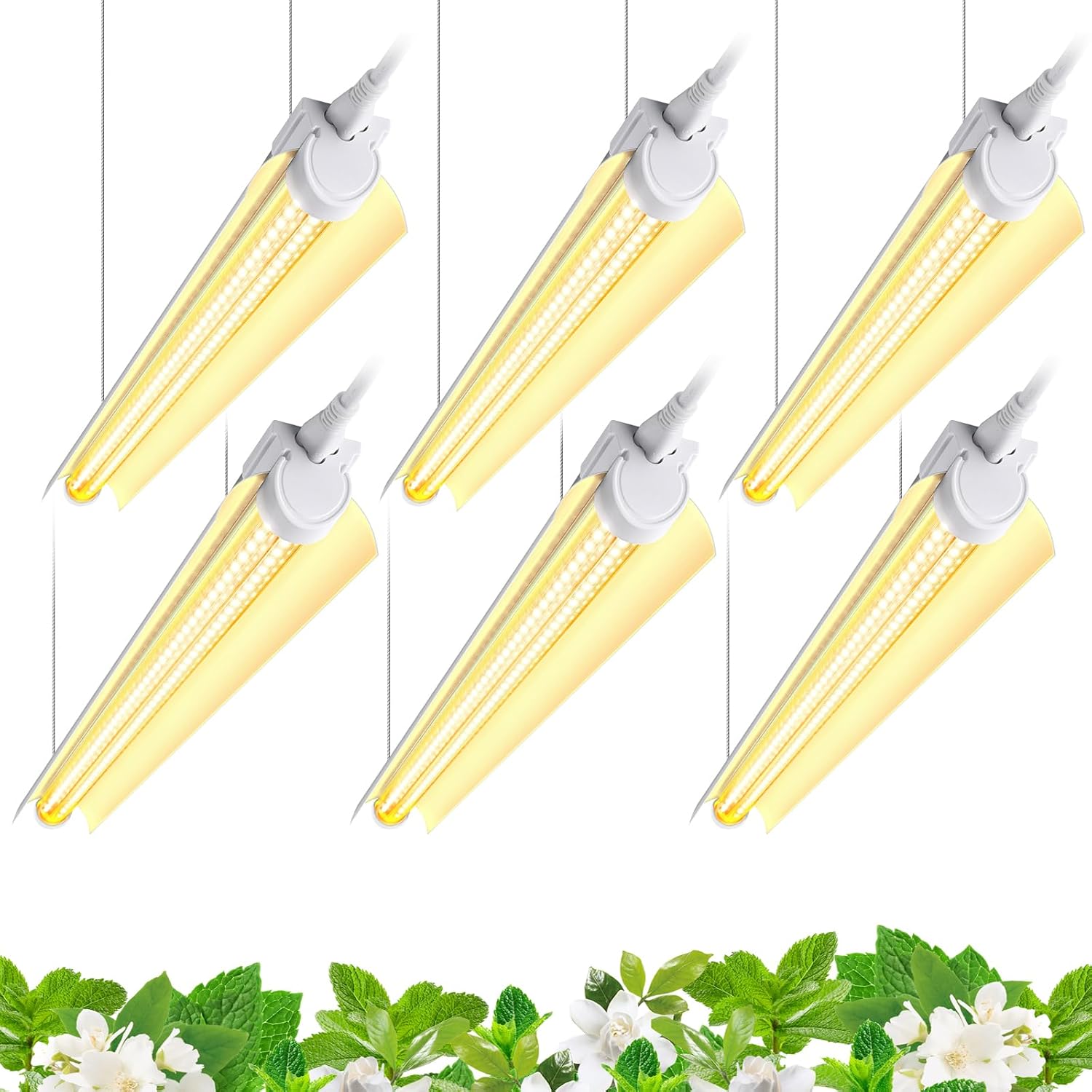
The value pick for covering a whole shelf: Barrina T8 LED grow lights.
 ★4.6
Barrina T8 LED Grow Light
Check Price on Amazon ★4.6Placement and Distance Rules
Grow lights obey the same physics as the sun: intensity drops fast with distance. Move a lamp from 6 inches to 12 inches above a plant and you lose roughly three-quarters of the brightness — not half. Distance is the control knob that matters most.
- Seedlings and succulents under bars: 4–8 inches above the foliage. Closeness is the point.
- Medium tropicals under panels: 12–24 inches above the leaves. Start far and watch new growth.
- Single plants under a bulb: 1–3 feet away — closer for high-light species, farther for shade lovers.
Angle the light straight down and center it over the plant's crown. For shelving, mount a bar directly beneath each shelf — one fixture can't serve two levels. Pale walls and white shelf liners bounce light usefully; dark corners swallow it. And keep plants off freezing windowpanes at night: cold glass plus a timer-lit plant means cold stress. The guide to temperature swings and plant stress explains why a few degrees matter so much in winter.
Timer Schedules for Winter
Consistency beats raw hours. Plants measure day length to set their internal clocks, so the same rhythm daily matters more than occasional long blasts. A cheap mechanical or smart-plug timer removes all guesswork — and it's essential for holiday travel.
- Most houseplants: 12–14 hours daily, matching standard extension guidance for supplemental lighting.
- Succulents, cacti, herbs: 14–16 hours — they evolved for long, bright days.
- Short-day bloomers (Christmas cactus, poinsettia, kalanchoe): 12 hours max plus uninterrupted darkness the rest of the night, or buds won't set. Don't park these on a 16-hour shelf.
A practical winter schedule: lights on at 7 a.m., off at 9 p.m. (14 hours). If the plant sits by a window, let the timer fill the gap — the morning and evening hours when the sun contributes nothing. And plants need a dark period; never run lights 24 hours.
Automate the short winter photoperiod: outlet timer.
Matching Light to Plant Groups
Succulents and cacti
The neediest winter customers despite their tough reputation. Winter windowsills turn them etiolated — pale, stretched, leaves widely spaced. Give them the brightest spot plus 14–16 hours under an LED bar 6–12 inches away. For this group, "more light" is almost never wrong in winter.
Tropical foliage (monstera, philodendron, calathea, ferns)
Understory plants that want bright but indirect light: 12–14 hours under a panel 1–2 feet away. Ferns and calatheas appreciate humidity away from radiators more than raw brightness, so a medium light in a good spot beats a strong light in a dry, drafty corner.
Trailing and low-light classics (pothos, heartleaf philodendron, ZZ, snake plant)
These tolerate darker winters and often need only a modest boost. Near a window, pothos may need nothing; in an interior room, one LED bulb on a 10-hour timer keeps it full. Snake plants and ZZ plants can skip supplemental light entirely in most homes — save fixtures for the plants that truly suffer.
Aquarium-grown and emergent plants
Emergent plants with roots in a tank or riparium ledge need winter light too — they're often farthest from the window. A clip-on bar angled at the emersed growth works well. See the seasonal aquarium plant care guide for how daylight changes affect planted tanks.
Signs of Too Little — and Too Much — Light
Read new growth, not old leaves: old foliage reflects the summer the plant already lived through.
Too little light
- Leggy, stretched stems with wide spaces between leaves (etiolation)
- New leaves smaller and paler than older ones
- Succulents turning green and soft, losing compact rosettes
- Lower leaves yellowing and dropping faster than normal
- Variegation fading toward plain green
- Leaning hard toward the window despite a nearby grow light (too weak or too far)
Too much light
- Bleached, washed-out patches on leaves facing the fixture
- Crispy brown edges appearing within days of a new setup
- Leaves folding or cupping away from the light
Too much light is far rarer in winter and easy to fix: raise the fixture or shorten the timer an hour or two. If leaves drop for other reasons, check your winter watering schedule — overwatering pairs with low light to rot roots fast.
Energy Cost and Safety Basics
Modern LEDs are remarkably cheap to run. A 20 W LED bar on a 14-hour schedule uses about 0.28 kWh per day — roughly 8–9 kWh per month, well under two dollars at typical US rates. Even three fixtures running all winter cost less than a fancy coffee per month.
- Never daisy-chain cheap power strips for multiple fixtures; plug timers into wall outlets and respect wattage ratings.
- Keep fixtures away from water — misting, humidifiers, and aquariums need distance from non-waterproof lights.
- Mount securely. A slipping panel landing on dry potting mix is a fire hazard; use the proper hanging kits or brackets.
- Check for heat. LEDs run cool, but enclosed fixtures need airflow; a housing too hot to touch means something is wrong.
A Simple 3-Step Setup for First-Timers
Here's the whole project reduced to one Saturday afternoon.
- Pick one shelf or plant group. Start with the worst sufferers — succulents on the north sill, the monstera in the dark corner. One LED bar or two bulbs is enough.
- Mount, distance, timer. Hang the light at the right distance (closer for succulents, farther for tropicals), set a 12–14 hour timer, and make sure light lands on leaves, not the wall.
- Watch for two weeks, then adjust. New growth should look compact and well-colored. Stretching means closer or an extra hour; bleaching means raise it. Fold checks into your weekly plant care routine so they happen.
One well-lit shelf this October beats a grand plan installed in February.
Frequently Asked Questions
Can I use regular LED light bulbs instead of grow lights?
Yes, for many houseplants. A standard daylight LED bulb (5000–6500K) placed close enough and run on a timer grows foliage plants well — extension sources note ordinary LEDs and fluorescents work, not just specialty products. Dedicated full-spectrum grow lights offer a tuned spectrum and higher output per watt, which matters most for succulents and large collections. For a few pothos or philodendrons, a daylight LED in a desk lamp is a fine start.
How long should grow lights be on in winter?
Twelve to fourteen hours daily suits most houseplants, matching standard extension guidance. Push to 14–16 hours for succulents, cacti, and herbs; drop to about 12 for short-day bloomers like Christmas cactus, which need long uninterrupted nights to set buds. Whatever you choose, keep it consistent with a timer — plants respond to a reliable rhythm far more than to occasional extra hours.
How close should a grow light be to my plants?
It depends on the fixture and the plant. LED bars over succulents and seedlings work best 4–8 inches above the foliage; panels over tropicals usually sit 12–24 inches up; single bulbs serve plants within 1–3 feet. Because intensity falls off sharply with distance, moving a light six inches closer often helps more than buying a stronger one. Start at the recommended distance and adjust.
Do grow lights work through a window or across the room?
No — grow lights sit close to the plant, not across the room, where they contribute almost nothing. The same fixture 12 inches above the leaves can deliver many times the light. Note also that window glass filters out some useful wavelengths, so a plant behind glass gets less than one under an indoor fixture. Put the light near the plant, and let the timer fill the dark morning and evening hours.
Will grow lights raise my electricity bill much?
Barely. A typical 20 W LED bar run 14 hours a day uses under 10 kWh per month — roughly a dollar or two at typical rates. Even a three-fixture setup costs less monthly than a single bag of premium potting mix. LEDs are far cheaper to run than old fluorescent or HID setups, one more reason extension services recommend them as the default for home growers.
Should I fertilize plants growing under lights in winter?
Lightly, if at all. Grow lights prevent deep winter dormancy, but plants still grow more slowly than in summer and need far less food. A quarter-strength balanced feed once a month at most — and nothing for truly resting plants like many cacti. Over-fertilizing in winter causes salt buildup and burned tips faster, because the plant can't use nutrients quickly. When in doubt, wait for spring growth.
Light Now, Thank Yourself in March
Setting up grow lights for houseplants in October is a quiet investment that pays off all winter: compact succulents, tropicals pushing healthy leaves, and a collection that greets longer days already growing instead of recovering. Start with one shelf, one timer, and the right distance — then let the plants tell you what to fine-tune.