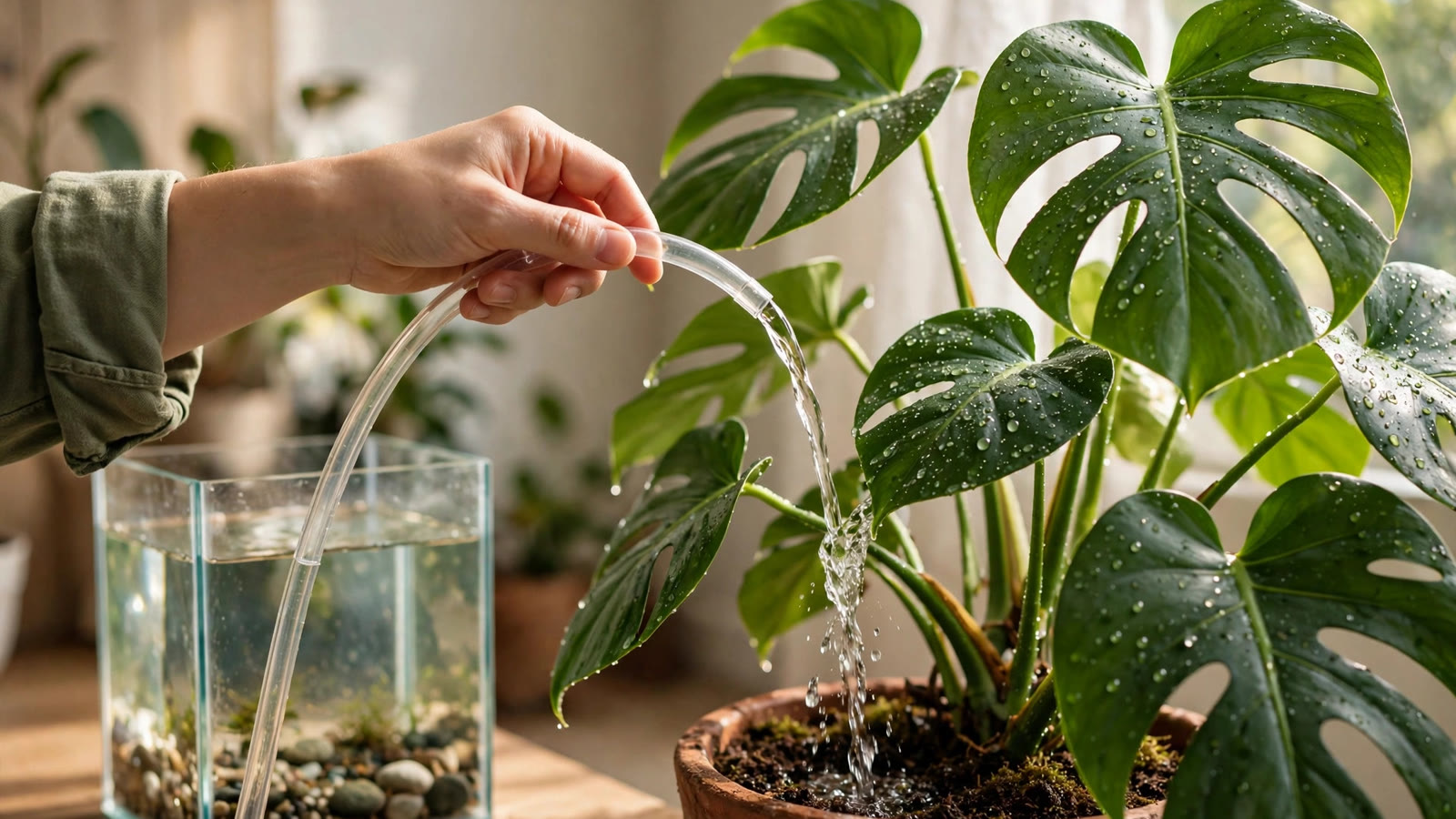
Every week, millions of aquarium keepers siphon out liters of nutrient-rich water and pour it straight down the drain — while across the hall, houseplant lovers pay for liquid fertilizer that mimics exactly what's in that bucket. Watering houseplants with aquarium water bridges those two hobbies beautifully: the "dirty" water from a healthy freshwater tank is a mild, organic feed full of the nitrogen and trace minerals that foliage plants crave. But not all tank water is safe, and the details matter. This guide explains what's actually dissolved in that water, when it helps, when it harms, and how to work it into your indoor-plant routine without risking either your fish or your fiddle-leaf fig.
Why Aquarium Water Feeds Houseplants So Well
An aquarium is, chemically speaking, a plant-feed factory. Fish excrete ammonia, uneaten food and decaying plant matter break down into more ammonia, and beneficial bacteria convert that toxic ammonia into nitrite and then nitrate — the same nitrogen form that most commercial houseplant fertilizers deliver. By the time you siphon it out during a water change, a healthy tank's water carries a gentle dose of ready-to-absorb nitrogen, usually in the range of 5–40 parts per million depending on stocking and maintenance.
The nitrogen cycle ends at nitrate — plant food
Nitrogen is the nutrient behind deep-green, vigorous foliage. When you follow a regular water change schedule for your aquarium, the water you remove is loaded with the nitrate your fish don't want but your monstera will drink up happily. Unlike synthetic fertilizers, this nitrogen arrives already dissolved, fully available to roots, and at a low enough concentration that it almost never burns tender houseplant roots when used sensibly.
More than nitrogen: phosphorus, potassium, and micronutrients
Fish food and decaying organic matter also contribute phosphorus and potassium — the other two letters of NPK — along with trace elements like iron, magnesium, and calcium. Understanding how aquarium plant fertilizers dose micronutrients shows the same principle at work: tanks are constantly mineralizing organic matter into plant-usable forms. Tank water is not a precisely measured fertilizer, and its strength varies, but it is unmistakably "fertile" compared to plain tap water.
| Nutrient in tank water | Main source | What it does for houseplants |
|---|---|---|
| Nitrate (nitrogen) | Fish waste, broken-down food | Lush foliage growth and deep green color |
| Phosphorus | Fish food, decaying matter | Root development and overall vigor |
| Potassium | Fish food, mineral content | Sturdier stems and disease resistance |
| Calcium and magnesium | Water hardness | Cell walls and chlorophyll production |
| Iron and trace elements | Food, supplements, substrate | Prevents yellowing in new growth |
Which Aquarium Water Is Safe to Use
This is the part you cannot skip. Tank water is only plant food if the tank itself is healthy. Water from a thriving, cycled freshwater aquarium is fine; water from a tank with problems can carry salt, medication residues, or pathogens you don't want in your soil.
Yes: water from a healthy, established freshwater tank
Look for clear water, active fish with good appetites, and stable test readings — ammonia and nitrite at zero, nitrate present but controlled. A proper siphoning technique for planted tanks pulls the most nutrient-rich water from the bottom, where mulm and settled waste collect. That gravel-siphon water is exactly what you want for your plants, since it contains the most dissolved organic nutrients.
Never: saltwater, medication- or copper-treated water
Saltwater aquarium water is an absolute no. Even diluted, salt damages soil structure and burns roots, and indoor plants have no tolerance for it. Pour marine tank water down the drain, never into pots. The same hard rule applies after treatment: copper-based medications, ich treatments, dewormers, and many algicides leave residues toxic to plants — copper is phytotoxic at very low concentrations, so if you've dosed copper for fish or invertebrate parasites recently, that batch of water goes in the drain, not the watering can.
The gray areas: conditioning, aging, and water age
Water treated with standard dechlorinators is perfectly fine for plants once conditioned. Water from a tank suffering old tank syndrome — very high nitrates, low pH — is extremely fertile but must be diluted first, since that concentration can overwhelm a potted plant's soil chemistry. And skip any batch taken right after a large algae treatment or pH-adjusting chemical dose; wait a week or two before recycling that water.
Watering Houseplants with Aquarium Water: A Safe Step-by-Step Routine
- Collect it during water changes. Siphon into a clean bucket or watering can rather than the sink. The water removed in a normal 20–30% weekly change is plenty for a modest houseplant collection.
- Use it the same day. Fresh tank water is best used within 24 hours. Left sitting for days, especially warm, it loses dissolved oxygen and starts to smell as anaerobic bacteria take over.
- Dilute when in doubt. If your tank runs high nitrates (above 40 ppm) or you skipped maintenance recently, mix it roughly half-and-half with tap water. Virginia Tech's extension guidance on properly watering container houseplants confirms that water from healthy freshwater aquariums is a suitable nutrient source, provided the tank is disease-free.
- Water the soil, not the leaves. Pour gently onto the potting mix. Tank water carries beneficial bacteria and organic residue you want at the roots, not sitting on foliage where it can encourage mildew.
- Match the plant's thirst. Only water plants that actually need water — the finger test still rules. Aquarium water replaces the liquid, not the schedule; soggy soil rots roots regardless of how nutritious the water is.
- Rotate with plain water. Alternate aquarium water with plain water every other watering or so. This prevents nutrient and salt buildup in the potting mix over time.
Plants That Thrive on It — and Ones That Don't
Not every houseplant wants the same meal. Fast-growing tropical foliage plants are the biggest beneficiaries; desert plants and mineral-sensitive species should be watered with it rarely or not at all.
| Enthusiastic drinkers | Use with caution | Skip it |
|---|---|---|
| Pothos, philodendron | Orchids (dilute only) | Carnivorous plants |
| Monstera, peace lily | Succulents and cacti | Salt-sensitive ferns at full strength |
| Spider plant, ferns | Herbs in small pots | Plants in bonsai soil mixes |
| Snake plant, ZZ plant | African violets (soil only) | Any saltwater tank's water |
Leafy tropicals in active growth can often be watered with aquarium water every time they're thirsty, and many growers report they stop needing commercial fertilizer entirely. Slow growers and arid species evolved in lean conditions — they appreciate the occasional diluted drink but don't need the extra nitrogen, and concentrated doses can push soft, floppy growth that looks worse, not better.
Dilution, Smell, and Hygiene
When and how to dilute
The simplest rule: if your tank water smells clean and slightly earthy, use it straight; if it smells strongly of fish or ammonia, dilute it 1:1 or skip that batch. High-nitrate water from a neglected tank should always be diluted, and you can alternate between aquarium water and plain tap water across waterings to keep soil chemistry stable. Plants in small pots concentrate whatever you pour in, so be more conservative with them than with big floor plants.
Handling the fishy smell
Most healthy tank water has only a mild pond-like scent that fades within minutes of application. If a batch smells genuinely foul, that usually means the siphon pulled up a pocket of anaerobic sludge — compost-rich but smelly. You can let it settle and use the clearer water off the top, or simply discard very smelly water and use a fresher batch next time. For indoor use, avoid straining it through cloth into your good watering cans; keep a dedicated bucket to spare your kitchen gear.
Keeping it clean
Tank water is alive — it carries harmless nitrifying bacteria and microfauna. That's part of the benefit, but it also means you shouldn't store it in sealed containers for days (pressure and odor build up), and you should wash the bucket between uses. Never return used plant water to the aquarium; soil particles and potential plant pests don't belong in a fish tank. If you grow herbs or vegetables and use heavily medicated tank water, be conservative — reserve aquarium water mainly for ornamental plants.
Frequently Asked Questions
Can you water houseplants with aquarium water every time you water?
Yes, for most leafy tropicals, as long as the tank is healthy and freshwater and you're only watering when the soil actually needs it. Many growers find their pothos and philodendrons thrive with no other fertilizer at all. Just watch for signs of over-fertilization — dark green, soft, leggy growth — and alternate with plain water if the potting mix shows salt crusting on the surface.
Is aquarium water better than fertilizer for houseplants?
It's gentler, free, and less likely to burn roots, but it's not precisely measured — nutrient levels vary with your tank's stocking, feeding, and maintenance. Think of it as a light, steady organic feed rather than a replacement for everything. Hungry heavy-feeders may still appreciate a measured dose of houseplant fertilizer now and then, especially during peak growing season.
What if I just treated my tank for ich or algae?
Discard that water instead of using it on plants. Copper-based and many formalin-based treatments leave residues that are toxic to plants at low concentrations, and algaecides can stress root systems. Wait at least two to three full water changes after treatment before resuming plant watering, and when unsure, pour it down the drain.
Can I use water from a planted tank with CO2 injection?
Yes — CO2-injected planted tanks produce some of the best plant water, since the dissolved CO2 quickly dissipates once the water is exposed to air and the remaining nutrients are abundant. Just note that heavily planted, lightly stocked tanks may have already had most of their nitrate consumed by the aquarium plants themselves, so the water can be surprisingly lean. Consider also looking into rainwater for planted aquariums if you want another natural, chemical-free water option.
Does aquarium water attract pests or smell indoors?
Applied to the soil surface, healthy tank water smells faintly pond-like for a few minutes and then fades. It doesn't attract insects any more than regular watering does. Persistent bad odor signals stagnant or anaerobic water — dilute it, use only the clear top portion, or discard that batch. Fungus gnats are a soil-moisture problem, not an aquarium-water problem, so keep drainage good as usual.
A Simple Routine That Works
Tie the two chores together: on water-change day, siphon into a watering can first and handle your houseplants while the bucket is fresh. Use it straight on your leafy tropicals when it comes from a healthy tank, dilute it when the tank was overdue for maintenance, and never use it after medication, algae treatment, or from a saltwater system. Rotating with plain water and following your seasonal aquarium plant care rhythm keeps both hobbies in sync — fish get clean water, plants get free fertilizer, and you stop pouring good nutrients down the drain. Few plant-care habits are this easy, this cheap, and this satisfying to stick with.
Tissue-culture plants are the exception — they’re grown in sterile gel and adapt with minimal melting, which is part of what you’re paying for. Plants bought submersed from another hobbyist’s tank also transition with little melt, since they’re already in the right form.
Which Plants Melt Most (and Least)
Heavy melters (expect significant leaf loss)
- Cryptocorynes — infamous for “crypt melt,” sometimes dropping every leaf after any disturbance. They almost always recover from the roots within weeks.
- Stem plants grown emersed — rotala, ludwigia, and hygrophila often shed lower emersed leaves while the growing tips transition.
- Amazon swords — emersed-grown swords typically lose their broad oval aerial leaves and replace them with longer submersed ribbon leaves.
Light melters
- Anubias, java fern, bucephalandra — slow-growing rhizome plants transition gradually; occasional old-leaf melt but rarely dramatic.
- Vallisneria — usually transitions well, though it dislikes the move itself and may sulk for a week.
- Floating plants — minimal melt since their leaves were already at the air-water interface.
The Acclimation Protocol
Step 1: Quarantine or dip first
Before acclimating to your tank’s conditions, make sure you’re not acclimating pests along with the plant. Run new arrivals through our quarantine and dip protocol — it adds days upfront but prevents months of regret.
Step 2: Float to temperature-match (30 minutes)
Float the bag or container in your tank for 20–30 minutes to equalize temperature. Plants are less temperature-sensitive than fish, but a 10°F shock on top of transplant stress is an avoidable insult.
Step 3: Trim before planting
Remove any leaves that are already damaged, yellowing, or heavily algae-covered — they won’t recover and they’ll rot in your tank, feeding algae. For stem plants, trim off the bottom inch and any emersed leaves that look unlikely to adapt; the plant wastes energy maintaining leaves it’s going to shed anyway. Keep the healthy growing tips — that’s where recovery starts.
Step 4: Plant correctly the first time
Follow our planting guide — right depth, crown exposed on rosettes, rhizomes unburied on epiphytes. Every uprooting and replanting restarts the acclimation clock, so get placement right on the first attempt. Decide where each plant goes before it goes in the water.
Step 5: Run a gentle first week
For the first 7 days after planting:
- Moderate light — run your normal photoperiod but consider dropping intensity 20–30% if your light is dimmable. Blast-level light on a melting plant grows algae on the dying leaves, not recovery.
- Stable CO2 — if you inject CO2, keep it consistent. Fluctuating CO2 during acclimation is a melt accelerator. If you’re low-tech, this doesn’t apply — see growing without CO2.
- Half-strength fertilizer — new plants with damaged leaves can’t use full dosing, and the excess feeds algae. Ramp to full strength over 2–3 weeks per our fertilizer schedule.
- No disturbance — don’t move, trim, or “check on” new plants for at least two weeks. Every touch resets root establishment. This is especially critical for crypts.
Step 6: Remove melt, keep the base
As emersed leaves melt, remove the mushy material promptly — decaying leaves release ammonia and grow fungus that can spread to healthy tissue. But never discard the plant while the crown, rhizome, or roots are firm and alive. A crypt that’s lost every leaf but has firm roots is a plant that’s about to recover, not a dead plant. Give it 3–4 weeks before judging.
Telling Normal Melt From Real Problems
Normal transition melt:
- Affects oldest/emersed leaves first, newest growth last
- New submersed leaves emerge even as old ones dissolve
- Roots and crown stay firm and white/green
- Timeline: 1–4 weeks, then obvious new growth
Concerning melt (see our full melting diagnosis guide):
- New growth also melts or emerges deformed
- Rhizome or crown turns mushy and brown — this is rot, not transition
- Entire plant dissolves within days with no new growth after 4+ weeks
- Melting spreads to established plants that weren’t recently moved
Buying Tips to Minimize Melt
- Buy submersed-grown when available — hobbyist-grown cuttings transition with almost no melt.
- Choose tissue culture for sensitive species — crypts and delicate stems establish far more reliably from sterile cups.
- Avoid plants already melting in the store tank — some melt is normal, but a plant that’s mostly mush at purchase has less energy for recovery.
- Transport carefully — keep plants damp and out of direct sun/heat. A plant that dries out or cooks in a hot car melts far worse than one transported properly.
The First-Month Timeline: What to Expect Week by Week
Knowing what’s normal when removes most acclimation anxiety. Here’s the typical timeline for a healthy plant adapting to a new tank:
Week 1: The quiet week
Almost nothing visible happens. The plant is growing roots you can’t see and assessing its new environment. Some species (vallisneria, stem plants) may start shedding their lowest leaves. This is normal. Resist the urge to “help” — no moving, no extra fertilizer, no light changes. The most common beginner mistake is intervening during a week when the correct action is nothing.
Week 2: Melt peaks
This is when emersed leaves give up in earnest. Crypts may drop everything; swords shed their broad aerial leaves; stem plants lose lower foliage. It looks catastrophic and it’s usually fine. Keep removing mushy material, keep conditions stable, and watch the crown and growing tips — if those are firm and green, recovery is already underway.
Week 3: The turn
New submersed-adapted leaves emerge — smaller, thinner, often a slightly different shade of green than the emersed foliage. Stem plant tips start growing visibly; crypts push tiny curled leaves from the crown; swords unfurl narrow ribbon leaves. This is the moment most beginners exhale for the first time.
Week 4+: Established
New growth outpaces melt, and the plant is functionally yours. You can resume full-strength fertilizer, normal trimming, and stop treating it as fragile. Some slow growers (anubias, bucephalandra) take 6–8 weeks to show obvious progress — that’s their normal speed, not a problem.
Acclimating Different Plant Formats
Tissue-culture cups
Sterile, pest-free, and already adapted to high-humidity (not emersed) growth — tissue cultures melt the least of any format. Rinse the agar gel off gently (leftover gel rots and feeds fungus), split the portion into small plantlets, and plant per our planting guide. They establish slowly for the first two weeks, then accelerate. No dip needed, minimal acclimation stress — this is the premium experience you’re paying for.
Potted plants
Remove the pot and strip away the rockwool completely — leftover rockwool traps debris and rots. Tease the root mass apart gently; if it’s a dense mat, splitting it into 2–3 smaller portions actually establishes faster than planting one big clump (more growing points, better water flow around roots). Potted plants are usually emersed-grown, so expect the standard 2–4 week melt cycle.
Bare-root / bunched stems
Typically sold as weighted bunches. Remove any bands, foam, or weights, strip the lower leaves, and plant stems individually or in small groups. Bunched stems from the store are often already transitioning — check for new submersed growth at the tips, which tells you the plant is mid-adaptation and will settle quickly.
Hobbyist cuttings
Already submersed-grown and the fastest to establish — often showing new growth within days. The main acclimation factor is water-parameter difference between the two tanks. Float to temperature-match, plant promptly, and they’ll usually take off with minimal melt. This is why experienced hobbyists prefer trading cuttings over buying potted plants.
Frequently Asked Questions
Should I use a “plant starter” or transplant fertilizer?
Products marketed for transplant shock are mostly B-vitamins and mild hormones. They don’t hurt, but there’s no strong evidence they help aquarium plants specifically. Stable conditions and patience outperform any bottle. Save the money for more plants.
My new plant melted completely — bare crown, no leaves. Is it dead?
Probably not, if the crown or rhizome is firm. Crypts and swords routinely lose 100% of their leaves and regrow from the base within a month. The test is firmness: firm and pale/green means alive; mushy and brown/black means rot. Give firm-but-leafless plants a full 4 weeks before declaring them dead.
Can I speed up acclimation with extra light or CO2?
No — and trying usually backfires. A melting plant can’t use extra light; the excess just grows algae on its dying leaves. Keep light moderate and CO2 stable (not boosted) during acclimation. Growth speed comes from the plant’s own adaptation timeline, which you can’t rush, only avoid delaying.
Should new plants go straight into my main display tank?
After quarantine/dipping, yes — there’s no benefit to a separate “growing-in” tank for most plants. They acclimate to your water fastest in the tank they’ll live in. The exception is very delicate species going into a tank with boisterous fish; give those a few weeks in a calm corner or breeder box first.
The Patience Rule
The single most important acclimation skill is restraint: plant it right, set gentle conditions, remove decay, and then leave it alone for a month. The hobbyists with the best plant growth aren’t doing something clever in week one — they’re simply not interfering in weeks two through four while the plants do what they’ve evolved to do. Melt looks like failure and feels like failure, but in most cases it’s the visible part of a plant successfully becoming yours.