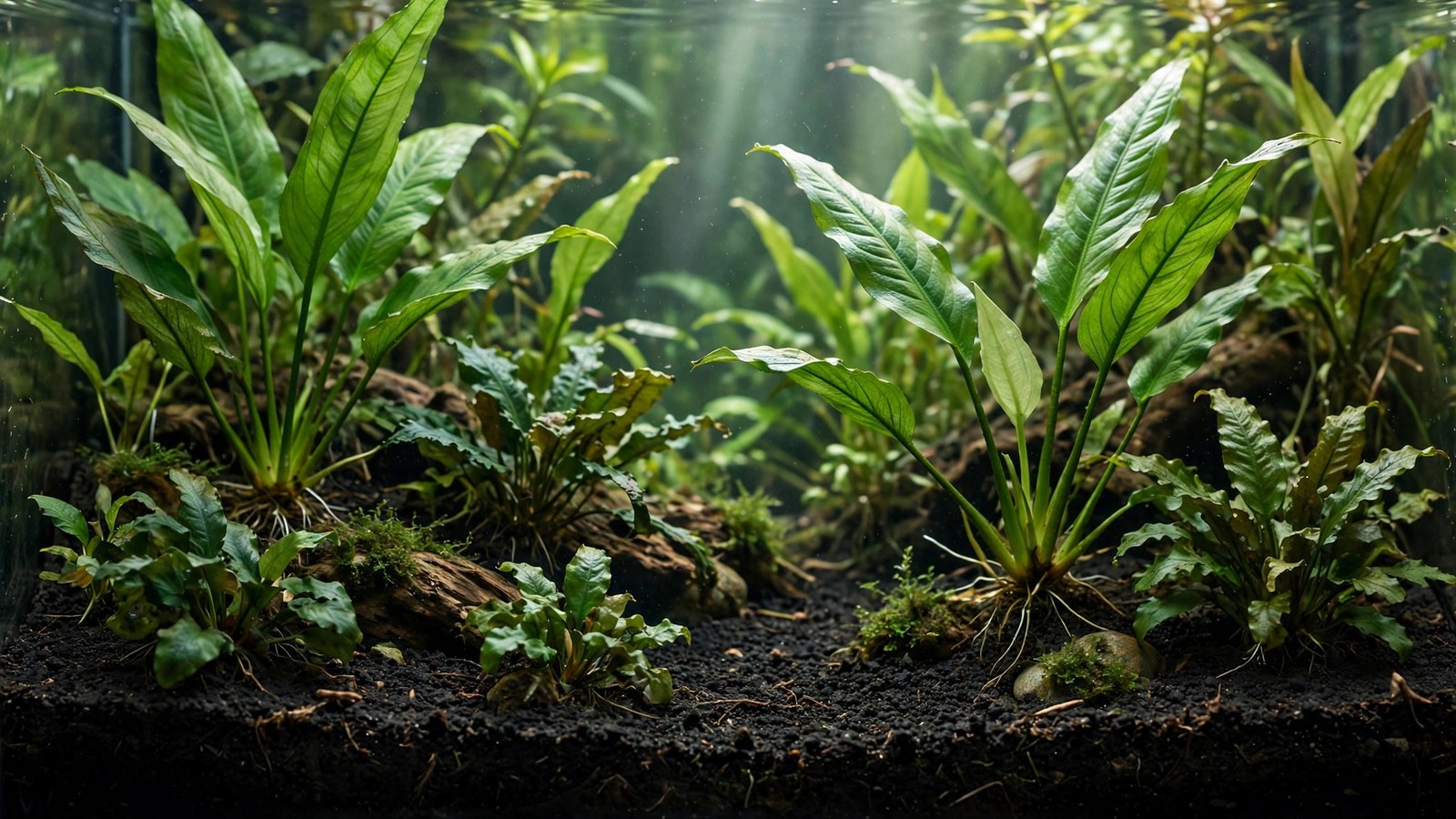
Every planted-tank forum has the same thread: whether the cheap green Jobe's fertilizer spikes from the garden center can double as DIY root tabs. If you arrived here by searching "jobe's fertilizer spikes aquarium" — at a couple of dollars for a pack of fifty, they cost a fraction of aquarium root tabs, and pushing one under an Amazon sword feels clever. It is also one of the quickest ways to trade healthy fish for an algae bloom. So before you bury that little green stick, see what to use instead of terrestrial spikes and read the chemistry below.
What's Actually Inside a Jobe's Spike
A Jobe's spike is a compressed stick of synthetic fertilizer engineered for houseplant soil — dry, airy, and free of livestock. Every formula shares one trait: nitrogen in ammoniacal and urea-based forms. The label numbers:
| Formula | NPK | Made for | Aquarium relevance |
|---|---|---|---|
| Houseplant | 13-4-5 | Pothos, monstera, ferns | The one hobbyists experiment with most; 13% nitrogen per spike is a lot in a small tank |
| Fern & Palm | 16-2-6 | Palms and ferns | Even more nitrogen — the worst choice for a tank |
| Slow-Release Palm | 10-5-10 | Palm trees | Large per-tree spikes; overdosing a nano tank is easy |
| Organics All-Purpose | 4-4-4 | General garden use | Milder NPK, but still terrestrial food with ammonia risk |
In moist potting soil, the 60-day feeding promise holds. Under aquarium substrate — constantly saturated, warm, and bacterial — the compressed stick softens and crumbles far sooner. "Slow release" doesn't survive the trip from windowsill to fish tank.
Why a Spike Is Not a Root Tab
A genuine root tab meters nutrients through a resin-coated prill: a polymer shell releases fertilizer steadily over three to four months. A Jobe's spike has no shell — just compression. Once saturated, it erodes and dumps its load front-loaded: a rush in the first weeks, then a taper. The exact opposite of what aquarium roots want.
Forums show the pattern: experienced aquascapers report noticeably more algae and parameter trouble with compressed spikes than coated prills, especially under strong lighting where fast growth leaves no margin for error. The damage came from delivering too much, too early — not from "wrong fertilizer."
The Ammonia Problem, in Plain Chemistry
Here is what decides the issue. Ammoniacal nitrogen exists in water as a balance between ammonium (NH4+, relatively harmless) and free ammonia (NH3, toxic to fish) — and the higher your pH and temperature, the larger the toxic share. Buried deeply and undisturbed, roots grab NH4+ eagerly (plants prefer ammonium over nitrate), which is why some buried spikes seem to "work" for a while.
The danger is escape. A spike that surfaces, gets dug up by cichlids, loaches, or Malaysian trumpet snails, or dissolves into a shallow sand bed dumps its nitrogen straight into the water column. University of Florida extension guidance on ammonia in aquatic systems notes that un-ionized ammonia above 0.05 mg/L can damage fish tissue, and around 2.0 mg/L sensitive fish start dying. A single houseplant spike carries roughly 13% nitrogen by weight — released at once into a small tank, that is easily enough to swing a test kit from yellow to alarm green. Shrimp and snails are even less forgiving, so anything with livestock should be dosed with shrimp-safe fertilizers rather than terrestrial shortcuts.
If You've Already Buried One: Harm Reduction
Already buried one? Don't panic — follow this order:
- Leave it buried. Digging releases a concentrated plume into the water column.
- Test ammonia daily for a week with a liquid test kit, not strips, logging readings at the same time each day.
- Cap the dose at one spike per 20 gallons. Buried more? Plan 30% water changes every other day for a week.
- Check the depth: less than 3 inches deep — or within 3 inches of the plant crown — risks surfacing. Re-bury only if you can avoid churning the substrate.
- Watch the telltales: green water, a hair-algae bloom, or gasping fish after burial all signal nutrient or ammonia leakage.
Never add spikes to a cycling tank, one with digging livestock, or a shallow sand bed. If ammonia climbs: 30–50% water change immediately, dose an ammonia-binding conditioner, and stop feeding for a day or two.
Jobe's Fertilizer Spikes Aquarium Verdict: Don't
No hedging here: terrestrial spikes were never tested submerged or around fish, and their dump profile is the wrong shape for aquarium roots — too much, too early, with ammoniacal nitrogen that punishes any placement mistake. All to save a few dollars a year.
Aquarium root tabs exist to solve exactly this: steady, low-dose nutrition, safe nitrogen forms, and ingredients chosen with shrimp and snails in mind. Compare formulas in our tested root tab roundup and place them with correct root tab placement. Prefer water-column feeding? Read how liquid fertilizer compares to root tabs first.
What to Use Instead
First, confirm the problem is real: many tanks run fine on fish waste and lean dosing, so start with whether your plants actually need supplemental fertilizer at all. If they do, place a proper aquarium root tab under each heavy root feeder (swords, crypts, lotus), swapped every two to three months. One pack of quality tabs lasts a small tank most of a year — the "savings" from garden spikes evaporate once you price per month instead of per pack.
Add a conservative dose of balanced all-in-one liquid fertilizer for stem plants and epiphytes, and let the plants — not the forum hack — tell you when they're hungry.
Frequently Asked Questions
Are Jobe's fertilizer spikes safe for fish?
No — not reliably. Their ammoniacal nitrogen converts to toxic free ammonia if the spike surfaces, crumbles, or is over-dosed; fish gills are damaged above 0.05 mg/L of un-ionized ammonia. Buried deep they sometimes cause no visible harm — but aquarium root tabs cost cents a month, so why gamble?
Can I use Jobe's spikes in a shrimp tank?
Definitely not. Shrimp are far more sensitive to ammonia and trace metals than most fish, and terrestrial formulas aren't screened for invertebrate safety. A shrimp tank is the single worst place for this experiment. Stick to products explicitly rated shrimp-safe.
Are Jobe's spikes the same as Osmocote DIY root tabs?
No. Osmocote's resin-coated prills meter nutrients over months; a Jobe's spike is a shell-less compressed stick that dumps its load far faster — hence more algae and ammonia complaints, even at similar NPK numbers.
I already buried a spike — should I dig it out?
Leave it alone. Digging releases a concentrated nutrient plume into the water column — worse than the slow seep of an undisturbed spike. Test ammonia daily for a week, change 30% of the water if readings climb, and watch for green water or algae as the leakage signal.
What's the cheapest safe alternative to spikes?
Proper aquarium root tabs, or resin-coated prills in gel capsules for the DIY route. A pack costs a few dollars and feeds a small tank for months — under a dollar a month, with none of the ammonia gamble.
Jobe's spikes do one job well: feeding houseplants in potting soil. Your aquarium has better tools — real root tabs and balanced liquid ferts. Spend the few dollars, skip the gamble, and let your fish keep their gills intact.