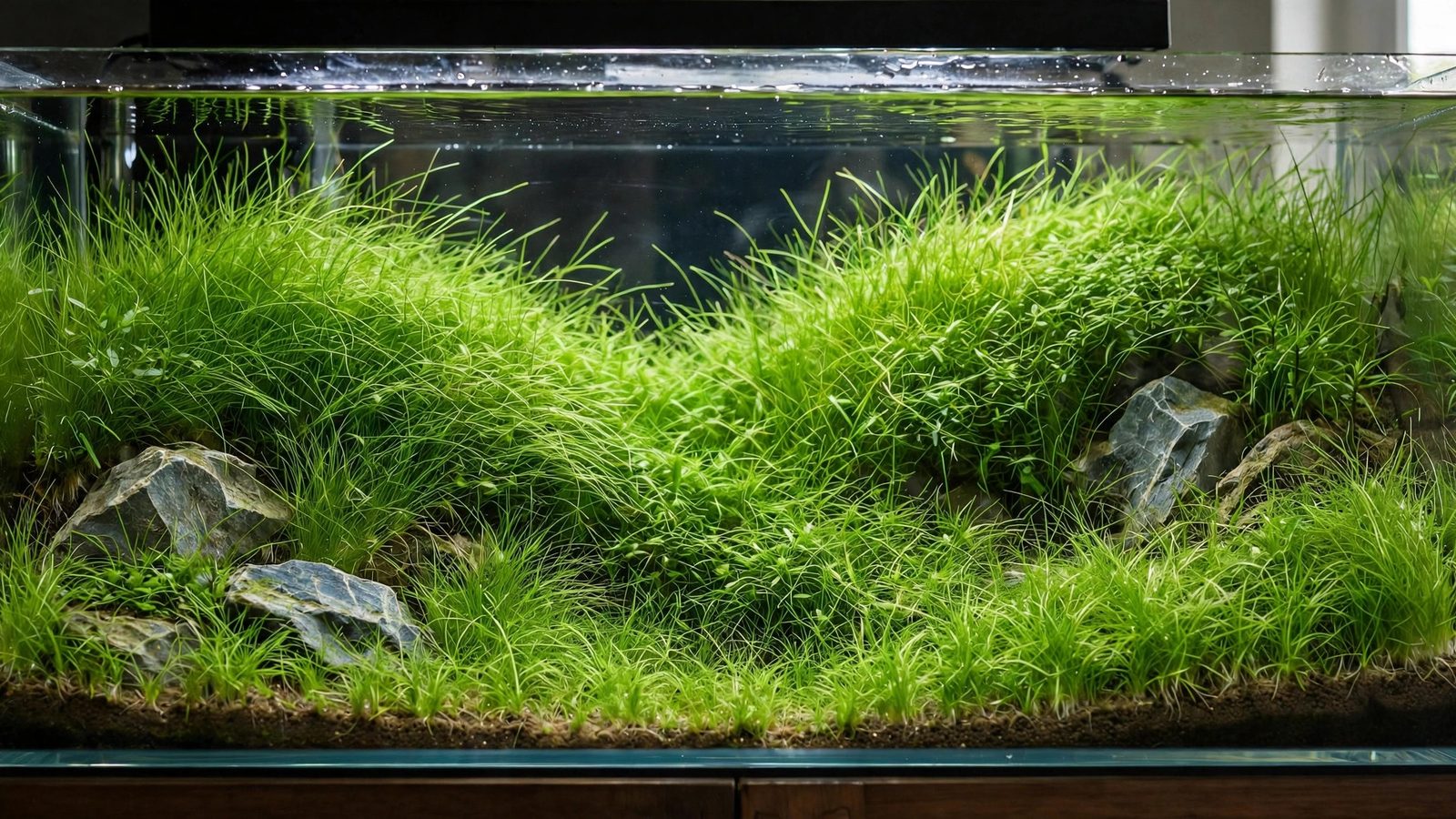
Most aquascapes dissolve into a jumble of species fighting for attention. A single species aquascape bets on the opposite: one plant, planted boldly, carrying the entire tank. Here's how to pick the right species, arrange it so the layout looks deliberate rather than empty, and run the trimming rhythm that keeps a one-plant tank sculpted for years.
If you're still shortlisting, browse the easiest aquarium plants for beginners — a one-plant layout needs a species you can grow reliably. The lightly planted aquarium setup guide covers the lighting, substrate, and filtration basics, which are identical here.
Choosing the One Plant
Species choice carries the whole concept — no second plant can rescue the composition. Your candidate must grow reliably in your setup, look good from across the room, and respond well to trimming so you can sculpt it over time.
Start from your constraints. Low-tech without CO2? Choose a plant that genuinely thrives there. Dislike trimming? Avoid fast stems. And be honest about taste: you'll look at this plant daily for years, so pick one you love. Cross-check your shortlist against the Tropica plant database for exact light and CO2 needs before buying.
| Species | Tech level | Layout role | Trimming load |
|---|---|---|---|
| Java fern (Microsorum pterotoides) | Low | Island, midground clusters | Low — thin old fronds occasionally |
| Vallisneria spiralis | Low–medium | Background jungle | Medium — cut tall leaves at the base |
| Java moss (Taxiphyllum barbieri) | Low | Shrimp tank, wood/rock coverage | Medium — shear to keep it dense |
| Pearlweed (Hemianthus micranthemoides) | Medium | Sculpted mounds, carpets | High — every 2–3 weeks to hold shape |
| Dwarf hairgrass (Eleocharis acicularis) | Medium–high | Full carpet | Medium — mow to ~3 cm monthly |
Buy enough at the start. Five lonely stems planted in hope look accidental for months — fill 60–70% of the planting area on day one. Tissue-culture cups and potted portions make quantities easy to calculate: a 60-liter tank needs about 6–10 cups of a carpeting species or 3–4 pots of a background plant.
Layout Rules That Make One Plant Look Intentional
Without species variety, you manufacture visual rhythm through height, mass, and the empty space around them.
Vary height, not species. Taller, denser masses at the back or one end, shorter and sparser toward the front. The scene recedes into the distance even though it's all one plant — let background vallisneria reach the surface while the foreground group stays at half height.
Leave deliberate negative space. Keep roughly a third of the footprint as open substrate or swimming corridor, and hold it. That emptiness makes the planted mass read as composition rather than clutter.
Group in odd numbers at different depths. Three clusters of the same plant at front, middle, and back reads as staging; one cluster reads as an accident. The height-first approach in concave layout aquascaping is a useful study in rhythm without variety.
Let hardscape anchor the edges. A single rock or small branch at the focal point gives the plant something to belong to — the placement math in one-rock aquascape layouts works regardless of plant count. Tempted by multi-species richness? Study Dutch aquascape plant arrangement first; seeing what full variety looks like sharpens your instinct for what one plant can and cannot do.
Single Species Aquascape Trimming Rhythms
Trimming is the tool that replaces species variety. Without regular cutting, a one-plant tank becomes a uniform green wall or a tangled mass with dead lower growth. The island-style aquascape walkthrough shows how to keep a single mass sculpted against open water.
- Fast stems (pearlweed and similar): every 2–3 weeks. Cut back to the previous trim line; replant only healthy tops if extending a mass.
- Runners (vallisneria, dwarf hairgrass): every 3–4 weeks. Cut leaves at the base — vallisneria shows brown tips on mid-leaf cuts.
- Rhizome plants (java fern, anubias): every 6–8 weeks. Remove algae-spotted fronds at the rhizome.
- Mosses: every 4–6 weeks. Shear with aquascaping scissors — untrimmed moss goes stringy and traps detritus; shearing forces dense new tips.
Do your biggest trim 3–4 days before a water change so disturbed detritus settles and gets exported. Never strip more than half the plant mass at once — your lone species is your filtration's partner, and sudden removal can swing nutrients and invite algae.
Four Example Builds
The Vallisneria Jungle
80 liters, low-tech, no CO2. Vallisneria spiralis along the back two-thirds in a rising arc — tallest at the left corner, stepping down right. Open sand foreground, one dark lava rock at the right third. Thin the leaves at the base when they hit the surface.
The Java Fern Island
60 liters, low light. Java fern tied to central driftwood plus three satellite stones — one island in open water. The empty surroundings make the island read as sculpture.
The Moss-Only Shrimp Tank
30 liters, sponge filter, low light. Moss covering all hardscape — branches, rocks, substrate mounds. A shrimp colony grazes it constantly, slowing the need for shearing. The biotope aquascape guide shows how one plant plus the right materials reads as a slice of nature.
The Pearlweed Sculpt
60 liters, CO2, medium-high light. Pearlweed planted dense across back and sides, trimmed every two weeks into two or three rounded mounds with a valley between them. Highest maintenance of the four, and the most designed-looking — proof trimming alone can sculpt one species.
Single-Species vs. Iwagumi: Not the Same Thing
Iwagumi aquascape layout is a strict Japanese style: an odd number of stones arranged by the golden ratio, with exactly one carpeting plant species. It's a specific recipe — stone layout plus dwarf hairgrass or glosso, traditionally. The annual IAPLC contest gallery shows pure Iwagumi and broader one-plant entries judged side by side.
A single-species aquascape is the broader design topic. It includes Iwagumi as one special case, but also moss-only shrimp tanks, vallisneria jungles, java fern islands, and sculpted pearlweed — wood instead of stone, tall background plants, no hardscape focus at all. The rule is "one plant," not "one carpet plus stones." Every Iwagumi is a single-species aquascape; most single-species aquascapes are not Iwagumi.
Frequently Asked Questions
Can beginners do a single species aquascape?
Yes — it's arguably the easiest style to start with. You learn one plant's needs instead of twelve, and mistakes stay contained. Diagnosing problems is simpler too, because there is only one set of plant needs to check. Pick a low-tech species like java fern or vallisneria, and plant densely from day one.
How much of one plant do I need to buy?
More than you think — fill 60–70% of your intended area on day one, because sparse one-plant layouts look accidental for months. A 60-liter tank needs roughly 6–10 tissue-culture cups of a carpeting species or 3–4 potted portions of a background plant.
Does a single species aquascape need CO2?
Only if your species needs it. Java fern, java moss, anubias, and vallisneria thrive without injected CO2 and make excellent one-plant layouts. CO2 becomes necessary for demanding choices like pearlweed sculpts or dense dwarf hairgrass carpets. Match the tech to the species — the layout style itself has no CO2 requirement.
Will one plant get boring over time?
Only if you neglect trimming. A single species that's sculpted and reshaped every few weeks keeps evolving — the composition changes through your maintenance. Mastering one plant deeply teaches more about growth, trimming response, and composition than juggling many species ever does.
Can I keep fish or shrimp in a single-species tank?
Absolutely — livestock doesn't break the one-plant rule. Shrimp are the classic pairing, especially in moss tanks where they graze constantly. Small schooling fish like ember tetras add movement against the planted mass. Just avoid livestock that eats or uproots your species — no goldfish with soft plants, no large cichlids with anything delicate.
Start With One Bold Choice
A single species aquascape is a design commitment, which is exactly what makes it striking. Pick the plant, buy enough of it, shape it with height and negative space, and trim on schedule. Two months in, you'll have a tank that reads as a deliberate underwater landscape — one green idea, executed well.