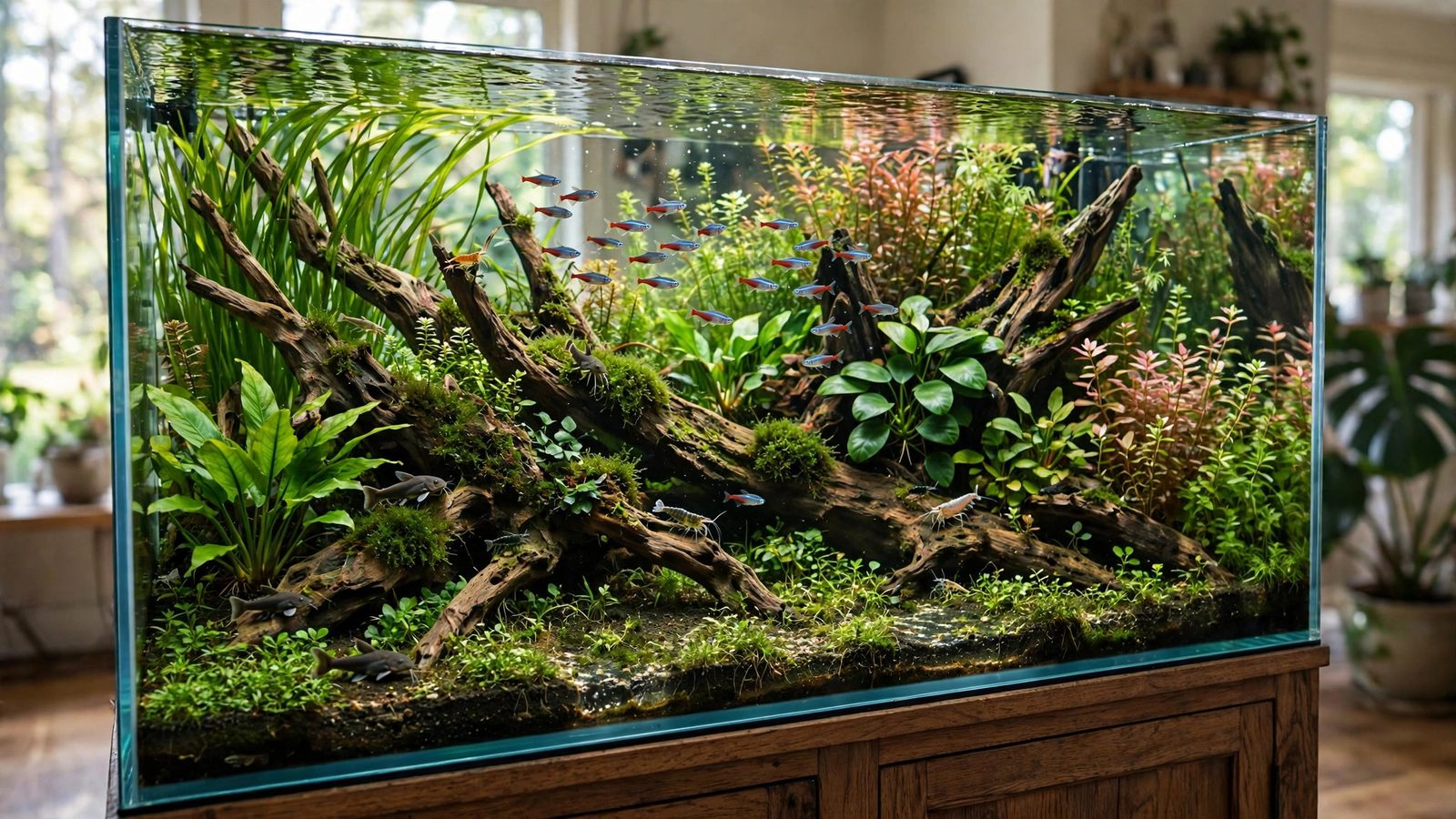
Big tanks — 75 gallons and up — are a different art form. Everything that works in a 60cm nano-aquascape breaks at 120cm: stones that looked monumental become pebbles, plant masses that read as forests become shrubs, and compositions that felt balanced become lost in empty water. Aquascaping large tanks demands thinking in scale: bigger hardscape, bolder masses, stronger geometry, and the humility to accept that large water volumes forgive chemistry but punish design timidity. Here's how the rules change when the glass gets big.
Rule One: Scale Everything Up (More Than You Think)
The beginner's large-tank error is linear thinking: "my 60cm used a 20cm stone, so my 120cm needs a 40cm stone." Wrong — visual mass scales faster than linear dimensions because the viewing distance increases. A good heuristic: hardscape elements should be 2.5–3× the size you'd use in a 60cm for a 120cm tank, not 2×. That hero stone isn't 40cm — it's 50–60cm, a genuine boulder. That driftwood centerpiece isn't a 40cm branch — it's a 70–90cm root mass.
Practical consequences:
- Buy hardscape in person, and bring measurements. Online "large" stones disappoint in large tanks. Visit the shop with your tank's dimensions and a tape measure; choose pieces that look almost absurdly big in the store — they'll look right in the tank.
- Budget for hardscape accordingly. Showpiece stone and wood for a 120cm+ tank can cost $200–500. This is the large tank's hidden expense — our budget guide has workarounds (field-collected stone, fewer premium pieces), but don't expect nano prices.
- Plant in masses, not specimens. A single pot of Cryptocoryne is invisible in 100 gallons. Think in tissue-culture multipacks and potted-plant dozens: 20–30 pots for a 120cm background, 10+ cups for the carpet. The planting bill for a large high-tech tank routinely hits $200–400.
Composition at Scale: Bolder Geometry
Subtle compositions die in big tanks. The techniques still apply — triangles, concave valleys, diagonals — but executed bigger and simpler:
- Fewer, larger masses. Where a 60cm uses 7–9 plant groups, a 120cm uses 4–6 — each one enormous. A Rotala mass 40cm wide and 30cm tall. A crypt colony the size of a dinner table. Restraint at scale means huge simplicity.
- Stronger focal points. The focal point in a large tank must be unmissable from 3 meters away — a 60cm boulder, a meter-wide wood mass, a dramatic red plant block. Timid focal points vanish.
- Exaggerated topography. Substrate slopes need to be dramatic — 15–25cm of elevation change — to read across a large tank. Build hills on lava-rock-bag cores; pure-soil hills this size are impractical and unstable.
- Repeat with rhythm. Large tanks suit repeated elements: a rhythm of three stone groups receding into the distance, or a repeated wood-and-plant module. Repetition creates the grandeur that single compositions can't sustain across 150cm.
- Mind the middle distance. Big tanks have a "dead zone" problem: foreground detail near the glass, background wall at the back, and a void between. Fill it with midground architecture — secondary stone groups, mid-size wood, billowing midground plants — so the eye travels through depth, not across emptiness.
Technical Systems for Large Tanks
Lighting
Even coverage across 120–180cm is the challenge. Options: multiple pendants (2–3 units spaced evenly — the premium look, with shimmer), long LED bars (1–2 full-length fixtures — even, economical), or T5/LED hybrids. Whatever you choose, verify PAR at the substrate in multiple spots — large tanks develop dim zones at the ends and corners that grow algae while the center thrives. Budget $300–800 for lighting a 120cm high-tech tank; it's the single biggest equipment line.
CO2
Large tanks need serious CO2: a 5–10 lb cylinder (paintball is a joke at this scale — you'd refill monthly), dual diffusers or an in-line reactor on the canister, and distribution thought through — CO2 mist must reach the far end. Place diffusers at both ends or use a reactor + spray bar spanning the back. Expect 2–4 bubbles/second total, tuned by drop checkers at both ends of the tank. Cylinder refills: every 2–4 months for a 120cm.
Filtration and flow
Turnover target: 5–10× tank volume per hour. For a 120cm/110-gallon tank, that's a large canister (or two medium canisters — redundancy is wise at this investment level) plus circulation pumps to eliminate dead zones. Flow pattern matters more than raw turnover: spray bars along the back pushing gently forward, or opposing powerheads creating a gyre. Dead spots in big tanks become algae farms and detritus sinks — walk around the tank and watch food flakes to map your actual flow.
Heating
Two smaller heaters beat one big one (redundancy + even distribution) — 2× 200W for a 120cm, placed at opposite ends near filter outflows. An external controller is cheap insurance when a stuck-on heater could cook $1,000 of livestock.
Water changes
50% weekly on 100+ gallons is 50+ gallons — plan the logistics before the tank arrives. A Python-style water changer (tap-connected siphon/fill) isn't optional; it's the difference between maintenance happening and not. Pre-mix and temperature-match in a brute trash can for RO-based setups. Budget 60–90 minutes for the weekly change on a large high-tech tank.
A reliable pick here is NICREW ClassicLED Plus (36-48 in).
Suggest as the cost-effective planted substrate at scale where premium aquasoils get expensive: CaribSea Eco-Complete.
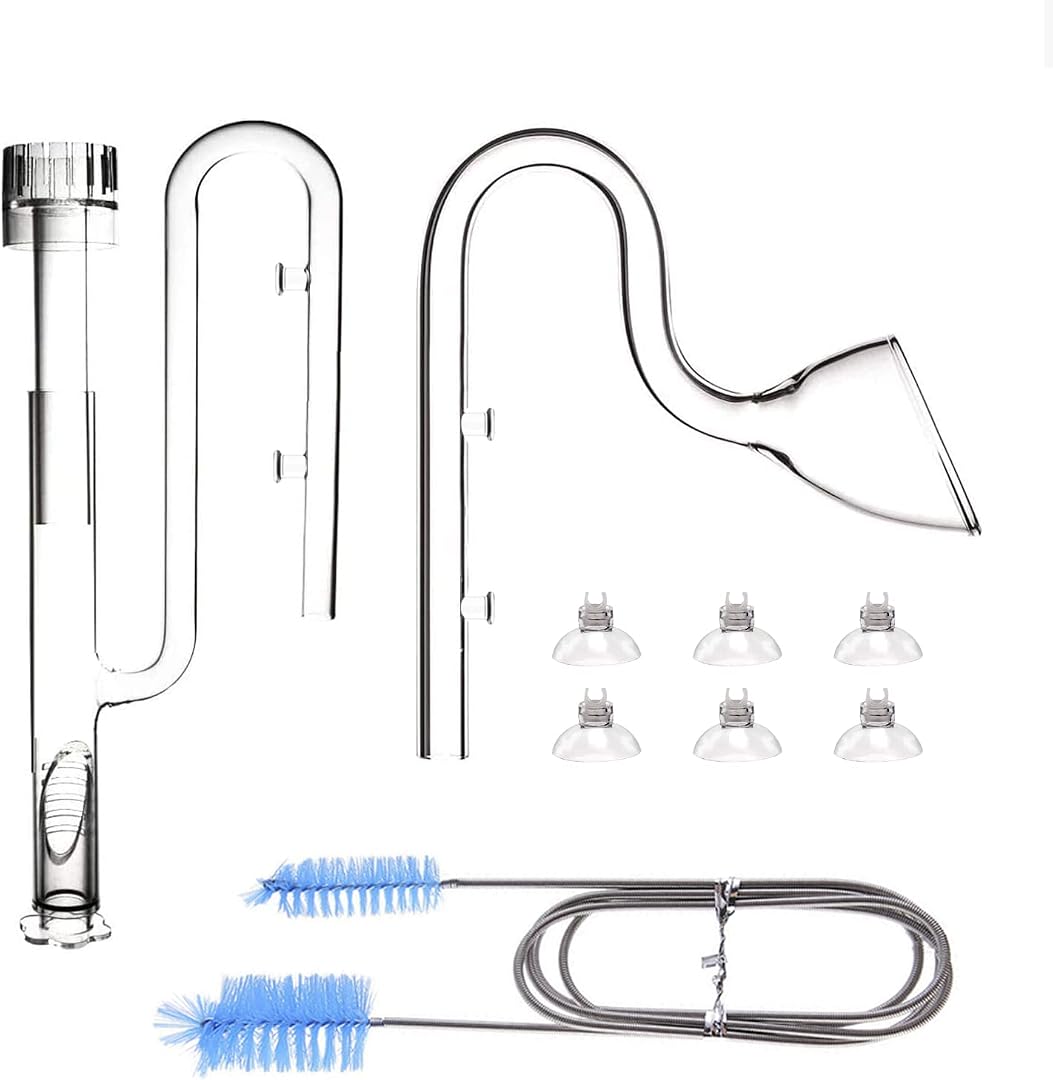
A reliable pick here is glass lily pipe set.
 ★4.0
FZONE Aquatic Glass Lily Pipe Set with Skimmer
Check Price on Amazon ★4.0Hardscape Logistics: The Unsexy Reality
- Weight: a 60cm boulder can weigh 30–50 lbs. Place a foam or egg-crate mat under heavy stone to distribute load and protect the glass. Never drop stone into a filled tank — place hardscape dry, then fill.
- Two-person rule: anything you can't lift safely alone needs a partner. Back injuries end hobbies.
- Pre-arrange outside the tank: mock up the hardscape on the floor in the tank's footprint (tape the dimensions) — rearranging 40-lb stones inside the glass is miserable.
- Secure tall structures: towering stone stacks in big tanks can topple (livestock bump them, substrate shifts). Drill and pin with acrylic rods, or mortar with aquarium-safe epoxy. A collapsed rock tower in 100 gallons is a disaster, not an inconvenience.
Stocking Large Tanks: Schools That Earn the Space
Large tanks finally allow real schools — and they need them, because a dozen tetras in 120 gallons look lost:
- Showcase schools (40–80 fish): cardinal tetras, rummy-nose tetras, harlequin rasboras, Congo tetras. A hundred cardinals moving as one organism through a valley is the large tank's signature spectacle.
- Centerpiece groups: 6–8 angelfish, a group of discus (dedicated setup), 4–6 pearl gouramis. Large tanks let centerpiece fish behave naturally instead of pacing.
- Bottom crews at scale: 15–20 Corydoras (a proper shoal — magical to watch), 3–4 bristlenose plecos, a squad of otos.
- Shrimp colonies: Neocaridina in the hundreds — see our shrimp scaping guide; large tanks grow legendary colonies.
Quarantine at this scale is critical — introducing disease to 80 cardinals is a financial and emotional catastrophe. A 20-gallon quarantine tank is cheap insurance for a 120-gallon display.
Layout Ideas That Shine Big
- The grand valley: our concave technique at full scale — 50cm stone walls, a carpeted valley floor 60cm wide, a hundred tetras. This is the large tank's natural masterpiece.
- Forest: multiple large wood masses planted as a Nature Aquarium forest — only achievable with real lateral room; the canopy needs 100cm+ to read as forest rather than bush.
- Ryuboku (wood-and-stone): the ADA large-tank signature — massive driftwood intertwined with stone, planted densely. Demands the finest large wood you can source.
- Biotope river: a 150cm+ tank can replicate a genuine river stretch — our biotope guide's ideas with room for accurate zones (riffle, pool, bank).
- Dutch at scale: Dutch streets 30cm wide, plant groups the size of throw pillows — the formal garden as landscape architecture.
Maintenance: The Weekly Commitment
Large high-tech tanks demand 2–3 hours weekly: the big water change, glass cleaning (long magnetic cleaners; consider a step stool), trimming (long tools — 60cm scissors and tweezers are mandatory; your arm isn't reaching the back of a 60cm-deep tank), filter maintenance monthly, CO2 checks. It's real work. Many large-tank keepers automate: dosing pumps for fertilizer, auto-top-off for evaporation, timers for everything. Automation isn't laziness at this scale — it's sustainability. A system you can maintain for years beats a perfect system you burn out on in six months.
Trimming technique at scale: work in sections (one plant mass per session if needed), remove cuttings promptly (decaying trimmings in a big tank spike nutrients fast), and replant tops to keep masses dense bottom-to-top — our trimming maintenance guide covers the methods; apply them with long tools and patience.
Frequently Asked Questions
What's the minimum tank size where "large tank rules" apply?
Around 75 gallons / 120cm length — below that, standard aquascaping scales fine with modest upsizing. The 120cm mark is where viewing distance, hardscape mass, and system logistics all shift simultaneously. A 90cm tank is "big standard"; 120cm is "small large."
How much does it cost to aquascape a 120cm tank properly?
Honestly: $1,500–$3,500 for a high-tech build (tank+stand $500–1,000, light $300–800, CO2 $200–300, filtration $200–400, hardscape $200–500, plants $200–400, substrate $100–150). Low-tech halves it. It's a serious investment — which is why planning (and this guide) matters. Our budget guide has large-tank savings strategies.
Can one person maintain a 120-gallon aquascape?
Yes, with the right logistics: Python water changer, long tools, automated dosing, and a realistic weekly 2-hour block. The water change is the crux — without tap-connected fill/drain, 50% changes on 120 gallons simply won't happen consistently, and inconsistency is what kills large tanks.
Do I need two filters on a large tank?
Strongly recommended: two canisters (or one large + circulation pumps) give redundancy — if one fails, the tank survives — and better flow distribution across the length. Clean them on alternating schedules so you never strip all biological filtration at once.
How do I photograph a 6-foot tank?
Our photography guide covers this, but large-tank specifics: shoot in a dark room, use a tripod, step back far enough that the lens doesn't distort the ends (a 35–50mm equivalent works), and take overlapping shots to stitch a panorama if one frame can't capture it without distortion.
Is a large tank harder or easier than a nano?
Chemically easier (huge stability buffer), logistically harder (water changes, cost, physical labor), and design-wise harder (composition at scale is unforgiving). Nanos punish mistakes fast but forgive cheaply; large tanks forgive mistakes slowly but punish expensively. Pick your poison honestly.
Think Big, Commit Fully
Large-tank aquascaping rewards boldness: boulders not pebbles, masses not specimens, rhythms not accents. The investment — money, time, physical effort — is real, but so is the payoff: a living landscape with genuine grandeur, schools moving like weather, and a presence in the room that small tanks can't match. Plan the logistics first (water changes, hardscape weight, system redundancy), compose boldly, and maintain sustainably. When it's mature, enter it — our competitions guide explains how large tanks fare in contests (spoiler: impressively, when the composition earns the scale).