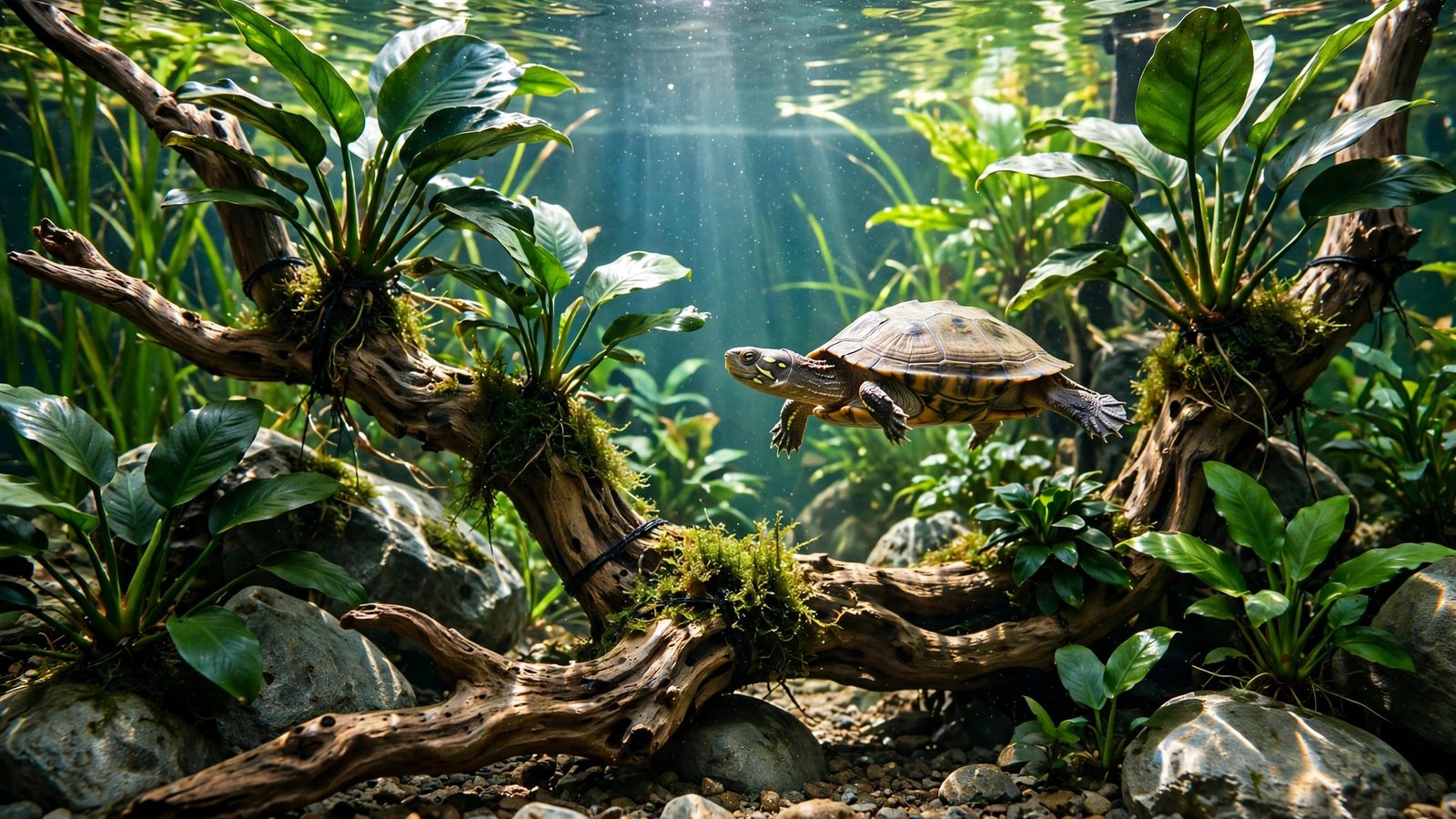
Turtles are the bulldozers of the aquarium hobby — claws that rip stems from substrate, jaws that turn a $12 anubias into lunch. Most keepers surrender to a bare glass box, but your turtle is healthier in a planted tank it can't destroy. Building a turtle safe planted tank isn't about finding "turtle-proof plants." It's a design system: hardscape-first layout, armored plant zones, and a sacrificial grazing buffet aimed away from your display.
This is the design manual, not the shopping list — our companion guide turtle tank plants ranked by toughness and edibility covers the species. Newer to planted tanks? The aquarium plants for fish tanks guide covers lighting, substrate, and care basics.
Why Turtles Eat Aquascapes Alive
A red-eared slider explores with its mouth: anything green is a candidate snack, anything loose is a toy, and anything blocking the route to the basking spot gets bulldozed. Digging is enrichment — sliders naturally root through riverbeds for food — so a planted foreground is not decoration to your turtle. It is a foraging puzzle it will win.
Don't stop these behaviors — channel them into sacrificial areas while armoring the plants you want to keep. Fighting turtle nature loses; designing around it wins.
Think Hardscape First, Plants Second
In a normal aquascape you design the plant layout and add rocks for accent. Here, flip it: the hardscape IS the design. Place large smooth river rocks and heavy driftwood first, forming walls between the activity zone and the plant zones. A turtle that must climb a 3-inch rock ridge to reach your plants usually gives up and eats the duckweed in its territory instead.
Use fist-sized rocks minimum, and driftwood heavy enough to sit flat on its own. Round every edge — rough rock scratches shells, and stacked gaps can trap a curious turtle. Never glue anything to the glass permanently; you will rearrange during deep cleans.
Basking Platform Placement That Protects Plant Zones
The basking area is the busiest highway in the tank — your turtle hauls out multiple times daily, dripping and clawing upward. So put the platform over your least-planted real estate: the deep open-swim zone, in a corner, with the filter intake and heater hidden behind it. Never dock over plant beds — the climb-and-splash churns substrate and crushes everything underneath.
Floating docks and suction-cup ramps work best because they occupy no floor space — the Zoo Med Turtle Dock is the classic, sized to your turtle's weight. Run heat and UVB lamps on a 12-hour timer above the dock; plants get their own full-spectrum LED, since basking bulbs scorch whatever they touch.
Designing a Turtle Safe Planted Tank in Four Zones
Divide the footprint into zones with different rules, and sketch it before buying a single plant. This layout discipline is what survives month six.
| Zone | Share | Rule |
|---|---|---|
| Activity | ~35% | Open swim + basking dock. Only sacrificial floaters (duckweed, water lettuce). Nothing planted, nothing to uproot. |
| Barrier | ~10% | Rock ridges and heavy driftwood walls. No plants, no soil — pure structure. |
| Armored plants | ~35% | Everything potted, meshed, or wood-attached. Tough species only. Place along the front glass as your display. |
| Grazing buffet | ~20% | Deliberate snacks the turtle is allowed to eat. Refilled monthly; keeps grazing pressure off the display zone. |
Anchor Everything: Potted, Mesh, and Driftwood-Attached Plants
Loose plants in substrate are temporary plants. Every specimen gets one of three armor methods:
- Terracotta pots with rock collars. Plant in aquasoil inside small pots, then ring the top with pebbles too heavy to lift. The pot holds the roots; the collar stops digging. Best for swords and crypts.
- Mesh pond baskets. Fill with substrate, plant, bury flush with the sand. Roots feed through the mesh; the basket body stops claws. Works with plants that grow without substrate.
- Driftwood-attached epiphytes. Anubias and Java fern tie on with fishing line or cyanoacrylate gel — no soil to dig up. The Tropica plant database lists which epiphytes attach best to wood.
If you can lift a plant out of position with two fingers, a turtle will do worse within a week.
Tough vs. Sacrificial: Run a Two-Tier Plant Strategy
Ask which plants you can afford to lose, and which must survive.
| Tier | Role | Examples |
|---|---|---|
| Tough | Long-term display plants. Bitter, leathery, or wood-attached — boring to turtles. | Anubias barteri, Java fern, potted Amazon sword, potted crypts |
| Sacrificial | Deliberate snacks and enrichment. Fast, cheap, nutritious. | Duckweed, water lettuce, hornwort, elodea |
The sacrificial tier is the pressure valve: a turtle with unlimited duckweed nibbles the anubias far less. Keep a 5-gallon bucket of hornwort and duckweed on a windowsill as your forever-refill station. Many turtle-tough species also survive goldfish, the other great plant destroyers, and gravel-planted options work well inside pots. Back the armored zone with background plants for tall tanks anchored in mesh baskets.
Substrate for Diggers: Sand Zones vs. Bare-Bottom Zones
Pool-filter sand is the turtle substrate of choice: fine enough to pass safely if swallowed, heavy enough to stay put under digging. Keep it 1–2 inches deep — deeper beds go anaerobic under turtle waste. Never use gravel; sliders mouth substrate constantly, and gravel impaction sends turtles to the vet.
Under the basking dock, run bare glass for easy siphoning — one adult slider produces waste on par with a mid-size cichlid tank.
Protect Filter Intakes, Heaters, and Cables
Wrap every intake in a coarse sponge pre-filter: it stops hatchling feet getting sucked in and the turtle ripping the tube off. Keep a spare for weekly rinses.
Heaters need full armor — an external inline heater, or a rigid guard cage. Turtles break heater glass, and shards in a live tank are a nightmare. Route all cables out through one rock-guarded corner; nothing dangling is a toy the turtle won't chew.
Your Weekly 30-Minute Turtle Tank Reset
Weekly: 25–30% water change with temperature-matched water, siphon the activity zone, rinse the pre-filter, refill the grazing buffet, and re-seat anything the turtle shifted. Check dock suction cups and the heater guard too.
Monthly, pull each pot and basket for a root check — turtles compact substrate hard — and trim dieback before it rots. Skip three weeks and the tank reverts to swamp; keep the routine and you own the only turtle tank on the block that still looks like an aquascape.
Frequently Asked Questions
Will my turtle eventually destroy the armored plants too?
Usually not. Anubias and Java fern are bitter and leathery — most sliders taste them once, then eat the sacrificial greens instead. Only loose or badly positioned plants fail.
Can a large adult turtle share a planted tank?
Yes — adults are calmer than juveniles, and their grazing is slow relative to plant growth. A 6-inch adult slider in a 75-gallon tank can coexist with potted swords and wood-attached anubias for years. Start juveniles with epiphytes and floaters only.
Do I need CO2 injection in a turtle tank?
No — skip CO2. Turtle waste already floods the tank with nutrients; added CO2 mostly feeds algae. Use hardy low-tech plants, moderate light 6–8 hours daily, and weekly water changes.
What size tank does this layout need?
40 gallons is the realistic minimum for one small turtle — four zones need floor space a 20-gallon can't provide. 75 gallons is where the design breathes. The "10 gallons per inch of shell" rule still applies.
Are common aquarium plants toxic to turtles?
Most mainstream aquarium plants — anubias, Java fern, swords, hornwort, duckweed, elodea — are safe to nibble. Avoid pothos or philodendron with roots trailing in the water; their leaves contain irritating calcium oxalate.
Build It Like a Riverbank, Not a Garden
The mindset shift is everything: a turtle tank is a riverbank you structure, not a garden you plant. Rocks and wood define the territory, plants fill the defended spaces, and the turtle gets its own grazing buffet. Build it that way and a year from now it still looks like an aquascape.