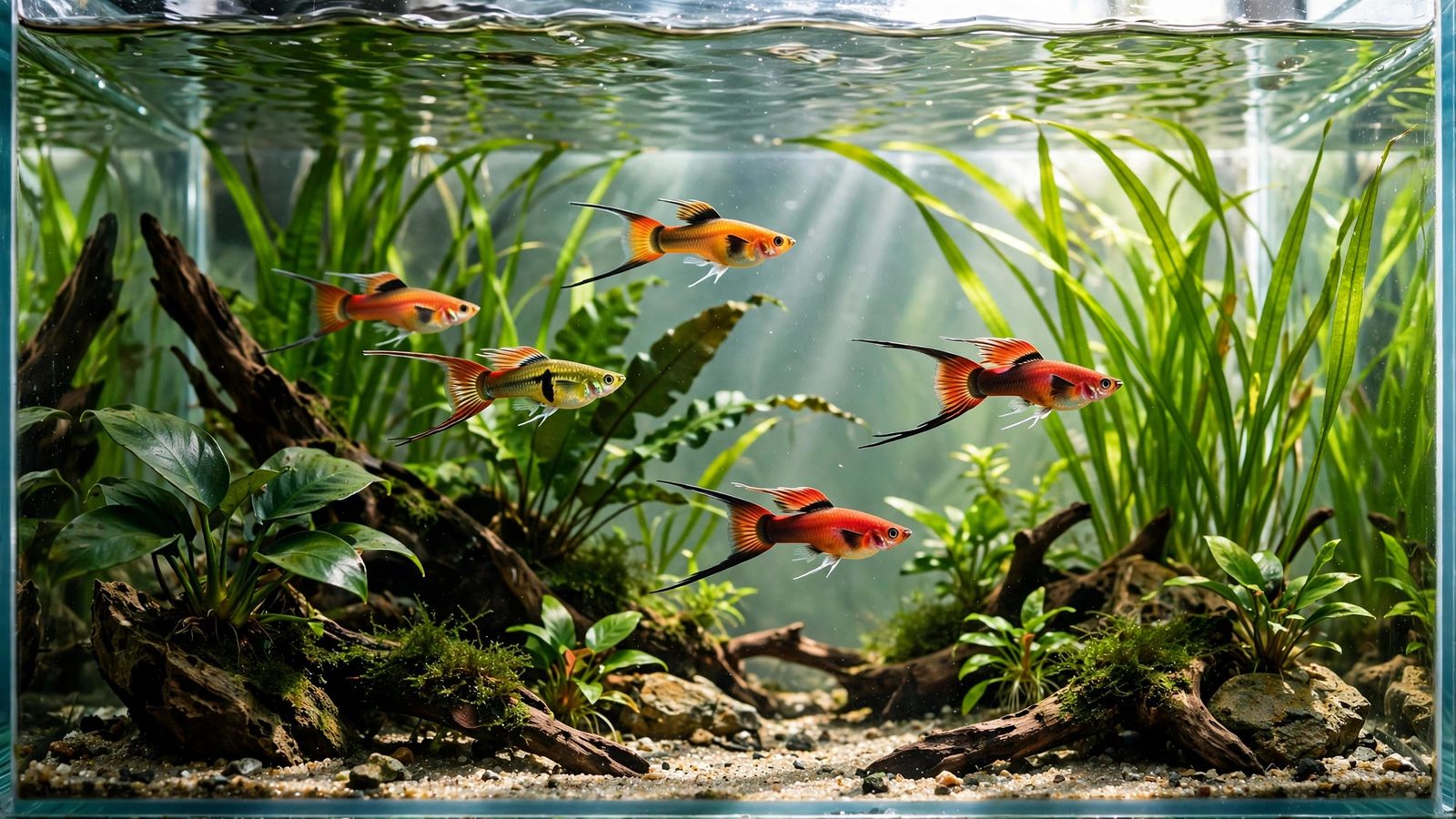
Swordtails are the friendly giants of the livebearer world — big, bold, constantly cruising the midwater in search of snacks. The expensive mistake is planting their tank like a shrimp scape: a carpet of delicate Monte Carlo and a forest of soft, tender stems. Within a fortnight your swordtails will have grazed the soft leaves to stubs and bulldozed half the stems out of the substrate. Building a thriving swordtail planted tank is not about finding "plants swordtails won't touch" — they sample everything. It's about choosing species tough enough to shrug off nibbling, planted so they can't be uprooted.
The good news: swordtails are hardwater, high-energy fish, and the plants that love the same conditions — Vallisneria, Java fern, Anubias, hornwort — happen to be the toughest plants in the hobby. Get the list and the method right, and the greenery will outlast the fish.
Why Swordtails Are Tough on Plants
Three habits cause most plant damage. First, nibbling: anything soft and succulent (bacopa, rotala tips, pearl weed) reads as food. Second, digging: males excavate little pits in the substrate while courting, popping shallow-planted stems out. Third, current: they love flow, which batters delicate stems.
The fix isn't fighting the fish — it's selecting plants whose growth habit neutralizes all three: tough rhizome plants, deep-rooted rosettes, and fast vertical growers. They all prefer the same hard, mineral-rich water swordtails need to stay healthy.
Designing Your Swordtail Planted Tank: The Three-Zone Layout
Think of the tank in three zones. The back zone is Vallisneria territory: plant 2–3 pots along the rear glass, 8–10 cm apart. Runners knit into a living curtain within 4–6 weeks, and the dense base is exactly where newborn fry hide from hungry parents. The midground belongs to epiphytes on hardscape — Java fern and Anubias tied to driftwood or rock, placed where the current is strongest. The foreground stays open swimming lane: a thin scattering of crypts is fine, but resist a full carpet, because swordtails patrol the bottom and turn fine carpets into a mess.
This fish-first selection is what our Aquarium Plants for Fish Tanks: The Fish-First Plant Guide recommends — match the greenery to the livestock's behavior, not the other way round.
The Swordtail-Proof Plant Shortlist
These seven species have survived swordtails in real tanks — leathery leaves, vigorous roots, growth habits the fish can't dismantle. The easiest aquarium plants for a beginner community tank overlap heavily with this list, so you can buy once and scape both setups.
| Plant | Why swordtails can't wreck it | Best placement |
|---|---|---|
| Vallisneria (jungle val or Italian val) | Tough strap leaves swordtails can't tear; spreads by runners | Background, 8–10 cm apart; forms a curtain |
| Java fern | Leathery, bitter leaves fish ignore; attaches to wood | Tied to driftwood/rock in midground |
| Anubias barteri / nana | Thickest leaves in the hobby — essentially armored | Wedged into crevices or glued to hardscape; never bury the rhizome |
| Hornwort (Ceratophyllum) | Outgrows grazing; needle foliage isn't tempting; great nitrate sponge | Floating, or weighted in clusters of 4–6 |
| Amazon sword (Echinodorus bleheri) | Deep roots anchor it against digging; recovers from nips | Midground centerpiece, one per 20–25 gallons, root tabs underneath |
| Cryptocoryne wendtii | Hardy in hard water; recovers from melts; low enough to dodge patrols | Foreground clusters, planted deep, weighted for the first month |
| Java moss | Grows as a mat on surfaces; bonus fry refuge | Tied to wood/rock near the back; trim monthly |
Planting So They Can't Dig It Up
Most "failures" are planting technique, not species choice. Plant deep and heavy: push stems 3–5 cm into the substrate and pin loose groups with plant weights for the first 3–4 weeks until roots establish. Put epiphytes where substrate never matters: anything tied to wood or rock is dig-proof by definition, which is why aquarium plants that don't need substrate make up half of the ideal swordtail plant list. Leave the rhizome exposed: Anubias and Java fern rhizomes rot if buried — superglue or cotton-thread them to hardscape instead.
For heavy root feeders like Amazon swords, push one root tab 5–7 cm under the crown every 2–3 months. And the best aquarium plants for platy tanks follow the same tough-and-anchored logic if you'd like a matched pair of setups, since platies are close cousins.
Water, Feeding, and Maintenance Rhythm
Swordtails want hard, alkaline water — GH 12–20 dGH, pH 7.0–8.2, 22–27°C — and every plant on the shortlist thrives in exactly that. No CO₂ needed; a moderate LED running 7–8 hours daily grows all seven species fine. Dose a liquid all-in-one fertilizer weekly and add root tabs quarterly under heavy feeders, and you'll watch Vallisneria grow 2–3 cm a week.
The nitrate equation matters: a school of six swordtails eating twice daily produces a serious bioload. Dense fast growers are your filtration partner — thick hornwort and Vallisneria stands can pull nitrate down 10–20 ppm between water changes, which is why plants for natural algae control and swordtail tanks pair so well. Feed twice daily plus one blanched-vegetable day a week (zucchini or shelled peas): well-fed swordtails nibble leaves noticeably less.
Maintenance is a 20-minute weekly water change of 25–30%, a monthly trim of hornwort and Vallisneria tips, and pulling melting crypt leaves. Expect the tank to look "planted" by week 3 and properly jungle by week 8.
Frequently Asked Questions
Will swordtails eat aquarium plants?
Swordtails sample plants rather than devour them, but soft species suffer all the same: tender stems like bacopa, cabomba, and pearl weed get grazed into stubs within weeks. Tough, leathery plants — Anubias, Java fern, Vallisneria — survive because their leaves are too thick to be worth the effort.
How many plants does a swordtail tank need?
Aim for roughly 60–70% visual coverage. For a 20-gallon tank: 2–3 potted Vallisneria along the back, 3–5 Anubias and 2 Java ferns on hardscape, one bunch of hornwort, and one Amazon sword as a centerpiece. Dense planting absorbs nitrate and gives fry hiding spots — err on the side of more plants.
Can swordtails live with Vallisneria?
Beautifully — arguably the single best plant for a swordtail tank. It thrives in the hard, alkaline water swordtails prefer, its tough strap leaves resist nibbling, and it spreads by runners into a dense background curtain whose base shelters newborn fry — a bonus in any breeding-oriented livebearer tank.
Do swordtail planted tanks need CO₂?
No. Every plant suited to swordtails — Vallisneria, Java fern, Anubias, hornwort, Amazon sword, crypts — grows well without injected CO₂. A moderate light, weekly liquid fertilizer, and root tabs under heavy feeders are plenty. CO₂ adds complexity for zero benefit: fast soft stems (the plants that want CO₂ most) can't survive swordtails anyway.
What tank size is best for a swordtail planted tank?
A 20-gallon long is the practical minimum for a school of six, giving them the horizontal swimming room these active fish demand. A 29-gallon or 40-gallon breeder is better: more room for a larger school, space for a full Vallisneria curtain, and a more forgiving water volume for the fry explosions livebearers are famous for. Avoid tall, narrow tanks.
Your Swordtail Jungle Awaits
A swordtail planted tank rewards a simple philosophy: pick plants as tough as the fish, anchor everything twice, and let density do the work. Start with the Vallisneria backbone, epiphytes on hardscape, and one or two fast growers for nitrate control — and in eight weeks your swordtails will be weaving through the leaves like they were born for it.