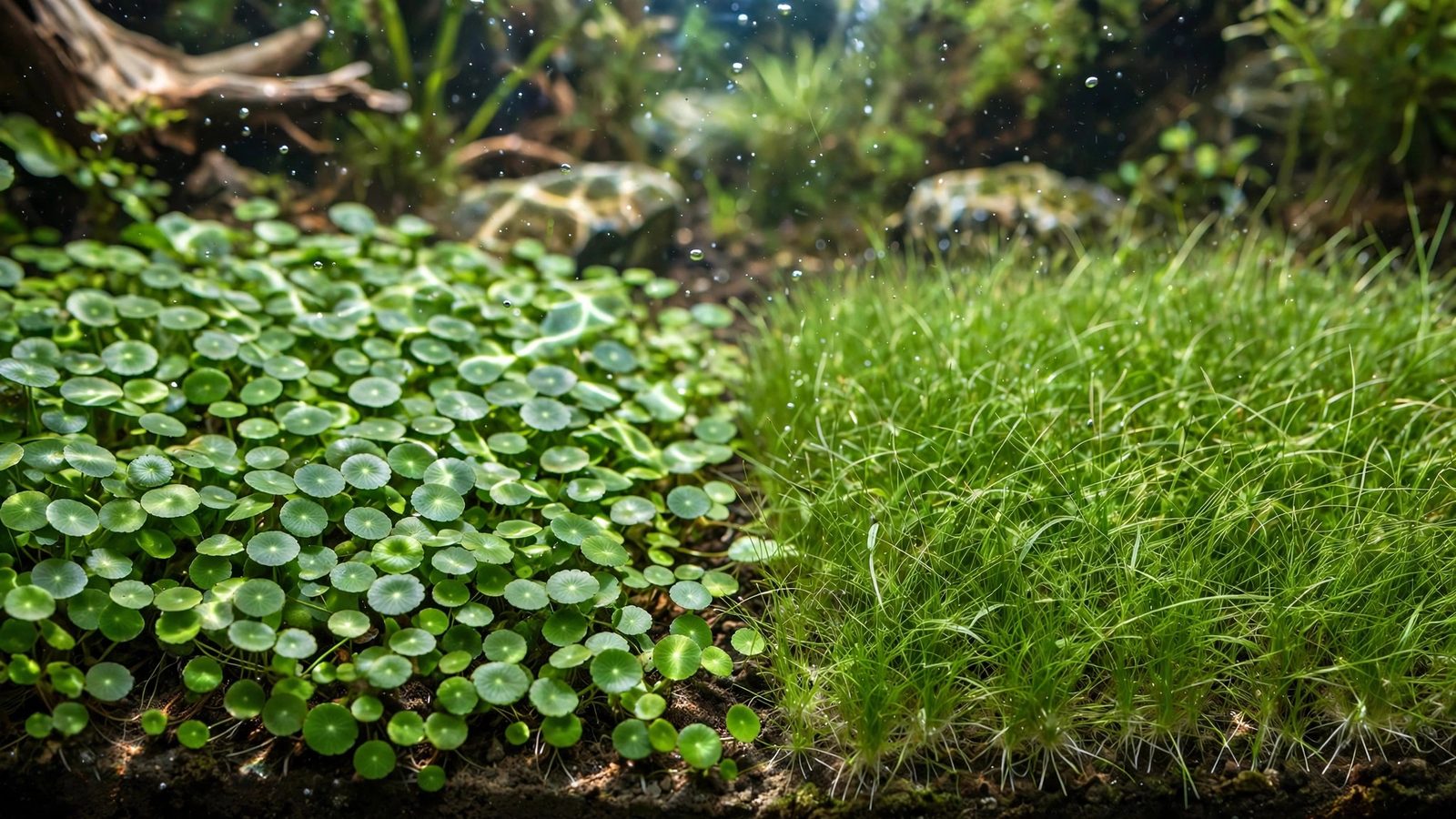
You bought the plant, planted it with care, and waited two months — only to watch your foreground turn into a patchy, algae-dusted mess. That is the cost of picking the wrong carpet, and the monte carlo vs dwarf hairgrass debate is where most beginners get it wrong. Both are marketed as easy carpets, but one forgives low-tech mistakes while the other quietly punishes them. Here is exactly how they differ, and which one deserves your foreground.
The Short Answer
Monte Carlo is the better carpet for most hobbyists. It spreads low and dense with moderate light (around 30–50 PAR), handles lean CO2 setups, and recovers from trimming without drama. Dwarf hairgrass looks more like a manicured lawn, but it demands more light and dissolved CO2 to carpet instead of merely surviving. If you want the full context on building a carpeted foreground, start with our guide to foreground carpeting plants for beginners, which covers substrate and layout before you choose a species.
Monte Carlo vs dwarf hairgrass: head-to-head comparison
| Criteria | Monte Carlo | Dwarf Hairgrass |
|---|---|---|
| Scientific name | Micranthemum tweediei | Eleocharis parvula |
| Look | Small round leaves, clover-like mat | Fine grass blades, lawn effect |
| Carpet height | 1–3 cm when kept trimmed | 3–6 cm, taller if untrimmed |
| Light needed | Low–medium (30–50 PAR) | Medium–high (50–80 PAR) |
| CO2 | Helpful, not required | Strongly recommended |
| Spread speed | Fast — 6–8 weeks to fill | Moderate — 10–16 weeks to fill |
| Trimming | Every 3–4 weeks once established | Every 2–3 weeks once established |
| Melt risk | Low from tissue culture | Moderate; old blades brown off |
| Best for | Low-tech and first carpets | High-tech aquascapes |
Carpet Look and Density
Monte Carlo grows as a creeping mat of tiny round leaves, hugging the substrate at 1–3 cm — a soft green cloud once filled in. Dwarf hairgrass produces needle-thin blades from small crown tufts; at its best it is a flooded meadow, but until the runners connect you see individual tufts and substrate gaps. Monte Carlo also forgives uneven planting better, since one sprig sends runners everywhere, while hairgrass runners need established roots first. See our aquarium plant placement guide for where each sits in a layout.
Light and CO2 Demands
This is where the two really diverge. Monte Carlo carpets under medium light (30–50 PAR at the substrate) and benefits from CO2 but will spread without it if you are patient and keep nutrients lean. Dwarf hairgrass is pickier: below about 50 PAR it sits still for weeks, grows leggy, and invites algae onto the blades. With CO2 injection it transforms — runners multiply and blades stay short and dense. In a low-tech tank, Monte Carlo is realistically the only one of the two that will reward you. Compare with the hardiest picks in our easiest aquarium plants that grow without CO2 roundup.
Planting, Spread, and Melt Risk
Both arrive as tissue culture cups or potted portions, and planting technique matters. Divide each into small tufts and press them just deep enough to stay put — tweezers are non-negotiable. In nutrient-rich aquasoil at 24–26°C, Monte Carlo sends first runners within a week and closes in 6–8 weeks. Dwarf hairgrass needs 2–3 weeks just to settle; expect 10–16 weeks for full coverage, longer without CO2. Melt risk favors Monte Carlo — hairgrass often sheds older blades during transition. Trim the brown blades and new growth returns shorter and denser. Read tissue culture vs potted plants before you buy.
 ★4.6
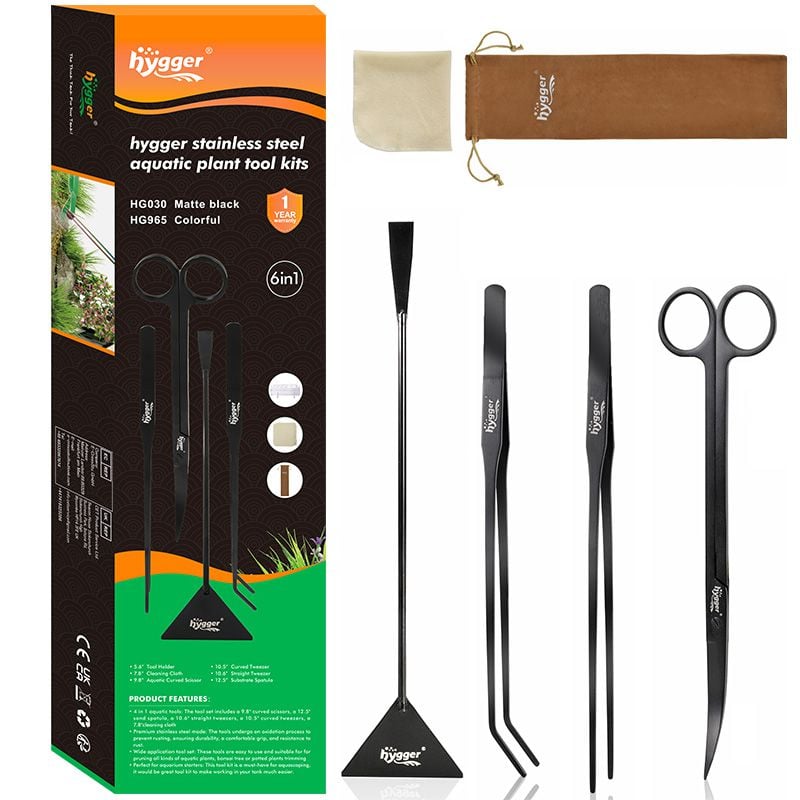
hygger 6-in-1 Aquarium Aquascaping Tool Kit
Check Price on Amazon ★4.6Trimming and Maintenance
Monte Carlo needs a trim every 3–4 weeks to stop it stacking into a thick sponge that traps debris. Dwarf hairgrass needs trimming every 2–3 weeks, since untrimmed blades grow tall, flop, and shade the runners filling gaps. Use curved scissors, then siphon clippings out of the carpet — decaying trimmings invite algae. One more difference: Monte Carlo can lift in whole sheets if the substrate is too coarse or shallow, so keep a fine 3–4 cm aquasoil bed. Hairgrass anchors firmly once established and almost never lifts. For low-maintenance midground options, see our best stem plants for beginners.
Buying: Tissue Culture vs Potted
Tissue culture cups are the smart buy for both: dozens of pest-, snail-, and algae-free plantlets that transition to submerged growth with minimal melt. One cup covers roughly a 15–20 cm square once divided. Potted portions are cheaper per plantlet but carry whatever algae or hitchhikers came from the nursery — quarantine and rinse well. Monte Carlo is farmed widely and its cups are affordable; dwarf hairgrass cups are often pricier and less consistently stocked. Cross-check care profiles in Tropica's Monte Carlo and Eleocharis parvula plant database entries.
The Verdict by Tank Type
Low-tech tank (no CO2, moderate light): Monte Carlo, no contest. It will carpet slowly but reliably where hairgrass stalls. Pair it with more forgiving species from our low-light aquarium plants for beginners guide.
High-tech tank (CO2 + strong light): Dwarf hairgrass if you want the lawn look, Monte Carlo if you want faster payoff with less upkeep — both thrive here, so pick by aesthetics. Hairgrass suits larger carpets; Monte Carlo suits detail work. For more options, browse our carpeting plants for high-tech tanks roundup.
Nano tank (under 40 litres): Monte Carlo. Its tiny leaves stay in scale, and a single tissue culture cup carpets most of the foreground. Hairgrass blades can overwhelm a nano scape if trimming lapses.
Frequently Asked Questions
Can Monte Carlo carpet without CO2?
Yes — its biggest advantage. With medium light (30–50 PAR) and nutrient-rich substrate, Monte Carlo spreads well without injected CO2, just slower: typically 10–14 weeks to full coverage. Keep nitrates and phosphates lean to starve algae while it fills in.
Why is my dwarf hairgrass not spreading?
Almost always light or CO2. Below roughly 50 PAR, dwarf hairgrass survives but sends no runners. Raise the light, add CO2, and make sure crowns are not buried too deep. Fresh plantings also need 2–3 weeks to settle before runners appear.
Which carpet is cheaper to start?
Monte Carlo. One tissue culture cup covers about 15–20 cm square once divided, and it multiplies fast enough that you need fewer cups. Dwarf hairgrass cups often cost more and spread slower, so the same area costs extra. Potted portions are cheaper but carry algae and pest risk.
Can I mix Monte Carlo and dwarf hairgrass in one carpet?
Yes — Monte Carlo in front, hairgrass behind it for texture contrast. But Monte Carlo grows faster and will eventually overrun slower hairgrass tufts, so keep a clear border and trim Monte Carlo runners that creep into the hairgrass zone.
How do I stop my carpet from lifting off the substrate?
Lifting means roots cannot anchor: coarse substrate, shallow bed, or sparse planting. Use fine-grained aquasoil at least 3–4 cm deep, plant small tufts 2–3 cm apart, and trim regularly so the mat stays dense and rooted. Dwarf hairgrass anchors firmly once established and rarely lifts.
For most hobbyists, Monte Carlo is the smarter first carpet: faster, more forgiving, and cheaper to start. Dwarf hairgrass earns its place in high-tech tanks where the extra light and CO2 unlock that perfect lawn look. Whichever you pick, plant small, plant often, and be patient — a good carpet is measured in weeks, not days.