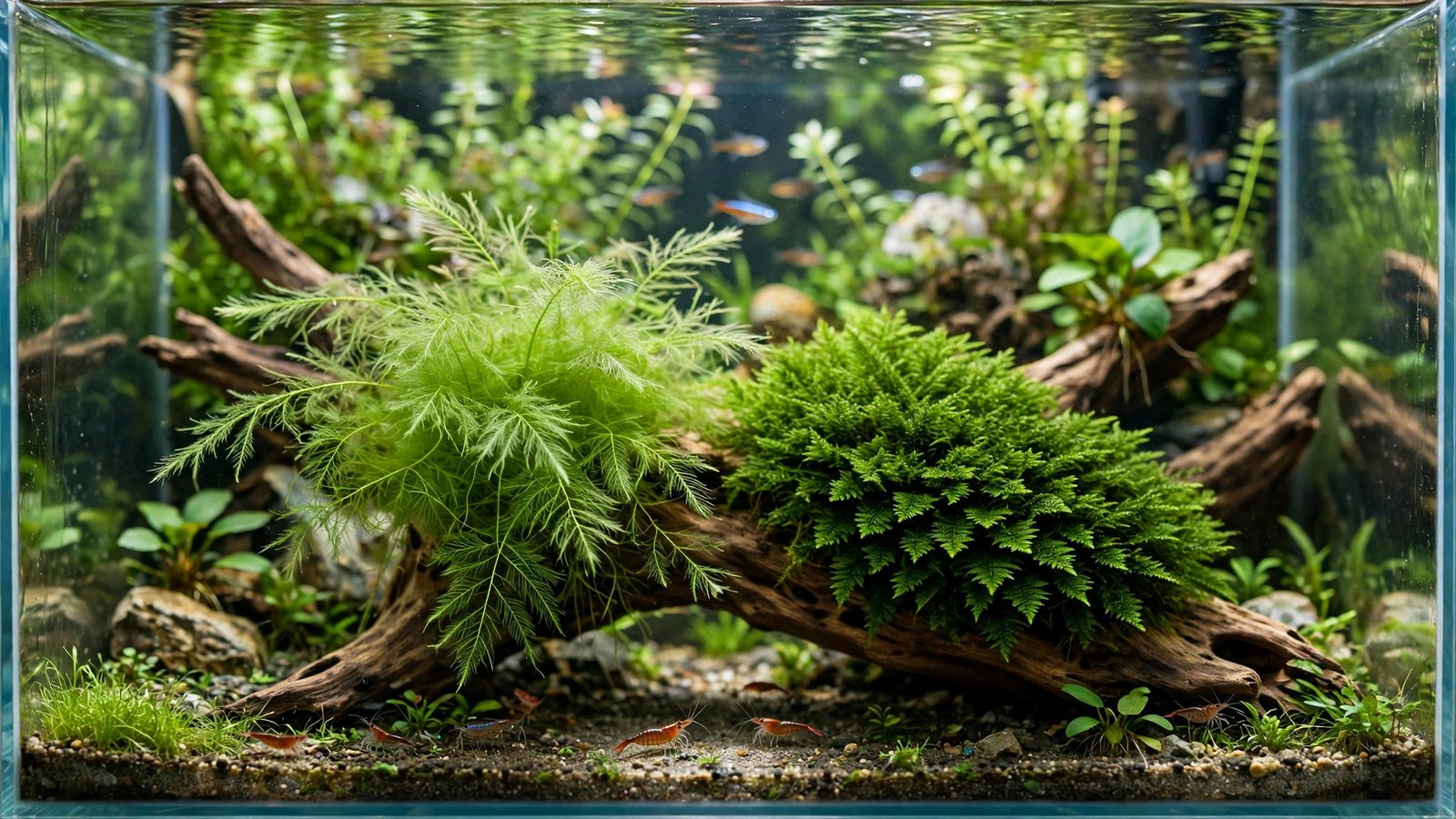
Picking between java moss and christmas moss feels harder than it should be, because shops sell both as tiny green clumps that look identical in the cup. In your tank they behave like completely different plants: one grows into a wild, bushy tangle that shrimp adore; the other forms tidy, triangular fronds like a miniature fir tree. Know what you want the tank to look like six months from now, and the java moss vs christmas moss choice becomes easy.
How They Look (and Why It Matters)
This is the comparison that actually matters, because most of the time you're choosing with your eyes. Java moss grows in an irregular, branching pattern — tiny oval leaves scattered along stems that wander in every direction. It looks like a green cloud. Tied to driftwood, it puffs outward and fills gaps quickly, which is exactly why it's the go-to for natural-style tanks. Among the best aquarium mosses compared, java moss is the wild one.
Christmas moss grows in deliberate tiers: fronds branch at right angles in a repeating triangular pattern, so a mature tuft resembles a tiny evergreen branch. Laid on hardscape, it creeps outward in overlapping layers instead of ballooning up. In a precision scape — a moss tree, a moss wall on mesh, detail work on rocks — that structure is the whole point. Java moss will cover the same shape, but it'll look like a bush wearing a tree costume.
Growth Speed and Hardiness
Java moss is the faster grower, especially in low-tech setups. Under moderate light it visibly extends week to week, and it tolerates dimmer tanks that would stall many other plants. It also shrugs off inconsistent dosing, occasional algae battles, and temperature swings from about 59°F to 86°F.
Christmas moss grows noticeably slower — typically half or less of java moss's weekly extension in the same tank. It prefers stability: steadier carbon levels, cleaner water, and moderate rather than harsh light. Forgiving once established, but the first month demands more patience.
Parameter Comparison
| Parameter | Java moss (Taxiphyllum barbieri) | Christmas moss (Vesicularia montagnei) |
|---|---|---|
| Scientific name | Taxiphyllum barbieri | Vesicularia montagnei |
| Growth rate | Moderate–fast | Slow–moderate |
| Growth habit | Irregular, bushy, chaotic branching | Tiered, triangular, evergreen-like fronds |
| Light | Low to high; tolerates very dim tanks | Low to high; colors up best under moderate light |
| Temperature | 59–86°F (15–30°C); hardy | 65–77°F (18–25°C); prefers stability |
| pH | 5.5–8.0 | 5.5–7.5 |
| CO₂ | Not needed | Not needed, but appreciates it |
| Trimming frequency | Every 3–4 weeks to avoid matting | Every 6–8 weeks; holds shape longer |
| Debris trapping | High — dense clumps catch detritus | Low — open tiered structure rinses clean |
| Typical price per portion | Low ($5–8) | Moderate ($8–15) |
Aquascaping Uses: Where Each One Shines
Java moss is the workhorse. Shrimp breeding tanks are its flagship use: the chaotic branching creates an endless maze of hiding spots where newborn shrimp and fry escape tankmates, and the moss harbors biofilm they graze on. It's also excellent for softening driftwood bases and filling background gaps fast.
Christmas moss is the detail plant. Moss trees, moss walls, and hardscape crevices you want to accent rather than bury all look better with its structured fronds. Because it grows in tidy layers, it drapes off edges instead of swallowing them. If you're planning a whole layout around detail work, our anubias varieties compared guide covers the classic slow-growing companions.
Maintenance Burden: The Honest Trade-Off
Here's what nobody tells you at the shop: java moss's biggest strength is also its biggest chore. Fast, chaotic growth mats into dense clumps that trap uneaten food and detritus inside, where it rots and fuels algae. Left unthinned, the mass develops a brown, dead core. Thin it every three to four weeks — ten minutes with aquascaping scissors and a rinse in old tank water keeps it green and open.
Christmas moss asks far less of you. The open, tiered structure sheds debris instead of swallowing it, and the slower growth means a trim every six to eight weeks is usually enough. Cut along the fronds' natural tiers rather than hacking straight across; the regrowth follows the same structure.
Buying: Loose, Mesh, or Tissue Culture?
Both mosses sell in three formats, and the format matters. Loose portions are cheapest — a golf-ball clump for a few dollars — but can arrive with hitchhikers: snails, snail eggs, sometimes algae. Moss already attached to mesh or stainless pads costs a bit more and skips the tying step.
Tissue-culture cups of java moss are pest-free and algae-free, though the moss needs a few weeks to transition from its gel-grown form. Christmas moss in tissue culture is less common but worth the premium for a show scape.
Expect java moss to cost roughly half of christmas moss per portion ($5–8 vs $8–15), and nearly every local shop stocks it while christmas moss may be an online order. Still, a single $12 cup of christmas moss, split across several hardscape pieces, can carry an entire nano scape.
Java Moss vs Christmas Moss: The Verdict by Scenario
You're a beginner. Buy java moss. It forgives every mistake you're about to make, grows fast enough that you'll feel successful within weeks, and costs little enough that mistakes don't sting — pair it with the easiest floating plants for beginners and your first tank practically runs itself.
You're breeding shrimp. Java moss again — the biofilm and hiding spots directly translate into more surviving fry. A small patch of christmas moss on the hardscape gives the tank a visual anchor.
You're aquascaping. Christmas moss, no contest. The structured fronds are the difference between a moss tree that reads as a tree and one that reads as a bush. Use java moss only for background filler where you want volume fast.
You have a low-light, low-tech tank. Java moss. Christmas moss survives in low light but stalls; java moss keeps creeping along and stays green. For the nutrient-competition side of a low-tech setup, do floating plants control algae is worth a read too.
Frequently Asked Questions
Can I grow java moss and christmas moss in the same tank?
Absolutely — they share nearly identical water requirements (pH 5.5–8.0, 65–77°F sweet spot). Many hobbyists run java moss in a shrimp breeding corner and christmas moss on display hardscape. Just keep them on separate surfaces, because java moss's faster growth can overrun a christmas moss patch if they touch.
How do I attach moss to driftwood so it actually stays?
The reliable method is cyanoacrylate super glue gel: dab a thin line on the wood, press a small moss tuft into it, and hold for five seconds. It cures underwater within minutes and is aquarium-safe. Cotton thread also works but stays visible for weeks and loosens as moss grows through it.
Why is my java moss turning brown in the middle?
The dense center is starved of light and flow while trapped detritus rots inside it. Pull the clump out, thin it to about half its volume, rinse it in old tank water, and reattach the healthiest green portions. Prevent recurrence by trimming every three to four weeks and keeping flow moving through the moss.
Does christmas moss need CO₂ injection?
No — it grows fine without injected CO₂, just more slowly. Adding CO₂ roughly doubles its growth speed and deepens the green, but it also accelerates algae on the dense fronds, so only add it if your lighting and fertilization keep algae in check.
The Bottom Line
Java moss is the forgiving workhorse: fast, cheap, perfect for shrimp fry — but messy and maintenance-hungry. Christmas moss is the precision instrument: structured, elegant, low-maintenance — but slower and pricier. Match the moss to the job and you won't go wrong. For supplier options, see the java moss listing at The Shrimp Farm and this moss comparison at Tankarium.