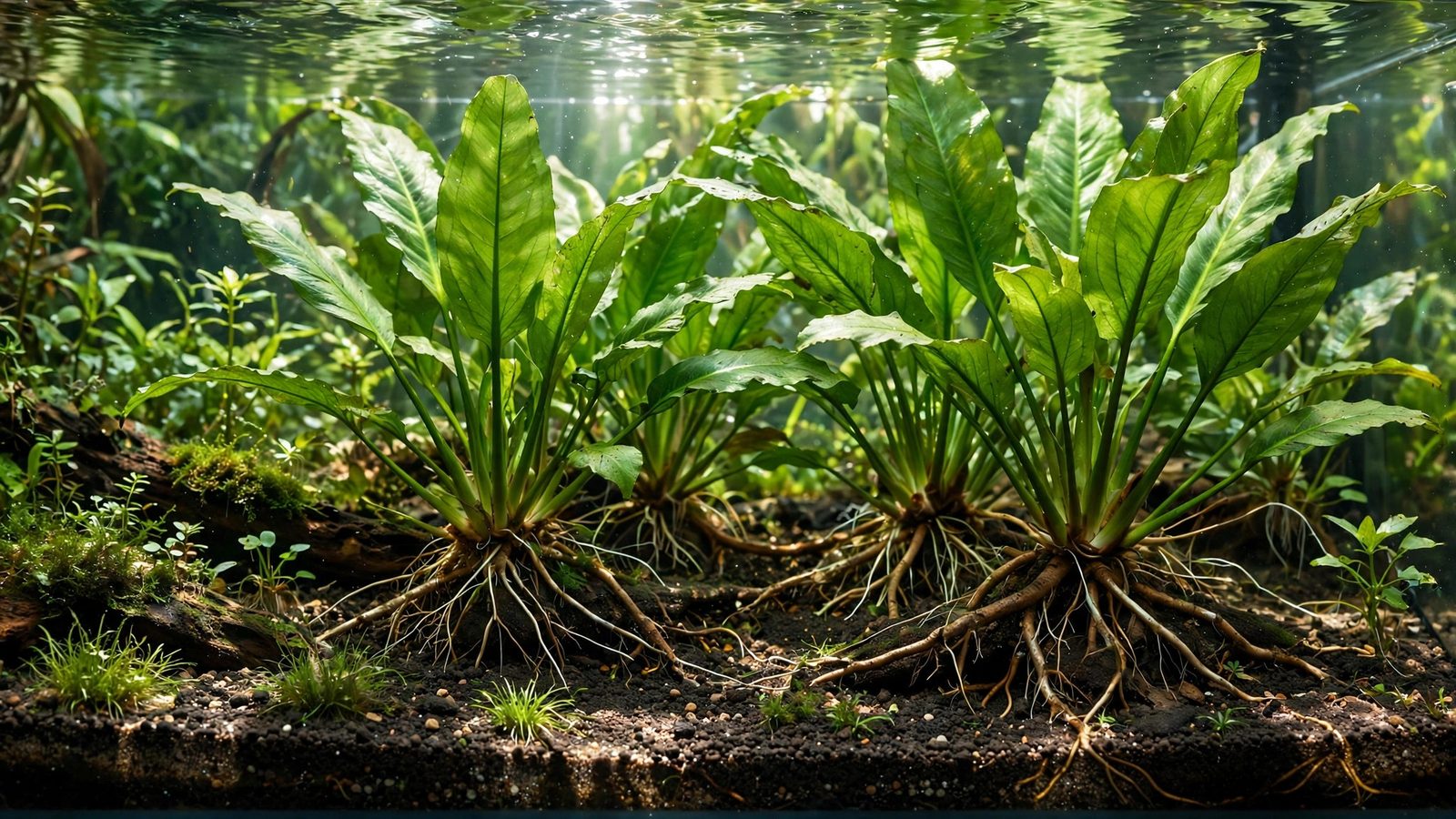
Most aquarium plants eat from the water. A dozen eat almost entirely from the ground beneath them — and if you skip the root tabs, they sit in your tank stunted, pale, and melting no matter how much liquid fertilizer you dose. This guide to heavy root feeder aquarium plants names the exact species that demand feeding through their roots, plus the tab math to keep them thriving.
Wondering which side of the fence your plants sit on? The plants below are the ones that answer YES to whether aquarium plants really need fertilizer — through their roots.
Why heavy root feeder aquarium plants ignore liquid fertilizer
Heavy root feeders evolved in riverbeds and floodplain soils, pulling nitrogen, potassium, iron, and trace elements through dense root systems. Their leaves absorb dissolved nutrients poorly, so the liquid fertilizer you dose weekly drifts past them and feeds your algae instead. A slow-release tab beside the crown dissolves over weeks right where the roots live — steady food no algae bloom can steal.
Think in pairs: liquid fertilizers feed the water-column plants — stems, mosses, floaters — while root tabs feed the plants in this article. Most tanks need a little of both.
12 plants that feed heavily through their roots
Every plant here feeds mainly through its roots; one DIY Osmocote capsule ≈ one commercial tab. Confirm tricky IDs against Tropica's plant database.
| Plant | Why it's a heavy root feeder | Tabs per plant |
|---|---|---|
| Amazon sword (Echinodorus spp.) | Huge root system; starves without substrate feeding | 3 for large, 2 for medium |
| Cryptocoryne spp. | Fed almost entirely through buried runners | 1–2 |
| Vallisneria | Runner-spreader feeding along its root zone | 2–3 per cluster |
| Dwarf sagittaria | Carpeting runner building its lawn via roots | 1 per 10 cm patch |
| Tiger lotus / red lotus | Bulb feeder; red growth needs deep food | 2 under the bulb |
| Aponogeton | Bulb plant with enormous seasonal root demand | 2–3 under the bulb |
| Crinum | Thick roots pulling minerals from sediment | 2–3 around the base |
| Lobelia cardinalis | Dense root clumps that out-drink its leaves | 1–2 per clump |
| Pogostemon helferi (downoi) | Rosette with wide roots; colors best root-fed | 1–2 |
| Alternanthera reineckii | Heavy iron needs, best delivered through tabs | 1–2 per stem group |
| Hygrophila difformis (wisteria) | Greedy roots that empty surrounding substrate | 1–2 |
| Bacopa caroliniana | Tabs prevent pale, brittle stems on sand | 1–2 |
Amazon swords and tiger lotus also rank among the best centerpiece aquarium plants — root tabs are what keep them looking expensive. Chasing deep reds on Alternanthera reineckii pairs tab iron with strong light — our red stem plants color guide covers the full routine.
Tab math: how many, where, and how often
The replacement schedule is the part people get wrong. A standard tab exhausts in roughly 60–90 days — four to six rounds per year. A 20-gallon tank with five root feeders needs about 8–12 tabs per round; one bulk bag covers a full year.
Depth matters more than brand. Push each tab 5–7 cm deep so it sits in the root zone, not leaching into the water where algae can grab it. In fine sand, punch a hole with aquascaping tweezers; in coarse gravel, work it down with a fingertip. Space multiple tabs in a ring 3–5 cm around big crowns like swords rather than stacking them in one spot.
Watch the plant, not just the calendar. Pale new leaves on a sword, stalled crypt runners, or a shrinking tiger lotus all mean the last round is spent. Feed early — deficiency recovery costs a month of growth.
Aquasoil or sand: the substrate decision
Premium aquasoils arrive nutrient-loaded, so tabs feel unnecessary for the first 6–12 months — then the soil exhausts and heavy root feeders decline on schedule. Start adding tabs around month 8 in aquasoil, one per plant. Inert sand or gravel is the cheaper, more honest route: it costs a few dollars, never exhausts, and you run nutrition entirely on tabs you control. You can also sandwich new tabs under fresh aquasoil when setting up — the plants don't care which route you took.
Soft, acidic water complicates feeding slightly because mineral availability shifts with pH. If your tank runs on soft tap or RO water, the aquarium plants for soft water guide pairs well with this article — several of its picks overlap with the heavy root feeders here.
The anti-list: plants that do NOT need root tabs
These plants feed from the water column and gain nothing from tabs:
- Epiphytes — Anubias, Java fern, and Bucephalandra grow attached to wood and rock. Their roots anchor, not feed. Tabs placed near them are wasted.
- Floaters — Water lettuce, frogbit, and duckweed absorb nutrients directly from the water through their dangling roots. Liquid fertilizer, never tabs.
- Mosses — Java moss, Christmas moss, and relatives feed across their whole surface. Tabs underneath moss are pure waste.
- Most fast stems — Rotala, Ludwigia, and hornwort are leaf feeders first; they drink from the water column and only occasionally use substrate roots.
A mixed tank gets a mixed menu: tabs under your swords, crypts, and lotus; liquid fertilizer for everything else. Most of these forgiving picks also appear in our easiest aquarium plants for beginner community tanks. If your tank is heavy on the fast-growing side, the fast-growing aquarium plants for new tanks guide will tell you which of those truly want the liquid approach.
Choosing root tab products (no fake reviews)
Commercial tabs come in two honest flavors. Seachem Flourish Tabs are the stocked standard — reliable and long-lasting. API Root Tabs do the same job cheaper per tab and suit big root-feeder tanks; DIY Osmocote capsules are cheapest for keepers comfortable with extra handling. Skip no-name "mega grow" tabs with no ingredient listing and anything promising visible growth in 48 hours — unbuffered ammonia means an algae farm, not a miracle.
One tool worth buying once: long aquascaping tweezers. They place tabs precisely in the root zone without clouding water or uprooting neighbors.
Frequently Asked Questions
Can I use root tabs and liquid fertilizer together?
Yes — and in a mixed tank, you should. Tabs feed heavy root feeders through the substrate; liquid fertilizer feeds water-column plants like stems and mosses. The two methods cover different plants, so they don't compete. Just don't double-dose the same plant out of enthusiasm.
How many root tabs does an Amazon sword need?
A large Amazon sword needs 3 tabs ringed around its crown every 60–90 days; a medium plant needs 2. Swords are the hungriest root feeders — underfeeding causes pale, translucent leaves. Replace tabs on schedule rather than waiting for deficiency symptoms to appear.
Do Cryptocoryne need root tabs or can they survive without?
Crypts survive without tabs in nutrient-rich aquasoil but rarely thrive long-term on inert sand alone. One or two tabs per plant every 2–3 months keeps runners spreading and leaves full-sized — and noticeably reduces crypt melt after planting, since roots can feed immediately.
How deep should I bury root tabs?
Push tabs 5–7 cm below the surface, about 2–3 cm from the plant's crown — deep in the root zone, out of reach of algae in the water column. In fine sand, use aquascaping tweezers to punch the hole cleanly.
Do Anubias or Java fern need root tabs?
No. Anubias, Java fern, and Bucephalandra are epiphytes that grow on hardscape and feed entirely from the water column. Tabs near them are wasted money — use a liquid fertilizer for epiphytes and save tabs for true root feeders instead.
Set a 75-day reminder for your biggest plants and let the roots do the rest. Feed the ground, not the water — and pair tabs with the right liquid fertilizer for your water-column feeders.