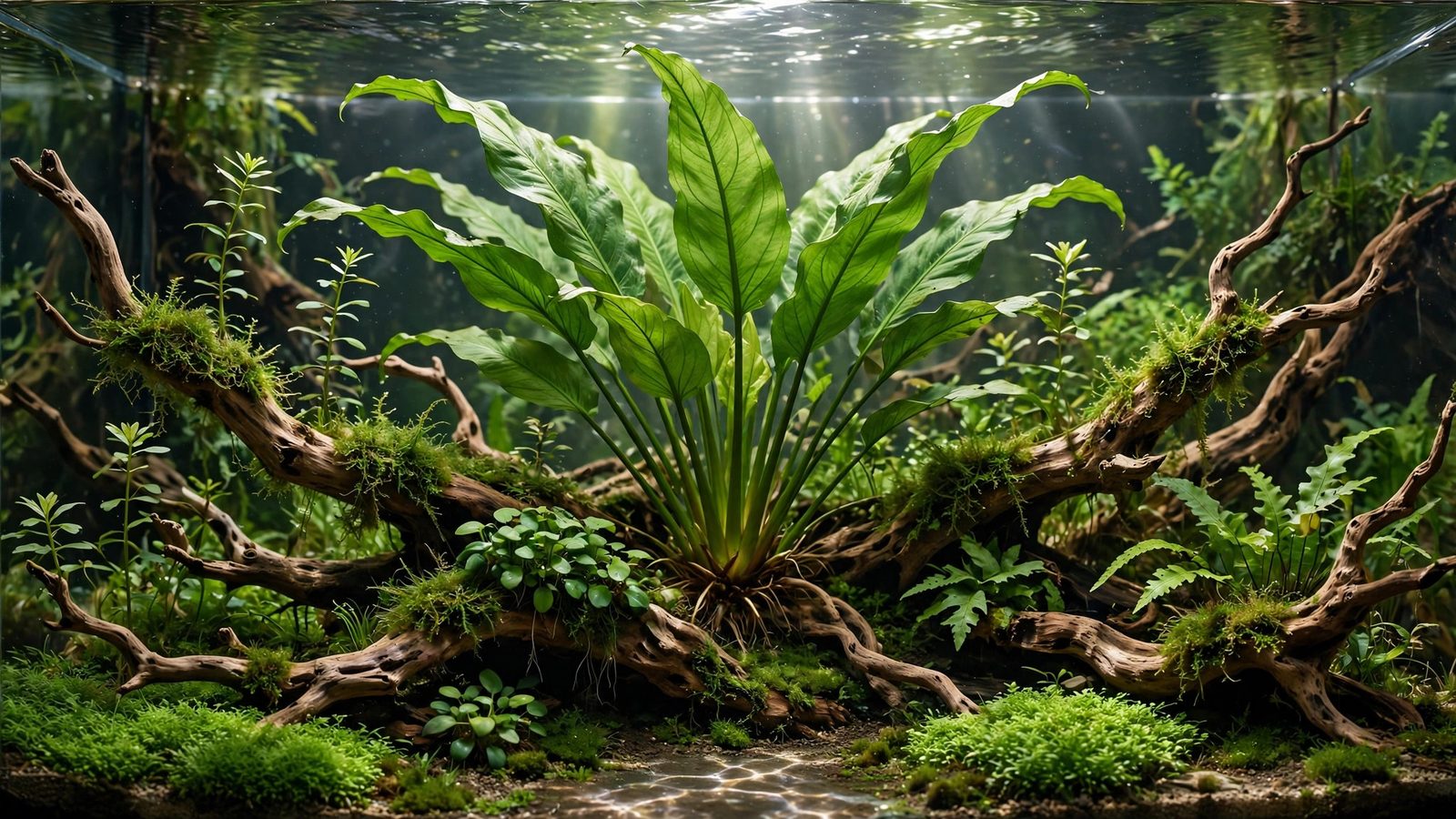
Every great aquascape has one spot your eye lands on first — and it's almost always one dominant specimen plant. The right centerpiece aquarium plants turn an ordinary planted tank into a scape that looks deliberate and alive. Here are ten plants that can carry that role, the placement rules that make them shine, and how to feed and prune a big plant so it stays the star.
What Makes a Plant a Great Centerpiece
A true centerpiece has presence — enough mature size to read as a single mass from across the room, usually a footprint of at least 12 inches wide or 16 inches tall in a 40-gallon tank. Anything smaller just joins the crowd.
The second quality is texture contrast: broad sword leaves behind a fine carpet, a red lotus glowing against green stems, Crinum's curls breaking hard hardscape lines. If your whole tank is one texture, no plant can stand out. Third is color and structure — reds and coppers pull the eye, but even a green sword works when its radial crown reads as architecture. Finally, a good centerpiece is manageable: it tolerates pruning and responds predictably, rather than turning into a weed. Judge every plant below against those four tests.
The 10 Best Centerpiece Aquarium Plants
1. Amazon Sword (Echinodorus bleheri)
Light: low–medium | CO2: not required | Mature size: 16–24 in tall | Difficulty: easy
The original statement plant, and still the hardest to beat. A radial crown of long, lance-shaped leaves creates a lush green fountain that anchors an entire scape. It's undemanding about light but a famously heavy root feeder — feed it root tabs, not just liquid fertilizer. Expect leaf melt in the first 2–3 weeks as store-grown emersed leaves are replaced by submersed growth; that's normal. See Tropica's Echinodorus bleheri profile for background, and our background plants for tall aquariums guide for other large options.
Why it works: big, bold, symmetrical, and green enough for any style. If you buy one centerpiece plant in your life, this is the safe pick.
2. Red Tiger Lotus (Nymphaea lotus 'Zenkeri')
Light: medium–high | CO2: optional, deepens color | Mature size: 12–20 in spread | Difficulty: easy–moderate
No plant delivers drama-per-dollar like a red tiger lotus. Grown from a bulb, it sends up round, wine-red pads with dark mottling that glow against green neighbors. The trick is keeping it submersed: lotuses want to send floating leaves to the surface, and once they do, the plant abandons its compact underwater form. Pinch floating shoots off at the base as soon as you spot them and the lotus stays low, dense, and bushy. Plant the bulb half-buried, pointed end up, and feed it like a sword.
Why it works: the fastest way to add warm color without demanding red stems. Pair it with ideas from our red aquarium plants for beginners guide.
3. Aponogeton crispus
Light: medium | CO2: not required | Mature size: 18–24 in tall | Difficulty: easy
Aponogeton crispus grows from a bulb into a rosette of long, ruffled, translucent green leaves with wavy margins. Its signature is movement: the leaves sway in current like underwater ribbons, which no stiff rosette can imitate. Give it root tabs and room, and a happy plant will eventually send a flower spike to the surface.
Why it works: that wavy texture reads as "aquatic" like nothing else, and it tolerates beginner mistakes well. One warning: aponogetons can go dormant, melting back to the bulb for weeks — leave the bulb alone and it usually returns. See best rosette aquarium plants for more crown-forming species in this style.
4. Crinum calamistratum
Light: medium | CO2: not required | Mature size: 24–48 in strap leaves | Difficulty: moderate
A slow-growing bulb plant with dark green, crinkled, grass-like leaves that can trail across the water surface in tall tanks. It grows slowly — painfully slowly at first — which is a virtue in a centerpiece: the shape you design around is the shape you keep. Once established it becomes a permanent fixture, occasionally sending up a spectacular white lily-like flower.
Why it works: nothing else combines wild, rippling texture with a narrow crown footprint. Don't bury the bulb's neck, give it 3–4 inches of substrate, and resist moving it — crinums sulk for months after transplanting.
5. Anubias barteri var. barteri (Large Specimen)
Light: low | CO2: not required | Mature size: 10–16 in tall | Difficulty: easy
Most people know Anubias as a nano-tank plant, but full-size Anubias barteri — grown out for a year or two on a big piece of driftwood — is a genuine centerpiece. Its broad, leathery, deep-green leaves shrug off nibbling fish and low light, and a mature rhizome becomes a sculptural trunk studded with leaves in every direction. Attach it to wood or stone (the rhizome rots if buried) and keep it out of direct high light to avoid green spot algae.
Why it works: the centerpiece for shaded, low-tech, or hardscape-heavy tanks where swords would starve. See our low-light aquarium plants for beginners guide for more shade-tolerant options.
6. Java Fern 'Trident' (Large Cluster)
Light: low–medium | CO2: not required | Mature size: 8–14 in tall | Difficulty: easy
'Trident' has narrow, forked leaves like tiny antlers. One pot is modest, but let three or four plants merge on a large rock or log and they fuse into a feathery fan that can dominate a 20–40 gallon tank's midground. Like Anubias, it attaches to hardscape and feeds from the water column, so it never competes with root feeders for substrate nutrients. Never bury the rhizome.
Why it works: the fine, forked texture contrasts beautifully with broad-leaf plants — or stands alone as the star of a fern-and-moss scape. Pair it with ideas from our midground aquarium plants guide.
7. Echinodorus 'Ozelot Red'
Light: medium–high | CO2: recommended for best color | Mature size: 14–20 in tall | Difficulty: moderate
The Amazon sword's flashier sibling: broad leaves splashed and speckled with red-bronze that intensify under stronger light and CO2. It keeps the classic rosette architecture — easy to place, easy to prune — while adding warm color that usually requires fussy stem plants.
Why it works: a red focal point with sword-level forgiveness. Give it root tabs every 2–3 months and don't let floaters shade its crown, or the red fades back to green. Its slightly smaller footprint suits 30–40 gallon tanks.
8. Cryptocoryne usteriana
Light: medium | CO2: optional | Mature size: 20–28 in tall | Difficulty: moderate
The giant of the Cryptocoryne world: long, ruffled, dark olive-green leaves from a basal crown, forming a bold upright mass that suits tall tanks the way swords suit standard ones. Like all crypts it can melt dramatically when first planted — but the roots survive, and fresh leaves emerge within 2–4 weeks if you leave it alone. Feed the roots and keep water parameters stable.
Why it works: the hammered, ruffled texture is unique among large centerpiece plants, and its upright growth stays narrow at the base, leaving room for carpet plants at its feet. Never move it twice.
9. Aponogeton ulvaceus
Light: medium | CO2: not required | Mature size: 24–30 in tall | Difficulty: moderate
The heavyweight of the aponogeton family. A single plant unfurls huge, translucent, lime-green leaves with softly rippled edges — enough to fill the back corner of a 55-gallon tank. The translucency is the magic: light passes through the leaves, so the plant glows rather than looms. Reserve it for 40 gallons and up; in anything smaller it shades the whole tank within months.
Why it works: for large tanks, nothing makes a bolder statement with less effort. It also goes dormant occasionally — the same "don't toss the bulb" rule applies. Surround it with fast-growing aquarium plants early on to keep algae down while it establishes.
10. Green Tiger Lotus (Nymphaea lotus, green form)
Light: low–medium | CO2: not required | Mature size: 12–20 in spread | Difficulty: easy
The green form trades the red cultivar's drama for speed and tolerance: it grows faster, accepts lower light, and its lime-green to bronze pads still carry the distinctive mottled pattern. For tanks where the red form would sulk — or scapes that need the lotus shape without a red focal point — it's the better choice.
Why it works: same sculptural shape as its red sibling, but easier to keep compact — remove floating shoots early. It pairs well with oxygenating aquarium plants in a balanced layout.
Placement Rules: Where the Centerpiece Goes
The most common mistake is planting the star dead center — centered compositions look static. Use the rule of thirds: set the plant's crown at one of the 3×3 grid intersections, ideally on a third line slightly behind mid-depth.
Give the centerpiece breathing room: open water or low carpet on at least one side so the silhouette reads cleanly, set slightly off any hardscape anchor rather than buried in a rock pile — the classic move is the plant emerging just behind a driftwood branch. Big root feeders need physical depth too: mound the substrate to 3–4 inches at the focal point before planting, since a sword's root mass can match its leaf spread. Match plant to tank: a tiger lotus can carry a 20-gallon alone; A. ulvaceus wants 40+ gallons. Check our 55-gallon planted tank setup guide to see how centerpiece scale changes with tank dimensions.
How to Feed and Support a Big Statement Plant
Centerpiece plants are almost all heavy root feeders — swords, crypts, lotuses, and aponogetons evolved to pull nutrients from rich riverbed mud, not the water column. Press one root tab into the substrate 3–4 inches from the crown and replace tabs every 2–3 months; new leaf size and color improve within two weeks. Never bury rhizomes (Anubias, Java fern) or bulb necks (lotus, crinum, aponogeton) — crowns sit at or just above the substrate line.
Pruning keeps dominance. A centerpiece that never gets trimmed shades everything beneath it and loses its shape. Remove outer, older leaves at the base first — this opens the crown's center to light. For tiger lotus, also remove floating leaves; cut a sword's flower stalk unless you want plantlets, since the stalk drains energy from leaf production.
 ★4.6
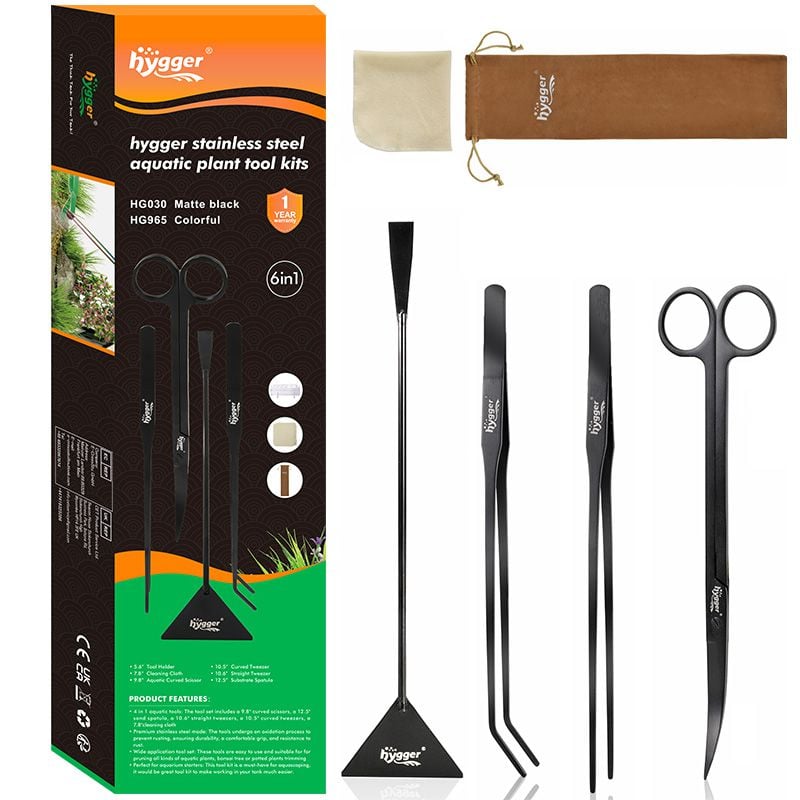
hygger 6-in-1 Aquascaping Tools Kit
Check Price on Amazon ★4.6All 10 Centerpiece Plants Compared
| Plant | Mature size | Light | CO2 | Difficulty | Min. tank |
|---|---|---|---|---|---|
| Amazon Sword (E. bleheri) | 16–24 in | Low–med | No | Easy | 30 gal |
| Red Tiger Lotus | 12–20 in spread | Med–high | Optional | Easy–mod | 20 gal |
| Aponogeton crispus | 18–24 in | Medium | No | Easy | 30 gal |
| Crinum calamistratum | 24–48 in leaves | Medium | No | Moderate | 40 gal |
| Anubias barteri (large) | 10–16 in | Low | No | Easy | 20 gal |
| Java Fern 'Trident' (cluster) | 8–14 in | Low–med | No | Easy | 20 gal |
| Echinodorus 'Ozelot Red' | 14–20 in | Med–high | Recommended | Moderate | 40 gal |
| Cryptocoryne usteriana | 20–28 in | Medium | Optional | Moderate | 40 gal |
| Aponogeton ulvaceus | 24–30 in | Medium | No | Moderate | 40 gal |
| Green Tiger Lotus | 12–20 in spread | Low–med | No | Easy | 20 gal |
Frequently Asked Questions
Can a centerpiece plant work in a small tank?
Yes — scale the star to the stage. In a 20-gallon tank, a red or green tiger lotus, a large Anubias barteri on driftwood, or a mature Java Fern 'Trident' cluster each make a perfect single focal point. Keep to one dominant specimen per 20–25 gallons: two competing centerpieces in a small tank create visual chaos, so pick your favorite and let the rest of the planting support it.
Do centerpiece aquarium plants need CO2 injection?
Most plants on this list grow perfectly well without injected CO2 — swords, crypts, lotuses, aponogetons, Anubias, and Java fern are all classic low-tech plants. CO2 mainly speeds growth and deepens red coloration, making the biggest difference on Echinodorus 'Ozelot Red' and the red tiger lotus. Watch out if you run it: a centerpiece that doubles its growth rate may need twice the pruning.
How often should I replace root tabs under a centerpiece plant?
Every 2–3 months for heavy feeders like swords, lotuses, and aponogetons. Push one tab in 3–4 inches from the crown — never directly under it, where fertilizer can burn new roots. Pale or shrinking new leaves mean it's time for a fresh tab. Anubias and Java fern skip tabs entirely.
Why did my Amazon sword melt after planting?
Almost certainly transplant shock, and it's normal. Store-bought swords are usually grown emersed (out of water), and those leaves can't survive submerged — the plant sheds them and grows new submersed leaves from the crown within 2–4 weeks. Don't pull the plant up to check the roots; remove mushy leaves at the base and keep feeding. If melt continues past a month, check the crown isn't buried too deep.
How do I stop a tiger lotus from taking over the tank?
Stay ahead of the floating leaves: every floater shifts energy away from the compact underwater form you want. Snip floating shoots off at the base weekly, keep floaters to two or three at most, and remove small runners sprouting from the bulb. A managed lotus stays a dense 12-inch mound; a neglected one becomes a surface monster within two months.
One Star Beats a Crowd
The difference between a tank that looks "nice" and one that looks designed is almost always a single confident focal point. Pick one plant from this list that fits your tank size and lighting, place it on a rule-of-thirds intersection with room to breathe, feed its roots, and prune it like you mean it. Everything else — carpet, stems, hardscape — exists to make that one plant look inevitable. Choose your star, and let it shine.