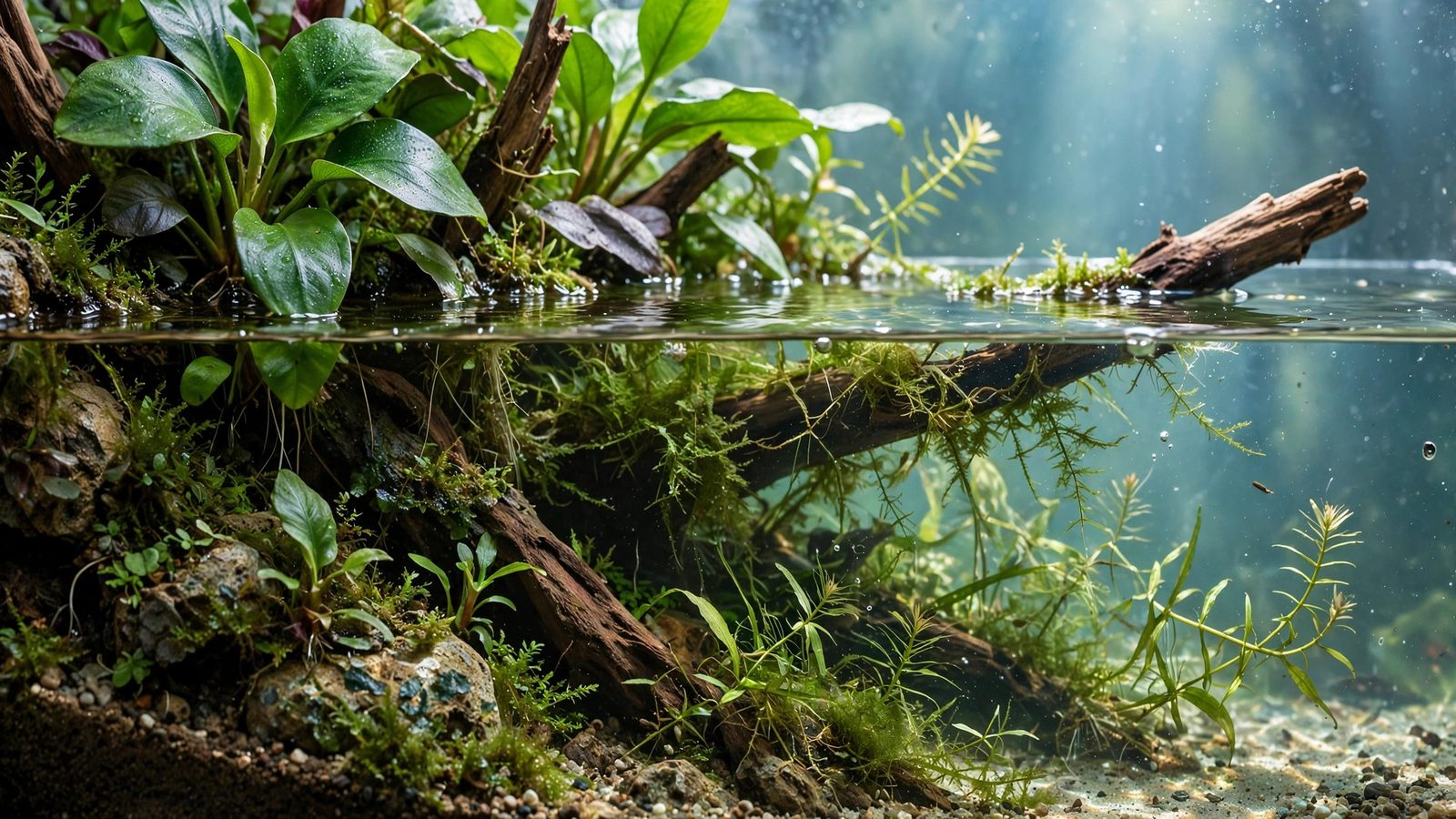
Walk into a shop, and the Java fern in the tank and the potted crypt on the shelf are the same species — but they're not the same product. One grew underwater and will keep growing the day you plant it; the other grew in humid air and may melt for three weeks before it comes back. Learning the difference is the highest-leverage skill for buying emersed vs submerged aquarium plants: it decides whether your money buys growth or a patience test.
Why the same plant can fail or thrive depending on how it was grown
A plant grown emersed (leaves in humid air) builds thick, waxy leaves armored against drying out. Dunked underwater, that armor becomes a liability: the plant scraps those leaves and grows thin, permeable submerged foliage from scratch. That shedding is the "melt" that terrifies beginners — and it's completely normal. Cryptocoryne can dissolve to bare roots before rebounding.
Submerged-grown plants skip the drama — their leaves were built for water from day one. But anything grown in a tank farm grew in water that also hosts snails, algae spores, and occasionally hydra — hitchhikers emersed stock essentially never carries. For the full picture on how transition melt works — timelines and how to tell melt from a dying plant — our guide to emersed-grown aquarium plants walks through it step by step. And if you're still deciding what to plant, start with the complete guide to freshwater aquarium plants before spending a dollar.
Buying emersed vs submerged aquarium plants: the full comparison
No option wins everything — the right buy depends on your tank, your budget, and your patience.
| Factor | Emersed-grown | Submerged-grown | Tissue culture |
|---|---|---|---|
| Price per portion | Lowest — mass-grown in humidity chambers | Highest — slower production, higher losses | Mid-to-high — dense portions per cup |
| Availability | Excellent — most shelf pots | Patchy — display tanks or order-in | Excellent — branded cups everywhere |
| Melt risk | High — expect 2–6 weeks of leaf turnover | Near zero — leaves already aquatic | Low — adapts in 1–2 weeks |
| Growth after planting | Slow 2–4 weeks, then fast | Immediate — within 7–10 days | Slow start — 3–4 weeks to establish |
| Pest and algae risk | Very low — no standing water in culture | Moderate — quarantine dip everything | Zero — sterile gel |
| Beginner-friendliness | Good for easy species; brutal for crypts, carpets | Best — instant gratification | Best for nano tanks; fiddly for big scapes |
Tissue culture: the third option everyone skips
Tissue culture cups erase the two biggest beginner killers — pests and melt. Each cup holds dozens of tiny plantlets grown in sterile nutrient gel. Rinse the gel off, divide the clump into 4–8 portions, and plant each one. Within six weeks a single cup of Monte Carlo typically outspreads a melted-back emersed pot.
Browse Tropica's plant database for any species — each entry lists whether it's sold as 1-2-Grow tissue culture, a genuinely useful cross-check when deciding which format to buy.
What to inspect in the shop before you pay
Shops rarely label the growth method — so learn to read the leaves. Emersed leaves feel thick, waxy, and leathery and often differ in shape from the underwater form (rounded leaves on swords, for example). Submerged leaves feel thin and papery and may look slightly translucent held to light. Dry-tray shelf pots are emersed; plants in the shop's display tanks are submerged.
The 60-second health check (either type)
- Roots: white-to-cream roots reaching out of the rockwool are ideal. Brown, mushy, or absent roots mean the plant is surviving on reserves.
- New growth: tiny leaves at the rosette center or stem tip prove the plant is actively growing.
- Hitchhikers: on submerged stock, check for snail eggs (gelatinous clusters), thread algae, and planaria on display-tank glass.
- Smell: sour or rotten rockwool means anaerobic decay — pass on that pot.
Which plants to buy emersed vs submerged
| Buy emersed (cheap, converts fine) | Buy submerged or tissue culture (conversion is painful) |
|---|---|
| Anubias and Java fern — barely notice the switch | Cryptocoryne — melts to the roots; submerged stock skips weeks of bare substrate |
| Fast stems (Rotala, Ludwigia, Hygrophila) — melt fast, regrow faster | Carpeting plants (Monte Carlo, HC Cuba) — emersed carpets stall for a month |
| Amazon swords — big root systems power through conversion | Bucephalandra — slow grower; lost leaves cost months |
| Easy rosettes for gravel-substrate tanks | Red varieties — conversion often loses color for 6+ weeks |
One more rule: in hard water tanks, converters face an extra handicap — many species convert more slowly above 12 dGH. If your tap water is hard, tilt every marginal call toward submerged or tissue culture stock.
The final call: buy this, not that
| Your situation | Buy this | Not that |
|---|---|---|
| First planted tank, tight budget | Emersed easy stems + Anubias | Emersed crypts or carpets — the melt will crush your morale |
| Aquascaping tall background stems for instant impact | Submerged-grown background stems | Emersed pots — weeks of bare stems behind hardscape |
| Low-tech tank, algae-prone | Tissue culture cups | Submerged shop stock — one algae hitchhiker undoes your tank |
| Carpet in a CO2 tank | Submerged carpet portions or 2–3 tissue culture cups | A single emersed pot — it won't spread for a month |
| Mature tank with livestock | Submerged stock, peroxide-dipped | Anything unquarantined — livestock plus pests is a bad combo |
 ★4.6
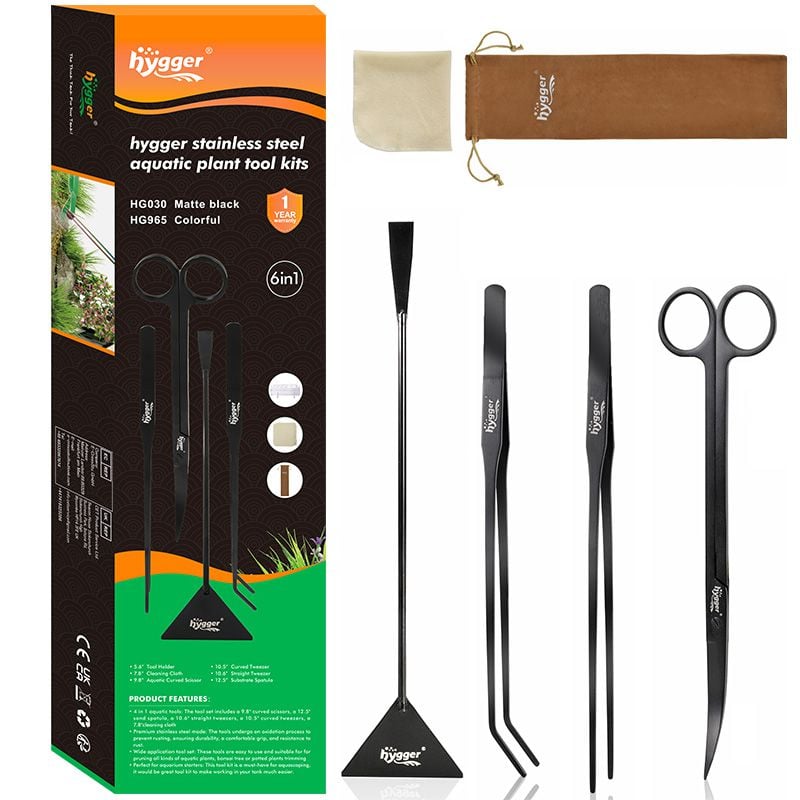
hygger 6-in-1 Long Aquarium Aquascaping Tools Kit
Check Price on Amazon ★4.6Frequently Asked Questions
Can you put emersed-grown plants directly into an aquarium?
Yes — rinse the rockwool off, plant them, and expect 2–6 weeks of leaf turnover as they grow submerged foliage. Easy species like Anubias, Java fern, and fast stems handle the switch with barely a pause. Cryptocoryne may melt dramatically first; that's conversion, not death, as long as the roots and crown stay firm.
How can I tell if a shop plant is emersed or submerged?
Emersed leaves feel thick, waxy, and leathery and often differ in shape from the underwater form — rounded leaves on swords, for example. Submerged leaves feel thin and papery, sometimes slightly translucent. Shelf pots in dry trays are emersed; plants in the shop's display tanks are submerged-grown.
Is tissue culture better than potted plants?
For pest and algae risk, yes — tissue culture is guaranteed sterile. The trade-off is size: plantlets are tiny and take 3–4 weeks to establish, and cups cost more per portion than emersed pots. Tissue culture wins for nano and low-tech setups; emersed pots win for instant aquascape fill.
Why did my new aquarium plants melt after planting?
Almost always, they were emersed-grown and are shedding air-adapted leaves to grow underwater ones. Firm roots and crowns with mushy leaves means normal conversion — new growth appears in 1–3 weeks. Mushy roots and a foul smell means actual rot.
Should beginners buy emersed or submerged plants?
Submerged or tissue culture for your first tank — seeing growth instead of melt in week one is what keeps beginners in the hobby. Once your tank is stable and a few months old, emersed stock becomes the budget way to fill larger tanks, since cheap stems convert reliably in established water.
The bottom line
Emersed plants are the budget play — cheaper, cleaner, slower to satisfy. Submerged plants are the instant-gratification play — pricier, with hitchhiker risk, but growing from day one. Tissue culture is the control-freak play — sterile, tiny, and unbeatable in nano and low-tech tanks. Buy each plant in the format that matches its conversion tolerance, then get your converters settled with the steps in our emersed-grown aquarium plants guide.